Water Deer Interaction with Humans - Agricultural Impacts
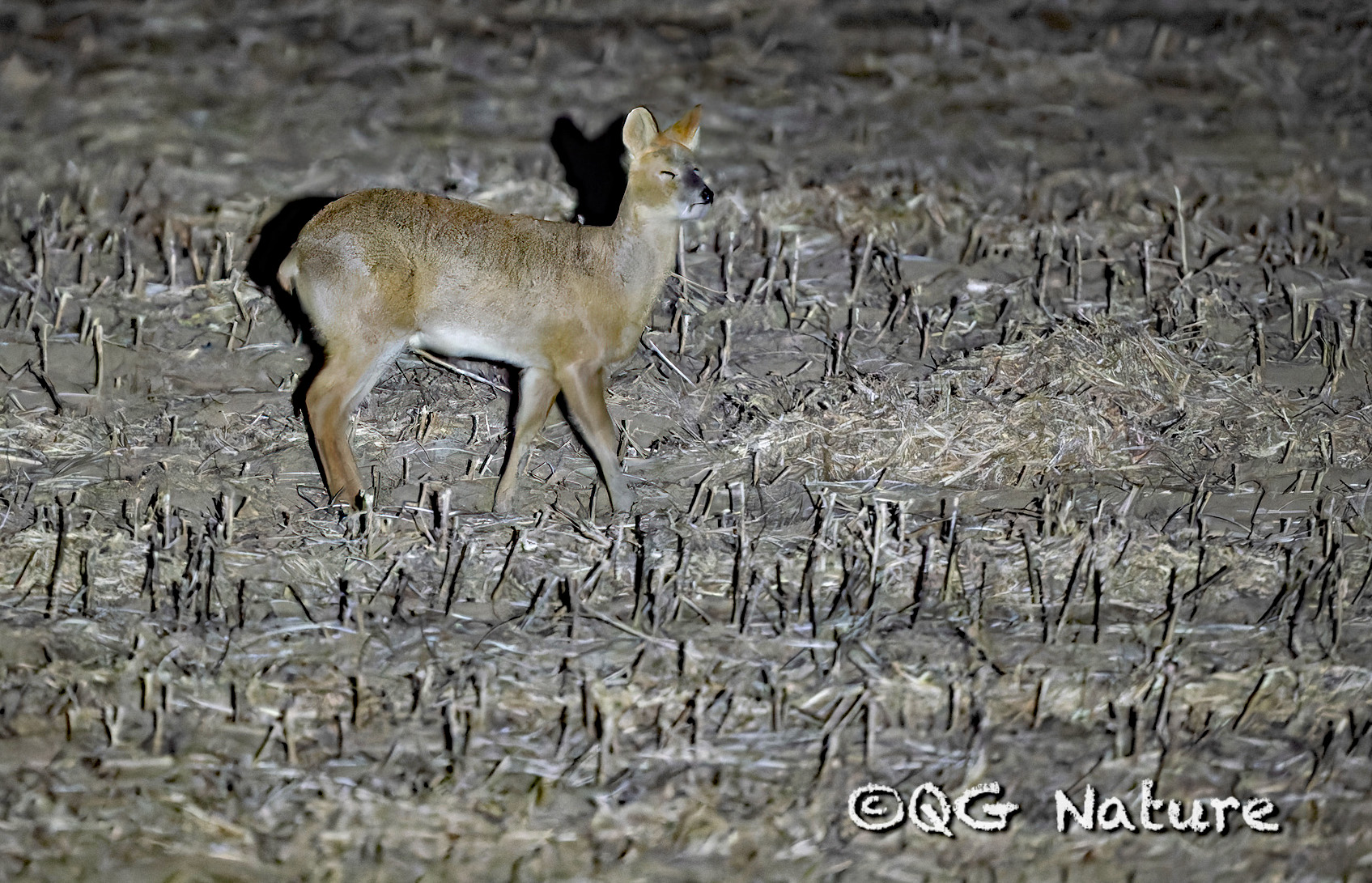
Historically considered to cause negligible agricultural damage at low to moderate densities, water deer were generally regarded as weak invaders compared with species such as muntjac and fallow. The UK government now considers them an invasive non-native species, although their impacts in England remain poorly studied. As populations have grown across parts of central and eastern England in recent years, evidence of impacts has accumulated. Damage to arable crops -- particularly oilseed rape and cereals -- has been reported by farmers and land managers across East Anglia and the Home Counties, with additional concerns around ditch in-filling, crop flattening, seed head loss at harvest, and contamination of cereal batches with deer droppings.
The damage threshold appears highly site-dependent, varying with habitat type, season, the presence of other deer species, and local land use. Forestry Commission East and East Anglia Deer Manager David Hooton, in recent correspondence with me, made the point that this multi-species dimension may matter more than density figures for any one species suggest: browsing pressure from several deer species feeding across the same ground can affect a far broader range of vegetation than the same total density made up of just one or two species. In other words, the combined impact of non-native deer (muntjac, fallow, sika, and water deer) across parts of eastern England may be greater than the individual numbers imply – even where each species remains at what would normally be considered a low density. While published data remain limited and population management is still relatively rare, awareness of the species' potential impacts on farming is clearly growing, and the picture in South Korea -- where water deer are designated a harmful species and culled in their tens of thousands annually -- may offer a cautionary precedent.
Note: The impact of water deer on nature reserves and conservation projects is covered in a separate article.
Table of contents
- Water deer and farming
- The wider picture
- Invasive status and culling
- The international picture
- References
Water deer and farming

Water deer remain arguably our least-studied deer, with significant gaps in our understanding of their biology, behaviour, and impacts on farming and forestry. In 2004, a team led by York University's Piran White reported to the Forestry Commission that water deer were "believed to have a negligible impact on agriculture in the East of England". Populations have increased considerably since then, however, both here and apparently across parts of their Korean range, and their impact on farming is likely to have grown accordingly, though published data remain scarce. As Arnold Cooke noted in his 2019 book Muntjac and Water Deer, water deer must eat, and their biomass means the potential exists for real impacts on farmland as well as on native flora and fauna. Compounding the difficulty is that water deer coexist with other species that feed in similar ways, making it hard (sometimes impossible) to attribute damage to one species without robust monitoring, which currently exists for only a handful of sites. Water deer also tend to move quite widely within their ranges, producing what Bedfordshire gamekeeper Paul Childerley calls "blanket grazing" rather than concentrated hotspots, which makes damage harder to detect and address.
Another complication is that deer distribution itself isn't fixed and shifts in nearby land use can move animals on or off a given field independent of any real change in the local population. In his unpublished 2019/20 Deer Surveillance Report for Woodwalton Fen, Cooke tied water deer numbers directly to land management on neighbouring ground: the population rose between 2006 and 2010/11 while a stand of elephant grass persisted nearby, then fell back once the crop was lost, a decline compounded by poor weather in some years. Cooke also found a clear inverse relationship, up until 2018/19, between average water deer counts in February–April and the number of fields with livestock; more livestock, fewer deer recorded. During our discussions, Buckinghamshire naturalist Sharon Scott has reported something comparable: deer avoiding fields once sheep are turned into them, and moving in and out of adjoining estates according to shooting activity. Impacts observed on any one site, then, may vary for reasons that aren't immediately obvious, rather than necessarily reflecting a straightforward change in local density or a stochastic event such as snow or flooding (see: Farm crop damage).
What follows is a summary of the available data on water deer's agricultural impact; I would be very interested to hear from others with experience of the subject.
Extent and tolerance of agricultural damage
In common with all wild deer species in Britain, the water deer population appears to be both increasing and spreading -- albeit more slowly than some other introduced species -- and with this comes potential conflict with landowners. Water deer are known to feed on crops, including carrots, sweet potatoes, soybeans, bean sprouts, and cereals (see: Food & Feeding), though the damage they cause seems less than that inflicted by other deer at comparable densities.
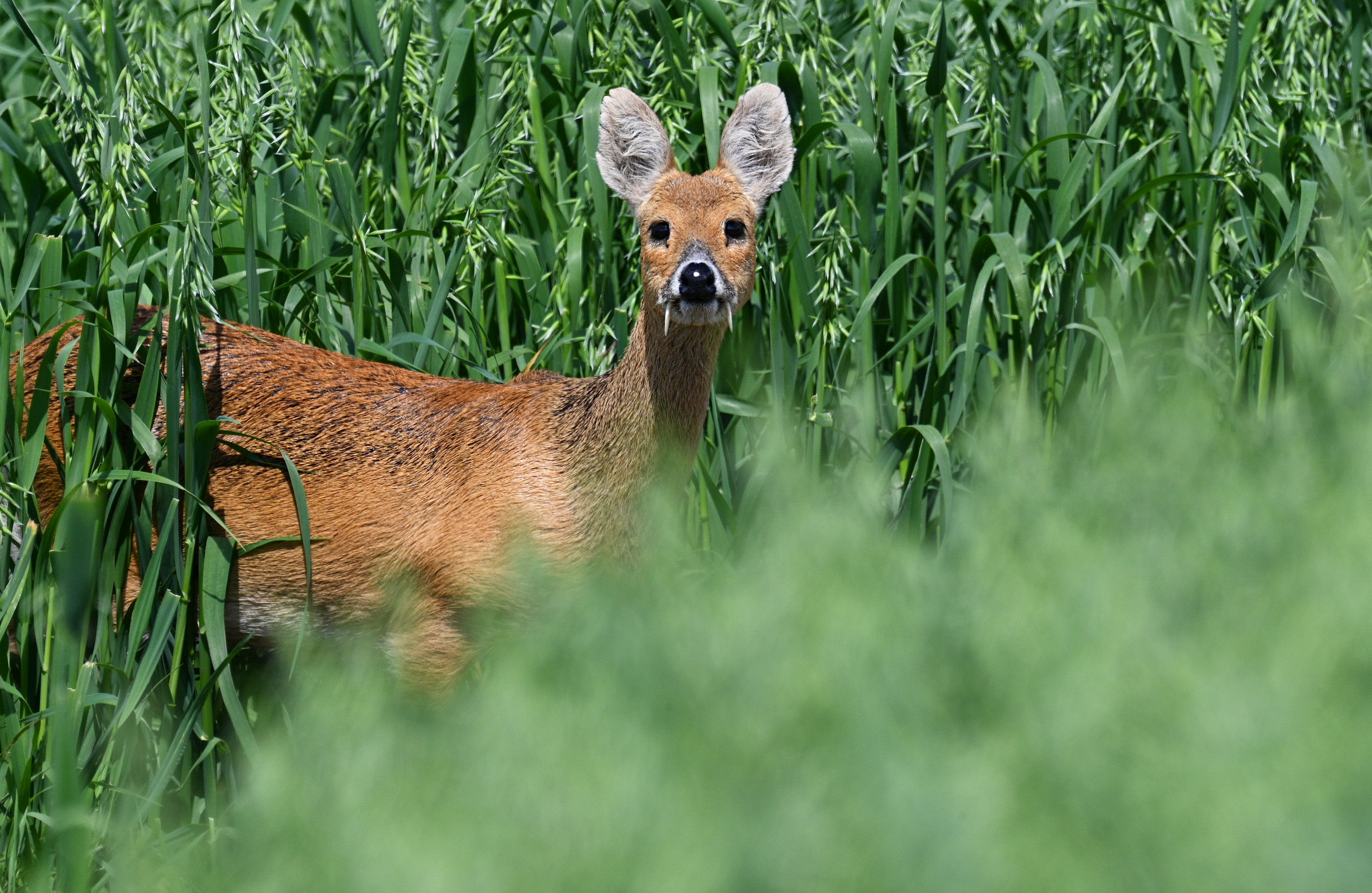
In 2020, I posed a question about water deer damage to a well-populated deer stalking Facebook group. The consensus was that, in England, they caused little (if any) damage in plantations or woodland beyond taking some leading shoots and leaves of young trees, and are likely only a minor pest in cereal crops under most circumstances. (This feedback was broadly echoed by the stalkers, farmers, and reserve managers I spoke to around the same time, though some of those have now revised their opinions.) That said, some respondents to the post described more notable impacts: one watched the same deer repeatedly grazing spring maize early in the season; another reported maize damage on his beat and what he called a "decimation" of his oilseed rape crop, though this coincided with a very wet autumn that placed additional stress on the crop. The thread was perhaps best summed up by one respondent who observed that, while some grazing is noticeable along woodland edges and on cereals, it rarely affects yield, and water deer "don't do anywhere near as much damage as other deer species in both forestry and arable". Where populations of other deer are already high, however, the added pressure from water deer may still prove intolerable.
Water deer are broadly non-territorial outside of the breeding season and can tolerate relatively high densities, which, coupled with the fact that they seem to range much less than some other species, means damage can become concentrated. Activities in the broader landscape can also have a significant impact, as we shall see.
Damage thresholds
Damage can be both relative and subjective, of course, and in parts of central and eastern England where water deer are managed for sporting purposes, the deer themselves become part of the "crop" and higher levels of damage may be tolerated than where no such management exists.
There are several examples from England that illustrate how difficult it can be to determine the densities at which damage on farmland is likely to occur. Arnold Cooke noted that Callum Thomson, then deer manager at Woburn Estate, received reports of crop damage at nearby Potsgrove when densities were as low as eight or nine per square kilometre (0.08 per ha). Conversely, at the Claxton Estate near Norwich, estate manager John Heathcote told me there was no concern about deer damage, despite the population rising from around 25 per km2 (0.25 per ha) in 2016 to 54 per km2 (0.54 per ha) in 2025.
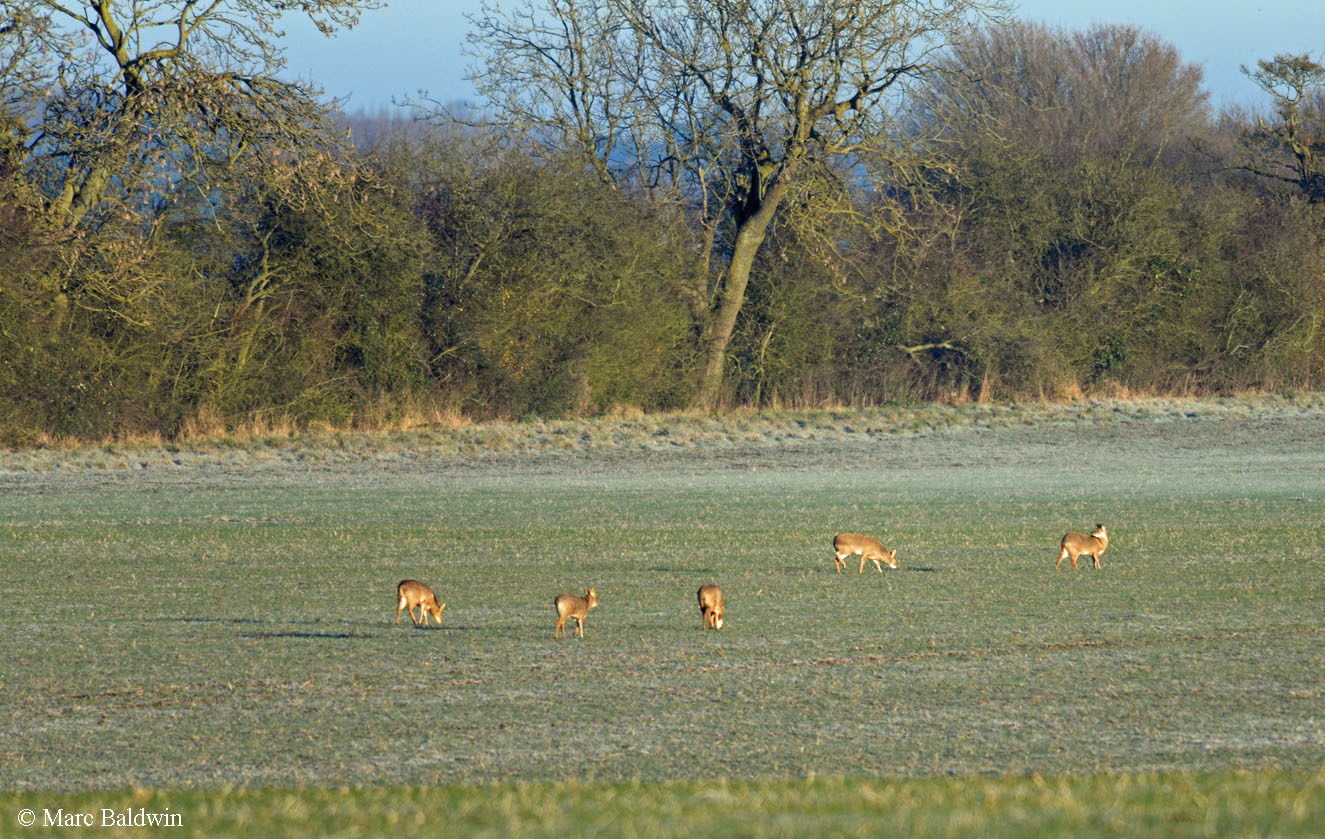
In the December 2022 episode of his Deer Management with Chris Rogers series on YouTube, Norfolk-based Rogers suggested that water deer can inflict significant grazing damage and become a general nuisance at higher densities, without specifying a threshold, while in March 2023, Adam Gage, head keeper on the Raveningham estate also in Norfolk, explained that they cull until they see evidence of damage declining to a tolerable level rather than setting a specific density or number to maintain. Paula Lester, in her 2024 article to Country Life noted the population of water deer at Beckerings Park, an estate covering about six square kilometres (1,500 acres) in Bedfordshire, was maintained at around 1,000 animals -- a density of about 167 per km2 (1.67 per ha) -- despite the estate being largely arable. That said, in August 2023, Childerley did mention on episode 16 of The Deercast podcast that the tenant farmers would prefer the deer population was lower as a lot of farmers in the area " hate them with a passion", though he did also note that part of the issue was that the deer are very visible, so farmers see them all the time. Despite this, the income generated from stalking means higher densities and potentially higher damage is tolerated.
Farm crop damage
Around the Woodwalton Fen NNR, Arnold Cooke and Lynne Farrell reported how deer were observed taking carrot (Daucus carota) and sugar beet (Beta vulgaris var. saccharifera) crops, both in the ground and in storage, particularly when forced onto farmland by flooding or snow, or during periods of high density. The damage was very limited nonetheless, as the deer tended to focus on the green tops rather than the root, and didn't aggregate.
Similarly, up until 1968, the 68-hectare (170-acre) farm at Whipsnade Zoo grew food for the collection, including barley, oats, wheat, potatoes, kale, and Russian comfrey (Symphytum × uplandicum). In their 1988 paper in the Journal of Zoology, Reinhold Hofmann and colleagues noted that, although water deer were recorded in the farm area throughout the crop-rearing period, no significant damage was observed.
Oilseed rape and game crops
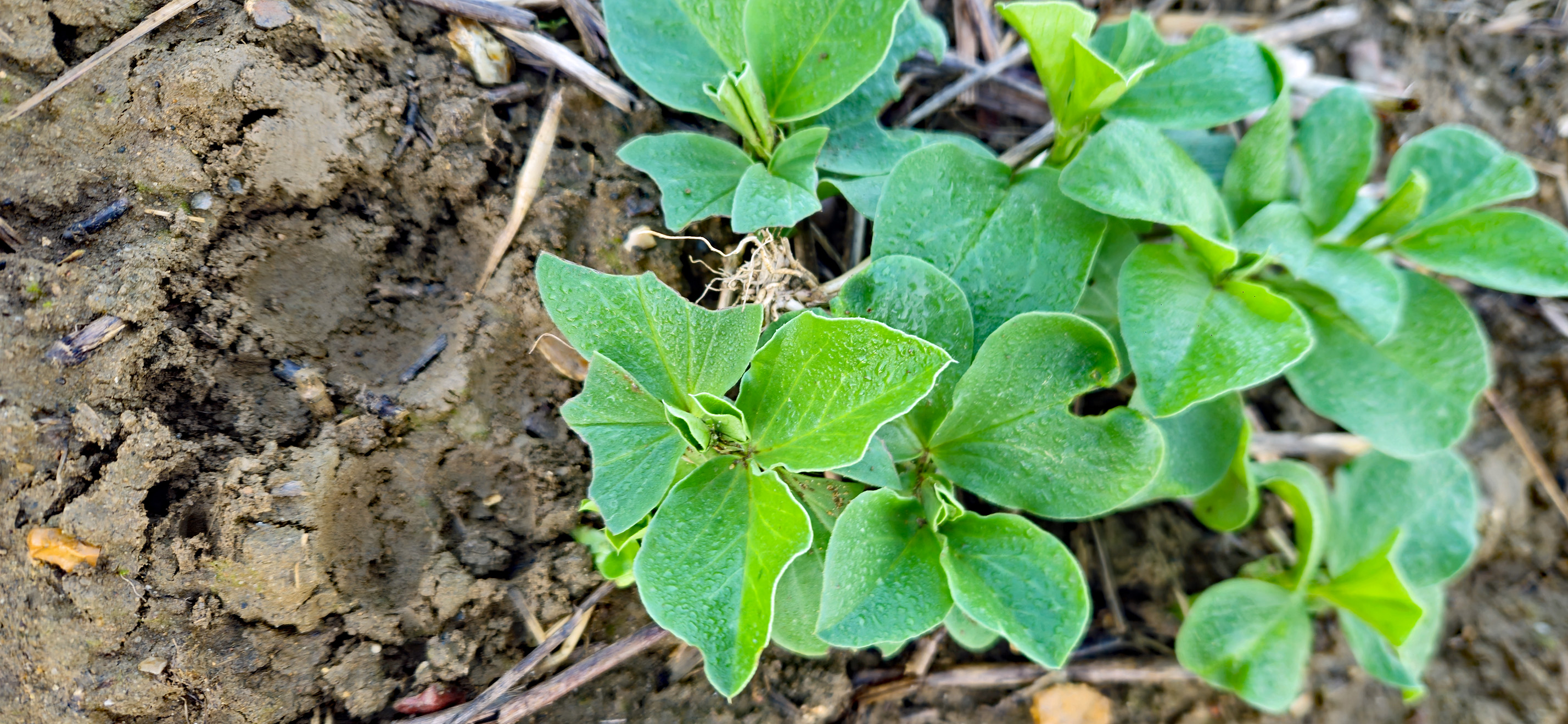
A recurring theme across several sites is the impact of water deer on oilseed rape (Brassica napus). Paul Childerley, writing in Sporting Rifle in 2014, reported that water deer can adversely affect commercial flower crops through feeding on flower heads, though impacts appear limited provided population densities are managed appropriately, though he didn't quantify this in the article. As mentioned above, however, Lester's recent Country Life account suggested densities on the estate may be as high as 167 per km2 (1.67 per ha). Walking footpaths on the estate in December 2025, I observed evidence of extensive browsing on young field bean (Vicia faba) plants in fields regularly frequented by water deer. Childerley also told me that a significant cull was necessary during the 2020/21 winter following what he described as "some considerable damage" to game crops and in his social media posts he frequently talks about needing to fence game crops to keep the deer off them during the growing season, something Adam Gage has also mentioned to me. Crops on the Beckerings estate include beans, maize and sorghum (Sorghum bicolor) grown as game cover, alongside oilseed rape widely cultivated on the tenant farms.
In the April 2025 episode of Fieldsports with Speed, Childerley explained that water deer will "punish" a rape crop while it's growing and when it's cold, noting how the crop sticks up through snow making it particularly accessible. He described the most significant concern, however, as occurring in late summer when desiccated rape is awaiting harvest (the so-called "popping stage") when deer sheltering in the crop will scatter as the combine moves in, knocking siliques (seed heads) to the ground where the combine cannot reach them – with sufficient deer in the crop, this can result in a direct loss of yield. In March 2026, a farmer in east Norfolk told me that this was precisely why he culled water deer on his land: the deer caused significant damage to the growing crop during winter and spring, then knocked siliques off during the summer. Arnold Cooke observed something similar at Woodwalton, where water deer apparently knocked ears off barley when running through the crop just prior to harvest, though in that case the farmer was largely unconcerned about what they considered minimal losses. In his 2020 book From Wasp to Water Deer, Martin Guy noted a fondness for oilseed rape during the summer more broadly, commenting that animals feeding predominantly on the crop can have a distinctly yellowish hue to their fat come winter.
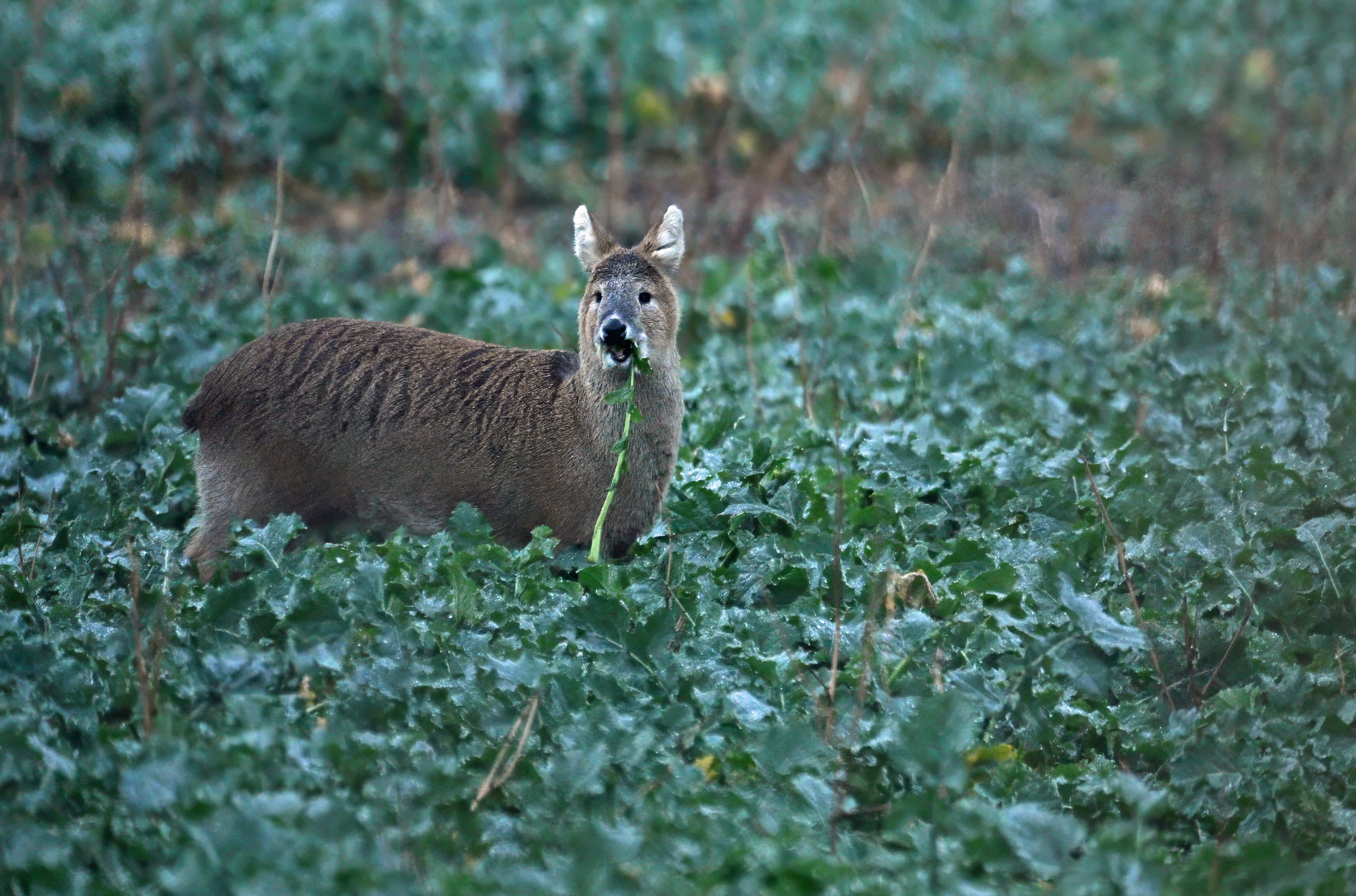
At Raveningham, Adam Gage told me that water deer targeted maize grown as game cover during 2025, with damage concentrated mid-stem and apparently exacerbated by drought conditions; some strips required fencing as a result. Gage also noted that the deer show a strong preference for GS4 herbal leys -- legume and herb-rich swards established under the Countryside Stewardship scheme to improve soil structure, enhance biodiversity, and provide high-quality forage for livestock (formerly known as set-aside) -- drawn by the diverse plant assemblages these habitats provide.
By contrast, in December 2024, John Heathcote told me that water deer on his Norfolk estate site caused few, if any, impacts on either the marshland or arable crops, doing no more harm than hares and considerably less than rabbits. He noted how the deer were more commonly observed foraging on ruderal vegetation (weeds, essentially) within crops or in GS4 habitats rather than on the crops themselves.
The wider picture
In March 2025, Suffolk-based pest controller Jonathan Tunmore told me he had seen significant increases in water deer numbers across the East Anglian grounds he manages, with farmers reporting damage in areas of high density, particularly in and around the Norfolk Broads. He noted that, unlike many deer species, water deer tend to be sedentary, occupying the same few fields throughout much of the year. While winter crops can tolerate moderate grazing through compensatory growth, he had observed water deer suppressing both oilseed rape and rye. More significantly, he described deer lying out on winter barley, flattening the crop and thereby increasing combining costs. A further complication arises from defaecation in these couches: combine sieves cannot distinguish between cereal heads and deer droppings, resulting in batches being rejected at harvest – a problem I heard echoed by a farmer in east Norfolk sometime later. During a walk around one of the farms Jonathan manages deer on in June 2025, he pointed out regular paths used by both red and water deer moving between fields and the damage this can cause to the ditch sides, resulting in soil slumping in, impairing drainage.
In a conversation with Michael Anker, Project Lead for the Norfolk Deer and Wild Venison Strategy, in March 2026, he described similar impacts felt more broadly across Norfolk, including trampling and lying in crops. Anker also noted how the deer will often walk across potato rows, dislodging soil and exposing potato tubers to sunlight, turning them green and unusable. He, too, commented on the infilling of ditches by deer as they cross between fields on grazing marshes.

Britain's growing deer population is undeniably hampering farming interests -- a recent BBC InDepth news article by Niall-James Convery noting increasing reports of damage from farmers, some of which see financial losses "easily run into the tens of thousands" -- but the water deer's specific contribution remains largely unquantified. Numbers can build rapidly, though, and several farmers, stalkers, and reserve managers have told me they're now seeing significant numbers where there were none five or ten years ago. Forestry Commission East and East Anglia Deer Manager David Hooton recently told me that the Commission is receiving increasing reports of water deer impacts on crops where densities are high, including damage to set-aside/GS4 buffer strips planted for birds and butterflies. The Commission is also seeing water deer impacts within nature reserves and wetland habitats, covered in the water deer's conservation impact article.
Invasive status and culling
Predicting how water deer impacts might develop in England is not straightforward, and their classification as an invasive species warrants some qualification. Earlier assessments generally considered them a weak invader, reflecting its relatively limited dispersal compared with species such as Reeves' muntjac (Muntiacus reevesi) and fallow (Dama dama). A 2010 assessment led by Wolfgang Nentwig at the University of Bern, for example, looked at 34 alien mammal species introduced to Europe and assigned water deer a "total impact score" of five, comprising a "potential impact score" of two for environmental damage and three for economic damage. Their "actual impact" scores were just 0.01 and 0.014, respectively. Muntjac and fallow deer each scored 25, by comparison. A 2011 analysis by Sabrina Kumschick and colleagues, assessing "invasiveness strength" across a range of mammals and birds, similarly rated water deer as weak invaders, with an average economic score of -0.7 and an average overall score of -0.2; muntjac, by comparison, scored 2.3 and 2.5, respectively. These assessments pre-date the recent expansion of water deer populations in parts of England and the accumulating evidence of local impacts, however.

Water deer are less exploratory than muntjac or fallow, being quite strongly hefted to an area, supporting their classification as weak invaders, but their ability to build rapidly in areas of favourable habitat means that a relatively low dispersal ability doesn't necessarily preclude substantial local impacts. Indeed, in February 2026, the UK Government explicitly described water deer as a non-native species "considered to be invasive" and announced that Defra will commission an updated risk assessment to establish the current risk they pose in Great Britain. The assessment is intended to inform future action, including measures to prevent new populations becoming established. Depending on its findings, the Government may consider listing Hydropotes under the Invasive Alien Species Regulations as a Species of Special Concern, alongside the muntjac.
The number of water deer taken annually under deer management plans in England is poorly documented. A 1996 survey of 10,000 BASC members by Alan McCormick and Jamie Cordery drew on just over 6,700 responses and found water deer accounted for just 0.2% of animals culled that year, compared with 49% roe (Capreolus capreolus) and 24% red deer (Cervus elaphus). No more recent national data are available at the time of writing, though conversations with stalkers and the Forestry Commission strongly suggest culling has increased considerably over the past three decades. An ongoing Forestry Commission project may shed new light on both the distribution of culling effort and the total number of deer killed in Britain in due course.
The international picture
Robert Swinhoe, in his original 1870 description of the species, noted that the deer ate mostly rush sprouts and coarse grasses but "they doubtless often finish off with a dessert from the sweet-potatoes, cabbages, &c. which the villagers cultivate on the islands during the winter". He nonetheless points out that the fact the deer are permitted to persist in such abundance suggests that they do very little damage to crops. Writing in Shooting in China, published during 1908, however, former US consul-general in Shanghai Thomas Jernigan recounted the experience of Jersey-born adventurer and writer Major-General William Mesny during his first campaign in Kwei-chow (modern day Guizhou, a mountainous province in southwest China), between 1867 and 1874. Mesny had described to him by natives a large and ferocious animal referred to locally as Ma-hswing ("house bear"). (I think this might've been a phonetic misspelling of Jiā xióng, 家熊.) It was larger than the biggest bear, with a mane like a horse, brown as an ox and ferocious as a panther; its roar was heard miles away. The farmers were well disposed to the Ma-hswing, though, because it kept away predators that took livestock and its favourite food was the river deer and wild pig, two of the greatest and most persistent crop depredators known to the farmer. This suggests that farmers were in well-established competition with deer by the mid-19th century, and Jernigan goes on to say "... there can be no shadow of doubt that [river] deer play havoc with the grain crops ...".

We know little about the present impact of water deer on agriculture in China, although the drastic reduction in the species' range and population in recent years likely means damage is less than when Swinhoe and Jernigan were travelling. In his thesis on water deer ecology at Whipsnade, Endi Zhang noted that in China they're fond of crops including soybean, peanuts, and sweet potatoes. Additionally, in their Chinese paper to the Sichuan Journal of Zoology in 2002, Endi and Xiao-long Zhang reported the results of a survey of local people living and working around the Defang Milu Reserve in Jiangsu Province during February and March of the previous year. The results indicate that water deer commuted through cotton fields at night en route to forage in wheat and rape fields when food is limited in the winter, suggesting potential conflict with farmers.
In South Korea, the picture seems very different: here the water deer has been designated a "harmful wild animal" since 1994, owing to the damage they inflict on crops and the number of traffic accidents they cause. In their opinion piece to the journal Restoration Ecology in September 2015, Yeong-Seok Jo and John T. Baccus noted:
"The demise of the wolf and dhole and other apex predators (tiger, Panthera tigris, and leopard, Panthera pardus) caused a substantial increase in populations of water deer (Hydropotes inermis) and wild boar (Sus scrofa), which are only now controlled by 'pest management' and hunting."
Indeed, in their 2018 Mammals of Korea, Yeong-Seok Jo, John Baccus and John Koprowski noted that, separate from licensed hunting, over 11,000 water deer were eradicated annually as vermin under a distinct pest-control channel in the South, and that the meat has little, if any, economic value, which aligns with discussions I've had with Korean naturalist Junha Kim. Jihyang Jung and colleagues, in their 2016 paper to Animal Cells and Systems, suggest that the agricultural sector in the South want the government to take coordinated action to manage water deer numbers:
"Farmers have been appealing to the [Korean] government for actions to reduce the deer population; however, the government has not yet responded ..."

In a paper to the Korean Journal of Environmental Biology published during 2007, Seong-il Yoon at Hanyang University in Seoul presented the results of a survey of crops lost to wildlife in 11 of South Korea's national parks. The data, which took the form of interviews with farmers, suggest damage by deer both in terms of trampling the crop and eating tender leaves of such as cabbages, sweet potato, and beans. Indeed, while the survey data don't differentiate damage caused by water deer from that by roe, it does suggest that the two species caused significant damage to cabbage and bean crops in particular.
An article published during November 2023 in The Hankook Ilbo, a well-respected Seoul newspaper, by Eun-kyung Ko reported that between 150,000 and 200,000 water deer were killed each year under a government bounty scheme designed to reduce crop damage. Drawing on statistics released by the Ministry of the Environment, which administers the scheme, the article noted that in 2022 just over 153,000 water deer were shot, having been estimated to cause nearly ₩1.2 billion (approximately £640,000 / US$822,000 / €750,000) worth of crop damage. This represents a substantial reduction from the peak of just over ₩3 billion (£1.6m / US$2m / €1.9m) recorded in 2012, when only around 30,000 deer were killed under the scheme – suggesting that culling pressure has increased considerably while the economic damage has fallen. The article also revealed a striking anomaly: in 2018, one water deer was shot on suspicion of having caused around ₩15,000 (£8 / US$10 / €9) worth of crop damage, roughly half the bounty paid per animal.
Ko, The Hankook Ilbo's animal welfare reporter, explained that a contentious element of deer management in South Korea is that while hunters are paid per deer shot, farmers who suffer losses tend not to be compensated because the critical threshold for reimbursement of ₩100,000 (£53 / US$69 / €63) is difficult to demonstrate as water deer damage tends to be small scale but repetitive. The article goes on to point out that water deer are a resource worthy of protection in South Korea and more effort should be directed to keeping deer off important crops, either by installing fences or planting species that the deer prefer elsewhere on the farms to distract them from the main crops; where this isn't possible, government funds should be used to compensate farmers appropriately rather than on bounties. The public comments left against the article were mostly people agreeing that water deer are a problem for farmers but criticising the author for underestimating the level of damage they inflict, with several mentioning that the deer trampling/flattening crops is just as important as feeding damage.
More recently, a January 2026 article by Lee In-ae in the Seoul Economic Daily reported the results of a large-scale culling operation targeting harmful wildlife in Seosan, South Chungcheong Province, during 2025. The 40 stalkers comprising Seosan City's Harmful Wildlife Damage Prevention Unit killed 3,738 water deer over the course of the year, with each stalker receiving a bounty of ₩40,000 (£20 / US$26 / €23) per animal. Interestingly, the same article noted that the bounty for wild boar was significantly higher at ₩300,000 (£150 / US$200 / €170) each.
Regrettably, the on-going political and military situation in the Democratic People's Republic of Korea (North Korea) means that we know nothing about either the current population status of water deer there, nor if they impact agricultural or conservation projects.
References
Childerley, P. (2014). Herd reduction. Sporting Rifle. (107):90-92.
Convery, N-J. (2025). Why Britain has a deer problem - leaving damage that costs millions. BBC InDepth. 29th December 2025.
Cooke, A. (2019). Muntjac and Water Deer: Natural history, environmental impact and management. Pelagic Publishing, Exeter.
Department for Environment, Food & Rural Affairs (Defra) and Forestry Commission. (2026) Deer Impacts Policy Statement: Managing the impacts of wild deer in England. Published 20th February 2026.
Guy, M.R. (2020). From Wasp to Water Deer. A Rifleman's Journey through the Countryside. Independently published. 215 pp.
Hofmann, R.R. et al. (1988). Seasonal changes in rumen papillary development and body condition in free ranging Chinese water deer (Hydropotes inermis). Journal of Zoology. 216(1): 103-117.
Jernigan, T.R. (1908). Shooting in China. Methodist Publishing House, Shanghai.
Jo, Y-S. & Baccus, J.T. (2015). Case studies of the history and politics of wild canid restoration in Korea. Restoration Ecology. 23(5): 513-518.
Jo, Y-S. et al. (2018). Mammals of Korea. Life Science Publishing Co., Seoul.
Jung, J. et al. (2016). Developing and testing a habitat suitability index model for Korean water deer (Hydropotes inermis argyropus) and its potential for landscape management decision in Korea. Animal Cells and Systems. 20: 218-227.
Ko, E-K. (2023). The unfortunate water deer hunted for eating 15,000 won worth of crops. The Hankook-ilbo – 16th November 2023. [In Korean]
Kumschick, S. et al. (2011). Weak or strong invaders? A comparison of impact between the native and invaded ranges of mammals and birds alien to Europe. Diversity and Distributions. 17(4): 663-672.
Lee, I-a. (2026). Water Deer Worth 40,000 Won Bounty in Korea Despite Global Endangered Status. Seoul Economic Daily – 10th January 2026.
Lester, P. (2024). Meet the tusk force. Country Life. 233(42): 78-81. (16th October 2024)
McCormick, A. & Cordery, J. (2003). Standards in deer management. p. 60-68. In: Goldberg, E. (ed.). Proceedings of the Future for Deer Conference. 28 & 29 March 2003. English Nature Research Report #548.
Nentwig, W. et al. (2010). A generic impact-scoring system applied to alien mammals in Europe. Conservation Biology. 24(1): 302-311.
Swinhoe, R. (1870). On a new Deer from China. Proceedings of the Zoological Society of London. 38(1): 89-92.
White, P.C.L. et al. (2004). Economic Impacts of Wild Deer in the East of England. Final report to Forestry Commission (East England Conservancy & English Nature).
Yoon, S. (2007). Crop loss survey by wildlife in National Parks of Korea. Korean Journal of Environmental Biology. 25(3): 223-227. [In Korean]
Zhang, X. & Zhang, E. (2002). Distribution pattern of Hydropotes inermis in various habitats in Jiangsu Dafeng Pere David's Deer State Nature Reserve. Sichuan Journal of Zoology. 21: 19-22. [In Chinese]