Water Deer Distribution & Spread - Native Range
Table of contents
China
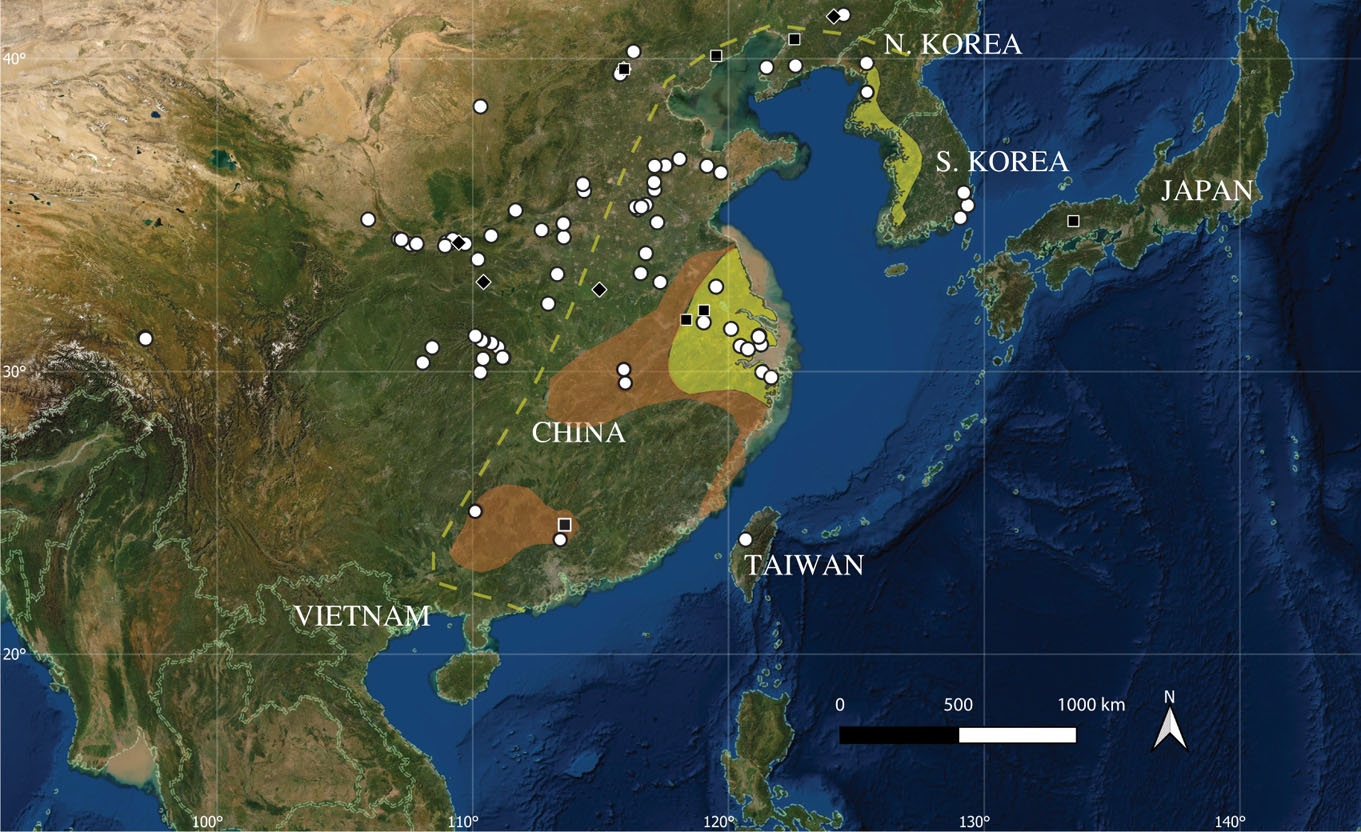
The sparse fossil data we have suggest that water deer had a historic range much larger than today's. According to Endi Zhang in his 1993 Ph.D. thesis, ancient Chinese texts suggest water deer were a common animal that roamed over much of China, widespread at latitudes between 28 and 42 degrees N and between a longitude of about 111 degrees E and the western coast of the Pacific. Since then, water deer remains have been found at archaeological sites that have extended their historic range even further. Yen-Jean Chen and colleagues reported, for example, remains from Iron Age sites in Taichung, west-central Taiwan in 2016 and suggested that they became extinct in the early 19th century, probably in response to human expansion into the wetlands. More recently, palaeontologist Chris Stimpson and his team found water deer jaw fragments among remains in a cave at Tràng An in northern Vietnam dating to between 13,000 and 16,000 years before the present.
Taking archaeological and contemporary records together, the species could be found from central China in the west, east across to the East China Sea coast, the island of Taiwan and the eastern coast of South Korea, south to at least northern Vietnam, and north into north-east China and possibly south-east Mongolia. There are even remains from southern Japan that date to the Middle Pleistocene, about half a million years ago.

In their 2006 paper in Biochemical Genetics, Jie Hu and colleagues presented a map showing a considerable reduction in the current distribution compared with its documented historical range, describing the population declines as "drastic". Apparently wiped out of Qingpu and Fengxian in the early 1920s, their range in China has been contracting eastwards over the past five or six decades into isolated populations in the coastal areas of Jiangsu Province, the Poyang Lake area in Jiangxi Province, and the Zhoushan Archipelago of Zhejiang Province. Composed of 1,384 islets, with Zhoushan being the largest, the Zhoushan Islands group is located just outside Hangzhou Bay in the East China Sea. The earliest record of water deer in the Zhoushan Archipelago of which I am aware is a reference in The Annals of Dinghai County, published in 1923.
While poaching remains a threat to the species' continued survival, there has been some good news. A recent project to reintroduce water deer to Shanghai has been largely successful, while several photos and videos of water deer, including a fawn, collected using trail cameras set in Jilin Baishan Musk Deer National Nature Reserve, north-east China, in 2018 represent the first confirmed records of the species in the province since 1949.

Most texts show the remaining population in China as having a southern boundary of roughly Fujian and Guangdong and Guangxi provinces, stretching north into Jiangsu and Anhui provinces, west as far as Hubei and Hunan provinces, and along the eastern Yangtze basin, with Poyang Lake being a principal population centre. In their Chinese text on the changes to plants and animals in China through recent history, published in 2006, Huanran and Rongsheng Wen show the species as being widely distributed throughout Guangxi in the south, but only sporadically present in the northern part of Guangdong Province. Min Chen and her colleagues, in their 2009 paper in Wetland Science, noted that the Yancheng coastal wetland deer consist of three isolated populations concentrated in two areas: one in Sheyang County, the centre being the Yancheng Reserve spreading into the surrounding reed beds; the second in Dafeng County, with the core in the Deer Reserve; and the third in the wasteland surrounding the Dafeng Reserve. A more recent analysis of survey data, including new transects and camera trapping, suggests some recolonisation of north-eastern areas, where they were thought to have been absent since the 1950s. The data, collected by a team at the Northeast Forestry University in Harbin led by Zongzhi Li, were published in Scientific Reports in 2023 and record water deer in Jilin, Heilongjiang, and Liaoning provinces.
Korean Peninsula
In Korea, as in China, the species' distribution may have been substantially reduced through poaching and habitat destruction, particularly in the North, though little information is available. In their 2015 IUCN Red List review, Richard Harris and Will Duckworth describe water deer as "relatively widespread" in South Korea, particularly along the west coast, and present in the lower-lying parts of North Korea – though they note that assessing true status is complicated by repeated releases of captive-bred stock. The species appears absent from the offshore islands of Ulleung-do, Dok-do, and Jeju-do.
In South Korea, Baek-Jun Kim and colleagues, writing in Landscape Ecology and Engineering in 2011, found water deer occurring across most of the country except Seoul and Jeju Province. They were occasionally observed in, but tended to avoid, Gyeonggi Province – one of the most intensively developed areas, lying close to Seoul.
A significant and often overlooked factor is the Demilitarised Zone (DMZ), the 250 km (160 miles) long, 4 km (2.5 miles) wide strip of heavily militarised land dividing the peninsula, bordered on either side by impenetrable fencing. Kim Seung-ho, Director of the DMZ Ecology Institute, told me in September 2025 that the dense wire fencing makes it "impossible for large mammals to move." While he acknowledged that water deer's swimming ability means one or two individuals might find a way around the fences, he considered the probability very low. As a result, Kim regards the peninsula as supporting three effectively isolated populations: one in South Korea; one within the DMZ itself, unable to pass into either North or South; and one in North Korea, which presumably mingles with deer from China and/or Russia.
In summary, the species is native to central China's eastern Yangtze Valley, parts of eastern China, the Zhoushan Islands off Zhejiang Province, South Korea, and North Korea – throughout the wetlands and forests of the Citizen Control Zone and the DMZ dividing the two countries. In North Korea, water deer may still inhabit the Taebak and Nagrim mountains, Kangwon Province, and adjacent South Hamgyong Province; in South Korea the species is more widely distributed, occurring in all provinces except Seoul and Jeju. In recent years the population appears to have expanded from North Korea into south-west Russia, potentially also repopulating parts of Jilin and Heilongjiang provinces.
References
Chen, M. et al. (2009). Distribution and abundance of Hydropotes inermis in spring in Yancheng Coastal Wetland, Jiangsu Province, China. Wetland Science. 7(1): 1-4. [In Chinese.]
Chen, Y-J. et al. (2016). New record of water deer (Hydropotes inermis) from Iron Age archaeological sites in Central Taiwan. Collection & Research. 30: 23-31.
Harris, R.B. & Duckworth, J.W. 2015. Hydropotes inermis. The IUCN Red List of Threatened Species 2015: e.T10329A22163569.
Hu, J. et al. (2006). Genetic diversity of Chinese water deer (Hydropotes inermis): implications for conservation. Biochemical Genetics. 44(3/4): 161-172.
Li, Z. et al. (2023). Distribution update of water deer (Hydropotes inermis) and prediction of their potential distribution in Northeast China. Scientific Reports. 13: 5610.
Stimpson, C.M. et al. (2021). Confirmed archaeological evidence of water deer in Vietnam: relics of the Pleistocene or a shifting baseline? Royal Society Open Science. 8: 210529.
Wen, H. & Wen, R. (2006). Research on the changes of plants and animals in Chinese history. Chongqing Press, China. [In Chinese.]
Zhang, E. (1996). Behavioural ecology of the Chinese water deer at Whipsnade Wild Animal Park, England. Ph.D. Thesis to University of Cambridge. 196 pp.