Britain's largest resident seal species, two subspecies are currently recognised: the nominate Halichoerus grypus grypus, described from a specimen collected at Amager in the Baltic Sea in 1788, and Halichoerus grypus atlantica, the Atlantic form separated by German zoologist and palaeontologist Alfred Nehring in 1886. The binomial name is composed of the Greek halichoerus 'pig of the sea' and Latin grypus 'hook-nosed' – thus, Halichoerus grypus translates as "hook-nosed sea pig".
That which follows is a summary of the natural history of the grey seal.
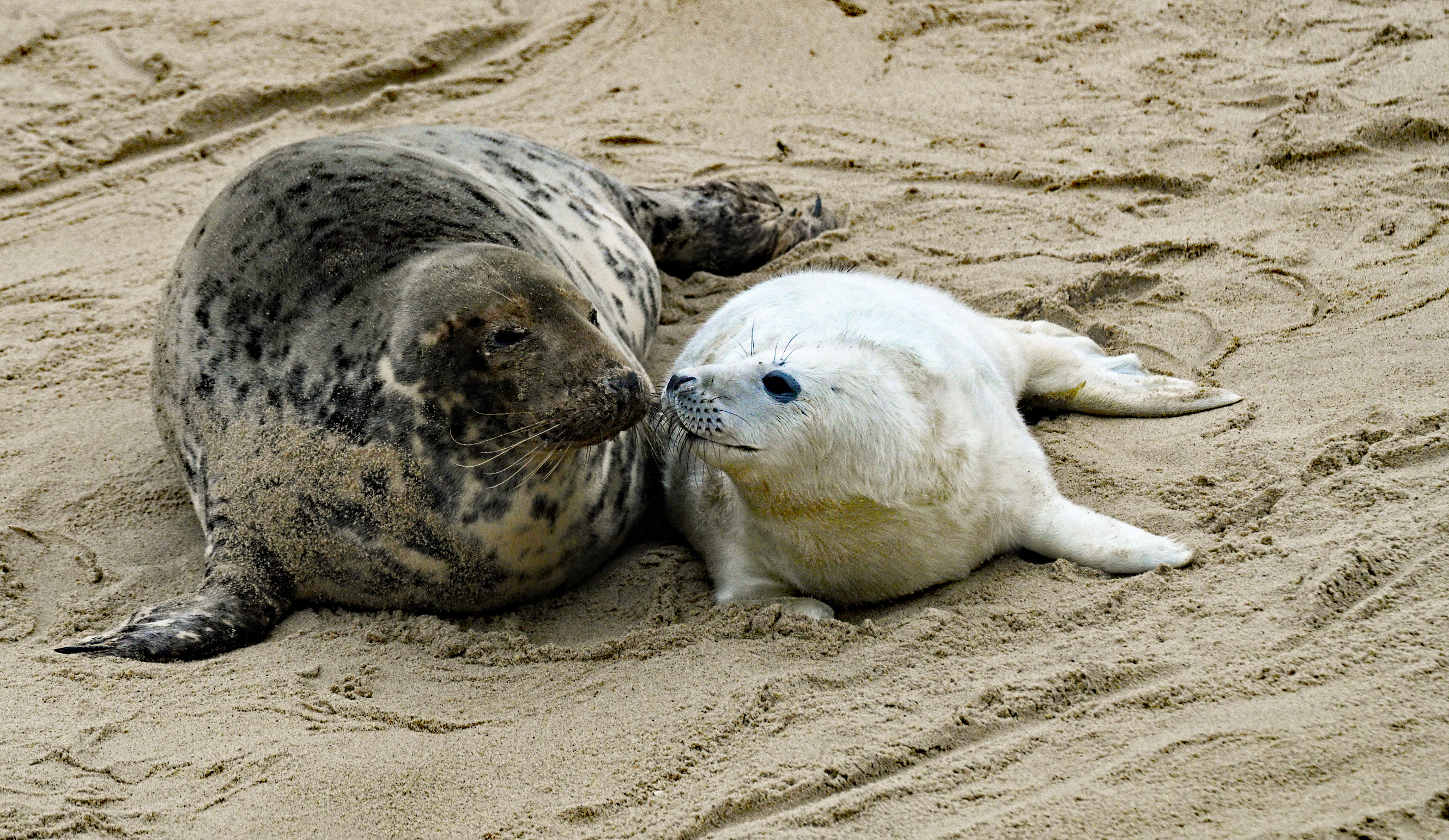
The grey seal at a glance
Size: The grey seal shows considerable variation in size across its range, with individuals in the western Atlantic substantially larger than those in the east. Globally, adults range from approximately 1.5 to just under 3.5 m in length (5-11.5 ft) and 100-400 kg (220-880 lbs – about 50 stone) in weight. Females are generally smaller, rarely exceeding 2 m or 250 kg (6.5 ft / 550 lbs). British populations are more modest: males average around 235 kg (550 lbs) and females 155 kg (340 lbs), according to the Working Party on Marine Mammals' Mammals in the Seas (1978).
Appearance: The grey seal is a medium-sized, robustly built pinniped. The head is rectangular, and the long, convex muzzle -- often described as a "Roman nose" -- lends the animal an almost horse-like profile. A fleshy area around the whisker pad partly obscures the lower jaw. The eyes are small relative to the head and widely set, positioned towards the top of the skull alongside the nostrils, enabling the seal to use both senses while only minimally breaking the surface. A reliable diagnostic feature separating this species from the common seal (Phoca vitulina) is the arrangement of the nostrils: in the grey seal these are parallel and widely spaced, forming a W-shape when viewed head-on, whereas in the common seal they converge to form a V. The fore-flippers are short and broad. Coat colouration is highly variable, ranging from largely white with black or grey markings through to uniform dark grey or black.
Sexing: Sexual dimorphism is pronounced. Males are considerably larger and heavier than females, though this may be less apparent when individuals are seen in isolation. In adult males the top of the muzzle is noticeably convex, whereas in adult females and pups it is flat. Males also possess a visible penile opening in the lower abdomen. The coat is also usually sexually dichromatic: females generally show dark markings on a pale ground colour, with a particularly light belly, while males carry lighter markings on a dark grey coat. Juveniles, which tend towards a more uniform coat, are almost impossible to sex reliably from appearance alone. Adult males are known as bulls, females as cows, and young as pups.
Distribution: The grey seal is widely distributed around all British and Irish coastlines and has a broader cold-temperate to sub-Arctic global range. Three genetically distinct populations are recognised: one in the Baltic Sea, one in the north-east Atlantic, and one in the north-west Atlantic around Nova Scotia and the Gulf of St Lawrence. The species has been recorded as far south as Portugal and as far north as Svalbard, with additional records from the southern Norwegian Sea, along the Norwegian coast, and in waters off northern Iceland. The Ocean Biodiversity Information System also holds a cluster of reports from the north-west Indian Ocean off Somalia.
Longevity: Direct data from wild populations derive largely from culls conducted in the 1970s, which indicated a maximum age of 46 years in females, though few individuals live beyond 35; in males the maximum was 26 years, with most failing to reach 20. The maximum recorded lifespan in captivity, as documented by Richard Weigl, is just under 43 years.
Habitat & Territory: Although primarily a coastal marine species, grey seals regularly move considerable distances offshore and will travel several kilometres up rivers. Long-distance coastal movements are also well documented – in April 2026, for instance, a pup swam 120 km (75 miles) from Cornwall to the west coast of Wales. When foraging, individuals may cover up to 100 km (62 miles) in a single day, spending around 10% of their time resting offshore to limit the energetic cost of repeated transit. They rarely venture beyond the continental shelf.
Diet: Grey seals are opportunistic, generalist predators whose diet centres on fish, including cod, haddock, ling, whiting, sand eels, and flatfish, supplemented by crustaceans, octopus, and squid. Most prey is taken at sea, but seals will travel considerable distances up rivers in pursuit of fish; the Montgaudier baton -- a prehistoric artefact found in a Dordogne cave roughly 160 km (99 miles) from the coast -- depicts two grey seals chasing fish and is widely interpreted as evidence of ancient seals following Atlantic salmon runs inland. An adult consumes between 4 and 7 kg (9-15 lbs) of food per day.
In recent years, a more varied and perhaps surprising dietary repertoire has been recorded. Several adults have been observed targeting seabirds, including gulls, guillemots (Uria aalge), and common eider (Somateria mollissima). Perhaps more striking is a series of observations off Ireland documenting predation on cetaceans: in November 2021 an adult drowned and partly consumed a harbour porpoise (Phocoena phocoena) calf off Clogher Head, County Louth; in March 2024 an adult bull was photographed near Skerries, Dublin, apparently gripping a common dolphin (Delphinus delphis) during a two-hour pursuit, although no direct predation was observed; and in January 2026 an adult was photographed attacking a common dolphin off Howth, the pair disappearing underwater and neither resurfacing – the day prior, a dead dolphin with extensive injuries had been found floating nearby. There are also reports of grey seals killing harbour seals, particularly at Blakeney Point in Norfolk and on Heligoland off the German coast, although these incidents do not appear to represent predatory behaviour.
Activity: Activity patterns vary markedly with season, with terrestrial activity peaking during the autumn breeding season when females return ashore to pup and males follow in order to mate. Outside this period the species appears broadly arrhythmic, with observational studies detecting no consistent effect of tide or time of day on activity levels; suckling females, however, show a cyclical pattern of swimming and nursing that tracks tidal state. Sexual activity continues through both day and night. The species has been characterised as a "population generalist, individual specialist," reflecting that foraging movements vary more between individuals than within them.
Behaviour & Sociality: Grey seals spend approximately 80% of their lives at sea, and around 90% of that time submerged. When diving, they can remain underwater for at least 32 minutes by dramatically suppressing heart rate -- from a resting rate of around 120 bpm to as few as 4-5 bpm -- thereby conserving oxygen. The deepest recorded dive stands at just over 200 m (656 ft). Typical underwater cruising speed is around 2 m/s (4.5 mph), and they rarely swim at the surface.
The species has a varied acoustic repertoire encompassing grunts, growls, and barks; in the water, individuals will clap their fore-flippers together to generate pressure waves. Large bulls, particularly on the east coast of Britain, have been recorded lifting themselves on their fore-flippers and throwing their bodies onto the beach with an audible slap, apparently as a threat display towards rival males. The species can sleep both on land and in the water; aquatic sleep takes the form of vertical floating ("bottling") or horizontal drifting ("logging"). Grey seals come ashore annually to moult: females shed their two layers of dense, waterproof fur between January and March, with males following in spring. Because fur growth demands increased blood flow to the skin, entering the water during this period would risk serious heat loss, and seals consequently remain ashore (and therefore do not feed) for the roughly six weeks the moult requires. The species is broadly gregarious and will haul out in large aggregations, though during the breeding season females become aggressive and maintain spacing of approximately 3 m (10 ft) between individuals.
Reproduction: Following mating, the fertilised egg undergoes diapause (delayed implantation) for approximately 2.5 months before implanting; active gestation then lasts around nine months. Females show strong site fidelity to their pupping grounds, frequently returning to within a few metres of the previous year's birth site. Singletons are the norm; twins are rare. Pups are born in autumn weighing approximately 14 kg (40 lbs) and grow rapidly, roughly trebling their birth weight over the 20-day suckling period. Once weaned, pups are abandoned by their mothers; they enter the water for the first time after moulting their white natal coat (lanugo) at around 18 days of age. Bulls reach sexual maturity at 4-6 years but rarely compete effectively for mates until at least 8. Cows mature earlier, at 3-5 years and come into oestrus approximately two weeks after giving birth. Although most UK breeding is concentrated in autumn, females can be polyoestrous and spring births are occasionally recorded, particularly in Wales.
Threats & Conservation: The grey seal is protected in England, Wales and Scotland under both the Conservation of Seals Act 1970 and the Wildlife and Countryside Act 1981, which make it a criminal offence to deliberately or recklessly, kill, injure, or disturb them, particularly during the breeding season, without a license. They're also listed in Annex II of the EC Habitats Directive, the Wildlife (Northern Ireland) Order 1985, and the Marine (Scotland) Act 2010. The Baltic population is further covered by Appendix II of the Convention on the Conservation of Migratory Species (Bonn Convention). The most recent global population estimate, produced by the IUCN in 2016, placed total numbers at around 316,000 individuals. The United Kingdom holds approximately 40% of the world's total Atlantic grey seal population -- an estimated 120,000-160,000 animals, concentrated particularly in Scotland -- and around 95% of the European population, making British waters among the most important habitats for the species anywhere in the world.
Historically, seals were widely hunted for meat, fur, and, until paraffin became a cheap source of light and fuel, oil. Today, the principal threats include depletion of fish stocks through overfishing, direct conflict with commercial fishing and aquaculture operations (which frequently results in seals being shot), entanglement in discarded or lost fishing gear (particularly netting, in which seals drown with some regularity), disturbance at haul-out sites, and chemical pollution – elevated levels of heavy metals and PCBs have been detected in livers from UK seals and are thought to impair immune function and reproductive success.
Bibliography
A Year with the Seals: Unlocking the Secrets of the Sea’s Most Charismatic and Controversial Creatures - by Alix Morris
Ithaka Books
-- 2025
-- ISBN: 978-1785127625
Atlas of the Mammals of Great Britain & Northern Ireland - by Multiple Contributors
Pelagic Publishing
-- 2020
-- ISBN: 978-1784272043
Britain’s Mammals 2018: The Mammal Society’s Guide to their Population & Conservation Status - by Multiple Contributors
The Mammal Society
-- 2020
-- ISBN: 978-0993567339
Collins Field Guide: Mammals of Britain and Europe - by David MacDonald and Priscilla Barrett
HarperCollins Publishers
-- 1993
-- ISBN: 978-0002197793
Mammals of the British Isles: Handbook, 4th Edition - by Stephen Harris and Derek Yalden (eds)
The Mammal Society
-- 2008
-- ISBN: 978-0906282656
The natural history "bible" covering all British mammals with detailed coverage of their biology, behaviour, ecology and taxonomy written by experts in the field and referenced to the primary literature.
Mammals of the World: A checklist - by Andrew Duff & Ann Lawson
A&C Black
-- 2004
-- ISBN: 978-0713660210
RSPB Spotlight Seals - by Frances Dipper
Bloomsbury Wildlife
-- 2021
-- ISBN: 978-1472971623
Seal (Animal) - by Victoria Dickenson
Reaktion Books
-- 2015
-- ISBN: 978-1780234892
Seals - by Sheila Anderson
Whittet Books
-- 1990
-- ISBN: 978-0905483801
Seals and Sea Lions of the World - by Nigel Bonner
Cassell Illustrated
-- 1994
-- ISBN: 978-0713723779
The British Mammal Guide - by Steve Evans & Paul Wetton
Isabelline Films
-- 2015
-- ISBN: None
UK Mammals: Species Status & Population Trends - by The Tracking Mammals Partnership
JNCC/TMP
-- 2005
-- ISBN: 978-1861075680
Where the Seals Sing: Exploring the Hidden Lives of Britain’s Grey Seals - by Susan Richardson
William Collins
-- 2023
-- ISBN: 978-0008404574