TREE SQUIRRELS

Last Updated: 12th June 2009

SECTIONS:

-- Taxonomy
-- Size
-- Weight
-- Colour
-- Distribution
-- Longevity
-- Sexing
-- Activity
-- Refugia
-- Territory & Home Range
-- Predators
-- Food & Feeding
-- Breeding Biology
-- Behaviour & Social Structure
-- Interaction with Humans
        -- Damage To Forestry
        -- Decline In Native Wildlife


In the UK we have the dubious honour of playing host to two species of squirrel; I say dubious because one species is widely considered to be causing problems for the other.   The UK is home to the native Red and the introduced Grey squirrel.   That which follows is a brief summary of the natural history of these two fascinating mammals.

Red Squirrel HeadGrey Squirrel Head

Taxonomy: Squirrels are rodents (i.e. they belong to the order Rodentia) and are conventionally placed in the Sciuridae family, along with Chipmunks (Tamias and Eutamias), Marmots (Marmota) and Prairie Dogs (Cynomis).   However, the present state of rodent taxonomy is something of a mess and there are molecular data suggesting that the current phylogenetic scheme is incorrect.   Based on jaw muscle morphology, the Rodentia are broadly divided into three groups (or sub-orders): the Sciuromorpha (modern squirrels), Myomorpha (rats and mice) and Hystricomorpha (capybara, guinea pigs, coypu, porcupine etc.).   Contained within these three suborders are some 2290 species, grouped into 29 families and 48 subfamilies.   Within the Sciuromorpha is the Sciuridae family (Squirrels); the Sciuridae consists of 36 extant (living) genera and around 230 species.   It is the so-called “Tree Squirrels” (i.e. those in the Sciurus genus) that are of concern to us here – the Sciurus genus presently contains 28 species in seven sub-genera (Tenes, Sciurus, Hesperosciurus, Otosciurus, Guerlinguetus, Hadrosciurus and Urosciurus).   British squirrels represent two of the 13 species within the Sciurus subgenus.   However, recent molecular evidence -- from nuclear DNA and mtDNA cytochrome b data -- strongly suggests that the current scheme is inaccurate and requires a complete overhaul.   Among other points there is doubt as to the validity of some genera (e.g. Microsciurus) and subfamilies within the Sciuridae.  

"British" Red SquirrelMore immediately relevant to us here is the subspecific taxonomy of the Red squirrel (and grey squirrels to a lesser extent), which has been the subject of great debate.   There is terrific variation in the size and colour of Reds throughout their range, which has resulted in a considerable number of subspecies being proposed.   In his 1978 The Mammals of the Palaearctic Region, Gordon Corbet lists 61 subspecies of Eurasian Red Squirrel (Sciurus vulgaris).   Among these is Sciurus vulgaris leucourus, a subspecies peculiar to Britain and Ireland and first described by Scottish-born surgeon and science writer/translator Robert Kerr in his 1792 The Animal Kingdom, or the Zoological System of the Celebrated Sir Charles Linnaeus (Mammalia).   Generally, the British subspecies is considered separate from Sciurus vulgaris vulgaris (first described from Sweden) on the basis of a blanching (whitening) of the tail during the summer; a phenomenon Corbet describes as a “progressive bleaching of the tail after each moult”.   However, in his 1971 review of tree squirrel subspecies, Polish anatomist Jerzy Sidorowicz studied the craniometric features (i.e. dimensions of the skull) of 1028 Red squirrels from throughout their range and concluded that there were only 18 valid subspecies.   Sidorowicz considered -- rather dubiously, it has to be said -- that S. v. leucourus was a valid subspecies based on a slightly shorter average skull height than S. v. vulgaris and the lightening of the tail.  (Photo: "British" Red squirrel showing the trademark bleached tail)

Undoubtedly some of the proposed subspecies are valid, although precisely how many is far from unequivocal and I remain unconvinced by some of Sidorowicz’s conclusions.   Indeed, studies on the skeletal anatomy of Red squirrel specimens from Britain during the early 1980s found insufficient differences to justify assigning the British/Irish squirrel subspecific status.   Ultimately, there is a considerable need for molecular genetic data to combine with the existing hard and soft tissue morphometrics, to provide a more rigorous insight into the subspecific groupings of this species.

In contrast to the Red, Grey squirrel subspecifics are apparently less controversial; I am only aware of six proposed subspecies and of these Sciurus carolinensis carolinensis is the one inhabiting the UK.   However, as with the Red squirrel, the number of subspecies that are truly valid remains to be established.   While the subspecific taxonomy of the Grey squirrel may be less tumultuous than for the Red, there is an interesting subgeneric peculiarity.   In his 1880 Catalogue des Mammiferes Vivants et Fossiles [Catalogue of the Living and Fossil Mammals], the late French naturalist Edouard Louis Touessart proposed that some members of the tree squirrels (i.e. Sciurus) should be grouped together into the subgenus Neosciurus (literally, ‘new squirrels’, but probably referring to New World squirrels).   Subsequent re-workings of squirrel taxonomy led to this subgenus being discarded.   However, in his 1953 A Field Guide to the Mammals of Britain and Europe, Frederik Hendrik van den Brink not only resurrected Neosciurus, but also gave it generic status and allocated it monotypically to the Grey squirrel.   In other words, rather than following the previous schemes, which place the Grey squirrel with all the other living tree squirrels (as Sciurus carolinensis), van den Brink considered that it was sufficiently different to warrant being placed in its own private genus, as Neosciurus carolinensis.   Unfortunately, quite why van den Brink considered this justifiable is something that he has probably taken to his grave – he doesn’t state his reasoning in the book and I’m not aware of any evidence to support his conclusion, even at a subgeneric level!

Although no thoroughly satisfactory scheme has yet been put forth to group the rodents, for the purposes of this summary I will follow the scheme laid out by Malcolm McKenna and Susan Bell in their Classification of Mammals Above the Species Level.   Ergo, that which follows is the most widely accepted and best-supported taxonomic scheme for Red and Grey squirrels.  (Back To Menu)

Red Squirrels (Sciurus vulgaris)


Grey Squirrels (Sciurus carolinensis)

Kingdom: Animalia (Animals)
Phylum
: Chordata (basic ‘backbone’)
Class
: Mammalia (Mammals)
Order
: Rodentia (Rodents)
Sub-order
: Sciuromorpha (Squirrel-like)
Family
: Sciuridae (Squirrels)
Genus
: Sciurus (Tree Squirrels)
Sub-genus
: Sciurus
Species
: vulgaris


Kingdom: Animalia (Animals)
Phylum
: Chordata (basic ‘backbone’)
Class
: Mammalia (Mammals)
Order
: Rodentia (Rodents)
Sub-order
: Sciuromorpha (Squirrel-like)
Family
: Sciuridae (Squirrels)
Genus
: Sciurus (Tree Squirrels)
Sub-genus
: Sciurus
Species
: carolinensis

 ** Sciurus is the Latin masculine noun for “squirrel”.  For more details on how we classify organisms, see my Taxonomy page. **


Length
: Red squirrels reach a maximum length of about 45cm (18 in.), of which up to 20cm (8 in.) may be the tail.   Grey squirrels tend to be larger than Reds, reaching a maximum of 55cm (almost 2ft), of which 25cm (10 in.) may be tail.   More commonly, Red squirrels reach about 21cm (8in.), while Greys attain about 26cm (almost 1ft) including the tail.   (Back To Menu)


Weight
: Red squirrels can weigh-in anywhere between 200 and nearly 500 grams (7 to nearly 18 oz.), although they commonly attain weights of 280 to 300g (7 – 10 ½ oz.) in Britain.   There is some evidence from Belgium to suggest that the weight of Red squirrels may vary according to habitat, with higher weights reported -- most notably during the winter months -- from coniferous forests than in deciduous woodlands.  Males also tend to be heavier than females.   Grey squirrels have been reported to weigh anywhere from 400 to 700 grams (14 – 25 oz.), with most specimens across Europe between 450 and 650g (16 – 23 oz.).   In the UK, Grey squirrels average about 550g (19 ½ oz.) and their weight is known to vary according to season, peaking during winter.   (Back To Menu)

Red SquirrelColour: Red and Grey squirrels are generally simple to separate based on coat colour.   However, coat colour in Red squirrels is highly variable -- so variable in fact that many of the 40 proposed subspecies are thought to be colour variants -- and can range from black to a dull yellowy-brown (often referred to as “buff”), covering most shades of red and brown in between.   Albino Reds are rare, while melanistic (black) Reds are common in some regions (such as Denmark and parts of continental Europe), but rare in the UK.   Pelage colour in S. vulgaris is known to vary according to location, season and age, with adults tending to be lighter than juveniles.   Grey squirrels are typically grey-backed, with grey tails and a white (or significantly lighter) underside and flanks that vary from grey to a dusky red.   Melanistic and albino Greys are rare, although white individuals (not necessarily albino) seem rather common in the south of Britain and parts of the USA – white (non-albino) squirrels account for about 23% of S. carolinensis in the city of Brevard North Carolina.   (Back To Menu)

White Grey SquirrelIn a recent paper to the journal Mammalia, a team of Italian biologists looked at whether coat colour in Red squirrels from northern Italy related to habitat and whether colour influenced survivability.   Luc Wauters, Massimiliano Zaninetti and Guido Tosi at the University of Insubria and Sandro Bertolino of Turin University report that so-called “Red Morphs” were most common in the mixed woodlands of the Upper Po-plain, while “Black Morphs” were the most numerous individuals they trapped in the Alps (esp. western and central Alps) – “Brown Morphs” were rare.   While juvenile survival did not alter according to coat colour, the biologists found that the frequency of black morphs was positively correlated with high proportions of fir and spruce in the forests.   Previous research (during the 1960s and 1970s) found that black morphs of have a longer and denser undercoat than red ones; also completely black S. carolinensis experienced (proportionally) 18% less heat loss, 11% higher non-shivering thermogenesis capacity (i.e. greater tolerance to cold) and had a basal metabolic rate 20% lower than grey morphs held below minus 10oC (14oF).   Taking this into account and coupling it with their findings, Wauters and his team concluded that while elevation alone could not explain the variations they observed in colour morphs, their results did support the ‘Cryptic Coloration Hypothesis’.   The Cryptic Coloration Hypothesis suggests that the presence of dark fur in dense conifer forests may provide a selective survival advantage – in other words, having black fur in a generally dark and gloomy conifer forest might make it less likely that a goshawk, fox, owl or other predator, will nab you.   The Red morphs were better camouflaged -- the red fur blending into light-shade patterns among leaves -- in the mixed broadleaf canopies than in conifers.   Moreover, the Red squirrels always retained a white venter (underside), which produced a counter-shading effect and further helped them blend into their surroundings.

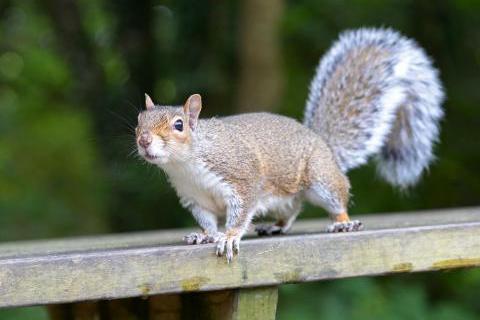
Grey Squirrel on Fence

Melanistic Grey SquirrelColour and appearance of both species may change in accordance with moults.   Both Reds and Greys moult biannually -- once in the spring (April to July) and again in late autumn (September to December) -- although their ear-tip and tail hairs are only replaced once a year (during the summer).   The spring moult proceeds from front-to-back, while the autumn moult starts at the back and moves forward.   In late spring or early summer, the tail of Red squirrels (possibly S. v. leucourus) is often almost white.   The summer coat of Red squirrels is often a chestnut brown, with small (or absent) ear tufts and a thinner tail that is chestnut to creamy in colour.   (Back To Menu)

Distribution: Generally, squirrels are found on every continent, excluding Australia and Antarctica.   I say “generally” because, although the so-called Australian Squirrels are actually petaurids (i.e. marsupials of the Petauridae family) and thus not true squirrels, there is evidence suggesting that some true squirrels may have started to colonize Australia – in particular, it seems that the Indian Palm Squirrel (Funambulus palmarum) has been found in South Perth.   However, neither of our resident species are known from either Australia or Antarctica.   The Red squirrel is found throughout Europe and Asia, from about 70oN to 30oN with Britain and China representing the west and east limits of range, respectively.   No specimens are known from Iceland or the Mediterranean Islands.   Within the UK, Red squirrels are still reasonably widespread throughout most of southern and eastern Scotland, as well as much (excluding the far west) of Ireland.   Reds can also be found in isolated pockets of England (e.g. Brownsea Island and on the Isle of Wight) and in three distinct populations in Wales (including Anglesey).

Grey squirrels are native to northeast America – their presence in Britain is a result of introduction by the Victorians.   In the UK, Greys are found throughout England, although they are absent from the Isle of Wight and apparently scarce in the area from the north Pennines to the Southern Uplands (ca. 56o to 54o N).   Having said this, Grey squirrels are occasionally reported from the Isle of Wight, with individuals making it across on ferries from the mainland – the last such instance was in 2001.   Despite the occasional sciurid stowaway, it seems that Grey squirrels have not been able to form a breeding population on the island – largely because invaders are reported to authorities and shot in a bid to protect the Red squirrels.   Scotland is also largely Grey squirrel-free (for much the same reason as the Isle of Wight), although there are populations near Glasgow, Edinburgh and Perth, among other places.   Grey squirrels are also absent from much of Ireland, with the exception of a population in the central east of the country.   (Back To Menu)

Grey Squirrel on GrassLongevity: In the wild, Red squirrels are known to live for up to seven years, although three is more typical.   Captive Red squirrels have been reported to live to ten years old.   Grey squirrels can live for up to nine years in the wild and the oldest captive specimen on record survived to 20 years old.   Studies on Grey squirrel populations in Southern England during the early 1980s, revealed a difference in survival between the sexes, with females living -- on average -- longer than males (4 to 5 and 2 to 3 years, respectively).   Mortality varies between species and populations.   First year mortality can be as high as 70% in some Red squirrel populations, with survival increasing dramatically (26% adult mortality) during the second year.   Similarly, first year mortality in Grey squirrels is high -- with as many as 75% perishing by the end of their first winter -- reducing to between 30 to 45% during the second year.   Mortality sources for squirrels include predators, domestic dogs and cats, starvation and road vehicles.   (Back To Menu)

Sexing: During the breeding season the testes are often swollen and, in the Red squirrel are darkly stained – this often makes it possible to decipher the sex at close range.   However, the lack of sexual dimorphism in both species makes sexing them from a distance all but impossible.   If handling squirrels, the distance between the genital opening and the anus can be used to determine the sex: in males the distance between the two apertures (ca. 1cm) is noticeably greater than in females (apertures very close together).   (Back To Menu)

Activity: Both Red and Grey squirrels are diurnal (i.e. active during the daytime) – Reds emerge about 30 minutes after sunrise, while Greys may be active immediately prior to dawn.   Red squirrels exhibit a bimodal activity pattern during the summer months, with a peak in activity three or four hours after sunrise and another two or three hours prior to dusk – during the winter there is only a single peak (in the morning).   It has been suggested that these peaks in activity during the spring may be a result of a ‘seasonal digestive bottleneck’.   The idea is that, in springtime, squirrels consume more bulky buds and shoots -- because nuts from the previous autumn have been eaten by this stage -- and the gap between the periods of highest activity may represent the time required to empty the digestive tract in preparation for the next ‘bulky’ meal.

The activity patterns of Grey squirrels are more seasonally sporadic than those observed in Reds.   During the autumn, Greys are generally active throughout the day, while activity diminishes to about four hours or less (in the mornings) in winter, before increasing again to between three and eight hours -- frequently bimodal -- in the spring and summer.   (Back To Menu)

Squirrel DreyRefugia: In his 1974 opus Mammals of Louisiana and its Adjacent Waters, the late eminent ornithologist George H. Lowery Jr. wrote that Grey squirrels -- as well as Fox squirrels (S. niger) -- create two types of dens.   The first type is simply a den within a tree cavity, while the second type consists of a ball or dome-shaped mass of leaves and twigs.   According to Dr. Lowery, these dens can be located anywhere from the ground up to 12m (39ft) in the trees and are referred to as dreys.   Dreys are typically about the size of a football (i.e. 30cm / 1ft diameter), with a combination of twigs, moss and leaves woven into a thick-walled shelter – the inner cavity is generally 12cm to 16cm (4.7 to 6.3in.) in diameter.   The dreys are lined with mosses, lichen and bark and it is not uncommon for a single squirrel to have several dreys.   Indeed, a nursing female will have several ‘alternative’ dreys located near to the natal drey – if the natal drey is disturbed, the female will move her young to a new drey.   In broadleaved woodlands, the cavity of a tree may be used as a drey – in the case of Grey squirrels, such nests will usually be in oak or beech trunks, with the centre hollowed out and an entrance gnawed to a diameter of about 10cm (4in.).   Grey squirrels tend to have two ‘types’ of drey, built according to the seasons; winter dreys are those described above, while summer dreys are, according to Corbet and Harris’ Handbook of British Mammals, “shallow platforms of twigs”.   (Back To Menu)

Territory/Home Range: Squirrels are known to range over a large area, the size of which varies according to several factors – the most significant of these are the season and the habitat type.   For example, in British Hardwoods, Grey squirrels tend to range over between two and ten hectares (0.008 to 0.04 mi2) for most of the year, but males may cover more than 100ha (1km2 or 0.4 mi2) during the mating season.   Red squirrels have similar sized home ranges -- typically between two and ten hectares, average of seven hectares (0.004mi.) -- although about one hectare of this range is intensively used (referred to as a “Core Area”).    Studies following radio-tagged Red squirrels found that while the range size for males during spring (breeding season) increased only marginally in deciduous woodlands, there was a two-fold increase in conifer habitats.   The area over which individuals (of both species) move reduces dramatically across some parts of their range in winter.

Red Squirrel in TreeFood availability is obviously an important factor regulating the area over which a squirrel will travel.   The overall range size of Reds in the deciduous woodlands of Northern Belgium is almost double that of Reds inhabiting coniferous forests in the same region.   Presumably, such a marked difference is the result of variations in resource availability between the habitats; conifer seeds are available for most of the year, while potential food is patchier and more diffuse in deciduous woodlands.   Likewise, Grey squirrels are known to make considerable excursions (of more than a kilometre – 0.7 mi – in some cases) in search of food.

Males tend to range over larger areas than females, although females maintain more stable ranges.   Range size may also depend on social status.   For example, on the Isle of Wight, squirrel biologist Jessica Holm found that the ranges of dominant Reds were smaller than those of subordinates – it is assumed that this reflects the ability of dominant individuals to hold-down the choice spots in a habitat.   Similarly, a study (published in 1992) by Luc Wauters and Andre Dhondt (both at the University of Antwerp in Belgium) found that subordinate Red squirrels behaved as “floaters” (i.e. without a fixed territory) or settled on the edges of the ranges of dominant females.   Indeed, earlier work by the same authors found that all sub-adult Red squirrels in the study spent their first winter as low-ranked floaters or on the periphery of home ranges maintained by dominant adults.

Where territories or core areas exist -- and territory establishment is essential for successful reproduction in Reds (and probably Greys) -- their boundaries are marked with scent.   Scent marking, in the form of urine, glandular secretions (scent glands are situated around the mouth) and faeces (observed in Greys, uncertain in Reds), occurs at specific locations in the home range such as tree trunks and branches.   Scent marks appear to signify occupation of a home range and contain information about the social status and reproductive condition of the landlord.   Vaginal secretions ‘posted’ in the range during the breeding season may also give males an idea of which females are in oestrous.

Although uncommon, territory shifts have been observed in squirrels, where an individual will relocate to a new territory from an established one.   Work by Belgian biologists published in the journal Animal Behaviour in 1995, reports that breeding dispersal is rare – of the 44 female Red squirrels in their study area, only seven (16%) vacated the territory on which they first settled in favour of adjacent, vacant spots during the eight year study.   The researchers found that females from territories with poor resources were more likely to move, although they only did so if the new territory had more (or better) resources than the current one.   Active bequest of territory to offspring was not observed and females that switched increased their reproductive rate on the new territory.   Ultimately, the biologists found that switching of territory was an adaptive phenomenon, occurring in response to poor breeding conditions.   Indeed, work by Luc Wauters and Luc Lens (both at Antwerp University in Belgium) has demonstrated that female Red squirrels in poor territories had reduced fecundity or suffered breeding failure (e.g. failure to wean litters, high kitten mortality etc.) compared to conspecifics in good territories.   (Back To Menu)
 

Young Red Fox & Black Cat Predators: In the UK and throughout much of Europe, predators of squirrels include red foxes (Vulpes vulpes), domestic cats (Felis catus), wild cats (Felis sylvestris), pine martins (Martes martes), domestic dogs (Canis familiaris), owls (e.g. Long-eared Owl, Asio otus), goshawks (Accipiter gentilis) and other raptors.   Stoats (Mustela erminea), weasels (Mustela nivalis) and mink (Mustela vison) may take young squirrels, while snakes may take neonates if the nest is within reach.   In North America, snakes, raccoons (Procyon lotor), grey foxes (Urocyon cinereoargenteus), bobcats (Lynx rufus) and coyotes (Canis latrans) will take squirrels.

Despite a rather broad predator base, predation is not considered to be a significant source of mortality for either species.   For example, a study by ecologists in Kielder Forest (Northumberland) found that, although the predation rate of Red squirrels by goshawks was highly variable over a 23 year period (from eight to 261 individuals taken), only an estimated 79 squirrels were taken by these birds each breeding season.   In stark contrast, the ecologists calculated between 2135 and 9167 kittens were produced annually in the forest.   (Back To Menu)

Red Squirrel on FeederFood & Feeding: Both species feed primarily on seeds and plant matter, including berries and fruit.   However, both species are also opportunists and will readily take other foods if available.   Red squirrels also feed on bark, shoots, tree flowers and fungi – the amount that each food type contributes to the diet changes with habitat and season.   For example, a study published in Mammal Review back in 1983 reported that, in a forest of Scots Pine in eastern Scotland, Red squirrels consumed fungi throughout the year with a peak (about 80% occurrence in the diet) between September and November, while conifer buds were consumed primarily in winter and spring (December to May).   The same study also looked at the dietary composition of Grey squirrels in English deciduous woodlands and found that this species fed primarily on deciduous seeds and fruit during winter and spring (December to May), after which the amount of flowers and buds consumed increased, peaking in mid to late summer (July/August).   Basically, this study has shown that, while both squirrels feed predominantly on seeds and fruit throughout the year, they are capable of adapting their diet to take advantage of seasonal changes to the abundance of different foods.

More specifically, Red squirrels eat spruce and pine seeds, nuts (e.g. hazelnuts, beech and chestnuts), acorn berries, fungus, bark and sap tissue; soil and tree bark are also eaten, presumably for roughage and minerals.   Grey squirrels will eat acorns (which Red squirrels are seemingly less able to digest), beech mast, tree shoots, flowers, samaras (key fruit), nuts, fruit, roots, cereals and sap tissue.   Both species will occasionally take insects.   There is some evidence to suggest that Reds and Greys will take bird eggs and chicks from nests, although such records are generally rare and, on a larger scale, squirrels are not thought to be significant predators of avians (although on a local scale avian predation may be more commonplace).   In urban environments, Greys will scavenge for leftovers and I have frequently seen them consuming the remains of discarded KFC meals, cereal bars and even ice cream cones; they will also raid bird tables and bird feeders.  

Grey Squirrel FeedingGrey squirrels consume between 40g and 80g (1.5 to 3 oz.) of food per day (ca. 10% body weight), while Reds will eat about 18g (0.6 oz.) per day (ca. 5% bw).   The availability of food is a significant factor in the regulation of populations – Red squirrel survival is favoured by wet autumns (which promote edible fungal growth) and population size is correlated with the year’s hazel crop.   Although the availability of food is important in regulating Grey numbers, the greater polyphagy observed in this species seems to have a moderating influence.   Following abundant mast crops, population densities of Greys frequently increase significantly.

Difference in diet is thought to be a key factor responsible for the rapid increase of Grey squirrel distribution, at the expense of the Red squirrel.   Specifically, the ability of Grey squirrels to eat foods that are toxic, or otherwise indigestible, to Reds -- the so-called “phytotoxic” explanation -- may be significant in partially explaining the success of Greys in the UK.   See Q&A.

In addition to their more regular diet, there are reports suggesting that squirrels will eat bones.   In an intriguing communication to the journal Science back in 1940, Professor Anton Carlson of Chicago University noted that he observed a pregnant and lactating Grey squirrel chewing on old bones (buried for one to thee years) in his garden; however, he had never observed the squirrel in question to eat bones before she became pregnant, nor did he witness bone-eating in any of the males or non-pregnant females.   Prof. Carlson suggested that he was witnessing a “special urge or appetite for calcium and phosophorous [both bone-forming salts] during pregnancy and lactation in this species”.   Prof. Carlson’s postulation is interesting, because there is evidence that some mammal and bird species have an inbuilt mechanism telling them when they are lacking in a particular nutrient and subsequently some idea what to eat to correct this imbalance or to treat an illness (that which Carlson refers to as a “physiologic guide to an adequate diet”).   For example, Red Colobus monkeys (Procolobus badius) on the African island of Zanzibar are known to consume charcoal.   It is conjectured that the charcoal binds with phenols (e.g. tannic acid) in the Indian Almond (Terminalia catappa) and Mango (Mangifera indica) leaves on which these primates feed – for more details, see chemist David Cooney and primatologist Thomas Struhsaker’s fascinating 1997 paper in the International Journal of Primatology.  Similarly, Scarlet Macaws (Ara macao) eat clay to guard against stomach upsets while foraging.   However, while the appropriation of essential nutrients and minerals are probably part of the story, other possibilities exist.   In response to Carlson’s original communication, Professor Alan Coventry at the University of Toronto shared his observations of a red squirrel visiting the skull of a long dead moose, both during and outside the breeding season.   Prof. Coventry writes:

During this summer [1928] a red squirrel (Sciurus [now Tamiasiurus] hudsonicus) regularly visited the skull twice a day, about 6 A.M. and 4 P.M., and nibbled for a few minutes at projecting parts, especially the upper edge of the orbits.  The amount removed each time was very small, but there was a real eating of bone.

In my local park, I have frequently observed Grey squirrels gnawing on the discarded chicken bones from KFC meals; I had always assumed that they were removing any remaining flesh and/or juices and had never bothered to inspect the discarded bones for compact bone or connective tissue removal.   However, in light of Carlson and Coventry’s brief correspondences -- combined with web postings by people who keep squirrels as pets and have observed them to enjoy gnawing on the occasional bone -- it seems likely to me that while the squirrels may gnaw on bone tissue in order to extract some valuable minerals (e.g. calcium and phosphorous), they may also use it as a method of grinding down and sharpening teeth.

Squirrel Caching FoodSurplus food is cached (i.e. buried) for retrieval when food is scarce; nuts (e.g. beech mast, hazel) and seeds (e.g. acorns) are generally cached during late summer and autumn for retrieval in winter.   Although it varies according to habitat, Grey and Red squirrels generally scatter cache in tree cavities or in shallow (2 or 3cm / ~3in. deep) pits dug into the ground – each cache contains between one and four items and Red squirrels will also cut fungal fruiting bodies and cache them singly in trees, to dry out.   The cache recovery rate is variable and related to the mast crop.   In a 1989 article to Natural History, Prof. Lucia Jacobs, at the University of California Berkeley, reports a nut recovery rate as high as 95% for Grey squirrels in North America.   Conversely, in a 1994 article for Natural History, Drs Michael Steele and Peter Smallwood note that in years where the mast crop is high, as few as 26% of cached nuts may be recovered.   In the USA (and presumably also in the UK), where squirrels feed on rapidly germinating oaks, they have been observed to bite out the seed-germ tip (thereby preventing germination) before burying the acorn.  

While data are lacking for Red squirrels, Grey squirrels seem to have a good spatial memory and exhibit learned cache retrieval (i.e. the squirrels use episodic memory to relocate caches).   Although there is no evidence to suggest that they remember the exact spot, they do seem to remember the general area of the cache and olfaction is probably used to home in on it.   See Q&A for a more detailed coverage of caching behaviour in squirrels.  

The notion that squirrels are able to relocate caches by vision is well supported by histological studies of the sciurid optical system, although historically the concept of colour vision in sciurids has been contentious.   Early studies on the squirrel retina suggested that it was predominantly (if not entirely) cones, while studies of photopigments have implied the presence of a red and green (but no blue) pigment.   Moreover, behavioural studies have demonstrated an apparent ability to discriminate between red and green food objects.   Grey squirrels (and probably Reds as well) are now known to have a two-tiered retina: one tier in the centre of the retina is composed of rod cells (light level sensors) and the outer tier is composed of cone (colour-sensitive) cells – the rod to cone ratio in Greys is about 2:3.   Recent electroretinographic studies have revealed that squirrels possess dichromatic (two-colour) vision, with colour discrepancy similar to a human deuteranope (i.e. someone who is red-green colour-blind and can decipher red or green from blue, but can’t distinguish red from green).   Work on squirrel spectral sensitivities by Professor Barbara Blakeslee and Doctors Gerald Jacobs and Jay Neitz during the late 1980s found that Greys had a peak rod sensitivity of 502nm and peak colour sensitivities at 444nm (Blue) and 543 nm (Green).   However, this leaves open the question of -- if Grey squirrels are deuteranopic -- how they managed to discriminate between the red and green biscuits offered to them by the University of Exeter’s Ian MacDonald.   MacDonald found that not only could squirrels discriminate between red and green in a foraging situation, but they could also discriminate colour hue – given the findings of Blakeslee and her colleagues, this ought not to be possible!   The reason for this contrariety is unknown, but it has been suggested that the squirrels in such behavioural experiments may have been responding to olfactory (smell) or luminance-related cues, rather than to colour per se.   Coupled with limited (by primate standards) colour perception, squirrels are also known to have excellent, wide-angle vision with exceptional focussing power.  

Albino Grey SquirrelIn relation to sciurid vision, there is some indication that retinal development may be associated with how well albino squirrels survive in the wild.   Typically, albino animals don’t survive long in the wild and this is often put down to a lack of camouflaging ability, which makes them easy targets for predators.   However, work by Jona Esteve at the University of Barcelona and Glen Jeffrey at University College London published in Vision Research back in 1998 suggests that retinal development may be a crucial factor.   Albino mammals generally exhibit a noticeably under-developed retina (with a rod deficit and central ganglion cell density about 25% lower than in pigmented animals).   Esteve and Jeffrey studied the retinas of two albino Grey squirrels and compared them with retinas from pigmented individuals of the same species.    The ophthalmologists found that the albino squirrels showed only a ca. 5% reduction in central ganglion cell density, implying that albino squirrels don’t suffer the same decline in visual acuity as that of other albino mammals.   Consequently, it seems that their relative immunity to retinal deficits may at least help to explain why squirrels are the only albino mammal to show consistently successful survival in the wild.   Indeed, several observers have reported albino squirrels to have a mastery of the treetops similar to that of their pigmented conspecifics; amongst other skills, they are perfectly capable of leaping considerable distances between branches.

Squirrel FeedingThe feeding kinematics of Red and Grey squirrels are similar – food items are held and rotated by the front paws as the squirrel either squats (on the ground or in a tree) or hangs.   Squirrels, indeed all rodents, have four long, curved, powerful incisors (one pair in the top jaw, one pair in the bottom) that grow continuously during the animal’s life.   The incisors -- which consist of a central pulp cavity (containing nutritive blood vessels) surrounded by a layer of dentine and enamel on the outer face -- are ground-down by the squirrel’s sempiternal gnawing.   The dentine, which comprises the bulk of the tooth, is softer and is worn down quicker than the enamel; consequently, the incisors develop a sharp, chisel-like profile.   Squirrels have a split upper lip (hare lip) through which the upper incisors protrude when feeding – they also lack the canine and most of the pre-molars, leaving a gap (called a diastema) between the incisors and the molars (at the back of the mouth).

Chewed Pine ConeFeeding methodologies can help differentiate squirrel-chewed nuts from those gnawed by other small mammals (e.g. voles and mice), although distinguishing those chewed by Reds from those chewed by Greys is decidedly more complex (if not impossible).   Squirrels use their incisors something akin to a crowbar, ‘jimmying’ the nut open from the top and causing it to split roughly in half, with clean edges.   They will also gnaw off the scales of fir cones to expose the seeds; the cone seeds are eaten and the seed wings are discarded along with the cone core.   (Back To Menu)


Breeding Biology
: Sciurids practice internal fertilization and, in common with most mammals, males have a bone called a baculum, which maintains his erection during copulation.   Although males may be sexually active all year round, they usually exhibit a redundant phase -- typically late autumn/winter -- during which there is testicular regression (i.e. the testes retract into the abdomen and the scrotum is empty).   In Grey squirrels, testicular regression is very pronounced: the testes shrink from about 7g to 1g (86% reduction in size), while the paired bulbourethral glands -- often referred to as “Cowper’s glands” after the 17th Century English anatomist, William Cowper, who first described them -- which secrete a mucous substance into the urethra during stimulation, reduce by about 70% and the prostate decreases by some 75%.   During late winter, the testes grow into the scrotum and reach full size by the beginning of the breeding season; when fully active, Red squirrel testes are sometimes darkly stained.   Squirrels don’t tend to indulge in elaborate courtship routines and pre-copulatory activity rarely exceeds an acrobatic arboreal ‘mating chase’ or bout of virile intrasexual aggression – during chases, the dominant male is usually at the head of the retinues.   After a, sometimes considerable, chase -- covering a substantial distance and lasting for an hour or more -- the female mates with one of her pursuers, although it is not clear whether she selects a mate or is just inseminated by the leading male.   Despite several groups of males chasing a single female during her receptive period, each chase will typically end in only a single copulation event, lasting about 30 seconds.   Interestingly, copulation plugs have been recorded from some members of the Sciurus genus – here a gelatinous white plug forms in the vagina in order to either keep the sperm in or to keep competitor’s sperm out (or, indeed, both).   In the case of the Fox squirrel (Sciurus niger), this plug is perhaps an ineffective method by the male to induce celibacy, because the female will often sit grooming her genitalia after intercourse and remove the plug.   Although the Fox squirrel is closely related to the Grey squirrel -- based on serum albumin, protein variation and cytochrome b gene sequences -- I have not come across any reports of copulatory plugs in either S. carolinensis or S. vulgaris.

Red Squirrel KittensFemale Red squirrels are polyoestrous (i.e. have multiple cycles each year) and receptive for only one day during each cycle.   There are often bimodal peaks in breeding activity: winter mating (December to March) leads to spring-born (March to May) young, while spring mating leads to young born in the summer (July to September).   Ergo, the breeding season for Reds can last from December through until the summer litters are weaned by September (peak mating between January and March).   Red squirrels gestate for between 36 and 42 days -- depending on the weather and food availability -- producing an average litter of three kittens (young).   Studies during the mid-1980s by Dr. John Gurnell, currently at the Frances Le Sueur Centre on the Channel Islands, found that the breeding season may be truncated if food is scarce; the first breeding season may even be skipped altogether.   Furthermore, there is evidence that breeding success of males is related to body mass, with heavier males mating more frequently than lighter ones.    (Photo: Red squirrel kittens at 23 days old)

Assuming successful parturition, Red kittens are generally between 10g and 15g (ca. ½ oz.) at birth and the mother will suckle them for 50 to 70 days.   The young will begin leaving the drey to explore at about seven weeks old and are fully weaned by ten weeks; the young are generally independent by 12 to 16 weeks old.   Red squirrels are sexually mature at ten months to one year old, although if spring-born males develop scrotal testes during the winter, they may be sexually mature by six months old.

Grey squirrels produce one or two (if mating begins in December) litters of two to four kittens (average is three, maximum recorded was eight), following a 42 to 45 day gestation.   Weight at birth is generally between 14g and 18g (0.6 oz.) and the female will lactate for 70 days.   Litters are produced during the spring if there has been a good crop of mast, or during the summer/autumn if the crop is less bountiful – occasionally, a female will produce a litter in each season.   As with the Red squirrel, Grey breeding season and kitten survival varies according to food availability and prevailing weather conditions.   Indeed, one study in Britain found that between 55% and 88% of the variation in post-breeding density was explained by the abundance of seed crops.   Young Greys can eat solid food and begin to leave the natal drey at seven weeks old, are completely weaned by about ten weeks -- by which time they weigh about 200g (7 oz.) -- and are considered independent by 16 weeks at the latest.   Adolescent squirrels are sexually mature by ten months to one year of age.

Squirrels produce altricial young (i.e. the kittens of both species are blind, deaf and naked at birth).   Skin pigment develops and the first hairs appear on the back after about 14 days.   Fur growth is complete by about three weeks, while the eyes and ears open after about a month.   While in the drey, the young will chew twigs in order to ‘cut’ their teeth – in the Grey squirrel, lower incisors are cut at about two-and-a-half weeks, with upper incisors cut as much as three weeks later.   Females are very protective of their young -- readily chasing away any intruders -- and the mothers of both species exhibit parental care.   In the Red squirrel, maternal protection has been recorded as long as two weeks after the young are weaned, while Grey maternal care appears to end at weaning.   Males play no part in natal drey building or in raising the young.   As the nursing period progresses, the female will begin spending more and more time away from her offspring so that, at the time of weaning, she may move back to her old dreys, leaving the young together in the breeding drey to fend for themselves.

Fecundity (i.e. number of kittens born) and breeding success (i.e. number of successfully weaned kittens) are highly dependent on habitat quality and resource availability –seemingly more so in deciduous woodlands than in conifer forests.   Furthermore, it seems that reproductive rate is inversely related to female abundance (i.e. as the number of females in an area increases, the number of females breeding decreases) and the number of females dispersing is related to the seed crop.   Following a good seed crop, more females disperse, although high densities of females apparently impede settlement success.   (Back To Menu)


Red Squirrel on BranchBehaviour & Social Structure: Red and Grey squirrels are solitary for the majority of their lives, although communal nesting is known in both species (typically during the winter and spring).   Work by Dr. Jessica Holm has found that Red squirrels sharing a drey appear to be familiar with one another.   Greys are also known to share nests (in one instance 20 individuals were found in a single cavity), although the relationship of the individuals is unknown.   Experiments with American Red (Tamiasiurus hudsonicus) and Grey squirrels by Ralph Ackerman and Peter Weigl at Duke University in North Carolina, found that the two species were most likely to share nest boxes (i.e. Reds and Greys in at the same time) when ambient temperatures were between four and ten degrees Celsius (39 to 50 oF).   Furthermore, the zoologists observed that the Greys ignored the Red squirrels, exerting a passive control over the nest box (i.e. Reds could come and go as they pleased).   Simultaneous sharing of nest boxes has not, to my knowledge, been observed between Eurasian Reds and Greys, although ‘timeshares’ -- where Greys will use Red squirrel nests when the Reds aren’t around and vice versa -- have been documented.

Dominance hierarchies are known in sciurid society, with pecking orders observed in both Reds and Greys.   In Red squirrels, inter- and intrasexual dominance has been recorded; males are not necessarily dominant to females.   Dominance or subordination seems to be based on a combination of size and age; chieftain animals are typically larger, older and frequently hold larger home ranges than subservient individuals.

Autumn is the peak season for Red squirrel dispersal -- dispersal is usually a juvenile phenomenon (where young squirrels leave the natal home range to look for their own home range) -- although there are also spring and summer dispersals in some populations.   Spring dispersal is probably the movement of squirrels away from their winter grounds, while it is presumably kittens born earlier in the year that disperse during the summer months.   Grey squirrels also disperse during the autumn and these months see a significant increase in the number of sciurids killed on roads.   However, while autumnal dispersal is recorded, a 1981 thesis on Sciurus carolinensis spatial dynamics found that Grey dispersal is highest in the spring (with a peak in June)

Red Squirrel FeedingThe distance travelled during dispersal will vary according to the habitat type and existing squirrel density and distances of up to three kilometres (two miles) have been recorded in Greys.   Migrations can involve the en masse movement of squirrels and early 20th Century America bore witness to some spectacular mass emigrations of squirrels during autumns when food was in short supply.

Anyone who has ever sat in their local park to eat lunch will doubtless have seen squirrels and seen how they move around.   Although Grey squirrels are less agile and less arboreal (i.e. spend less time in the trees) than their Red counterparts, both species move in much the same way.   Movement on the ground is perhaps best described as “scurrying” and in their Handbook of British Mammals, Corbett and Harris describe the terra firma locomotion as: “a weaving run or a series of leaps with the tail held out behind”.   While on the ground squirrels will often stop periodically and sit bolt upright, with their ears erect, apparently surveying for danger.   In the trees, squirrels are impressively agile (Reds noticeably more so than Greys), leaping acrobatically between branches several metres off the ground and moving up and down tree trunks head first.   The Handbook of British Mammals notes that the escape behaviour of Red and Grey squirrels includes: “moving up the far side of a tree to the observer or predator, or ‘freezing’ flat against tree trunk or on a branch”.   Both species are able to swim.

One frequently observed behaviour in British sciurids is that of grooming, which follows a distinct sequence of events.   The squirrel will start by grooming its head and forepaws before it moves on to groom its body.   After body grooming is complete there is a period of hind leg scratching and hind foot licking.   Once all the aforementioned actions have been completed, the squirrel will groom its tail.

Social interactions, especially those related to the defence of resources or kittens from interlopers and predators, often involve sound.   Indeed, Red squirrels are known to produce both loud and soft “chucking” noises, a vehement “wrruhh-ing” as well as various moans and teeth chattering.   Piercing screams have been documented during particularly aggressive encounters and Red kittens produce “shrill piping calls”.   Observations on the social dynamics of the Grey squirrel have resulted in the typification of 11 different call types:  mating calls, buzz, muk-muk, moan, squeak, kuk, tooth-chatter, scream, lip smacking, growl and quaa.   Exaggerated body language -- including vigorous tail flicking, foot stomping and tail biting and chasing -- often accompany alarm and agonistic calls.   (Back To Menu)


Grey Squirrel in TreeInteraction with Humans: Most, if not all, animals have a place in human religion and culture and the squirrel is no exception.   In her Dictionary of Omens and Superstitions, Philippa Waring writes:

Although the [presumably Grey] squirrel – or ‘tree rat’ as the authorities would have us describe it – is now hunted as a pest, the superstition does still persist in some parts of Europe that anyone who shoots a squirrel will have bad luck and lose his hunting skill.

Waring goes on to suggest that this superstition probably developed from the biblical fable in which a squirrel apparently saw Adam and Eve eating the “Forbidden Fruit” in the Garden of Eden.   According to Waring, in The Bible (Genesis 2:16-3:19), said squirrel was so horrified at this affront to God’s law that he drew his tail -- which was small and thin (more akin to non-sciurid rodents) at the time -- over his eyes and was rewarded by having it transformed into the impressive brush that adorns modern day tree squirrels.   Interestingly (and thank you to Mark Wooding for pointing this out), so far as I know, there are no references to squirrels in The Bible, so I am unsure where this story originated.

Although there are several pest control companies that can come to your aid if squirrels invade your house, if they invade your dreams it is generally considered succour.   Apparently, dreaming of a squirrel means that you are a hard worker and should be content with your ‘lot in life’ – ostensibly, a squirrel in your dreams is a reminder to be cheerful and persevere.   In a more general aspect, dreaming of “vermin” avowedly foretells disease, although dreaming that you cast off -- or otherwise rid yourself of -- these vermin signifies deliverance (i.e. recovery from the malady).

The word “squirrel” conjures up different emotions in different people: hardcore British naturalists regard the Red squirrel as enigmatic and the Grey squirrel as a serious pest; some (myself included) consider both species to be enigmatic and fascinating to watch; still others view both species with indifference or abhorrence.   However, regardless of one’s personal feeling towards squirrels, Red squirrels are fully protected by the Wildlife & Countryside Act of 1981.   No such protection is afforded to the Grey squirrel, not least because this species is flourishing in Britain to the extent that many see it as vermin.

Human perceptions of an animal are generally directly proportional to the amount of grief they cause the individual and Grey squirrels are frequently portrayed as the villain of the piece when it comes to British natural history.   Sciurus carolinensis is generally blamed for both the decline of the Red squirrel and some British bird species, as well as for the destruction of trees in some areas.   Such conservation issues, especially given their cause by an alien species, have lead to heavy persecution of the Grey squirrel.   Persecution has largely been through hunting (e.g. by gamekeepers and landowners as well as organised ‘squirrel hunts with hounds’) and, while hunting has been rather un-regulated at times (e.g. during the 1950s when the British government offered sixpence for every squirrel brush received), it is now viewed as more of a sustainable industry.  

Grey SquirrelIn the West Country (i.e. the southwest of England comprising Cornwall, Devon and Somerset) Greys are shot in a bid to protect the declining songbird population.   Fur from the pelt goes to make hats and gloves, while the brush is used in the commercial production of fishing lures.   Squirrel meat was eaten during the harsh times of the First World War, although it was (until recently) rather difficult to come by.    However, the meat from these ‘squirrel control shoots’ is now being served on the menu of some London restaurants.    According to an article in The Times newspaper recently, the hind legs are braised, the loin is roasted and the heart, liver, kidneys and front paws are chopped and made into a pie filling.   The control of Grey squirrels is not only an activity practised on sites important to songbirds and Reds – I know several naturalists who will readily shoot any Grey squirrel with the audacity to set foot in their garden.

In addition to the fact that Grey squirrels are not native to Britain, control of Greys in the UK is generally deemed necessary based on three main areas of conflict: damage to forestry, decline in native bird species, and decline in the native Red squirrel.   (Back To Menu)

Ring BarkingDamage to Forestry
The presence of Grey squirrels in plantations and woodlands is a mixed bag of fortune – in many ways they are believed to play significant roles in the structuring and composition of woodlands.   Consumption of seeds and bulbs by Greys can reduce or even prevent regeneration of some plant species, while caching of seeds can enhance plant and fungal dispersal and germination.   In their study of the fungi eaten by Red squirrels in the subalpine forests of the Alps, Sandro Bertolino of Turin University in Italy and three colleagues found that as many as nine different genera of hypogeous (sub-surface living) fungi were consumed during summer and autumn.   Dr. Bertolino and co-workers observed that the fruit bodies of hypogeous -- and to a lesser extent, epigeous (surface-living) -- fungi represented an important, seasonally variable, food source (more genera consumed in summer and autumn than in winter) for these squirrels.   The large home ranges and dispersal distances of these mammals make it likely that they play a major role in spore dispersal.

However, despite the -- perhaps nugatory by comparison -- benefits of their presence, Grey squirrels are generally seen as a significant pest to forestry.   The primary problem is bark stripping – a complicated situation because both Reds and Greys do it.  Squirrels will strip away bark to eat it, but much of the stripping is done to gain access to the sugary sap underneath.   During the winter, Red squirrels will also strip bark from dead or dying oak trees in order to harvest the Vuilleminia fungal mycelium (the body of the fungi that spreads masses of filaments out into its food source) underneath.   Alternatively, squirrels may engage in so-called “ring-barking”, where they chew away a narrow ring of bark tissue from a branch.   Bark, as it is phytologically defined, is an inclusive term for the part of the tree comprising four tissues: the cork, cork cambium, phelloderm and the phloem.   The tissue of interest here is phloem.   Basically, a plant’s vascular system is composed of two “conducting” tissues: the phloem and the xylem.   The xylem is composed of tubular cells that carry water and minerals up from the roots, while the phloem is a similarly structured (although living) tissue that distributes sugars, amino acids and various other organic nutrients throughout the plant.   Consequently, removal of the bark entails removal of the phloem tissue and thus effective cessation of food supply to the affected limb.   This process is something akin to wearing a very tight ring on your finger; after a while the finger begins to turn purple because the blood vessels that usually supply the tissues with oxygen and food (and remove metabolic wastes) have been vastly restricted (if not completely shut-off) by the ring – if the ring isn’t removed the finger will die.   The same process happens in ring-barked trees; the branch dies and either falls to the ground under gravity or is snapped off by the wind – either way there is a dieback of the tree.  

The reasons for this debarking behaviour are still something of an enigma.   It has been suggested that the squirrels are after the sap -- probably phloem sap more so than xylem sap, because phloem sap is predominantly the disaccharide sucrose (a sugar) -- and that this may explain why some species and ages of tree are targeted more than others (e.g. the apparent preference of Greys for Beech and Sycamore during their most intense growth phase).De-Barking

If the squirrels are attacking trees in order to gain access to the sap, it is presumably quantity of sap rather than quality that they are looking for, because they do not appear to target the species with highest sap sugar concentration.   With this in mind, it is possible that other factors (e.g. tannins) reduce the palatability of sap for squirrels and that this affects the squirrel’s choice of tree, although this has yet to be confirmed.   It has also been conjectured that high densities of squirrels -- particularly juveniles from spring litters -- may lead to increased agonistic behaviour and bark stripping may be a displacement activity related to increased intraspecific interaction.

Displacement activities are behaviours that seem to have no relevance to the situation at hand (e.g. birds that preen at apparently inappropriate times).   However, it is important to make the distinction between a displacement activity and a behaviour that is simply unexpected to the observer.   Classical ethological theory states that an animal’s behaviour is built up of a series of regularly repeated, stereotyped movements (or combination of movements) peculiar to that species; these movements are commonly referred to as “fixed action patterns”.   It has long been recognized that animals sometimes behave in a manner that cannot be linked to any obvious stimuli and some ethologists have suggested that this behaviour manifests where a high priority activity is opposed by another strong drive.   For example, if an animal is scared of its mate, the strong urge to mate may conflict with the strong urge to flee and can lead to the individual grooming itself, eating or sleeping.   In essence, displacement activities are ‘comfort activities’ in which an animal engages when it is confronted by a situation (that is to say, two equally powerful driving forces), which it does not know how to handle – such activities typically require a low level of performance and can be implemented when there are no more urgent demands being made on the body.   Perhaps, in the case of the squirrels, the conflicts revolve around the necessity to either turf several interlopers out of your core area simultaneously, perhaps with considerable frequency.

Fungal InfectionWhatever the root cause(s) for bark stripping -- and recall that the reasons behind some bark stripping is distinctly apparent (i.e. stripping bark to eat, stripping it to use as nest-lining material and stripping it to get at fungi underneath) -- this behaviour can cause considerable damage to a plantation.   Damage from bark stripping is particularly apparent in orchards, market gardens and arable crop plantations that are inopportunely located in, or peripheral to, prime squirrel habitat.   However, as a paper in the Proceedings of the National Academy of Sciences back in 1993 points out, bark stripping might also have important positive ecological consequences for native species.   Branches that die, or become infected with fungal growth, provide important habitat for some invertebrate species and consequently their predators – woodpeckers will, for example, feed on saproxylic (i.e. wood-eating) invertebrates found living in rotting branches and stems.

In addition to debarking, squirrels can also cause defoliation, although this may not always be problematic.   In 1934, Assistant Professor of Plant Physiology at Yale University, Carl Deuber, wrote a brief article to The Scientific Monthly journal detailing some defoliation activities of Grey squirrels in American Elm Trees (Ulmus americana) on the university campus.   From early May, Dr. Dueber observed squirrels feeding on Elm seeds, frequently scurrying out to the ends of branches and nibbling the seed clusters before reaching across and pulling over neighbouring branches, with equally tempting clusters.   The squirrel “nervously” bit the adjacent branch off, stripped off the seed cluster (or dexterously removed the oily kernel) and discarded the branch and associated leaves.   Dueber recognised that the loss of leaves represented a physiological loss to the trees and began monitoring the squirrel’s behaviour.   The squirrels were observed to cut twigs rapidly (almost four per minute by one individual) and two squirrels cut 517 twigs, with 2,685 leaves adding up to a surface area of nearly seven square-metres  (75 ft2) -- roughly equivalent to a 2 ½ x 3m (8 x 9 ft) rug -- in only one day.   Defoliation was marginally reduced on cloudy and wet days -- just fewer than six square-metres (63 ft2) -- while on one very warm and sunny day, defoliation increased to more than 12 m2 (131 ft2).   Cumulatively, Prof. Dueber estimated that these two squirrels removed more than 46 m2 (500 ft2) from a single tree during the ten days over which he observed them – Dueber calculated that this represented a decline of some 4% in the tree’s tissue and food generating capacity.   However, far from being disastrous for the elms, Dueber suggested that the squirrels might be providing a service to the trees.   The theory was that, because American Elms are not native to the campus region, they often showed signs of water stress (i.e. dehydration) – one way to combat this is to reduce the amount of foliage to a level that can be sustained by the water extraction capacity of the roots.   In other words, one method of combating a water shortage is for the tree to defoliate.   Considering that Grey squirrels only targeted the most vigorously growing trees (for their abundant seed crops), Prof. Dueber concluded that this brief (roughly two-week) stint of defoliation was “about as beneficial as destructive so far as the well-being of the tree is concerned”.   (Back To Menu)

Decline In Native Bird Species

ChaffinchIn their fascinating paper to the journal British Wildlife, ornithologists Chris Hewson, Robert Fuller and Ken Smith with squirrel biologist Brenda Mayle, present some -- admittedly rather anecdotal (based on 25 nest recorders) -- evidence suggesting that Grey squirrels can, on a local scale at least, be significant predators of bird nests.   Amongst other results, the researchers found that as many as 27% of total nest failures of tit species (Parus) in Nottingham were attributable to Grey squirrels.   Overall, the authors classify the impacts of Greys into three categories: Predation, Competition for Breeding Holes, and Competition for Food.

Predation: One particular example from Norfolk, saw the predation rate for 38 species of open-nesting birds by Greys decline from 85% (114 out of 135 nests) in 1983 to between 5 and 10% in 1984 after the population of Grey squirrels had been greatly reduced through shooting.   However, Norfolk does seem to be a rather extreme case and the rates of direct predation (i.e. killing of birds or stealing of eggs) varies considerably according to region.   The paper suggests that, given the Grey squirrel’s proclivity to forage at almost all elevations (i.e. from the ground to right up into the canopy), birds of all nesting ilks are potentially at risk.

Competition for Breeding Holes: In the paper it is suggested that the instance of squirrels denning in trees that would otherwise have been suitable for nesting birds, is sufficiently high to suppress the breeding of some species (e.g. Tawny Owls, Kestrels and Jackdaws).   Such intimation is based on observations of Grey squirrels inhabiting nest boxes created for birds – in some instances, the squirrels apparently killed the occupants and consumed the eggs before taking over the box.   The paper also contains a communication from one nest recorder of a Grey squirrel consuming the eggs in a Rook’s (Corvus frugilegus) nest, before building its drey on top of it – this provides circumstantial evidence to suggest that Greys may also be competitors for nest sites with “open-nesting” species.   While directly competing with some birds for nesting sites is one problem, it seems that squirrels might change the dynamics of the nest, rendering it uninhabitable for subsequent avian use.   Dr. Hewson and his colleagues report that by gnawing the edges of old Great Spotted Woodpecker (Dendrocopos major) holes, Greys expand the entrance and make the nest unsuitable for any further use by this species – whether this also affects the suitability of the hole for other bird species remains unknown.   There is also concern that Greys could takeover the roost sites of some woodland bat species, although this has yet to be subjected to any rigorous investigation.

Competition for Food: Squirrels compete with birds and other native small mammals for food resources.   Hewson et al. suggest that because as much as 95% of the Grey squirrel’s diet can be seeds and, moreover, that the squirrels will often harvest these seeds (e.g. hazelnuts, acorns and sweet chestnuts) several weeks before the ‘seed rain’ (i.e. the time when the seeds fall off the tree), they are removing a significant food resource for native small mammals such as mice, voles and the Red squirrel.   Indeed, a paper to the journal Mammal Review in 1996 reports that more than 60% of hazelnuts returned during a Dormouse (Muscardinus avellanarius) survey had been opened by squirrels.   Along with the direct competition associated with reaching or utilising a food resource before any other species, there is also the problem of cache robbing by Grey squirrels – although this presumably works contrariwise too.   Dr. Hewson and his colleagues state that Grey squirrels will rob the caches of birds (e.g. Jays, Garrulus glandarius) and may even be dominant over some birds when foraging in the same area.   Hewson et al. cite Derek Goodwin’s 2002 communication to the journal British Birds, in which a Grey squirrel was seen to chase away a Eurasian Jay attempting to re-locate a seed cache in a lawn.   Finally, the authors consider that the Grey squirrel may compete with some native birds -- such as the Nuthatch (Sitta europaea) and bullfinch (Pyrrhula pyrrhula) -- for insects; in conjunction with the scavenging of dead birds and apparent consumption of live birds.   In this case Robert Fuller witnessed a Red squirrel eating a young Chaffinch (Fringilla coelebs) alive.   (Back To Menu)

Grey SquirrelAs Hewson et al. point out, the biggest problem with trying to gain a definite grasp of the impact that Grey squirrels might be having in and on our native woodlands, is that there are no long-term, systematic studies from Britain.   Much of the data we have comes in fragmented studies from around the globe and anecdotal observations from naturalists.

Perhaps the final manner in which Grey squirrels are of concern to conservationists involves the disturbingly rapid replacement of our native Red squirrel with this American import.   Since their initial introduction to the UK during the late 19th Century -- with at least 32 documented releases between 1876 and 1930 -- the Grey squirrel has flourished, apparently at the expense of the Red.   This subject is covered at greater depth in my Questions & Answers section (see below), but the abridged story is that since about 1920 -- when only around 13 small populations of Greys were present in the UK -- the Grey squirrel has expanded and forged northwards.   The expansion pattern of Grey squirrels matches closely -- although it has to be said not veraciously -- the pattern of Red squirrel decline and today, the Grey squirrel is practically omnipresent in England and Wales.   Despite a substantial population of Greys in Northumberland and a small (apparently isolated) population on the eastern part of Scotland around Aberdeenshire, Scotland and the Isle of Wight are generally seen to be the last strongholds of the Eurasian Red squirrel in the UK.

Interestingly, while it has traditionally been assumed that the decline in Red squirrel numbers over the last 85 years was the responsibility of Sciurus carolinensis, this is by no means indubitable.   Indeed, much of the evidence to support many of the theories for Grey-mediated removal of Sciurus vulgaris (e.g. competition for food, direct fighting or killing and higher breeding rates of Greys) is inconclusive.   Perhaps the most incontrovertible theory for Red demise involves the parapox virus, to which Greys are immune but Reds are fatally susceptible.   However, although our knowledge of this virus has improved over the last decade, much of its epidemiology remains unknown and the routes of transmission have only been speculated upon.   Ultimately, humans are responsible for the decline in Red squirrels -- a situation that we are now happily trying vigorously to combat -- because it was humans that imported and, in many cases, released Greys.   Importations and releases aside, there is evidence to suggest that some of our poor environmental management strategies may have helped Greys to become established and expedited the decline of the Red squirrel (see Q&A for further details).

Red SquirrelIn conclusion, since the end of the last ice age, when a small tree-dwelling rodent crossed that which is now the English Channel from mainland Europe to invade our birch and pine forests, the squirrel has been almost monarchic to our nation; hunted for food and fur while also capturing our hearts and imaginations.   As the ice retreated northwards, the forests and the squirrels dwelling in them followed, such that the Red squirrel was commonplace across the UK.   During the 1800s, Victorians released several Greys that they imported from America and, unfortunately, various management practices, interspecific competition elements between the two species and disease lead to a rapid and widespread decline in the Red squirrel.   To the contrary, the Grey squirrel has thrived in the UK and is now the commonplace sciurid throughout most of the British Isles.   Part of the Grey’s success is undoubtedly a result of how easily it adapts to our urban sprawl, feeding on our leftovers and being perfectly at home in our towns, cities and back gardens.   Hopefully, through the conservation partnerships and legal measures currently in force, combined with the considerable effort being directed to Red squirrel preservation and reinstatement, we will see an increase in the squirrel species that has been an enigmatic character on the British landscape for almost 10,000 years.   (Back To Menu)

Related Q\A:

Q: Why is the Red Squirrel declining in the UK?
Q: How do squirrels find their buried nuts?
Q: Why are some individuals black, some grey and others white?


TO RETURN TO THE TOP OF THIS PAGE, CLICK HERE

This site is a member of WebRing. To browse visit here.