EUROPEAN HEDGEHOG
Erinaceus europaeus
Content Updated:
2nd September 2012
When people think of British wildlife, hedgehogs are usually pretty
high on their list of favourite animals. Indeed, in 2005, a survey by
the Royal Horticultural Society and the Wildlife Trusts (called Wild About
Gardens) found the hedgehog to be Britain’s favourite wild animal – the
survey’s 2,000 plus respondents helped Britain’s prickliest mammal knock
the Robin (Erithacus rubecula) into number three, kicking the Red fox (Vulpes
vulpes) to number 12 and the European badger (Meles meles)
to number 15. Similarly, when St. Tiggywinkles (a wildlife hospital in Aylesbury,
Buckinghamshire) opened its doors for the first time in August 1985,
their visitor survey found that ‘prickles’ was people’s favourite form
of wildlife. That which follows is a brief diagnosis of the European
hedgehog, the only hedgehog species found wild throughout the UK.
CONTENTS:
Taxonomy
Length and Weight
Appearance and Colour
Distribution and Habitat
Longevity
Sexing
Activity
Hibernation
Dens/Nests
Territory and Home Range
Predators
Food and Feeding
Breeding Biology
Natural Mortality and Population Density
-- External Parasites
-- Internal Parasites
-- Infection and Poisoning
-- Misfortune
Behaviour and Social Structure
-- Vision
-- Olfaction (Smell)/Tactility (Touch)
-- Audition (Hearing)
-- Self-Anointing
-- Running In Circles
-- Learning
Interaction With Humans
Questions and Answers
Taxonomy: Hedgehogs are insectivorous (insect-eaters) and, until
recently, were placed into the Insectivora order. Unfortunately, despite
the retention of several ‘primitive’ mammalian characteristics, which
has made this group of great interest to evolutionary biologists, the
considerable study and debate about the Insectivora has failed to yield
a taxonomic scheme that can be widely agreed upon. Even with the
advances of molecular genetics, the details of how this group should be
classified are highly contentious. The specifics of this problem are
largely out of the scope of this article, but I will try and summarize
the situation here.
Traditionally, the Insectivora had been something of a dumping ground
for smallish insect-eating mammals that were rather unspecialised in
their appearance; it included the hedgehogs, shrews, moles, tenrecs
(sometimes referred to as ‘fake hedgehogs’), and colugos (gliding
mammals found in Southeast Asia, also called flying lemurs). All-in-all,
there were around 350 species classified into 60 genera. Use of
the Insectivora as a taxonomic order has, however, been largely abandoned in
recent years; more rigorous study, combined with the advent of molecular
genetics hase yielded quiet different phylogenetic arrangements to those
proposed by early naturalists.
The first broad split of the Insectivora was proposed in 1864; it was
divided into two groups (called “clades”) on the basis of their
intestinal anatomy, which (after a bit of tweaking) were named the
Menotyphla and Lipotyphla. Subsequent morphological analyses lead to
these clades being further split into four orders: the menotyphlans were
divided into the Protoeutheria (extinct insectivores), Scandentia (tree
shrews) and Macroscelidea (elephant shrews), while the remaining animals
(hedgehogs, moles and remaining shrews) remained lipotyphlans.
Morphologists followed this arrangement for many years until along came
molecular data. By definition, a clade is only considered valid if it’s
monophyletic – that is to say, if it contains the ancestor and all its
descendents. The molecular data is controversial (largely because
different genetic markers produce different results), but the emerging
consensus is that the Lipotyphla is not monophyletic (i.e. it’s not a
valid clade) and should be split into two (monophyletic) groups: the
Afrosoricida and the Eulipotyphla.
Additional genetic work suggested that the tenrecs (family
Tenrecidae) and golden moles (Chrysochloridae) are distinct from the
other lipotyphlans and warranted their own order; the Afrosoricida was
proposed in 1998 to house these animals (with sub-orders Tenrecomorpha
and Chrysochloridea). After removing the tenrecs and moles, a group of
taxonomists at the Institute of Statistical Mathematics in Tokyo placed
the remaining lipotyphlans into the Eulipotyphla order in 1999. In a
2002 paper to Molecular Phylogenetics and Evolution a multinational team
of biologists, fronted by Christophe Douday at Queen’s University of
Belfast presented data supporting the Japanese taxonomist's inference
that the Lipotyphla is diphyletic (i.e. needs to be split); their data
also provide strong support for a sister-group relationship between the
hedgehogs and shrews, when moles are excluded – in other words,
hedgehogs are more closely related to the shrews than they are to moles
or any other insect-eater. Some (namely nuclear DNA) molecular studies
have continued to support the monophyletic status of the Eulipotyphla.
Scientists looking at mitochondrial DNA (mtDNA), however, found that --
based on their data -- the Eulipotyphla is only monophyletic if the moles
(Talpidae) and hedgehogs (Erinaceidae) are taken out. In addition to
this, a morphological study of snout musculature by Howard Whidden,
published in the Journal of Mammalian Evolution during 2002, suggested
that we also needed to reconsider the relationships of the golden moles, tenrecs, elephant shrews, aardvarks and several other African mammal
groups.
To cut a long story short, it appears from the mtDNA data that
hedgehogs should be placed in their own order, the Erinaceomorpha (as
originally proposed by Malcolm McKenna in 1975), leaving the shrews and
moles grouped together in the Soricomorpha order. The Eulipotyphla
is now more typically thought of as a grand-order (i.e. a taxonomic
group containing closely-related orders), but even this is arguable. In
The New Hedgehog Book, Pat Morris sums the situation up nicely when he
says that one thing we can be fairly confident of (with regards to
insectivore taxonomy) is that hedgehogs have no really close mammalian
relatives, although they have distant links to the moles and shrews.
Here I will follow McKenna’s proposal that hedgehogs should be placed
in their own order, distinct from the moles and shrews. Thus, within the
Erinaceomorpha sits the hedgehog family (Erinaceidae), which can
currently be divided into two subfamilies: Erinaceinae (the spiny
hedgehogs) and Galericinae (formally Echinosoricinae – the hairy
hedgehogs, or ‘moonrats’, and gymnures). Eight species of Galericids are
recognized, split into five genera: the Greater moonrat (Echinosorex);
Lesser gymnures (Hylomys); Philippine gymnures (Podogymnura); Shrew
gymnure (Neotetracus, formerly synonymised with Hylomys); and the Hainan
gymnure (Neohylomys, formerly synonymised with Hylomys). Gymnures
are curious-looking creatures; appearing more like large shrews than
hedgehogs.
Spiny hedgehogs (Erinaceinae) have a fairly unique appearance among
British mammals and it is this subfamily -- or more specifically, one
species from this subfamily -- that will be the focus of this article. Having read this far, I’m sure it will come as no surprise that there is
debate between experts as to how many species of spiny hedgehog there
are. In his 1965 book. Hedgehogs – A Comprehensive Study (an abridged
translation of his 1952 book Igel), German zoologist Konrad Herter
described more than 20 species, and several subspecies, of spiny hog. Despite controversy over the numbers, most authors agree that between 11
and 14 species of spiny hedgehog is a reasonable estimate. (Photo:
Lowland Streaked Tenrec, Hemicentetes semispinosus, found in
Madagascar)
Perhaps the most comprehensive review of hedgehog taxonomy was
produced by University of St. Andrews graduate and former curator of the
British Museum of Natural History, Gordon Corbet in 1988. In his paper,
published in the journal Mammal Review, Corbet revises the existing
hedgehog taxonomy, presenting data for the existence of 14 species of
spiny hedgehog in four genera: Hemiechinus (four species of Long-eared
hedgehogs); Atelerix (four species of African Pygmy hedgehogs);
Paraechinus (three species of Desert hedgehogs); and Erinaceus (three
species of European hedgehogs). Subsequent authors have synonymised
Atelerix with Erinaceus, and Paraechinus with
Hemiechinus, while others
have preferred to demote each to subgeneric status (see McKenna and Bell,
1997 – bibliography). In his booklet, The Hedgehog, Pat Morris states
that the British hedgehog had previously been considered a separate
subspecies -- Erinaceus europaeus occidentalis (occidentalis
being Latin for "western") -- from those on the European continent, but
that the minor differences leading to this separation were unjustified
given the terrific variability in the species.
Finally, it is briefly worth mentioning the tangled taxonomics of the
Eastern hedgehog (E. concolor); various authors have argued either that
it is a distinct species, or that it is a subspecies of E. europaeus. In
his Mammals of the Palaearctic (published ten years before his hedgehog
taxonomy review), Gordon Corbet listed 40 ‘forms’ of Erinaceus
europaeus, classifiable into nine probable subspecies; among these
subspecies was E. europaeus concolor (concolor being Latin for 'of
uniform colour'). The results of a chromosome analysis, however,
presented as a short paper to the journal Nature in April 1967 by
biologists at the Pathologisches Institut der Universität Bonn in
Germany, was the first genetic evidence -- of which I am aware -- to
suggest that Eastern and Western hedgehogs were different species.
Subsequent to the this Nature paper, in 1978 Nils Mandahl presented data
that not only supported the species split, but showed that the karyotype
(basically an organized profile of an organism’s chromosomes) of the
Eastern and Western hedgehogs can be divided into two and three “races”,
respectively. Mandahl’s subjects included two Western animals
collected from southern England, both of which showed a karyotype
distinct from his other samples (collected from Germany, Poland and
Scandinavia); he named this karyotype WIII. Subsequent analysis of the
bone marrow from a hedgehog caught by a trap in Aberdeen (UK) by Jeremy
Searle and I. Erskine concluded that the karyotype was most readily
classified as WIII, suggesting this race may be widespread in Britain.
More recently, in a paper presented to the 3rd International Hedgehog
Workshop during 1999 (and later published in the journal Molecular
Ecology), Fiammetta Santucci and colleagues at the University of
East Anglia reported the findings of their genetic studies on the “DNA
footprints” of European hedgehogs. Not only did the geneticists find a
deep divergence between E. europaeus and E. concolor (i.e.
supporting the idea that they’re distinct species), they also observed a
further subdivision of the species themselves into western and eastern
clades. In other words, their findings imply that there is sufficient
variation (at the genetic level, at least) between E. europaeus
in Germany and Italy and those in France, Spain and the UK to suggest
the two populations represent subspecies. Similarly, there may be two
subspecies of E. concolor; one in the Balkans, Greece and northeast Italy and
another in Turkey and Israel. Santucci and her colleagues’ data
also suggest that E. europaeus and E. concolor diverged nearly
six million years ago, while each species further diverged into their
respective clans about three million years ago. (Photo:
Long-Eared Hedgehogs, Hemiechinus auritus, in captivity)
While the idea of these subgroups and races is an interesting one, it
should be noted that not all studies support it – in 2005 nuclear
studies (MHC) published in the journal Heredity by Berggren and
colleagues only found support for the two E. concolor subgroups (north
and south of the Bosphorous strait that separates the European and Asian
parts of Istanbul). Nonetheless, genetic profiling of Western hedgehogs
from Oxford has demonstrated significant genetic differentiation between
neighbouring populations, suggesting that the populations don’t mix very
often – genetic isolation is one factor involved in the formation of new
species and subspecies. So, despite a few arguments, the general
consensus at the moment is that the Eastern and Western hedgehogs
represent two separate species. Whatever the true number of species and
subspecies may eventually turn out to be, it should be mentioned that
these are merely constructs of our own convenience – they have little
relevance outside of satiating our desire to classify things into
groups!
In the end, even today -- almost 250 years since Linnaeus first
grouped hedgehogs into the Bestiae order together with other
‘long-snouted’ animals (including pigs) -- there is still no scheme for
classifying insectivorous mammals that is universally agreed upon. Nonetheless, at the time of writing, I consider the best supported
classification for the European hedgehog to be as follows:
Kingdom: Animalia (Animals)
Phylum: Chordata (Possess a basic
'backbone')
Class: Mammalia (Mammals)
Super Order: Eulipotyphla
(hedgehogs, shrews and moles)
Order: Erinaceomorpha (Hedgehogs, moonrats
and
gymnures)
Family: Erinaceidae (Hedgehogs, moonrats and gymnures)
Subfamily: Erinaceinae (True hedgehogs)
Genus: Erinaceus (from Latin
meaning 'hedgehog' or ‘spiked barrier’)
Species: europaeus (after
Europa, the daughter of the Greek King of Tyre, Agenor)
Note: Henceforth, where I use the generic term “hedgehog” or “hog”,
it is to Erinaceus europaeus that I am referring. For more information on how species are classified, see my
Taxonomy
page. (Back to Menu)
Length and Weight: When un-curled, adult hedgehogs range in length from
24 to 35cm (9 ½ - 14 in.), between two and five centimetres (1 – 2 in.)
of which is the tail. The weight fluctuates considerably -- between 500g
(1 lb) and nearly 2 kg (4.5 lb) -- in accordance with season, age and
sex. Peak weights are generally attained in late autumn, just prior to
the onset of hibernation or in captivity (where one animal tipped the
scales at 2.2 kg / 5 lbs ). Increasing age tends to be reflected by
increasing girth rather than length. European individuals are generally
larger than those found in the UK. (Back to Menu)
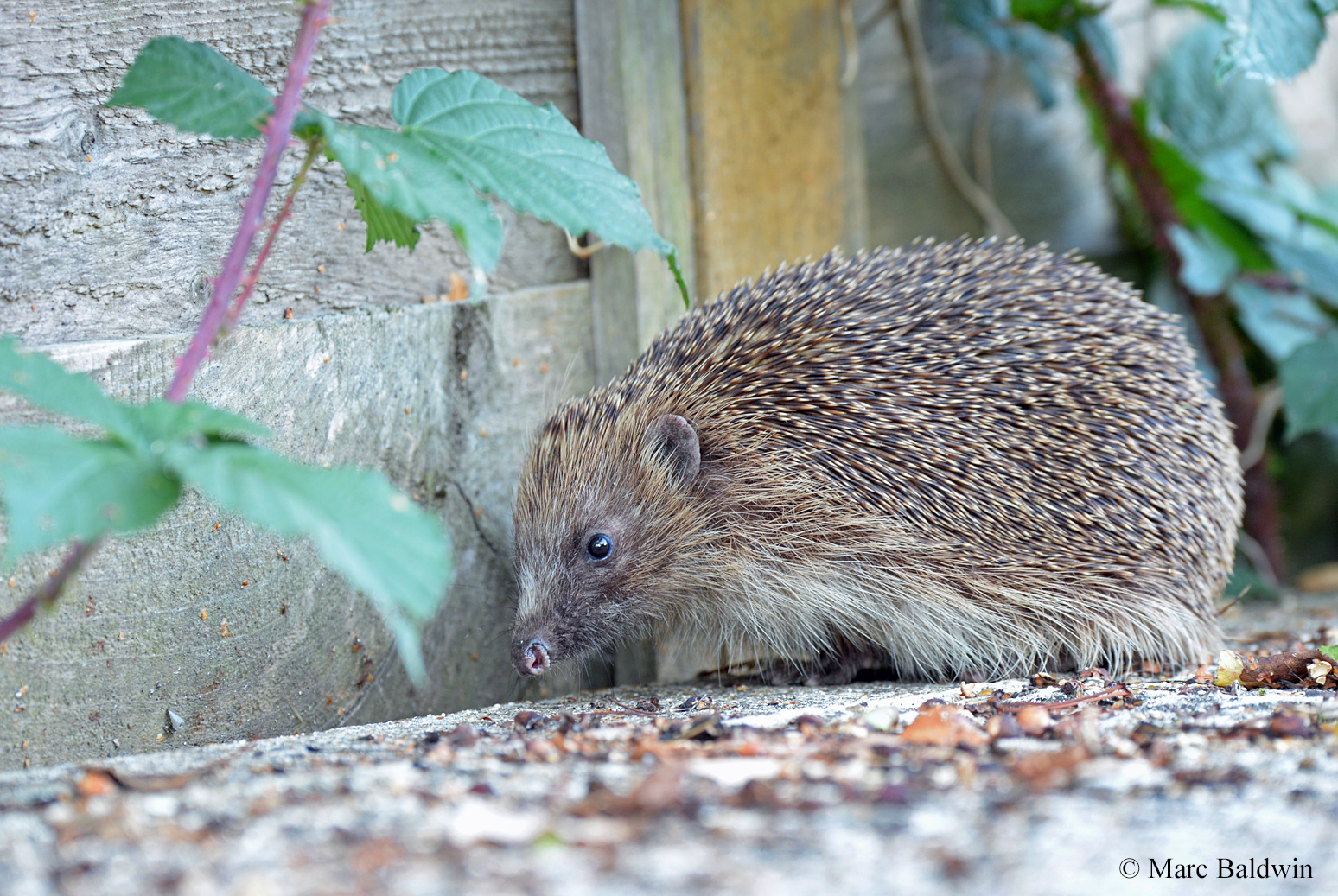
Appearance and Colour: Hedgehogs are arguably the most easily
identifiable of any British mammal. They have a rather unspecialised
body form; each of their four feet has five toes (with the exception of
the African hedgehog, Erinaceus albiventris, which has four on its hind
feet) each with a sharp claw and several toughened pads of skin –
hedgehogs are plantigrade (i.e. they have small, flat feet, the entirety
of which are placed on the ground while walking), with forefeet
measuring roughly 2.5 cm (1 in.) long by 3 cm wide, hind feet measuring
3 cm by 2 cm and a stride of 10 to 15 centimetres (4 – 6 in.). They have
a fairly long snout, covered with whisker-like hairs, small bright
brown/black eyes that protrude slightly and small ears about 1 cm (just
under half-inch) high. In The New Hedgehog Book, Pat Morris notes that
despite their apparent bulk -- which results from loose-fitting skin --
hedgehogs can squeeze under sheds, fences and through small holes.
 
A hedgehog's skin is covered with as
many as 7,000 modified hairs called 'spines'. Each spine tapers to a
point at the tip and terminates in a bulb at the base. The arrangements
is such that the spines interlock to form an almost impermeable barrier.
Scale in left-hand image is 1cm.
The skin is covered with about 3,500 spines by the time the animal is
weaned and as many as 7,000 spines as an adult. These hollow spines are
modified hairs, which grow to about 2.5 cm (1 in.) in length and are
composed of numerous transparent tubes arranged vertically – as Les
Stocker notes in his Complete Hedgehog, this arrangement produces a
lateral cross-section reminiscent of a piece of rolled corrugated card
(see below, left) and structurally quite distinct from the honeycomb
arrangement found in the superficially similar quills of porcupines. The
spines terminate in a small hemispherical bulb (see below, right) that
provides superb anchorage in the skin -- field observations have
demonstrated how a single spine can support the total weight of the
hedgehog -- as well as preventing the spine being driven into the
hedgehog’s body upon impact. The slight (ca. 60-degree) curving of the spine
immediately anterior to the bulb, coupled with a width of only 1 mm
(i.e. were you to line them up next to each other, there would be about
25 to one inch) -- which provides optimal elasticity, without kinking -- also
serves to absorb impact-associated shock.
 
Each spine is attached to its own muscle (making each one capable of
moving independently of the others), which anchors it to the panniculus
carnosus (a large sheet of muscle lining the hedgehog’s back). It is
contraction of the panniculus that causes the hedgehog to roll up; the
muscularis orbicularis -- a fringe of muscle running along the periphery
of the panniculus -- then contracts, drawing the hedgehog into a tight
ball. Erection of the spines is achieved via contraction of the muscles
anchoring them to the panniculus – each hair is embedded at a slightly
different angle, producing an almost impenetrable barrage of
intersecting spines. In their 2005 book The Natural
Hedgehog, Lenni Sykes and Jane Durrant describe two ‘stages’ to rolling
up: when initially threatened the hedgehog will erect its spines before
drawing them down to cover its face, feet and tail; if the danger
remains the hog will roll-up completely. Lenni and Jane also mention
that, unfortunately, hedgehogs rely on their spines for protection,
which means they rarely move away from approaching threats (e.g. cars
and garden strimmers) – see Interactions with Humans and
Q/A for more
details.
Moulting of spines is on an individual basis (moulting the entire
coat would leave the animal defenceless) and spines may be in place for
up to two years – it appears that each hair follicle has its own growth
rate and isn’t synchronised with any others. The spines themselves are
concentrated on the back and are creamy white in colour with a dark
brown band around the middle; they’re fringed by a ‘skirt’ of coarse
guard hairs, which extend to cover much of the face. The underside is
covered by sparse softer hairs (allowing the skin to be easily seen and
meaning hogs are poorly insulated), ranging in colour from white to dark
brown.
Leucistic individuals have white or pale yellow spines giving them a
‘ghostly’ appearance and light breast colouration – such colour patterns
are also frequently seen in hybrids with the Eastern European hedgehog
(Erinaceus concolor). In a 1996 paper to the Journal of Zoology, Pat
Morris and Andrew Tutt from the University of London reported the
results of a questionnaire distributed to the households on the Channel
Island of Alderney (where hedgehogs were introduced sometime after
1810). The survey found that 64 of the 95 respondents (67%) had seen
‘blond’ hedgehogs – closer inspection found these to be leucisitic
animals with pale creamy-white spines and fur, black eyes and pink skin,
claws and feet. During their study, the biologists performed transects
across various sites on the island; they observed 50 hedgehogs, 17 (34%)
of which were leucistic – leucism was not linked to either sex or age. It seems that although the distribution of leucistic individuals was
patchy on Alderney, this -- presumably recessive genetic -- trait was
(and probably still is) considerably more common than on the mainland;
in the same paper, the biologists mention how they have only come across
three examples (two from Wales and one in Hampshire) of leucistic hogs
during their 30 years-plus of studying this species. It is suggested
that the lack of mammalian predators on Alderney probably allows colour
variants, which would otherwise be easily picked off, to flourish.
Partially leucistic individuals (with patches of white) have been
found, as have albinos, although the latter are rare (despite being
recorded rather frequently in the literature). Interestingly, unlike
many other mammal species, no melanistic forms have ever been
documented; in his booklet Hedgehogs, Pat Morris suggests that
probably less than one in 10,000 hedgehogs deviate so markedly from the
normal colouration.
Individuals lacking both hair and spines (so-called ‘naked’
hedgehogs) have been documented; total loss of both hair and spines may
be the result of a (presumably) rare genetic abnormality (possibly a
deficiency in keratin production), while disease -- most notably
Demodectic mange (i.e. infestation with the mite Demodex, which
lives in hair follicles) -- may cause spines to fall out. Hedgehogs that
have lost all their spines (either through illness, injury or some
genetic predisposition - right) are rarely reported from the wild, presumably
because they don’t survive long without their protective
spines. Naked individuals can, however, thrive in captivity, a recent
example being the spineless hedgehog taken to the British Wildlife
Rescue Centre in Staffordshire – a photo of this hedgehog appeared on page 50 of
the June 2007 BBC Wildlife Magazine,
next to Pat Morris’ appraisal of the hog’s condition.
Internally, hedgehogs have a very standard mammalian skeletal
structure, modified with a short neck (although still consisting of
seven vertebrae), fused ulna and radius (near elbow) and fused tibia and
fibula (near ankles) as well as a very flexible spine (allowing them to
roll up). They also have a small (2cm / three-quarters inch), spineless tail. The
skull is between 54 and 64 mm (2 – 2.5 in.) long by 32 to 39 mm (~ 1.5
in.) wide with 36 teeth – there are 24 deciduous (‘milk’) teeth, which
are lost in the first couple of weeks. There are several unusual
features of the hedgehogs dentition, including very prominent first
incisors (easily mistaken for canines), which are used for scooping up
prey and lie flat, pointing forwards rather than upwards – this coupled
with the large gap between the front teeth (which the lower incisors
bite into) means that these incisors do not form a sharp cutting edge. The teeth are arranged in the dental formula: 6-2-6-6 / 4-2-4-6.
It appears that dental abnormalities can be common in some
populations and in a paper to Nature during 1964, Robert Brockie
presents the results of his analysis of dental structures from hedgehogs
in New Zealand. Combining his data with earlier findings of Konrad
Herter, Brockie notes that 39 of the 77 skulls (almost 51%) had
dental abnormalities – typically extra teeth or faulty eruption of
incisors or premolars. These figures are considerably higher than the
abnormality rate of roughly 1-in-6 (just under 17%) seen in British
hedgehogs. In his paper, Brockie wrote: “This characteristic
[heritable dental abnormality] was transmitted to New Zealand with the
original stock of perhaps a dozen animals … and has now become
widespread and common there…”. (Back to Menu)
Distribution and Habitat: The ancestors of modern hedgehogs lived in
Asia some 25 million years ago, towards the end of the Palaeogene; their
descendents are thought to have spread across Europe, Africa and into
North America. Today, Erinaceus europaeus is widespread (although
perhaps declining) throughout the lowlands of Britain (in every county
and most offshore islands), across much of western Europe north to
southern Scandinavia and Finland, and south to the Mediterranean. In
July 2004 a European hedgehog was found dead on a road in Chvojnicka
pahorkatina hills, which represents the first (and, to my knowledge,
only) confirmed record of this species from Slovakia - if a population
can be identified, this would push the verified range further east. This
species is found along treelines up to 2,000 m. There are no indigenous
British populations of E. europaeus higher than 60-deg north; where such
populations exist, they have been introduced by humans – hedgehogs have
also been introduced to Ireland since the last Ice Age (about 11,500
years ago), presumably as food.

The approximate global distribution
of Western (Erinaceus europaeus - red) and Eastern (E.
concolor - blue) hedgehogs. Modified from various sources.
British settlers introduced the species to New Zealand’s South Island
as part of acclimatisation experiments during the nineteenth century –
Pat Morris notes that the first introduction occurred in 1870, when one
pair of hogs were brought over on the ship Hydaspes, with more imports
to follow. Les Stocker gives subsequent release dates of 1885 and 1892 in
The Complete Hedgehog, with a date of 1910 for the introduction of some
South Island individuals to North Island. No wild hedgehogs of any
species exist natively in America. In his booklet, The Hedgehog, Pat
Morris writes of how hedgehogs are prone to being scooped up in loads of
thatching, peat and animal fodder such that they may have been widely
transported during prehistoric times – this, Morris suggests, may
explain their presence on many islands.
Hedgehogs, as their name implies, are found in hedgerows as well as
on farmland and in copses (particularly in bushy and shrub-rich
habitats). They are also found in woodland, particularly at the
periphery -- some authors suggest that the heterogenous habitat provides
a diverse range of prey -- in parks, gardens and on sand dunes.
Tracking studies by Gorgen Göransson at Sweden’s Kalmar University have
emphasized the importance of waste ground and lawns to hedgehogs during
the summertime (owing to the abundance of Scarabeidae beetles on lawns
between June and July). Indeed, a study looking at the abundance of
hedgehogs in Oxford by a group of biologists at Oxford University found
that hedgehogs were almost six-times more abundant on mown grass playing
fields than on pasture (four per field compared with fewer than one per field), owing to the
greater abundance of prey items. The same paper found that food
distribution and, more importantly, predator (largely badger)
territories combine to regulate the abundance of hedgehogs, while
isolation from other populations (caused by the aforementioned) serve to
exclude hedgehogs from otherwise suitable sites. A similar paper to the
same journal (Journal of Animal Ecology) reports that the Oxford
hedgehogs showed strong attraction to edge habitats (which act as
corridors for dispersal) and tended to avoid arable areas in favour of
urban sites.
 
Hedgehogs are conspicuously absent
from moorland, marshland and pine forests (perhaps because they provide
unsuitable nest sites). Un-treated church yards, gardens and Playing
fields can provide vital foraging areas for hedgehogs, especially during
the summer months.
Hogs are conspicuously absent from marshland and open moorland and
records are sparse from areas of dense pine forest, although there is a
population in the Alps, where they persist in the Mountain Pine, Pinus
mugo, (highest) treeline some 2,100 m (6,900 ft) above sea level. Their
apparent penchant for dry areas with plentiful nesting materials
probably explains their typical absence from damp woods, marshes and
conifer plantations, although hedgehogs have been observed to build
nests from pine needles and thrive on the invertebrates found in conifer
forests. Hedgehogs are deceptively good climbers and swimmers (they have
been radio-tracked crossing rivers, although some reports suggest they
may have difficulty judging distances across water); these abilities
mean that most boundaries (such as streams, ivy-clad garden walls,
chain-link fences etc.) seldom pose a significant barrier to hedgehog
movements. (Back to Menu)
Longevity: Unfortunately, the question of how long hedgehogs live is
not an easy one to answer because ageing hedgehogs is not a simple task. Eye lenses are known to increase their dry weight progressively and can
provide a useful index of relative age, but this technique requires a
freshly dead animal. In Hedgehogs, Nigel Reeve notes that low-power
dental X-rays can be used to view the degree of epiphyseal fusion (where
cartilage at the end of long bones ossifies) in the forelimbs – however,
this bone growth is complete by 18 months, making the technique useful
for youngsters only. The most reliable technique currently applied
involves ventrobuccal (lower jaw) sectioning to count the periosteal
growth rings. Changes to calcium metabolism during hibernation leads to
declines in (even stoppages of) bone growth in the periosteum (a thin
connective tissue membrane covering a bone), which appear as rings in
cross-section. The rings vary in size but work in much the same way as
tree rings; one ring represents one year. Even this method is not 100%
accurate, because physiological stress (e.g. pregnancy or illness) can
cause ring formation and the technique cannot be performed on a live
animal.
In some instances, it may be possible to estimate an animal’s age
based on obvious morphological features, including claws and teeth; both
of these wear down throughout the animal’s lifetime and so strong
pointed claws and sharp, barely worn, teeth usually signify a yearling. Unfortunately, these have their limitations and -- as is seen in many
other species that prey heavily on subterranean invertebrates, like
worms and centipedes -- animals feeding in gritty soils will experience
a more rapid wearing of teeth than those foraging in more peaty
habitats. Old individuals often also have a 'gingery' tint to their fur
(see right).
The average age for a wild hedgehog is widely cited as five or six
years, although the reality is probably closer to three years – the
upper age limit for this species in the wild is probably six to eight
years. The maximum reported age, until recently was ten years. In 2005,
however, Wilfried Meyer and Klaus Pohlmeyer, both at the Anatomisches
Institut in Hanover (central northern Germany), published a paper in the
German anatomical journal Kleintierpraxis, presenting the results of
their post-mortem analysis on an “old female” hedgehog. The anatomists
counted 15 or 16 rings (the latter one being apparently arguable),
suggesting that captive hedgehogs have the potential to reach at least
15 years of age. To the best of my knowledge, this represents the oldest
verifiable age for a European hedgehog on record. (Back to Menu)
Sexing: Discerning between sexes often requires a considerable degree
of skill, not because visual discrimination is particularly difficult,
but because getting the hedgehog to un-curl is something of a fine art! While telling male from female at distance is impossible, owing to the
lack of intersexual differentiation in this species, if you are able to
turn the hedgehog over without it rolling up, sexing is relatively
simple. Males have a penis situated approximately medially (where one
might expect to see a belly button); as Lenni Sykes and Jane Durrant put
it, in their Natural Hedgehog, if you feel the middle of a hog’s belly
and there’s nothing but fur, it’s a female! In her 1997 book, Everything
You Wanted To Know About Hedgehogs, Dilys Breese wrote:
"In adult males the penis shows as a large projection approximately
where you would expect the navel to be, about 5 cm [2 inches] in front
of the base of the tail. In females there are two openings close
together, near the base of the tail."
This technique can be a little more difficult in hoglets, because the
penis and anus start out closer together and separate (i.e. the penis
migrates forward) as the animal grows. Males are referred to as “boars”,
while females are “sows”. (Back to Menu)
Activity: Hedgehogs are more active and range further than many
people realise – a tracking study by Pat Morris saw one individual
travel from the feeding site to rest 300 m (about half-a-mile) away, in
less than an hour, and back again in the same night! Hog-lovers who have
tagged their ‘resident hog’ have been surprised to find that what they
thought was one hedgehog visiting their garden was actually a dozen or
more different individuals! Indeed, in his 1988 Shire book The Hedgehog,
Pat Morris writes that the bulk of mark-recapture studies have been
carried out by amateur naturalists, which means that they are rarely
long-term or particularly systematic. Nonetheless, they provide a
valuable insight into population dynamics in that few are recaptured;
this suggests that while a few are regulars, most either wander widely
or are nomadic. As we shall see shortly, more recent tracking studies
have supported some of these cursory findings.
Hedgehogs are primarily nocturnal, waking from their diurnal slumber
at dusk to forage throughout their home range. Precisely how long
hedgehogs are active for (across a circadian -- 24 hour -- timescale)
seems to vary according to location, sex and state of reproduction. On
their West London golf course, Nigel Reeve and Pat Morris found that
lactating females were active constantly throughout the night, although
in his New Hedgehog Book, Morris notes that hedgehogs “can do
nothing for hours on end”.
It is widely considered that a hedgehog seen out during the daytime
is probably unwell and while this is still a largely accurate ‘rule of
thumb’ it is not always the case. Hedgehogs born later in the year (the
so-called “autumn orphans”) may be seen out in daylight trying to build
sufficient fat reserves to allow hibernation despite being otherwise
healthy. Similarly, the pressures of raising a litter (most notably
finding sufficient food to support lactation) may cause recent mothers
to venture out during the day. In a Russian study during which hedgehogs
were radio-tracked around Kalinin (north-west of Moscow, Russia), one
lactating female was observed to be active for equal periods of the day
and night.
Still, while diurnal activity is known, hedgehogs are predominantly
nocturnal (even if as the evenings lighten they may be seen out under
light conditions) and captive observations have documented bimodal peaks
in their activity: the main period of activity is apparently between
about 10pm and midnight, with a smaller peak around 3am. Some data
collected from field studies on hedgehogs seem to support this general
activity pattern, although the periods are less well defined and bimodal
patterns are not universally accepted. Despite this, in Hedgehogs, Nigel
Reeve writes: “…with regard to general activity, I found that the
animals were active throughout the night and their speed of movement
varied erratically with no apparent rhythmicity. Animals only
occasionally took short rests (not in a nest) at various times during
their nocturnal excursions.” Nonetheless, Andrew Wroot found clear
evidence for a bimodal peak in hedgehog activity. Data from stomach
content studies have found hedgehogs consume between 57g and 71g (2 – 2.5 oz.) -- this represents about 20% of their body weight -- per night,
but their stomach only holds around 32g (just over 1 oz.). The
hypothesis is that if the hog can fill its stomach early in the evening
it will rest and digest its meal before continuing to forage, while
those who are less able to obtain food early will forage continually
throughout the night. Indeed, observations on captive individuals (and
those fed by householders) suggest that hedgehogs can eat between five
and ten percent of their body weight and drink more than 300 mL in a
single sitting!
Hedgehogs forage at the woodland edge, under hedgerows, over pasture
and along beaches at low tide as well as in gardens, parks, playing
fields and even refuse tips in more urbanized areas. On farmland, they
can often be found foraging at dung heaps near livestock sheds, owing to
the number and diversity of invertebrates such locations attract. During
its nightly foraging, a hog may travel several kilometres (see
Territory
and Home Range), visiting several different gardens. Tracking studies by
Pat Morris -- formerly of the University of London -- and his former
student Nigel Reeve have demonstrated that hedgehogs do not follow a
specific route while foraging, nor do they visit specific gardens where
they know they’re going to be fed first (as, say, foxes and badgers are
known to). At the same time, hedgehogs don’t wander randomly about their
range. Instead, they travel a meandering path, frequently speeding up or
stopping altogether to sniff the air and the ground; they have a good
sense of direction and impressive homing skills.
As they forage, hedgehogs are constantly alert and any prey
encountered is readily snapped up with short, darting movements. Indeed,
in his Ph.D thesis on the feeding ecology of Erinaceus europaeus, Andrew
Wroot found that 70% of a hedgehog’s movements are very short and very
few bursts of rapid movements were observed. Wroot’s data also showed
that foraging speed was heavily influenced by the percentage of cover. The type of cover also affects the speed of travel; movements across
open grassy areas tend to be faster than those through more dense
undergrowth – this may be a consequence of both impedance (i.e. it is
physically more difficult manoeuvring through dense bramble than short
grass) and the potential of predation (i.e. out in the open you’re more
vulnerable to attack). Hedgehogs can also move rapidly if the need
arises: Reeve clocked one doing 60 metres per minute (just over 2 mph)
across open grassland, while Wroot recorded one travelling at
120 m per min (almost 4.5 mph!). Sprinting feats aside, however, the
average speed at which hedgehogs travel is typically between two and
four metres per minute (6.5 to 13ft per min); on average males travel
faster (3.73 m per min) than females (2.19 m per min).
On average foraging hedgehogs (i.e. primarily females and
non-breeding males) range over a few hundred metres, up to about one
kilometre (just over half a mile) each night. As one might imagine, the
distance travelled seems to be related to the habitat and hedgehogs in
dense woodland and urban areas (where there is presumably a higher
density of food and obstacles) range less than those in
pasture/grassland habitats. In Hedgehogs, Nigel Reeve reports that the
current British record for a radio-tracked hedgehog to travel in a
single night is 3.14 km (nearly 2 miles). While foraging, hedgehogs will
quickly snap up prey they encounter, although experiments with captive
hogs have demonstrated that dead or moribund prey is either ignored, or
sniffed for a considerable time prior to being consumed – active prey is
consumed immediately and may be pounced upon from up to 50cm (1.5 ft)
away. Buried food -- especially earthworms, which are eaten tail-first,
and beetles -- can be detected under three centimetres (about an inch)
of soil and is dug up; hedgehogs don’t appear to dig very deep for
prey. At dawn, a suitable diurnal resting place is found. Hedgehogs may
construct a daytime nest in which to sleep the day away, or they may
simply lie-up in areas of dense/long grass; often (especially during the
autumn and winter) the hog will return to the same nest over consecutive
days, although this is not always the case (e.g. during the summer – see
Dens/Nests).
Much of our information regarding how hedgehogs spend their time
comes from radio-tracking studies. Radio-tracking undeniably provides a
wealth of valuable data, however it can only tell you where an animal is
at a given time and whether it is moving or stationary (in some
instances, physiological data can be collected too); we have no idea
what the animal is actually doing (i.e. when its stationary, is it
feeding, resting, grooming etc?). Consequently, in order to really
understand how hedgehogs spend their time, we must couple radio-tracking
data with direct observation. Nigel Reeve and Andrew Wroot did just this
(conducting ‘spot checks’ on the hogs they were tracking) as part of
their studies on the hedgehog population from a West London golf course. Pooling their data it transpires that the hedgehogs spent 40% to 55% of
their waking hours foraging, with only 10% of their time standing still
(with no obvious goal, such as standing while eating or grooming), 4%
spent on courtship and only 2% or 3% meeting and/or grooming. Correcting
for the time spent in private gardens (where they were inaccessible to
the researchers), Wroot suggests that, overall, hedgehogs
probably spend 68% to 84% of their time foraging.
A study in and urban area of Bristol, led by Bristol biologist Claire
Dowding, revealed that hedgehog movements were associated with the
weather conditions and the risk of encountering a predator or car. In a
fascinating paper to the journal Animal Behaviour during 2010,
the researchers report that the 38 hedgehogs (19 of each sex) that they
tracked between May and September 2004 and 2005 preferentially used the
gardens of semi-detached and terraced houses, but that females avoided
the larger back gardens of detached houses, which were also popular with
badgers. Interestingly, the males showed no such preference, which the
authors put down to differences in breeding behaviour between the sexes. The hedgehogs also avoided foraging near roads and on road verges,
although didn’t avoid crossing roads – males were, however, more prone
to crossing roads than females. The hogs were, however, significantly
more active after midnight, when there were fewer cars and people
around.
Hedgehogs are active for approximately eight months of the year
(April to November), although this varies considerably according to the
prevailing climatic conditions (and thus latitude). In the
milder regions of New Zealand (e.g. North Island), for example, hogs are active all
year around (or hibernate for only a couple of months) because the
climate is warm and allows them access to food for 365 days – in cooler
areas, torpor can be from July to October. At latitudes where cold
winters lead to food shortages, hedgehogs enter a torporic state
referred to as hibernation. In the UK, hedgehogs that undertake
hibernation begin putting the finishing touches to their hibernaculums
(see Dens/Nests) late in the year; larger individuals tend not to settle
down until at least November, if not December or January. In his
Complete Hedgehog, Les Stocker notes how, in the UK, hedgehogs seem to
“prefer” to wait until at least November before settling down to
hibernation and that small hedgehogs seem to know that they don’t have
sufficient fat reserves to survive hibernation; consequently they’re
seen out at all times of the day and night searching (often vainly) for
food. (Back to Menu)
Hibernation: Among the mammals, hedgehogs, dormice (Nuscardinus
avellanarius and Glis glis) and bats (Chiroptera) represent the only
true British hibernators. Contrary to popular misconception, hibernation
is not simply a long period of sleep, although certain features of
hibernation (e.g. body temperature and breathing regulation) do resemble
those observed during slow-wave sleep. Sleep is a physiological
necessity; it’s time during which our body exhibits increased cellular
anabolism and decreased catabolism – in other words, sleep allows our
body to repair and replace cells. There is no universally-presiding
theory as to the function of sleep, but aside from providing much needed
‘downtime’ for the body to repair itself, it also seems to be required
for anatomical development, consolidation of memory (spatial, procedural
and declarative) and may even help to keep the animal safe (sleep at
night when most predators are hunting). In humans, sleep deprivation
leads to various physical and mental problems; infants deprived of sleep
are known to exhibit decreases in brain mass and increased neuronal
necrosis (nerve cell death). According to the Australasian Sleep
Association in Sydney, the current official record for the longest
period spent awake is 18 days, 21 hours and 40 minutes, with the
‘winner’ reporting hallucinations, blurred vision, slurred speech as
well as lapses in memory and concentration – lethargy, irritability and
even anorexia are known in long-term insomniacs.
While sleep appears to be physiologically essential (the case of
Vietnamese livestock farmer Thai Ngoc, who apparently hasn’t slept since
a bout of fever more than 30 years ago, being rather exceptional),
hibernation is an adaptation to climatic conditions – it is by no means
essential and is actually an inherently dangerous undertaking, although
the likelihood of survival seems to increase significantly for
subsequent hibernation episodes.
Hibernation is a major physiological readjustment with the goal being
to reduce the animal’s metabolism (in the case of mammals, by turning
down their internal ‘thermostat’), thereby conserving precious energy
stores during periods when food is in short supply – it is energetically
expensive to maintain a body temperature higher than the ambient
(especially for poorly-insulated animals like hedgehogs) and decreasing
the body temperature slows down the rate of biochemical reactions. Indeed, in his New Hedgehog Book, Pat Morris notes that hibernation
occurs in response to any dramatic and prolonged food shortage, not
necessarily only during the winter. Moreover, Desert hedgehogs
(Paraechinus) will undergo hibernation if translocated to a cooler
climate.
The plasticity of hibernation is well illustrated by hedgehogs. At
the northern extent to their range, hogs may hibernate for more than 200
days, while in warmer climates (for example, in parts of New Zealand)
they may forego hibernation altogether. Consequently, there are no fixed
dates between which hedgehogs hibernate – hedgehog carer Linda Fuller
tells me that, during the winter of 2006/2007,
at least one of her resident hogs, DJ, didn’t
hibernate, opting instead to eat her way through a whole can of dog food
per night! Unfortunately, the bulk of hedgehog hibernation studies have
been conducted in captivity and we still have relatively few data from
wild specimens.
Following the breeding season, hedgehogs spend the bulk of their time
feeding voraciously, laying down the fat reserves that will sustain them
during hibernation. In a single evening, a hog may consume 20% of its
body weight, drinking more than 300 mL in a single sitting. The result
is that immediately prior to entering hibernation, a hedgehog is likely
to weigh at least 600 grams and 30% of the hog’s bodyweight may be fat.
The fatty tissue observed in hedgehogs at this time of year is of two
distinct types: Brown Adipose Tissue (BAT or Brown Fat, which despite
its name is actually more orange in colour owing to a mixture of
different cytochromes) and White Adipose Tissue (WAT or White Fat). These tissues differ both in their biochemistry and structure as well as
in their location in the body. BAT is stored around the shoulders,
chest, neck and under the front legs; it may represent 3% of the
hedgehog’s bodyweight immediately prior to hibernation. WAT is found
subcutaneously (under the skin) and along the gastrointestinal tract
(around the stomach and intestines).
Males enter hibernation earlier than females, because they have had
more time after mating to build up their fat reserves, although (as
mentioned) there are no set dates for the initiation of hibernation.
Indeed, the factors involved in inducement of hibernation have long been
eagerly sought and contested by biologists. Data from studies on captive
hedgehogs suggest that hibernation is predominantly governed by
persistent cold temperatures and Herter Konrad found that his captive
hogs entered hibernation when the ambient temperature was between 15 deg-C
and 17 deg-C (59 – 63 deg-F) – it should be noted that these temperatures do not
appear to be universal and one study published in 1964 reports that hogs
from Finland tolerated lower pre-hibernation temperatures than their
German conspecifics. In The Hedgehog, Pat Morris states that hedgehogs
must be kept at between 15 deg-C and 20 deg-C (59 – 68 deg-F) in order to remain
active. Still, although temperature seems to be a highly significant
influence for hedgehogs, several studies have presented data suggesting
a molecular control of hibernation. Studies on hibernating Ground
squirrels (Spermophilus lateralis) by Standford University’s Thomas
Kilduff have suggested that there may be a protein regulating torpor in
this species, implying the presence of a potential hibernation-inducing
factor. Not all data agree, however, and as Aline McKenzie put it in her
review article to BioScience in 1990: “A hibernation-inducing factor is
one of the holy grails of the field, with conflicting reports as to its
sighting.”
Regardless of its cause, hibernation itself is typified by several
physiological changes: a decrease in heart rate; lowering of peripheral
body temperature; reduced breathing rate punctuated by apnoea (brief
cessation in breathing); reduced metabolism sustained by fat reserves;
and changes to the normal rate of function in key homeostatic organs.
An active European hedgehog will have a body temperature between 33
deg-C
and 37 deg-C (91 – 99 deg-F) -- varying with their circadian (24 hour) rhythm
--, averaging 35 deg-C (95 deg-F) and falling to around 10 deg-C (50 deg-F) during
hibernation. In a paper to the Journal of Comparative Physiology during
1990, Paul Fowler and Paul Racey (both at Aberdeen University) provide a
fascinating insight into the changes of hedgehog body temperature over a
daily and seasonal timescale. The zoologists inserted temperature
sensitive radio transmitters into the abdomen of their subjects and
found that changes in body temperature (TB) over a circadian timescale
were closely tied with the photoperiod (maximum TB occurred two hours
after midnight). Also, TB was closely matched with the ambient
temperature during hibernation but TB showed a marked increase when the
surrounding air temperature fell below -5 deg-C (23 deg-F), although arousal did
not always follow (see below). The data show that the ‘average hedgehog’
entered hibernation at just before 2am and came out of hibernation at
just before midnight. More interestingly, the results of these
experiments show that the hedgehogs underwent spontaneous bouts of what
the authors term “transient shallow torpor” (or TST). The observation
that the bulk (80%) of TST events were recorded in August (although
events were recorded throughout the year) suggests that they may serve
as some kind of ‘physiological preparation’ for the main event, although
TST bouts immediately preceded hibernation in only 20% of cases.
The heart rate of active hogs varies in accordance with prevailing
conditions; still, electrocardiographic studies have demonstrated that
most active hedgehogs have a heart rate of between 190 and 280 bpm
(beats per minute), dropping to ~147 bpm in sleeping animals and
averaging just under 14 bpm during hibernation. In conjunction with
changes to the heart rate, hedgehogs entering hibernation seem to
exhibit hypovolaemia (decrease in blood volume). In his 1961 paper to
Nature, Einar Eliassen quotes a reduction in blood volumes of
8% body weight and 2% to 3% bodyweight for active ‘summer’ animals and
“sleeping” winter animals, respectively. Eliassen notes, however,
that these figures may not be entirely accurate and he may actually have
witnessed “pronounced differences in blood-flow in different vascular
areas”. Nonetheless, there does seem to be a decrease in the animal’s
blood volume and it appears to be linked with haemolysis (destruction of
blood cells) and plasma excretion.
Foraging hedgehogs breathe at about 50 brpm (breaths per minute);
this rate halves when resting and averages 13 or less during hibernation
(at 4 deg-C / 32 deg-F). Hibernation is also punctuated by periods when
breathing cessates completely (i.e. apnoetic events); these periods are
typically brief, lasting only a few minutes -- although one study
published in 1964 reported apnoetic events lasting two-and-a-half hours
in Erinaceus europaeus -- and are punctuated by periods of rapid
ventilation lasting between three and 30 minutes. Apnoeic events
serve to reduce water loss (evaporation across the lungs) and conserve
energy; cessation of breathing leads to a progressive acidification of
the blood (a result of the build-up of carbon dioxide), which inhibits
glycolysis (the breakdown of glucose).
During hibernation, the hedgehog is sustained by the (very slow)
metabolism of its WAT fat reserves (i.e. through lipolysis). Torporic
individuals may exhibit a metabolism only one or two percent of their
active state and the virtual cessation of carbohydrate metabolism means
that there are very low levels of blood insulin and glucagons
(pancreatic hormones that control glucose metabolism), which manage the
metabolism of glycogen (a chain of glucose molecules often referred to
as ‘animal starch’). Indeed, carbohydrate metabolism begins shutting
down before hibernation is fully underway; in his book Hedgehogs, Nigel
Reeve notes that a hedgehog at the onset of hibernation may have
undergone a 43% reduction in blood sugar level compared to that of its
active state (54 mg per 100 mL cf. 125 ml). In his book The Complete
Hedgehog, Les Stocker notes that hedgehogs also exhibit a doubling of
blood magnesium content and a decrease in body tissue oxygen demand of
some 98% (from 550ml per kilogram per hour to only 10 mL). Explanations
for the aforementioned events have yet to be uncovered, but other
species have demonstrated similar increases in magnesium during torpor
-- Marvin Riedesel and G. Edgar Folk reported a 50% increase in blood
magnesium from two hibernating bat species in a 1956 paper to Nature --
and this element has recently been shown to help prevent hypertension
(high blood pressure) and arrhythmia (irregular heart rate) – ergo, the
increased magnesium may offer an additional cardioprotective influence
(see below).
Hedgehogs have evolved a number of physiological strategies that help
them cope with the pressures of hibernation. There is a migration of 90%
of the white corpuscles to the gastrointestinal tract (presumably to
fight any bacterial infections that may arise as food decomposes in the
digestive tract) and a significant reduction in the activity of the
kidneys and brain (specifically the cerebellum and cerebral cortex). Perhaps the most
fascinating adaptation can be seen in the heart. Ordinarily, cold blood returning to the mammalian heart leads to an
uncoordinated (often frenzied) contraction of the ventricles, a
condition referred to as ventricular fibrillation; this random twitching
of the cardiac muscle means that blood isn’t pumped into the systemic
circulation and if the arrhythmia continues for more than a few seconds
the circulation may collapse. The hedgehog heart has a number of specialised adaptations that help prevent ventricular fibrillation,
including reduced adrenergic innervation (few nerves that respond to
adrenaline), low noradrenaline content (like adrenaline, noradrenaline
is involved in fight-or-flight response and triggers release of glucose
from storage), glycogen stores (act as fuel stores) and high alpha-GPDH
activity (enzyme pathway that converts fat to energy) – see Nigel
Reeve’s Hedgehogs for more details. Despite these protective measures,
it is only the peripheral circulation that exhibits a decrease in
temperature; the feet, ears and skin are cold to the touch, but the core
temperature (e.g. around the heart) is close to normal.
As early as 1925 studies have demonstrated the phenomenon of
so-called ‘insulin hibernation’ in several animals -- including dogs,
cats and marmots -- following a cold bath (to lower body temperature)
and injection with insulin to lower blood sugar levels to a convulsive
level. While one could argue the semantics of the term “insulin
hibernation” (it’s actually insulin shock, rather than true
hibernation), it does demonstrate the possibility for insulin to be
involved in the maintenance of hibernation. Indeed, in a 1939 paper from
the journal Annales Academiæ Scientiarum Fennicæ, Paavo Suomalainen of
Helsinki University demonstrated that injecting hedgehogs with insulin
can induce or maintain hibernation. Several studies have, however,
presented evidence that the hibernative state is maintained by the ratio
of serotonin and noradrenaline. It appears that when serotonin levels
are high, noradrenaline is low and body temperature is decreased causing
continuation of hibernation; conversely, when serotonin levels are low
and noradrenaline levels are high, body temperature increases and
arousal occurs.
It should be mentioned that hibernating hedgehogs aren’t ‘dead to the
world’, nor is hibernation a static state. Hibernating hedgehogs will
‘bristle’ (i.e. erect their spines) when touched or exposed to noise,
tucking themselves into a tighter ball. Moreover, hibernation fluctuates
in accordance with changing environmental conditions and is punctuated
by frequent bouts of arousal; undisturbed individuals tend to ‘wake up’
on average every seven to eleven days, although others may not do so for
several months. In his New Hedgehog Book, Pat Morris states that it
takes three or four hours to raise the body temperature by 25 deg-C (45
deg-F). During these brief (two or three day) intermissions from hibernation the
hog may remain in the nest or venture outside. The reasons for these
brief periods of activity haven’t been conclusively demonstrated,
although suggestions include searching for food to top up fat reserves
and removal of metabolic by-products that can only be neutralised in a
hyperthermic state. In extremely cold weather, however, food is likely to
be scarce (hence the need for hibernation in the first place) and there
are no data to suggest that either urea or lactate accumulate during
hibernation. Nonetheless, even hedgehogs kept under constant conditions
in a laboratory arouse periodically -- some 20 times during the course
of the winter -- spending only 80% of their hibernation in a hypothermic
state; this suggests that periodic arousals are a necessary part of
hibernation.
Hedgehogs often use these periods of activity to move nests. Indeed,
moving nests during the winter is apparently a common behaviour; in his
Hedgehogs book, Nigel Reeve reports how new nests are built throughout
the winter and that the occupancy of winter nests varies considerably,
with the average nest being occupied for only two months (the maximum
was six months). Pat Morris affirms Dr. Reeve’s observations, in a
response to the April 2006 issue of BBC Wildlife
Magazine in which he writes: “Hedgehogs rarely stay in the same nest for
the whole of the winter – they tend to move and build at least one new
nest between November and March. Heavy rain or disturbance of the nest
by other animals or humans may force them to move away, but even in
constant conditions in the laboratory, winter arousal is normal and
frequent.” Similarly, moving nests may be necessary if the temperature
falls too low. If exposed to temperature below one deg-C (34 deg-F), hedgehogs are
vulnerable to frostbite or can even freeze solid. Consequently, brief
periods of arousal during exceptionally cold spells may prevent the
hedgehog from freezing to death.
Final arousal seems to be triggered by an increasing photoperiod
(i.e. the number of light hours in the day starts to increase) and a
rise in ambient temperature, although population studies on European
hedgehogs have demonstrated a sex biased arousal and hibernation. During
his studies on hogs in London, Nigel Reeve found that males were caught
during March, while females were rarely caught before May. Reeve
proposed that males may arouse earlier than females in order to gain
access to females as soon as they become active (early litters stand a
better chance of survival than late ones) or because arousing early
allows them to feed with reduced competition and make up for the time
spent courting and mating (valuable feeding time). Off-hand, both seem
entirely plausible, especially given that Reeve’s tracking studies
have also demonstrated that males range less in these first weeks
post-arousal than during the rest of the year (especially during the
rut), which may help offset the energy costs associated with early
arousal.
The difference in arousal times may be mediated by different
controlling factors between the sexes. In his contribution to the
1986 compendium Living in the Cold: Physiological and Biochemical Adaptations,
Michel Saboureau demonstrated that a decrease in testosterone caused
males to enter hibernation, while the hormone’s absence extended toporic
events. In January, as photoperiod begins to increase, males experience
a decrease in levels of a chemical called 5-methoxy-N-acetyltryptamine (commonly known as
melatonin, a neurohormone produced by several tissues including the
brain’s pineal gland). Melatonin has numerous effects on the body, but
in male hedgehogs its decline leads to a rise in testosterone levels,
which causes a progressive reactivation of the gonads. So, hibernation
in male hedgehogs appears to be heavily influenced by hormonal changes,
while -- as Nigel Reeve notes in his book Hedgehogs -- hibernation of
females is more closely associated with ambient temperature and food
availability than changes in reproductive hormones.
Despite the various suggestions, there is currently no single theory
proven to explain the arousal from hibernation, probably because more
than one mechanism is involved. Still, it is perhaps difficult to see
how changing photoperiods affect hedgehogs deep within their
hibernaculums. It has been suggested that hogs could possibly ‘sample’
the photoperiod during their periodic arousals – presumably females also
‘sample’ the food availability and ambient temperature during these
‘intermissions’. Moreover, data from studies by Saboureau, Racey
and Fowler show that administration of melatonin in September leads to
the onset of testicular reactivation during the Spring, suggesting that
it may act as some form of internal ‘timer’ that influences the Spring
arousal of males. Thus, an internal timer, food availability and changes
in ambient temperature may combine to stimulate the arousal of hedgehogs
from hibernation.
During hibernation, it is the WAT that fuels the hedgehog’s
metabolism. The BAT is activated upon arousal; this is possible because
BAT produces a considerable amount of energy as a by-product of its
respiration (as much as 400 watts per kilogram of tissue). All
biological tissues produce heat as a by-product of respiration, but this
is typically negligible. In WAT, the final step of cellular respiration
that the fatty acids go through is a biochemical process known as
oxidative phosphorylation; in this process, adenosine triphosphate (ATP,
the energy source for virtually all cellular functions) is created. In
the case of BAT, this last step is prevented by a mitochondrial
uncoupling protein (UCP) that effectively ‘short circuits’ the oxidative
phosphorylation process, allowing the oxidation of fatty acids to
produce heat instead of ATP. This process enables a substantial amount
of heat to be generated (about twenty-times that of WAT), without the
reliance on spasmodic reflex muscle contraction (i.e. shivering); hence
this process is often referred to as “non-shivering thermogenesis”.
According to Dr. Reeve (Hedgehogs), the thermostatic control of BAT is
achieved by sensors in the hypothalamus, skin and along the spinal cord,
while its metabolism is controlled by the sympathetic (i.e. those
responsible for increasing or decreasing a mechanism/response) nerve
endings that penetrate the tissue and by circulating adrenal hormones.
In a laboratory setting, arousal can take as little as two hours;
under more natural conditions Paul Racey and Paul Fowler found that it
took 12 hours for their subjects to become fully active – BAT can warm
the body at between 6 deg-C (11 deg-F) and 21 deg-C (38 deg-F) per hour depending on the
individual and ambient conditions. In Hedgehogs, Nigel Reeve describes
the arousal process. Upon arousal, BAT is metabolised and the heart
beats vigorously (heart rate may increase from 10 to 300 bpm)
circulating the heat throughout the hedgehog’s body (the BAT is
infiltrated by a rich network of capillaries which supply it with oxygen
to fuel respiration and help distribute the heat). As the body
temperature rises past 15 deg-C (59 deg-F), carbohydrate metabolism resumes and
at 20 deg-C (68 deg-F) glucagon (a pancreatic hormone) secretion rises,
stimulating the release of glucose into the bloodstream. The eyes remain
closed below approximately 20oC; above this temperature the eyes open
and the front of the body may stand and shiver. When the body
temperature has increased to between 28 deg-C and 30 deg-C (82 – 84 deg-F) the hog
begins to move around and when normal body temperature is reached (i.e.
approx. 35 deg-C / 95 deg-F), the hedgehog is fully active. Studies on captive
individuals suggest that hedgehogs lose one or two grams of body weight
(0.2 to 0.3%) per day while in hibernation and thus, by the time the
hedgehog is fully aroused, it needs to eat and drink as a matter or
priority. Weight loss varies geographically, but the hog may have lost
anywhere from 25% (in the UK) to 40% (in Finland) of its pre-hibernation
body weight. Hence, a pre-hibernation weight of about 700 grams (1.5
lbs.) is recommended by most vets and hedgehog welfare charities. (Photo:
An actively-foraging hedgehog, such as this, has a heart rate of 190 to
280 beats per minute; this drops to fewer than 14 during hibernation.
Breathing rate declines from 50 breaths per minute to 13, or fewer.)
For an authoritative and comprehensive treatment of hedgehog
hibernation and energetics, I highly recommend Chapter 6 of Nigel
Reeve’s book, Hedgehogs. Those wishing to read more on the subject of
hibernation in general are directed to Hibernation (Greenwood Guides to
the Animal World) by Clive Roots (Greenwood Press; ISBN: 0-313335-44-3),
while children are recommended John Crossingham and Bobbie Kalman’s book
What Is Hibernation? (Crabtree Publishing Co.; ISBN: 0-865059-64-0). The
more advanced reader might find Barbara Cannon and Jan Nedergaard’s review
of the function and significance of BAT (Physiological Review, 2004,
81,1: 277 – 359) of interest. (Back to Menu)
Dens/Nests: Hedgehog nests can be broadly classified into two types
-- summer and winter (or hibernacula) -- and the ‘art’ of building
appears to be honed rapidly; observations of captive hogs have shown
that they start nest building at about three weeks old and have mastered
it by eight weeks. Despite very large individual differences in nesting behaviour, summer nests tend to be less well insulated (i.e. flimsier)
than winter ones, although both are equally well constructed; they may
be widely spaced or clustered depending on the habitat and the
individual. Summer nests are generally loosely constructed of grass and
leaves, while hibernacula are thicker (as much as 50cm / 20in thick),
composed of carefully placed leaves, twigs, grass other plant material
and may measure 30cm to 60cm (1 – 2 ft.) in diameter. Hibernacula are
waterproof and very well insulated, with internal temperatures remaining
between about 1 deg-C and 5 deg-C (34 deg-F – 41 deg-F), despite fluctuations in ambient
temperatures between -8 deg-C and 10 deg-C (17.5 deg-F – 50 deg-F). In colder parts of
Europe, hedgehogs are known to excavate their hibernaculum. The time
taken to build a hibernaculum varies from animal-to-animal, and depends
upon the availability of dry leaf litter. In the literature, periods
range from a single day to three-or-four days and one blind hedgehog
residing in rescuer Natasha Harper's garden took four days to construct
its hibernaculum.

Hedgehog nests, such as this
hibernaculum, are often rather unassuming piles of leaves and twigs that
are easily overlooked.
Nursery nests (occupied from May onwards) tend to be larger than
summer nests and all types are ‘combed’ into shape by the hedgehog’s
paws and spines. In his Complete Hedgehog, Les Stocker notes that
hedgehogs will pluck grass to line their nest and construct nursery
nests more diligently than either summer rests or hibernacula. While
summer nests are common, they are not always used and hedgehogs will
often lie up in long grass or bramble (this can lead to problems when strimmers are used to ‘tame’ long grass – see
Interactions with Humans).
Hibernacula may typically be more durable than summer nests, but the
structural stability of these winter nests seems dependent (at least in
part) on the location in which it is constructed. In a paper to the
journal Oecologia back in 1973, Pat Morris presented data from his study
on 167 winter nests from Bushy Park in West London (UK). In this
fascinating study, Morris reports that the hedgehogs left the
exposed parts of the park for more sheltered hibernation sites
(increasing the number found in peripheral plantations as winter
progressed) and that 25% of the nests to be used in the proceeding
winter were built in November, with only a few constructed between
January and March. The average lifespan of a nest was just short of
six-and-a-half months, with those constructed under cover such as
bramble or log piles (i.e. better supported) out-lasting those that were
less well supported (such as those built in grass). Among the
well-supported nests, some 17% could be found a year later, while only
2% of the poorly-supported ones lasted that long.
Once abandoned by their creators, nests may be inhabited by
conspecifics or other small mammals (such as mice or shrews). Indeed,
while hibernacula-sharing is uncommon in the UK and sharing of summer
nests is unknown for this species – although, in Mammals of Eastern
Europe and Northern Asia, Sergi Ognev notes that sharing of
winter nests was not uncommon in European hogs, and there is a record of
a male and female of the closely-related Erinaceus concolor sharing a
summer nest in Israel -- Nigel Reeve’s tracking studies have uncovered
non-simultaneous nest sharing; thus, different individuals use the same
nest at different times. Regardless of whether the nest is being used by
its builder or a squatter, Morris’ study revealed a close
correlation between the ambient temperature and the number of hogs
occupying their hibernaculum; at temperatures below -2 deg-C (28 deg-F), the
mean number of hedgehogs found in hibernacula was 13, compared to only
one or two at temperatures above 4 deg-C (39 deg-F).
Perhaps unsurprisingly, initiation of hibernaculum construction seems
to be triggered by cooling weather. In a paper to the Zoological Society
of London during 1963, University of Reading zoologist, E.J. Dimelow
reported results from her observations on captive hedgehogs; during her
studies Dimelow found that her subjects began constructing nests when
the temperature fell below 16 deg-C (61 deg-F). It should be noted that nests
aren’t always built; some come ready-made. In his Oecologia paper,
Morris notes that hedgehogs have been found nesting in tree
hollows, thatched roofs, and (rabbit?) burrows, although none of these
seem particularly common choices.
Hedgehogs typically exhibit very low levels of nest fidelity. The
picture that has emerged from radio-tracking data shows that nests are
used periodically, for periods lasting a few days, before being
abandoned for days, weeks or even months at a time – in his Oceologia
study, Pat Morris found that 60% of the nests he surveyed were occupied
for less than two months. Additionally, further observations by Morris suggest that despite there typically being more nests than
hedgehogs in a given area, hedgehogs always built a new nest after
abandoning their old one and never moved into a ‘ready made’ one. Males
tend to move nests more frequently than females -- males move every
three days, on average, compared to every ten days in females --
(although both sexes change frequently) and one particularly active
individual tracked by Nigel Reeve used 15 nests and changed nests a
staggering 41 times in 68 days. Reeve suggests that the increased
‘restlessness’ of males may relate to the larger area over which they
range when compared to females. Whatever the reason for the periodic
relocations, nest changes are most common during the spring -- when
hedgehogs are most active -- and, although less frequent during the
winter months, it is rare for a hedgehog to remain in the same
hibernaculum for the entire winter. (Back to Menu)
Territory and Home Range: Despite the largely solitary nature of
hedgehogs, tracking studies have demonstrated both site fidelity and sympatry within this species – in other words, they have a tendency to
remain in (and/or range over) the same area across consecutive years and
that these home ranges overlap (sometimes entirely) with other hedgehogs
of either sex. Indeed, as this sympatry suggests -- and despite some
reports implying dominance hierarchies and scraps between hedgehogs kept
in close quarters (see Behaviour and Social Structure) -- there is no
conclusive evidence to support territoriality within this species and
the scraps observed more likely represent defence of the kinosphere
(i.e. interpersonal distance). Further affirmation that hedgehogs aren’t
territorial is provided by the observation that scats are deposited at
random – in most territorial species (e.g. Red fox, European badger
etc.), faeces are placed at specific locations on the territory (usually
around at the boundaries) and signify that the spot is taken, as well as
encoding various information about the proprietor. Other territorial
animals -- especially canids and felids -- also mark their territory
with urine; this is possible but, in The New Hedgehog Book, Pat Morris
notes that hedgehog urination is impossible to document because it is
done so unobtrusively.
It should be noted that while the use of a home range is well
established within hedgehogs, it is not universally applicable to this
species; many hedgehogs have been observed to remain in a given area for
consecutive months and/or years, while others apparently range
nomadically. Those that use a home range seem to remember them (in terms
of boundary markers and geographic position) well – experiments by John
Lamming (described in The Complete Hedgehog) found that hogs moved
around Brownsea Island always found their way back home, running from
the release site at an average of 466 metres per hour (about 0.3 mph)
and slowing to 180 m/h (0.1 mph) to allow foraging as they entered
their home range.
Where home ranges exist, the size is determined by the distribution
of essential resources (i.e. food, water, shelter, mates etc.) and the
observation that urban wildlife may exhibit smaller home ranges than
their rural counterparts is not uncommon; hedgehogs are no exception. A
study tracking the hedgehog population in Zurich, Switzerland found that
the nightly range, and therefore the home ranges, of urban hedgehogs
were substantially shorter than those of their rural conspecifics.
Mathematical models applied to hedgehog bioenergetics suggest that
the minimum area over which a hedgehog should range (taking into account
patchy distribution of resources) is between three and six hectares (7
to 15 acres); these estimates fit well with the smallest ranges
calculated from radio-tracking data. While the minimum may be three
hectares, average home ranges are considerably larger, with considerable
geographical variation. Tracking and mark-recapture studies by Pat
Morris and Nigel Reeve suggest that, in the UK, male hedgehogs have an
average home range of some 32 ha (70 acres), while females move over an
area of only 10 ha (almost 25 acres); consequently, the range of a
single male usually overlaps the ranges of several females. Further data
from these studies in west London suggest that young have a dispersal
stage shortly after weaning and it is during these few months that they
establish their future adult ranges (either before, or soon after, their
first winter).
The greater ranging of males has largely been presumed a search for
potential mates. Such a theory is, however, difficult to verify because
UK hogs don’t appear to show any obvious movement changes with the
changing seasons. Despite a Swedish study finding a clear reduction in
male activity from about mid-July onwards -- where males ranged less and
females ranged further (although males still ranged further than
females, overall) -- Reeve was unable to detect any clear pre- and
post-mating period during his studies; sexual activity spanned almost
their entire active period (from mid-May to September). Nonetheless,
this sex-biased ranging doesn’t appear to be the result of food
availability. A study by Pat Morris (published in Mammal Review during
1985) looking at the impact supplementary feeding had on movements of
the local hedgehog population showed that, despite the presence of
abundant food (supplied by householders), males still ranged 75% further
than females; in his New Hedgehog Book, Morris suggests that males
might wander even further in areas where there is less food to delay
them. (Back to Menu)
Predators: The spines of a hedgehog provide a formidable barrier to
most would-be predators; it has been suggested that these spines
probably make hogs less vulnerable to predation than any other mammal of
similar size. Despite this, hedgehogs can still fall prey to other
animals. Red foxes (Vulpes vulpes) are widely reputed to catch and kill
hedgehogs, although it is not known how common this behaviour is (see
Q/A). Other species known to take various life-stages of hedgehogs when
the opportunity arises include tawny owls (Strix aluco), brown rats
(Rattus norvegicus), wild boar (Sus scrofa), magpies (Pica pica), weak
birds (Gallirallus australis – in New Zealand), otters (Lutra lutra) and
various species of small mustelid, including pine martens (Martes
martes), polecats (Mustela putorius), mink (M. vison),
stoats (M. erminea) and weasels (M. nivalis). In parts
of Europe, particularly Sweden, Eagle owls (Bubo bubo) and Golden eagles (Aquila
chrysaetos) can be significant hedgehog
predators and, in his chapter on hedgehogs in
the 1981 RSPCA Book of Mammals, Nigel Reeve notes that large birds such
as crows can “get past the spines with their beaks and they take some
hedgehogs in the early morning”.
Even combined, the above species contribute relatively little to the
problems faced by hedgehogs when compared with the European badger
(Meles meles). Badgers are significant predators of hedgehogs and their
presence has been implicated in regional (and even national) declines in
-- and barriers to migration of -- hedgehog populations (see
Q/A).
People often seem concerned about the impact of domestic cats on hedgehog
populations, but I know of no evidence to suggest they are significant
predators of hogs. The experience of myself and many others is that cats
are at best curious of (generally indifferent to) hedgehogs, and I have
never observed an aggressive encounter between the two species. In the image above, a still from
a video taken on the trailcam in my garden, the hedgehog marched over to
the plate, displacing the cat. While cats may not represent a
significant threat to hedgehogs, every year rescue centres receive hedgehogs that have been attacked by dogs. In many
cases, the dog is not being directly aggressive towards the hedgehog,
but even an over-enthusiastic 'mouthing' can cause damage.
Ultimately, natural causes of mortality pale by comparison to the
anthropogenic ones; it is probable that more hedgehogs die from contact
with cars, strimmers and molluscicides than from predation – these are
discussed at more depth in Interactions with Humans and
Q/A. (Back to
Menu)
Food and Feeding: In his 1981 book, The Mammalian Radiations, John
Eisenberg tells of the inherent problems involved in classifying animals
into groups on the basis of what they eat. Eisenberg writes:
“Mammals, like all other living organisms, have a perverse tendency to
defy exact classification.” Nonetheless, such problems haven’t stopped
some trying. In the late 1960s Maurice Burton and Konrad Herter argued
that the blunt teeth, stronger jaws and shorter body-to-gut ratio (1:6)
of hedgehogs (compared with other insectivores) implied an omnivorous
diet. In Hedgehogs, however, Nigel Reeve notes that hogs possess simple
stomachs and a non-complex colon with a poorly defined ileocolonic
junction (where small intestine becomes large intestine).
To be an omnivore (from the Latin omne meaning all and vorare to
devour) in the most rigorous sense, an animal must be physiologically
adapted to consume and digest animal and plant tissues (i.e. in order to
occupy multiple trophic levels). In support of such a classification for
Erinaceus, in The New Hedgehog Book, Pat Morris mentions that hedgehogs
have more than one metre (over three feet) of guts and a very large
stomach (for their size) containing potent digestive juices that can
cope with their varied diet. Despite this, Reeve notes that the lack
of a caecum (the pouch marking beginning of the large intestine) in
hedgehogs means that food passes rapidly (within 12 to 16 hours) through
the gut, making it unlikely that much fermentative digestion (necessary
for plant decomposition) occurs. Thus, although -- as we shall see --
hedgehogs have been found with plant remains in their stomachs (some
have been observed eating plants), they are not technically omnivorous;
rather they are insectivorous (insect-eating) predators, which take a
wide spectrum of invertebrate prey while supplementing their diet with
small vertebrates and carrion. Most dietary studies have concluded that
plant material is a comparatively unimportant component of their diet.
Those who feed and care for hedgehogs are usually quick to point out
how captive individuals can become rather choosy about what they will
eat, while wild individuals display a less discriminating palate. Pat
Morris affirms this, in his New Hedgehog Book, remarking on how captive
hedgehogs may become very fussy about what they will and won’t eat;
nonetheless, this is not always the case. Indeed, in his presentation to
the Third International Hedgehog Workshop, Ray Jackson of the Lower Moss
Wood Wildlife Hospital in Cheshire quotes Manchester Metropolitan
University’s Gillian Key, who wrote of their hedgehog food choice
test: “the results will be no surprise to anyone who has ever kept
hedgehogs. Nine out of ten animals did not mind what they ate (nose in
the first bowl encountered and munch) – the tenth preferred to roll in
it”.
Several studies have been conducted in a bid to establish what
hedgehogs eat, but most have analysed stomach contents or remains found
in droppings. These methods are widely used and can provide some
interesting insights as to the dietary preference of animals, but they
also have their problems. Most noticeably, such studies tend to
underestimate certain components of the diet; the relatively inedible
items like bone, fur, feathers and beetle elytra tend to persist, while
softer material like flesh and muscle is rapidly broken down and
unlikely to be found in scat. Only one study -- Andrew Wroot’s 1984 Ph.D
thesis -- has attempted to classify prey in terms of energetic
contribution to the diet. The result of this was to challenge the idea
that hedgehogs feed opportunistically and unselectively; Wroot’s
data suggest quite the opposite, that hogs feed to maximize their energy
intake (the “energy maximization” arm of the oft-cited Optimal Foraging
Theory). There are, however, some exceptions to this concept; mainly
that earthworms are often not highly selected (despite yielding roughly
nine-times more energy than other major prey items) and seem to be taken
when other, more preferable, prey is scarce. Dietary studies by other
authors have documented apparent switching of prey to take advantage of
seasonal abundance – for example caterpillars seem to be taken more
frequently during their peak abundance during April and May, while Nigel
Reeve’s golf course studies found that while leatherjackets were
important all year around, earthworms and carabid beetles were taken
most frequently during June and July. In the end, as Dr. Reeve notes,
one should remember that energy intake is only part of the role filled
by food; provision of nutrients is equally as important.
In her studies of captive hedgehogs, Dimelow found evidence to
suggest that there may be ontogenetic changes in the diet (i.e. young
and old hedgehogs take different prey). She observed that younger
hedgehogs would try, unsuccessfully, to tackle thick-shelled snails and
take prey that adults found unpalatable, such as woodlice. Similarly,
data from a dietetic study by Derek Yalden suggest that juveniles may
learn to tackle more tricky prey, taking more vertebrate carrion while
adults took more earthworms, carabids and slugs. In his 1988 paper to
the Journal of Zoology, Syndey University’s Chris Dickman found that
young hedgehogs consumed a wider variety of prey than adults, which
demonstrated a tendency to specialise – however, while offering an
interesting insight into ontogenetic feeding niches, Dickman’s
study size was small, making the results difficult to analyse
statistically.
In Hedgehogs, Reeve describes the hedgehog’s diet as “catholic
and flexible”, writing of how “In the two European species
[erinaceus and concolor], all relevant studies have revealed a dynamic,
constantly changing balance of prey in the diet”. This is well
illustrated when we consider the variety of prey consumed. Adult
beetles, earwigs (Forficula auricularia, in the UK) and earthworms
(largely Lumbricus rubellus) seem to form the bulk of the diet by volume
(although, as we have seen, prey can change locally and seasonally),
representing between 80% and 87% according to various dietetic studies –
this is despite the former two groups contributing little to the overall
energy budget. In The New Hedgehog Book, Pat Morris describes how one
dietetic study looking at the stomach contents from 137 hedgehogs found
beetles in 75% of them and earwigs in more than half. Indeed, hedgehogs
seem to specialise in herbivorous beetles and, in The Complete Hedgehog,
Les Stocker notes that even while feeding on carrion, hedgehogs will
still pause to snap up a beetle, should one venture close enough.
Beetles, especially ground beetles (Carabids) are commonly found in
stomach contents – Black clock (Pterostichus madidus) are the most
frequently encountered, although others including Harpalus, Nebria,
Amara and Bembidion are listed by Dr. Reeve. The dung and chafer beetles
(Scarabaeids) are also eaten with varying frequency, with the
cockchafers (Melolontha) taken in vast -- often seasonally abundant --
quantities. Weevils (Curculionoidea) have been recorded in stomach
contents, as have the ordinarily avoided ladybirds (Adalia). Caterpillars -- and to a lesser extent, butterflies, moths and skippers
(collectively, the Lepidoptera) -- are often eaten, contributing 26% of
the stomach’s wet weight contents in some samples. Earthworms are
important prey, although, as mentioned earlier, their frequency varies
seasonally and can only be taken when weather conditions are
sufficiently wet for the earthworms to surface. During his Ph.D studies,
Andrew Wroot found that earthworms contributed about 35% to the total
energy intake of his hedgehogs, with cheatae (bristles covering the
earthworm’s body involved in locomotion) recovered from 95% of scats
collected.
Molluscs -- predominantly slugs and snails -- feature to a varying
extent on the menu and are usually taken from September onwards when
other prey is scarce (See Q/A). Woodlice -- to the
exclusion of the pill bug, Armadillidium, which has poorly developed
odour-producing lateral plate glands and was readily accepted during
Dimelow’s food preference studies -- are rare components of the diet;
grasshoppers (Orthoptera) and small ‘bugs’ such as aphids are seldom
eaten (although Nigel Reeve cites one observation of aphid eggs in
scat). Bees and wasps (collectively the Hymenoptera) are sometimes
taken, and despite some observations of hedgehogs raiding hives and
attacking live bees, the majority of those consumed are probably taken
when moribund or dead. Flies, especially larvae and pupae, are
occasionally eaten, while centipedes and millipedes (myriapods) are also
taken; the former rarely (perhaps because they bite and run fast) while
the latter is a common dietary component presumably because of its layer
of subchitinous fat. Small spiders, thrips (Thysanoptera), mites
and nematodes all feature on the hedgehog’s menu, but they are rare and
there is some speculation that they, especially the latter two groups,
may be ingested incidentally.
Vertebrates have been recorded in the diet of hedgehogs, although the
bulk of studies are insufficient to demonstrate active predation as
opposed to scavenging of carrion. In Hedgehogs, Nigel Reeve cites some
exceptions, including observations by Robert Brockie of hedgehogs
killing and eating Green and Golden Bell frogs (Litoria [was
Hyla]
aurea) in New Zealand and hogs attacking Black-headed gull (Larus
ridibundus) eggs and chicks as observed by carnivore biologist Hans
Kruuk. The observation that hedgehogs will eat nestling chicks and eggs
has lead to them being widely implicated in the decline of several
ground-nesting bird species (see Q/A). Stomach analysis by Manchester
University’s Derek Yalden published in 1976 found remains of shrews,
mice (considered to be a field mouse, Apodemus), moles, voles and rabbit
– their comparative rarity in the diet suggests such species were rare
in the hedgehog’s overall diet and may have been taken as carrion. Indeed, although in his
1988 The Hedgehog Pat Morris notes that there is
a report of a hedgehog chasing and killing a rabbit, in his New Hedgehog
Book, Morris suggests that such reports (along with those of
hedgehogs attacking chickens and rats) are dubious and, as such, should
be treated with caution. Nonetheless, I have heard credible reports of
what certainly appear to be hedgehogs actively pursuing mice (see
Q/A).
 
The diet of a hedgehog, like most
animals, can often be determined based on scats. Food remains (including
vegetable matter and beetle chitin) can be often dissected out. Scats of
sloppy, jelly-like consistency indicate a preponderance of annelids
(worms) in the diet.
The European hedgehog has been observed to occasionally tackle snakes
(see below), while the skin and scales of lizards and snakes and the
feathers of birds have been found in stomachs of the closely related
Eastern European hedgehog (E. concolor). In their study on the diet of
hedgehogs in the wetland and braided riverbed sites of New Zealand’s
upper Waitaki Basin, Chris Jones, Kristen Moss and Mark Saunders found
native lizard (mainly skink, Oligosoma spp.) remains in the guts of 37
(6%) of the 615 stomachs they analysed; the bulk of these hogs were
females, which the authors suggest may relate to the higher energetic
demands of females during the breeding season. The biologists also found
sheathed-wing beetles (Coleoptera) to be the most common prey item,
followed by butterflies and moths (Lepidoptera) and earwigs (Dermaptera)
– bird remains, spiders and worms were less common, contributing 10%, 8%
and 3% respectively.
Some authors have described hedgehogs actively eating plant material,
such as clover leaves and plant buds; moss, conifer needles, bark
fragments, fibrous roots and straw, and the seeds and leaves of various
plants have also been found among stomach contents. Among the stomach
contents of New Zealand’s hedgehogs (from the New Zealand Journal of
Ecology study referenced above), Chris Jones and his colleagues found
grass, flower petals, leaves and seeds; the Sweet Briar (Rosa rubiginosa) was one of the plants consumed. Hedgehogs have also been
observed eating seed and other scraps that have fallen from garden bird
tables and feeders. According to Dr. Reeve, however, no study has ever
reported the digestion, or even the chewing, of plant remains, implying
that most vegetation is probably taken incidentally. Nonetheless,
several reports suggest that fruit and berries may be taken
deliberately. Indeed, friends of mine have regaled me with stories of
how hedgehogs have been somewhat worse-for-wear after consuming fruit in
their garden. In one such example on the Isle of Wight, consumption of
wind-fallen apples and pears is believed to have caused a drunk-like behaviour in the hedgehogs (see
Q/A).

Hedgehog dietary components from
three studies of populations in Britain and Europe. The three pie charts
represent percentages of dietary energy, while the bar chart shows the
percentage occurrence of each species/group in the stomachs of 137
hedgehogs. Pie charts drawn from data calculated and tabulated by Nigel
Reeve in his 1994 book, Hedgehogs. Original data from: Yalden,
1976 (East Anglia); Grosshans, 1983 (N.W. Germany); and Wroot, 1984
(Middlesex). Bar chart compiled from Yalden's (1976) dataset. Click to
enlarge.
Hedgehogs, it would appear, are not averse to consuming the odd
inedible item. In his book, Hedgehogs, Nigel Reeve cites examples of
hogs found with plastic, paper and even cotton wool in their stomachs.
Similarly, Pat Morris alluded to the hedgehog’s occasional penchant for
consuming the bizarre when he described one licking sulphuric acid off a
car battery in his 1966 paper to the London Naturalist!
Hedgehog feeding behaviour tends to be short, darting movements to
snap up prey while foraging. Hogs are, however, well known to have
developed specific techniques for dealing with otherwise tricky prey
items. Most people who have encountered slugs in their garden can
testify that they’re…well…slimy! As fascinating as slug mucus may be --
there are two types, which at the molecular level, represent
highly-organised polymeric substances that are exceptionally hygroscopic
(i.e. absorb water) -- the thick mucus produced by the pedal gland of
the foot represents a defensive mechanism and can be distasteful to
predators; its thickness also hampers the physicality of eating the
slug. Hedgehogs presented with slugs have been observed to roll them on
the ground to remove the mucus covering, before eating their prize.
Snakes represent formidable prey for many predators and there is much
in the popular and scientific literature about how hedgehogs handle
adders (Vipera berus - left). The adder’s venom is generally less potent than
that of other viper species (cf. the Chain viper, Daboia russelii) and
delivered in lower quantities; still its proteolytic activity makes it
potentially lethal to the victim. Nigel Reeve amalgamates several
sources in Hedgehogs to provide a description of an encounter between
these species. According to Reeve, upon meeting an adder, the
hedgehog will bristle its spines and draw down its spiny skin to cover
the snout and legs; part of this motion causes the spines to bunch up
over its head, producing a shelter. The hedgehog then approaches and
attempts to bite along the snake’s body. Invariably, the snake responds
by trying to bite the hedgehog – adder fangs are solenoglyphous, so
they’re hollow, located anteriorly in the mouth and are hinged such that
they are erected when the mouth is opened. In his study of viper fang
lengths, published in the Journal of Herpetology in 1982, Chris Ernst
notes that the fangs of adult (i.e. 61cm / 2ft) V. berus are
only a maximum of 4mm (just over one-tenth of an inch) long, making the
hedgehog’s spines some 60 times longer than the adder’s fangs!
Consequently, the snake’s bite comes nowhere close to the hedgehog’s
skin.
In cases where hedgehogs have been bitten by snakes the response is
variable; some show no reaction, while it has proved fatal for others. Biochemical assays of hedgehog muscle plasma have yielded a
macroglobulin proteinase inhibitor called “erinacin”, which appears to
neutralize the haemorrhagic (blood vessel rupturing) activity of venom
of at least ten species of snake (reported in two papers to Toxicon, one
in 1994 the other in 1996). That snake bites can be fatal to some hogs
but not to others suggests any ‘immunity’ to venom is either incomplete
or individually variable. Indeed, in the 1996 paper to Toxicon, Dietrich
Mebs and his co-workers report that dissociation of erinacin (i.e.
breaking it into its subcomponents) resulted in a complete loss of its
antihaemorrhagic activity.
Snake venom is apparently not the only predator ‘tool’ that doesn’t
have the desired impact on hedgehogs; several species of beetle that
secrete distasteful chemicals when disturbed or attacked are still eaten
by hogs. Oil beetles (Meloe) and the appropriately-named Blister beetles
(Lytta) secrete cantharidin, a terpenoid (type of lipid) that can cause
urinary tract irritation and genital swelling; it can also be toxic to
humans. Cantharidin is given to the female beetle during mating by the
male and is used to cover the eggs, thus protecting them from predators;
in human medicine, when diluted it can be used to treat warts and remove
tattoos. When Lytta or Meole beetles are attacked, they secrete
cantharidin, but hedgehogs apparently ignore it. While feeding,
hedgehogs also seem to pay little attention to the melittin in apitoxin
(bee venom), the mastoparan in wasp venom or the stinging bites of ants. Interestingly, as mentioned, they do exhibit an apparent dislike of
woodlice, presumably owing to the distasteful secretions produced by
their lateral plate and uropod glands – if this is the reason, as food
preference studies with Armadillidium have hinted (see above), hedgehogs
might be more interested in young woodlice, whose glands -- Dr. H. Gorvett of Bristol University suggested in his 1956 paper to the
Proceedings of the Zoological Society of London -- may be inactive.
It is briefly worth mentioning two other accounts of hedgehog feeding
that have appeared in numerous popular and folklorian accounts: carrying
off apples and suckling from cows. I mention them here, rather than in
the Behaviour and Social Structure section because they -- and I refer
more to the cow suckling than the apple pilfering -- are probably more
related to feeding than any ‘quirky’ behaviour on the hedgehog’s behalf.

I think most hedgehog biologists (and probably some hog fans) have,
at some point, attempted to make an apple stick on the spines of their
subject. As a child, in 1988, I remember Sir Peter Scott’s regimental
narration of the Anglia TV Junior Survival episode The Truth about
Mrs. Tiggywinkle in which film-maker Elizabeth Bomford managed to impale a
small, soft apple on the spines of one of their stars – the golf ball
sized fruit remained attached for a few seconds, until the walking
motion of the hedgehog caused the spines to move sufficiently,
dislodging it a few metres from where it had been impaled. Nigel Reeve
writes of how Pat Morris tried a similar experiment during the BBC’s The
Great Hedgehog Mystery in 1982, with comparable results.
Given that caching of food has never been observed in this species --
although the Indian hedgehog, Paraechinus micropus, is known to take
food back to its burrow for later consumption -- that food is not taken
back to the nest for young, and that even items used as nesting material
are carried in the mouth, intentional carrying off of apples or other
fruit seems unlikely. The stories of Pliny the Elder (in Historia Naturalis),
however, tell of hedgehogs climbing trees to dislodge fruit
before dropping on to them and trotting off with their impaled prize.
Similarly, a brief piece to the journal Folklore in 1917 by Mabel
Peacock told of how a groom and several others had “a clear view” of a
hedgehog with apples stuck on its spines in a local orchard. The most
reasonable hypothesis presented thus far for impaled fruit is that
hedgehogs may be stimulated into self anointing (see
Behaviour and Social
Structure) by the presence of apples. Indeed, in his 1969 book The
Hedgehog, Maurice Burton observed a half-grown captive hog to impale
crab apples in the throes of self anointing, but many other observations
have failed to elicit self anointing in the presence of fruit. Despite
the rather overwhelming evidence suggesting that carrying off fruit on
the spines is at best a purely accidental affair, most authors agree
that such accounts should not be dismissed out of hand (given their wide
distribution).

Hedgehogs do occasionally tackle
snakes, although their battles are generally less grandiose!
Suckling from cows, is somewhat less apocryphal than carrying off
fruit to eat. Cow’s milk is certainly readily consumed by hedgehogs and,
in his Complete Hedgehog, Les Stocker suggests that people who have
witnessed such ‘suckling’ behaviour may have actually observed a
hedgehog lapping at milk leaking from an udder. There is a
report, however, of a farmer finding a hedgehog attached to the udders of a dairy
cow – in this particular case, the cow kicked the hedgehog off and the
farmer killed it. The only account of hedgehogs biting cow’s udders that
has made it into the scientific literature -- a brief note to Veterinary
Review in 1969 -- documented the aforementioned incident and described
torn teats with shallow, longitudinal incisions on either side. It is
these bite marks that have lead to the suggestion that, far from
suckling from the cow, the hedgehog might actually have been trying to
eat the udder! Such an inference does not require a particularly great
‘leap of faith’ to be believable; hedgehogs are known to take animal
flesh if presented with the opportunity and Reeve cites the case of
a hedgehog attached to the udder of a sheep in Hedgehogs. Additionally
-- as rejection of the original theory -- in their Natural Hedgehog, Lenni Sykes and Jane Durrant note that adult hedgehogs cannot actually
suckle.
Whatever the reason behind hedgehogs being found around cow udders,
the problem was obviously a serious one in the past (having been
largely, and perhaps unwisely, relegated to the realms of fiction these
days). Les Stocker writes, in The Complete Hedgehog, that some medieval
Britons would leave a bottle of home-brewed beer and a piece of cake out
for the ‘farming fairy’ Old Nancy, who they believed could prevent
hedgehogs from taking milk from their cows. If Old Nancy failed,
hedgehogs were slaughtered in great numbers. Similarly, Stocker
notes that Irish people often considered hedgehogs to be “Graineeogs”
(translated to “ugly ones”) that were witches in animal form; not only
did they suckle from cows, but they also bewitched the livestock and
caused their milk to dry up! (Back to Menu)
Breeding Biology: The breeding season of hedgehogs varies
geographically in accordance with hibernation. Throughout most of
Europe, testis activity resumes in the final stages of hibernation --
such that the testis are usually fully active at the time of final
arousal -- and full spermatogenesis (i.e. sperm production) can be
present from March or April. Testis activity tends to persist into
August -- explaining the ‘autumn orphans’ (see later) -- declining to a
minimum by September. Thus, in the UK the breeding season (often
referred to as the “rut”) runs from the middle of May through until late
September; this appears to be a constant process, rather than the rut
being divided into spring and late summer bouts (as is observed in
France). In New Zealand, hedgehogs breed from November to March. During
his Ph.D studies, Nigel Reeve observed courtship by hedgehogs inhabiting
his London golf course study area to peak during August, which tallies
with Pat Morris’ findings of a peak pregnancy rate in September – 52%
females studied in England and Wales were pregnant during this time,
compared to an average of 44% between May and July. Nonetheless, in his
Complete Hedgehog, Les Stocker notes that while births may be as late as
early October, most litters are born before July – Pat Morris states
that most are probably born in June and July in his New Hedgehog Book.
Courtship can be aggressive; the female often reacts to the male with
lowered forehead, bristling spines and a loud, rapid snorting, which
sounds like a sharp exhalation of breath. Snorts are emitted every three
seconds-or-so and each one is accompanied by a jerk of the body. Interestingly, it is often thought that the snorting and grunting are a
mutual exchange, but these seem to be entirely the product of females;
males are apparently virtually silent during courtship. Despite the
female’s daunting response to the male, he will approach and try to
either herd or circle her while she butts at his flanks – such butts are
often made with sufficient force to knock the male off his feet. While
circling, the male will intermittently change direction and make
attempts to mount the female.
It is not uncommon for several males to vie for the attentions of a
single female – in some instances the female has wandered off, while the
males were busy fighting over her! Females are polygamous (i.e.
unfaithful) and may court and mate with several males; it should be
remembered that courtship does not always lead to copulation. In their
1986 paper to the Journal of Zoology, Nigel Reeve and Pat Morris write
of one female who was observed to court 76 times, with at least seven
different males over a 14 night period in August; however, only five of
these courtships (6.5 %) were observed to result in copulation. Courtship may last for several hours.
The act of copulation has rarely been observed in the wild and
conflicting reports (perhaps representing observer influence) exist as
to how the female accommodates the male; some authors report the female
flattening her spines, while others describe bristling spines. In
Hedgehogs, Reeve calls upon several literary sources, concluding
that copulation generally involves the female pressing her stomach to
the ground and raising her tail-end, thus presenting her genitalia to
the male. The male responds by mounting her, often gaining purchase by
gripping the female’s shoulder spines in his mouth. Erection of the
male’s bulbospongiosus–type penis (i.e. it has a muscle, the
bulbospongiosus, covering the bulb of the penis that contributes towards
erection, ejaculation and orgasm) is achieved by engorgement of the
corpus cavernosum (spongy tissue) and muscles running down its length;
no exact measurements of the erect penis exist, but it seems to increase
with age and body size from one or two grams in immature specimens up to
six grams (about one-fifth of an ounce) in adults. Indeed, during the
peak of the rut, Reeve notes that the male reproductive tract may
account for 10% of the animal’s body weight and the seminal vesicles
alone can increase by ten times (to 20g or 30g / 1 oz.) from that of
their regressed, quiescent hibernation state. In their Natural Hedgehog, Lenni Sykes and Jane Durrant write that the penis extends from the
middle of the abdomen to beyond the nose, which no doubt helps
copulation.
Mating may involve the female being mounted for between three and
twenty minutes, with three to six copulations consisting of ten or
eleven rapid thrusts. Once mating has taken place, the male dismounts
and the pair separate; there are no records of mate guarding in this
species, and males don’t play any role in provisioning for the female or
her offspring. Indeed, females will often chase away males when
parturition is imminent. Once the peak mating season has drawn to a
close by late summer, males roam widely looking for food and any
remaining receptive females.
Nigel Reeve notes that hedgehogs are polyoestrous (i.e. experience a
succession of oestrous cycles) and can, under favourable conditions,
produce two litters in a year. Indeed, several authors have suggested
that females found pregnant in September or October are probably on
their second litter. This is, however, generally considered rare and --
in the absence of the death of her young, which may lead to an almost
immediate re-entry to breeding condition -- late litters are not
necessarily second litters (the possible exception being in New Zealand,
where the climate is milder). Here in the UK, hedgehogs rarely seem to
conceive at their first oestrous and there is some evidence to suggest
that they may suffer two-or-three pseudopregnancies (infertile
copulations lead to a swelling and vascularization of corpus lutea for
up to two weeks, before oestrous recurs) before they successfully
conceive. In The Hedgehog, Pat Morris notes that while females fail to
breed in their year of birth, they may breed into their sixth year.
Conception is apparently fairly infrequent and in Hedgehogs, Dr.
Reeve describes hedgehogs as “rather inefficient at getting pregnant”. Nonetheless, conceptions obviously do occur and it seems that once it
has, the pre-natal mortality (i.e. embryos resorbed by their mother in
the uterus) seems to be low, at around 3%. Assuming an embryo isn’t
resorbed, the gestation process takes around 35 days, although periods
of torpor may extend this and records of gestations lasting in excess of
40 days exist. Following successful gestation, litter sizes range
between two and eleven young (“piglets” or “hoglets”); the average in
the UK is four or five and the litter of 15 recorded in 1997 was
probably the combination of two females combined. In The Natural
Hedgehog, founder of the Welsh Wildlife Hospital in Llanddeiniol, Jane
Durrant, writes that she has observed larger average litter sizes in her
local town hedgehogs when compared to their rural conspecifics, which is
presumably a reflection of a higher density of food, water and suitable
shelter.
Observations of the birth itself are exceptionally rare even in
captivity – the main reason for this is that sows are extremely
sensitive to disturbance while giving birth and any interference can
lead to her eating her offspring (disturbance several days or weeks
after the birth generally cause the female to move her offspring to an
alternative nest). Despite the scarcity of reports, Nigel Reeve sums up
the process in Hedgehogs. The female lies on her side or on her belly
with front paws extended and hind raised; alternatively, she may stand
with her hind legs apart. She licks her genitals periodically, while
trembling and straining against the contractions. The hoglets can be
born head- or tail-first – the spines are buried under a pocket of
oedematous (fluid-filled) tissue, which drains fairly soon after birth,
and the young are encased in amnion. The female quickly turns and
consumes the placenta and birth membranes, licking the baby clean during
the process. Some reports suggest that she then picks up the youngster
and places it gently under her belly until the delivery is complete.
The birth of the whole litter can take anywhere from a few minutes to
several hours (Pat Morris quotes two minutes per hoglet in his New
Hedgehog Book) and the female will remain with the hoglets for the first
24 hours before leaving to forage – while the mother’s out foraging, the
hoglets will be in the nest huddled together for warmth (hoglets have a
large surface area to volume ratio meaning that they lose heat rapidly
and cannot thermoregulate fully until they’re about one month old). The
mother stimulates her offspring to urinate and defecate by licking
genitals and lapping at the excretions; this bowel stimulation is
required until the hoglet is three or four weeks old. If the hoglet is
separated from its mother, it emits a shrill piping call (similar to a
high-pitched bird squeak) that stimulates the mother into retrieving it.
European hedgehogs have five pairs of nipples and the hoglets
stimulate milk flow by kneading the area around the teat with their
forepaws and rocking rhythmically back and forth while suckling. Little
is known about the constituents of hedgehog milk, although one
comparative study by Devorah Ben Shaul published in the International
Zoo Yearbook during 1962 reports that hedgehog milk is just over 10% fat
and almost 7.5% protein (compared to cow milk which is only just under
4% and 3.5%, respectively) and has less water and sugar than cow’s
milk. As Dr. Reeve notes in Hedgehogs, however, this paper gives no
indication of the amount of milk tested or the number of replicates
(samples), so the data should be considered tentative at best.
Nonetheless, in their Natural Hedgehog, Lenni Sykes and Jane Durrant
provide similar -- if slightly lower -- values for protein and fat
content (6.5% and just under 10%, respectively), but no indication of
the sample base is given here, either.
 
Until three or four weeks old,
hoglets are unable to empty their own bowels or bladder; the mother does
this by licking around the youngster's genitals. In captivity (right),
this one-week-old hoglet (with a mixture of first generation black, and
second generation white, spines) is being stimulated to empty its
bladder with the aid of a damp cotton bud. By four weeks old (right) the
adult spine colouration is through and the hoglet is only a couple of
weeks from independence.
Hedgehogs produce altricial (i.e. totally dependent on their parents
for warmth and food) young. At birth, the hoglets measure about 7cm
(just under 3 inches) and weigh between 8 and 25 grams (less than one
ounce) depending on the number in the litter; they’re pink, hairless and
their eyes and ears are tightly closed – in the ear, it is the pinna
that folds down to close the ear channel. Their backs are covered with
small ‘pimples’ that betray the presence of spines below the skin; a set
of about 100 white (first generation) spines begin to emerge within
about an hour, although they may take 24 hours to be fully exposed – the
spines grow in two distinct tracts with a partitioning down the middle.
Contrary to popular misconception, these white spines aren’t soft;
rather they are sharp and bristly and, if disturbed by a potential
predator, a hoglet will call and snort while arching their back to jab
at the intruder with their spines. Nonetheless, this first generation of
spines are short (7mm or one-third inch) and weakly rooted in the
skin. The second generation of pigmented spines (which begin development
before birth) erupt in between the white ones 36 to 60 hours (1.5 to 2.5
days) after birth, matching their length about 14 days later and
obscuring them by 20 days (about 3 weeks) old. The second generation
spines are smaller (only 12 to 15mm, or about half-inch) than the adult
(third generation) spines, but are otherwise identical to them. Shedding
of the white spines commences at about one month old as the adult spines
begin to grow; second generation spines start dropping out at about six
weeks of age.
Hoglets have muscular control over their spines (permitting erection)
and begin growing hair at about one week of age. The eyes and ears open
and the youngsters begin rolling up -- although their morphometrics
(body proportions) prevent them rolling into a tight ball -- at two
weeks old; a covering of short fur is present by two or three weeks. The
hoglets have lost their blunt snout and can roll up tightly by three or
four weeks old. Hoglets are entirely lactophagus (i.e. consume
only milk) for the first three or four weeks of life, at which point
their milk teeth have begun to erupt, allowing them to start taking
solid food – it is at this time that they begin accompanying their
mother on foraging expeditions.
A hoglet will typically have doubled its birth weight in the first
seven days and will be about ten-times its birth weight by six weeks
old. Indeed, the hoglets are considered fully weaned by six to eight
weeks old (the adult dentition is complete by four months old), at which
time they leave their mother and fend for themselves – once they have
left the family fold, they do not appear to socialise with their mother
or siblings and often do not tolerate company. Tracking studies suggest
that males and females disperse equal distances. One study by Hanne-Mari
Saether at Trondheim University radio-tracked 25 juvenile hedgehogs in
Trondheim (Norway) for four weeks. Saether found that there were no
differences in dispersal distances, dispersal date or body weight at the
time of dispersal that could be related to sex – nine (36%) of Saether’s
subjects were predated during her study. (Photo:
A newly-independent hedgehog, about six weeks old.)
The newly-independent hoglets now spend their time feeding in
preparation for winter; in the UK, a hedgehog should be at least 450g (1
lb.) by winter in order to survive hibernation – in continental Europe,
the weight can be closer to 700g (1.5 lbs.). Litters born late in the
year may have their weaning cut short by their mother’s entry into
hibernation. At the very least they have less time to build up
sufficient fat reserves to see them through the winter and stand little,
if any, chance of surviving hibernation without human intervention –
these ill-fated individuals are often referred to as “autumn orphans”.
There is debate as to the age at which the hoglets will become
sexually mature. In Hedgehogs, Nigel Reeve suggests that, while captive
individuals have been observed to reach maturity at only seven months
old (perhaps owing to the ready supply of food), wild individuals are
unlikely to become sexually active until between nine months and a year
old. Consequently, most wild hogs will not breed within their first
spring. In his 1971 paper to the Journal of Zoology, Pat Morris
suggested that -- based on his studies of epiphyseal fusion of the
forelimb bones -- hedgehogs may be fully grown by about 18 months old,
while more tentative data from Chris Dickman’s paper to the same journal
in 1988 proposed that the maximum size was reached at two or three years
old (based on road casualties). (Back to Menu)
Natural Mortality and Population Density: We have seen that pre-natal
mortality rates are low in hedgehogs; unfortunately, the same cannot be
said for post-natal mortality. In his Complete Hedgehog, Les Stocker
notes how roughly 20% of hedgehogs will not live to see the outside of
their nursery nest – of the average four hoglet litter, three will be
raised to weaning. Overall, it is estimated that 70% of hedgehogs die
within their first year; half of those die during their first winter. Nonetheless, high mortality of yearlings is not uncommon for a wild
animal and the mortality rate tends to decline dramatically if an
individual makes it past its first birthday. In the case of hedgehogs,
adult mortality seems to decline to about 30% per annum. There doesn’t
appear to be any sex-related difference in age-specific survival (i.e.
males don’t out-live females or vice versa), although there are
geographic differences in overall survival. In Hedgehogs, Nigel Reeve
notes how, in Britain and Sweden, the average life expectancy for this
species is two years, while the figure is closer to three for New
Zealand conspecifics.
Sources of natural mortality can generally be grouped into one of
three categories: Predators (see Predators); Disease and Parasite
Infection; and Misfortune. Hedgehogs, like most
wild mammals, are known to carry various parasites including a range of
fleas, ticks, mites, myiasis (where flies lay eggs around wounds),
fungal infections, parasitic worms, protozoa (esp. Cocidia and
Toxoplasma), bacterial and viral infections. Tumours have
been recorded in hedgehogs (e.g. squamous cell carcinoma, and tumours of
the colon and pituitary gland). There is a single record of a skin
tumour from E. concolor (by Walter Poduschka in his 1981 paper to
Kleinteir Praxis), but I’m not aware of any similar records on
europaeus.
Hedgehogs have a propensity for eating almost anything and will readily
consume high fat foods (e.g. cat food, processed meats, etc.) put out in
gardens and if offered in captivity. Hedgehog metabolism is geared to
the digestion of high protein invertebrate prey and unrestricted access
to high-fat foods can result in fatty liver disease, obesity and
coronary complications as is seen among humans.
External Parasites
Hedgehogs are renowned as carriers of fleas and, perhaps even more
so, for giving their fleas to dogs. The first point to make is that
hedgehog fleas (almost invariably Archaeopsylla erinacei, although others -- e.g.
Xenopsylla, Nosopsyllus, Ctenocephalides
and Hystrichopsylla talpae (the Mole flea) -- are
occasionally found) are host-specific. Ultimately, hedgehog fleas can
only breed (and hence complete their lifecycle) on hedgehog and even if
a few ‘jumped ship’ on to your dog, they wouldn’t survive long. Similarly, suggestions that hedgehogs are flea-prone, either because
they cannot groom their spines, or because they need their fleas (I’ve
heard it said that de-fleaing a hog will kill it!) are unfounded. Hedgehogs can easily contort their bodies to groom their spines and
rescue centres routinely de-flea their hedgehogs with no adverse
effects. The fleas are typically 2.5 to 3mm long and infest the female
hog’s nest, even surviving the animal’s hibernation period. Most
hedgehogs will carry some fleas and they generally won’t cause the
hedgehog more than periodic discomfort (itching), although some
individuals can become infested. One count in Sweden during the early
1970s, for example, found an average of 130 per animal, varying with
season, age and sex and, in his New Hedgehog Book, Pat Morris wrote:
“It
is very unusual to find one with no fleas on it and sometimes there may
be up to 500 on a single animal. What makes this appear even worse is
the fact that the coarse hair and widely spaced spines do nothing to
hide the fleas from our horrified gaze.”
In The Complete Hedgehog, Les
Stocker writes that the ‘average’ hedgehog has about 100 fleas, while
there may be as many as 1,100 in extreme cases – Stocker also notes
that the skin on a hedgehog’s back is very thick and insensitive,
perhaps explaining why they seem largely unconcerned by their parasite
burden. During the summer months, hedgehogs may be found with a brown
gooey substance on their spines – assuming there are no obvious wounds,
this is probably blood excreted by their fleas. Interestingly, New
Zealand hedgehogs don’t suffer with A. erinacei, but apparently pick up local flea species
and are more prone to mite infestations than their British conspecifics.
Ticks, typically Ixodes hexagonus (left), and mites are also common
parasites of hedgehogs. Generally, a hedgehog will have one or two
ticks, but individuals can present with heavy tick-burdens and it is not
unusual for hedgehog carers to have to remove 10 or 20 ticks at least
before starting treatment. One study of a hog nest during the 1930s
counted 72 adult ticks, 314 nymphs and 412 larvae and St. Tiggywinkles
in Aylesbury have removed 153 ticks from one juvenile hog. Such very
heavy tick burdens can result in the hedgehog becoming anaemic. There is
a curious discrepancy in that it tends to be female ticks found on the
hedgehog’s body, with males often remaining in the nests and the ticks
also appear to have a fairly predictable feeding cycle. A series of lab
studies by Freie Universität Berlin biologist Franz-Rainer Matuschka and
colleagues found that ticks detached from their hedgehog host during the
scotophase (i.e. when it gets dark), becoming replete during the late
evening and early morning hours; this means they drop off while the
hedgehog is out foraging and thus disperse outside of the nest.
The satiating and detaching of fleas overnight may assist with
dispersing outside the nest, but it raises the question of how ticks
find their next meal – do they just sit and hope another hog wanders
past? Interestingly, a detailed study by Hull biologist Toni Bunnell has
revealed a strong correlation between hedgehog health and tick burden;
i.e. sick animals consistently had more ticks than healthier ones.
Moreover, in a fascinating paper to the Journal of Chemical Ecology
during 2011, Bunnell and her co-workers report that ticks were attracted
to the smell of sick hedgehog faeces. The biologists found that ticks
were attracted to a chemical (called indole) that gives faeces their
characteristic smell. Curiously, when indole was added to healthy hog
scat, however, the ticks didn’t find it attractive, indicating that the
indole reacts with other chemicals in the scat of sick animals to
attract these parasites. The researchers suggest that ticks may choose
their host based on the odour of their faces, thereby potentially
reducing the likelihood that they’ll find a healthy host whose immune
system may put up more of a fight! Other ticks found, generally less
frequently, on hedgehogs include Dermacentor, Haemaphysalis and
Rhipicephalus.
Infection with mites, particularly Caparinia tripilis in Europe and
New Zealand, can cause mange in hedgehogs; the result is a loss of hair
and spines and eventual death. Sarcoptes and Notoedres mites have
also been recorded from hedgehogs, but are generally less common.
Demodex erinacei commonly infect hair follicles of European hedgehogs,
but generally do not cause harm.
In Hedgehogs, Nigel Reeve describes how myiasis (fly-strike) is a
common and distressing illness in hedgehogs, occurring even in wounds of
otherwise healthy animals. Essentially, myiasis (from the Greek
myia,
meaning “fly”) occurs when flies lay clusters of eggs in wounds or
around the nose, eyes, ears, genitals or anus – the eggs hatch and the
maggots begin consuming their host. In Europe, such infections are often
caused by Lucilia blowflies.
Fungal infections are fairly common in European hedgehogs and, while
various species have been found (e.g. Candida albicans, Rhodotorula,
Torulopsis, Emmonsia, Histoplasma, etc.), ringworm is most prevalent. Ringworm in hedgehogs is a rather complex disease (not least trying to
identify the species of fungi causing it; typically Trichophyton
erinacei), but many individuals carry it with few obvious signs of
illness or distress; indeed, even severely infected animals may continue
to feed and behave normally. It is thought that ringworm affects about
one-quarter of the British hedgehog population, although prevalence may
be higher (up to about 45%) in urban areas and no recent studies have
been conducted on the prevalence of this disease. Ringworm is typically
host-specific, but there are cases where hedgehog ringworm has been
contracted by carnivores and humans.
Internal Parasites
Hedgehogs are hosts for various parasitic worm species -- nematodes, cestodes, trematodes and acanthocephaids -- and lungworm,
Crenosoma
striatum, in particular is sufficiently common among British hedgehogs
(especially hoglets born in late summer or early autumn) that
individuals taken in by rescue centres are routinely administered
anthelminitic drugs. Lungworm causes a dry ‘rattling’ cough, as
the newly-hatch larvae are coughed out of the lungs, swallowed and
expelled in the faeces, and can be
fatal if left untreated. The most common route of lungworm
infection in hedgehogs is unknown, but slugs and snails are intermediate hosts for the
parasite and their consumption by hedgehogs may be a significant source
of infection. Intestinal flukes in hedgehogs include Brachylaemus
erinacei, Agamodistomum pusillum, Euparyphium melis and
Dollfusinus
frontalis. A range of nematodes (e.g. Capillaria,
Crenosoma,
Physaloptera, Gongylonema, Gonglyonema and
Trichinella) are also found in
hedgehogs, with varying prevalence. In many cases, a mild worm burden is
to be expected and causes few problems, although heavy worm burdens can
manifest medically. (Photo:
Crenosoma striatum larvae in the lungs of a hedgehog - 400x
magnification)
Infections and poisoning
Infections may result from fights between rival males or between
courting males and females. These wounds may subsequently become
infected with pathogenic bacteria or fly-strike. Hedgehogs are known to
be susceptible to many protozoan and bacterial infections, including
toxoplasmosis, sarcosystosis, coccidiosis, leptospirosis, colibacillosis,
Pseudomonas and Salmonella to name a few. Viral infections -- such as
Foot and mouth, rabies (experimental infection only) and tick-bourne
encephalitis -- have also been documented. Tuberculosis has been
recorded in hedgehogs from New Zealand, although there are haven’t been
any reports of the bacteria in hedgehogs from the UK. There is
also a single case of clinical Lyme disease from a hedgehog in Europe,
although other studies have shown hogs can carry the Borrelia
burgendorferi bacteria without showing symptoms of Lyme disease.
Hedgehogs may also be at risk from poisons used to control rodents
(rodenticides), slugs (see Q/A) and weeds (e.g. Paraquat poisoning is
known in UK hedgehogs). In a paper to the journal Environmental
Pollution during 2010, a team of biologists from Bristol University led
by Claire Dowding found that two-thirds of the 120 hedgehogs they
studied had traces of at least one rodent poison in their livers. The
suggestion is that the invertebrates that form the bulk of the hedgehog
diet pick up these rat/mice poisons by feeding off bait and the
carcasses of poisoned animals. Hedgehogs may also be more directly
exposed, given that they will feed on carrion if the opportunity arises. Either way, the study suggests only that hedgehogs are susceptible to
accumulating these poisons, although the authors found no direct
evidence of lethal exposure. The authors note:
“Although exposure of hedgehogs to anticoagulants may be widespread,
there is no evidence from our study that this commonly causes lethal
poisoning. The post-mortem examination of the animals in our study did
not identify any instances of haemorrhage that appeared consistent with
rodenticide poisoning.”
To give some idea of prevalence of some of the above, most popular hedgehog literature
(e.g. books by Pat Morris, Les Stocker and Nigel Reeve) quote infection
figures of about 10% for Caparinoptic mange (infection with Caparinia
tripilis) and 20% for ringworm fungus (symptoms including dry, swollen
ears) – there are also data implying parasite burdens are higher in
urban than rural hedgehogs (perhaps a reflection of habitat stress or
contact with other parasite-carrying species). Additionally, in a paper
to the journal Lutra back in 2001, Toni Bunnell from Hull University
presented the results of his analyses of 168 wild hedgehogs brought into
an animal shelter in York (UK). Bunnell found that ticks, nematodes,
ringworm, sarcoptic mange, demodectic mange and Escherichia coli were
isolated from 14%, 11%, 4%, 6%, 1% and 1% of animals, respectively. Ringworm and sarcoptic mange were found mainly in nestlings. Other
maladies have been documented less frequently: Vanessa Kuonen and
colleagues at Ohio State University’s College of Veterinary Medicine
describe a carcinoma (cancer) in the left lacrimal duct of a five year
old female hedgehog in a paper to Veterinary Ophthalmology, while Widden and colleagues report a fatal herpesvirus infection of two
nestling hedgehogs in the journal Veterinary Record and Glen Cousquer,
at the RSPCA Wildlife Hospital in Somerset (UK), notes that hedgehogs
can be susceptible to verminous pneumonia in a paper to the same journal
in 2004. The topic of hedgehog parasites in relation to humans (both
human health and impact on livestock) is discussed at greater depth in
the Q/A section.
Misadventure
This seems like a rather obscure category, but hedgehogs are somewhat
‘accident-prone’ and death through misadventure isn’t uncommon. Such
instances include hedgehogs drowning in garden ponds, becoming entangled
in netting (left), electrocuted by electric fences, falling into holes (most
notably cattle grids, many of which now have hedgehog ramps built-in),
and getting their heads stuck in pots/cans and starving to death. Hedgehogs are also prone to lying up in long grass and piles of leaves
and branches – this makes them particularly susceptible to being injured
by strimmers/mowers and burnt in bonfires. The advice is always to check
for these animals before you start strimming/mowing or light your
bonfire.
Hedgehogs may also suffer from bloat (swelling to almost the size of
a football) and ‘pop-off disease’ where the spines ride up over the
back, exposing the feet and tail; the latter of these is actually an
orbicularis muscle prolapse and can be caused when adult hogs struggle
to get free when caught or, in hoglets, a vitamin b (thiamine)
deficiency. In hot, dry weather hedgehogs may show signs of
dehydration and/or starvation.
Population density estimates are highly variable, changing in
association with the type of habitat one surveys – there are also no
reliable estimates as to the size of Britain’s hedgehog population,
making it difficult to measure trends (see Q/A). Density estimates
published in the scientific literature (reviewed by Nigel Reeve in
Chapter 9 of Hedgehogs) range from about 0.25 hogs per hectare -- i.e. one hedgehog per four hectares (or one per ten acres) -- in rural Oxford
to 0.83 per ha -- i.e. 1.5 ha has one hedgehog (or one per three
acres) -- on Reeve’s West London suburban golf course study site. In
New Zealand, population estimates are much higher, with as many as 2.5
animals per hectare in favourable habitat. (Back to Menu)
Behaviour and Social Structure: European hedgehogs don’t demonstrate
the level of social interaction or the same complex social dynamics seen
in other mammals (e.g. badgers, foxes, primates etc.). Instead, they are
largely solitary creatures that shun the company of others outside of
the breeding season and away from feeding posts. Nonetheless, they are
not totally asocial and they exhibit some fascinating, if a little
quirky, behaviours – including the “dormitories” mentioned by Les
Stocker in The Complete Hedgehog. Before taking a closer look at the
socio-biology and behaviour of this species, it is worth taking a brief
look at the battery of senses that help a hedgehog experience and
interpret its environment and the objects in it.
Vision: Most mammalogists with an opinion on the subject seem to
agree that vision is probably not of the utmost importance to hedgehogs,
pointing out that their niche (moving around in the, sometimes tall,
undergrowth at night) makes vision somewhat inutile. In an environment
of twigs and brambles the large eyes sported by other nocturnal mammals
(e.g. bush babies, Galagidae) would probably be a liability. Consequently, it follows that they probably do not have exceptional
eyesight and, as is the case for most nocturnal animals, colour vision
is probably of little consequence to them.
A retinographic study published in the journal Vision Research during
1973 reports that hedgehogs have a rod-dominated monochromatic retina
containing rhodopsin (the visual pigment in rod cells) with a peak
sensitivity of about 500 nanometres – this lies within the narrow range
of between 493 and 502 nm (i.e. blue-shifted) reported in surface-living
terrestrial animals, including humans. While the aforementioned
paper makes no mention of cone (colour-sensing) cells on the retina of
Erinaceus europaeus, however, in his 1965 Hedgehogs: A Comprehensive Study (cited
in Nigel Reeve’s, Hedgehogs), Konrad Herter notes that about 4% of the
hog’s retina are cone cells -- humans and other primate are closer to
25% -- and writes of how he was able to train his subjects to
distinguish yellow from shades of blue and grey. Ultimately, it seems
that in good light conditions, hedgehogs may have the potential for
limited colour vision.
The rod cells in their moderately-sized eyes probably impart
sufficient scotopic (low light) vision, allowing the animal to
distinguish shapes and moving objects in moonlight. A further testament
to the unimportance of vision to hedgehogs comes from Pat Morris’ study
on the impacts of supplemental feeding on this species published in
Mammal Review during 1985. During his study, Dr. Morris tracked a
virtually-blind male hedgehog that, in spite of the occasional collision
with objects in his path, lived an otherwise normal life. (Back to Menu)
Olfaction (Smell) / Tactility (Touch): Observations on hedgehog
olfactory sensitivity have suggested that smell probably plays an
important role in their reproduction and sociality – I say “probably”
because, although we know hedgehogs have a keen sense of smell and sniff
the air constantly, there have been very few rigorous studies into the
role scent plays in the lives of any hedgehog species. Perhaps the most
telling sign that scent is of importance to hedgehogs can be seen in
their morphology; they have a long snout with a large moist tip (called
a rhinarium). In conjunction with olfaction, it seems that much of the
hedgehog’s sense of tactility (touch) is concentrated around the face
and in the long guard hairs that fringe its spines.
Internally, Nigel Reeve notes (in Hedgehogs) that the brain of these
animals possesses well-developed olfactory lobes. Additionally,
hedgehogs have a well-developed vomeronasal organ (VON, sometimes
referred to as Jacobson’s organ). The VON comprises a pair of
blind-ending sacs, connected via ducts to the mouth and nasal cavity –
most vertebrates have a VON, which feeds its sensory input into the
accessory olfactory bulbs. While the function of the VON in humans --
found in the vomer bone, between the nose and mouth -- remains something
of a mystery, in other animals it seems to be involved in the sampling
of scents – the flicking of a snake’s tongue and the rapid tongue
movements and drawing back of the lips by ungulates and big cats
(referred to as ‘flehmen’) are some of the best examples. Among the
molecules capable of being detected by this organ, are steroid (i.e.
sex) hormones. The function of the VON has not been conclusively
demonstrated in hedgehogs, but some biologists consider it probable that
it plays a role in analysing reproductive pheromones and it has been
implicated in self anointing (see below).
Despite the current lack of information regarding the importance and
use of scent by hedgehogs, the presence of sexual accessory glands
(males mark the ground, and perhaps the female with odiferous secretions
exuded from the penis tip) and proctodeal glands -- sebaceous glands,
about 7mm long and 5mm wide (one-third by one-fifth inch), located just inside the
anus, which may potentially add scent to the faeces -- suggest that
scent probably has an important role in reproductive (and perhaps also
intraspecific recognition) behaviour. Dr. Reeve also notes that, to the
exclusion of the large multi-lobed sebaceous glands in the corners of
the mouth and the meibomian (eyelid) glands, hedgehogs have very few
specially developed skin glands. This is not necessarily surprising;
after all, many of the scent glands found on mammals are involved in
marking territory, as much as providing information as to the fitness of
the individual who secretes it, so it is perhaps not surprising that
fewer skin glands are to be found in a non-territorial species like the
hedgehog. (Back to Menu)
Audition (Hearing): In common with olfaction, there are no studies
looking at the importance of sound to hedgehogs. Nigel Reeve notes (in
Hedgehogs) how hedgehogs flinch when keys are jangled or tongues are
‘clicked’ near them, which implies that they probably hear in the
ultrasonic (20kHz and above) – anyone who owns a bat detector can
testify to the horrible metallic grating that keys make when jangled
near it. On my Bat MKII detector, tongue clicking seems sharpest and
loudest at around 42 to 45 kHz and barely discernable above 50 kHz; this
fits well with the hearing frequency figure of 45 kHz quoted by Les
Stocker in The Complete Hedgehog.
Studies looking at hedgehog species other than E. europaeus suggest
hearing between 8 and 85 kHz, with a peak at 20 kHz. In their 1969 paper
to Journal of Auditory Research, Richard Ravizza and his team from
Vanderbilt University in Tennessee report that Hemiechinus auritus can
hear tones from 250 Hz to 45 kHz, although the peak was at 8 kHz and at
42 kHz the discrimination was only 2.5%; extrapolating from the
audiogram, the biologists conclude that this species can probably hear
up to about 60 kHz. Ravizza and his colleagues write: “In
comparison to the opossum, the hedgehog is measurably more sensitive
throughout most of its [auditory] range but is, nevertheless, less
sensitive than most other mammals.” For comparison, humans can hear
within a range of about 20 Hz – 20 kHz (depending on age), dogs 30 Hz –
45 kHz, cats 45 Hz – 65 kHz, and bats 2 kHz – 110 kHz.
In his Frequency Hearing Ranges in Dogs and Other Species article,
Louisiana State University neuroscience professor George Strain lists
“hedgehog” as hearing in the range of 250 Hz to 45 kHz, although no
species or specific reference is given for the value (judging by the
range, this is probably the Raviza study). Finally, in his paper on the
middle ear anatomy of fossorial (burrowing) and non-fossorial mammals,
Matthew Mason at St. Catherine’s College in Cambridge, reports that
E. europaeus has a smaller pars tensa (tympanic membrane) and an otic
cavity volume that’s less than half that of their H. auritus
specimen, despite their specimen of E. europaeus being
larger. The larger tympanic membrane (the membrane that closes the
middle ear off from the outside world) in H. auritus may allow
this species to hear lower frequencies than E. europaeus.
While we have no definitive auditory ranges for the hedgehog, this
species has been reported to emit several different sounds. These sounds
include the “twittering” of hoglets and the “shrill piping whistles” (at
around 8 kHz) of nestlings. Other sounds include “clucking”, “quacking”,
various snorts, spits, huffs, and ultrasonic “clicks”. Interestingly,
Walter Poduschka has suggested in several papers that hedgehogs may use
the ultrasonic clicks to echolocate. The evidence is, however,
unconvincing and despite the data presented by Edwin Gould (Tulane
University, Louisiana) in his Ph.D thesis in 1962, and subsequently in a
co-authored paper to the Journal of Experimental Zoology, suggesting
that shrews may be capable of echolocation, no such ability has ever
been conclusively demonstrated in hedgehogs.
Perhaps the sound every hedgehog keeper fears is “the scream” – in an
online article about hedgehog vocal repertoires, hog keeper Mike McGary
writes: “My young male (Adam) has been known to scream when frightened. This isn't a small squeak, but a full-fledged rabbit-caught-in-a-trap
scream.” The experiences of hedgehog owners suggest that screams aren’t
necessarily related to fear or danger. On the Hedgehog Central
discussion boards, one member writes: “The hedgie scream of death will
make your blood curdle. … Emma did it one time when HORRORS, we
rearranged her cage on her and she was royally pee'd off about it. Pebbles got a nail caught in her blankie as she was trying to leave her
igloo and of course she couldn't go too far. Their room is on the second
level of the house and everyone in all parts of the house heard her and
came running wondering what was wrong. We all thought for sure she was
being killed.” This suggests that frustration may be a cause of the
scream, at least in captive individuals. In Hedgehogs, Dr.
Reeve mentions that he’s never heard “the scream” in wild hedgehogs,
although it is fairly well documented in the literature.
In his 1981 The Mammalian Radiations, the late mammalogist John
Eisenberg described and classified the social systems of mammals. Eisenberg divides mammals into 11 groups based on the degree of social
contact during mating and courtship, from solitary ranging through to
monogamy. Nigel Reeve notes that hedgehogs are typically classified
within the ‘type one’ system of Eisenberg’s scheme owing to -- amongst
other traits -- their fundamentally solitary lifestyle. Within this
first (or ‘type one’) group, there are two “variants”, the first of
which involves “semiexclusive adult home ranges regardless of sex” and
the second “considerable home range overlap between opposite-sexed
adults”. Hedgehogs seem to fit into this second variant, although as we
have seen (see Territory and Home Range), there can be considerable home
range overlap between individuals, regardless of sex. Additionally,
despite the presence of proctodeal glands (see above), there is no
evidence to support the idea that faeces are used in any territory or
home range marking capacity – indeed, the overlap observed during
tracking studies implies that hedgehogs do not maintain territories.
Evidence for territoriality may be lacking, but observations on
captive hedgehogs have shown that dominance hierarchies are sometimes
established, although these don’t seem to follow the conventional
‘rules’ in that they’re apparently not based on individual size or
‘prowess’ and the relationships are highly changeable. Similarly, fights
have been observed between wild hedgehogs at feeding stations and in
captivity temperaments seem to vary on an individual basis – some are
hostile when introduced to ‘cellmates’, while others appear supremely
indifferent to the company. Where fights occur, they often involve each
individual lowering its head, raising its spines and butting each
other’s sides, while making ‘threatening’ snorting and grunting noises. Hedgehogs are commonly found with minor wounds to their flanks and face,
which are probably largely attributable to fights with conspecifics.
So, if this species is as solitary and antisocial as the tracking
data thus far suggests, how do they prevent aggressive encounters
without using a territory? Well, the answer seems to be that they just
try and keep out of each other’s way! In his 1969 Ph.D thesis, Pat
Morris suggested that hedgehogs might use mutual avoidance, possibly
mediated by scent (hedgehogs are certainly very alert while foraging,
stopping and sniffing the air every few seconds) to allow
non-simultaneous use of the same area, thereby avoiding direct
competition and/or conflict. Tracking studies generally suggest that
hedgehogs rarely meet in the wild, providing support for Morris’
theory. Indeed, during his studies on the suburban golf course in west
London (recounted in Hedgehogs), Nigel Reeve observed only 17 non-sexual
encounters -- representing only 0.7% of the 2,568 clearly visible
interactions -- of which four (0.2% of all interactions, but 24% of
non-sexual interactions) involved fights between males. Reeve notes
that Andrew Wroot recorded four fights (0.06%) during the 6,154
observations of hedgehogs he made during his Ph.D studies in London,
although he doesn’t mention how many of these 6,154 observations
involved non-violent or non-sexual meetings. Wroot has also
suggested the use of body odour cues as a means of avoiding each other. In support of this idea, in
Hedgehogs, Reeve writes: “… animals (of
either sex) approached to within a few metres of each other, then
paused, sniffed the air and changed direction. The animals were silent,
showing no overt aggression …”.
How ever avoidance is achieved, it seems that after the young leave
the nest at about eight weeks old, they go through a dispersal stage
lasting a few months -- during which they establish their adult home
ranges -- and spend the rest of their lives without much in the way of
non-sexual social contact.
Self-Anointing: Perhaps one of the most bizarre facets of hedgehog behaviour is the curious act of self anointing. Self anointing involves
the hedgehog covering its spines with a frothy saliva-stimulant mixture;
the behaviour itself may take a few minutes or several hours, during
which the hedgehog is totally absorbed and almost oblivious to the
activity in its surroundings. This behaviour is reported frequently, and
most people who own (or have owned) a hedgehog have witnessed it at some
point. Nigel Reeve describes the process in Hedgehogs. When a hog comes
into contact with a stimulating object or substance, it is sniffed,
licked and then chewed – the trigger object may be taken into the mouth,
but sometimes the odour alone is sufficient to trigger anointing. The
resulting saliva is applied to the spines and fur as the hedgehog
contorts its body and licks itself. (Photo:
Self-anointing begins with incessant chewing or licking of a stimulus
material. Here a hedgehog is chewing a piece of carpet and saliva can be
seen developing around the mouth.)
There have been numerous theories proposed to explain this
fascinating behaviour, but none suggested so far can explain the
activity totally. Typically, the only universal factor is that trigger
objects have smells or tastes that can be considered pungent or acrid,
although in his 1969 book The Hedgehog, Maurice Burton notes how
hedgehogs have been known to self anoint when presented with distilled
water (which has no smell or taste)! Also, while some substances that
are known to elicit anointing are, indeed, pungent (e.g. polish, glues,
dog urine and faeces. etc.), others are -- to us, at least -- much less
so (e.g. glazed surfaces, cotton etc.) and some pungent and/or acrid
substances (e.g. petrol, vinegar, whisky etc.) don’t appear to induce
self anointing. Moreover, although the stimulus doesn’t need to be novel
(hedgehogs can be stimulated by the same substance on successive
occasions), objects that stimulate the hedgehog to anoint on one
occasion may not do so on another.
The list of objects recorded as inducing self anointing is quite
remarkable (not to mention extensive) and in Hedgehogs, Nigel Reeve
lists 34 including fox fur, human sweat, carpet, varnish, creosote,
tobacco, newsprint and even tortoises! In his 1976 paper to Animal Behaviour, Robert Brockie
presents his observations on the self anointing of wild hedgehogs in New
Zealand. In the paper Brockie
suggests that, because he only found saliva-covered spines on
individuals during the courtship season, self anointing may be a way of
presenting sexual odour. Dr. Reeve, however, found evidence of anointing
outside of the breeding season in his golf course subjects and this
phenomenon has since been reported in both sexes, when solitary, when
meeting and in all ages (even still-blind nestlings).
While it has been well established that hedgehogs of both sexes and
all ages (this phenomenon has been observed in juveniles barely two
weeks old) self anoint, some more recent research suggests that there
are some patterns in the behaviour. In a 2005 paper to the journal
Acta
Theriologica, a team of biologists at the University of Antwerp led by
Helga D'Have report that, from their observations on European hedgehogs,
self anointing was "clearly dependent on gender, age and season." During
2002, the scientists recorded the occurrence of self anointing among
nearly 200 tagged hedgehogs from several populations at five study sites
in Antwerp, Belgium. Incidence among the hedgehogs was relatively low,
with only 46 (11%) showing signs of self anointing. (This figure may
appear higher than most other studies, which observed the behaviour in
less than 2% of animals, but these researchers recorded both recent and
'trace' self anointing, while other authors only monitored recent
activity - when the trace evidence is removed, the results from this
study tie nicely with previous ones, with evidence of recent self
anointing observed in seven animals (2%). Incidentally, the observed
rates of self anointing probably don't represent an accurate picture of
its true occurrence in the wild, because the mixture seems to dry
quickly once applied.) The data from the Belgian study show that males
tended to self anoint more than females. In terms of frequency, subadult
males tended to self anoint most: young males (35% of observations),
young females (18%), adult males (8%), adult females (4%). There was a
peak of self anointing observed during the summer, with almost 40% of
the adults and about 15% of the juveniles found with evidence of self
anointing in July - observed self anointing then declined in August
(about 12% adults and 8% juveniles) only to increase for adults during
September (around 35%).
Overall, but there are five main schools of thought on the reason for
self anointing. The first theory (the so-called "camouflage hypothesis")
suggests that covering the spines with a foreign substance may serve to
mask the hedgehog’s odour and thereby impart some anti-predator quality.
Indeed, from their results, D'Have and her team suggest that the
camouflage hypothesis may indeed explain the self anointing patterns
that they observed. The biologists note that juveniles self anointing
more than adults could be a bid to provide extra protection from
predators at their most vulnerable life stage. Similarly, as we have
seen, adult males range further than adult females and this may explain
their higher self anointing frequencies - ranging further means you're
more likely to come in contact with both predators and conspecific males
(which links to the 'mutual avoidance' theory proposed by Pat Morris). To the best
of my knowledge, there a no studies looking at whether self
anointing does make hedgehogs less prone to being detected by predators
(or conspecifics), but many of the substances that induce this behaviour
would not be efficient in repelling (i.e. prove olfactorally
repulsive to) most potential predators. (Photo:
Once a significant amount of saliva has been produced, the hedgehog uses
its tongue to apply it to the spines.)
Along a similar vein to the first theory, it has been proposed that
the substances applied to the spines may add an extra ‘irritation
factor’ to the spines, causing a chemical trauma to any would-be
predator that was unfortunate enough to be stabbed with one. A rather
famous experiment by Edmund Brodie Jr. published in Nature during 1977
demonstrated that African hedgehog (Atelerix) spines covered with cane
toad (Bufo marinus) skin secretions (both manually applied and applied
through self anointing) caused immediate and intense local burning when
jabbed into the arms of volunteers; “splotchy red areas” developed
around the puncture site. Spines that had been washed in alcohol or
coated with ordinary (i.e. non-anointed) hedgehog saliva caused no
effect, suggesting it was the skin secretion that caused the
irritation. While this may demonstrate a plausible explanation
for self anointing, any anti-predator effect is probably coincidental;
it is difficult to imagine that spines anointed with saliva generated in
response to more innocuous substances (e.g. carpets, tortoises, glass
etc.) would provide to be an irritant given that the saliva itself isn’t
toxic (see below).
A third theory is that the saliva and its trigger compound(s) may
serve a grooming purpose, conditioning the skin and spines or perhaps
killing parasites , although the latter would presumably require some
form of ‘toxic saliva’. According to a paper to Toxicon in 1999 by
Dietrich Mebs, extracts from the Glandula submandibularis and Glandula
parotis (two salivary glands) of Erinaceus europaeus yielded no lethal,
haemorrhagic or myonecrotic (heart damaging) effects when injected into
mice – this certainly implies that hedgehogs (unlike other insectivorous
mammals, like shrews) do not have toxic saliva. Perhaps the most
insightful observation for anointing not being aimed at grooming is that
Nigel Reeve found a hedgehog that had anointed its spines with dog
faeces! Additionally, hedgehogs are impressively flexible and perfectly
capable of grooming themselves, they just seem rather uninterested in
doing so. Overall, there is no evidence to suggest that the spines need
conditioning in order to remain supple (not least because they’re
constantly replaced), nor that the self anointing affects parasite
burden.
The fourth theory suggests that self anointing may be a non-adaptive
behaviour (i.e. it isn’t performed in order to increase the likelihood
of survival), similar to the behaviour exhibited by cats toward catnip
(Nepta spp.). Still, the response of cats to catnip (caused by the
excitatory effect nepetalactone has on the cat’s brain) is recognisably
sexual in nature; the same cannot be said of self anointing. Similarly,
other non-adaptive suggestions -- such as the saliva serving to cool the
spines -- don’t seem likely; it seems counterproductive to spend hours
plastering the saliva over your spines if cooling is the aim.
The final theory, and thus far the most plausible, is that self
anointing plays a role in scent-marking, perhaps involving the
vomeronasal organ; there is little doubt that the spines act as a large
evaporative surface for any scent and this may be linked to the ‘mutual
avoidance’ discussed above. It may be that the characteristic tongue
flicking against the roof of the mouth helps clear the froth from the
nasopalatine duct, which leads to the vomeronasal organ. (Photo:
A hedgehog with saliva applied to spines during self-anointing.)
Whether any of the aforementioned theories do actually represent a
true explanation of this peculiar behaviour, it seems clear that it must
serve some adaptive function; hedgehogs are entirely absorbed during
anointing (making them vulnerable to predators) and when they’ve
finished they are often dazed, tired and hungry (suggesting it can be an
energy expensive behaviour).
It is worth mentioning quickly that self anointing is not unique to
hedgehogs (although it has been found in all hedgehog genera). In 1995,
Zhongjian Xu, Hanbo Ding and Jian Zhang at the Fujian Normal University
in China and Michael Stoddart at the University of Tasmania in
Australia, published a paper in the Journal of Mammalogy describing self
anointing behaviour in the Rice-Field rat (Rattus rattoides) upon
presentation with weasel scent. Additionally, a paper to the journal
Primates by Matthias Laska, Verena Bauer and Laura Salazar reports how
Spider monkeys (Ateles geoffroyi) have been observed to self anoint in
the presence of three species of plant (Brongniartia alamosana,
Cecropia
obtusifolia and Apium graveolens) – the biologists conclude that the scent
of the plants is used in a social context. Other species known to self
anoint include Capuchin monkeys (Cebus spp.), Owl monkeys (Aotus spp.)
and Siberian chipmunks (Eutamias sibiricus asiaticus). (Back to Menu)
Running In Circles: Self anointing may not be a behaviour unique to
hedgehogs, but running in circles may well be. Most popular hedgehog
books report the -- well documented, but infrequently witnessed --
phenomenon of apparently healthy hedgehogs running in circles, sometimes
for hours on end, without seeming to get bored. In a paper to the
Journal of Zoology published during 1967, the late Cambridge University
theologian John Sandwith Boys Smith describes one such instance. Boys Smith writes of how, over a period of several nights, a hedgehog of
unknown sex ran anticlockwise at a steady speed of about 4 ½ mph (about
7 kph) in a 46 ft (14 m) diameter circle for more than two hours. If we
assume a constant speed (4.5 mph = 6,600 m hr), a constant diameter (14
m diameter = 44 m circumference) and a constant two hours of activity
then the hedgehog ran around this circle 303 times (a distance of 13.3
km or 9 miles), without seeming to tire or bore! Outside of this
running, Boys Smith notes that the hedgehog behaved and foraged
normally. It is currently unknown what causes this behaviour, although
some have suggested it may be related in some way to the courtship
circle. In his New Hedgehog Book, Pat Morris suggests, albeit
tentatively, this may be an aberrant behaviour resulting from illness
(perhaps inner ear imbalance) or pesticide poisoning – that this
behaviour has only been documented post-1960 (when relatively large
amounts of garden pesticides have been used) seems to provide some
support for the latter. Unfortunately, neither explanation really serves to
explain the periodicity of the behaviour.
Learning: It is perhaps observations of hedgehogs running in a circle
more than 300 times before continuing its nightly foraging that have
fuelled the idea that hedgehogs are not the smartest of animals. Indeed,
while the olfactory lobes of the brain are well developed (with complex
olfactory circuits), the cerebral hemispheres are fairly unelaborated
and lack the ridges found in other ‘higher’ vertebrates, like birds and
primates. Moreover, some behavioural experiments seem to suggest
hedgehogs lack the same learning abilities of other species (e.g. rats,
birds, sharks, primates etc.); one oft-cited example involves a man who
tried to teach his pet hedgehog to associate a red door with food – the
gentleman gave up after the four-thousandth attempt! Similar
experiments have, however, been successful and, provided the colour (black or
white) is not changed, hedgehogs can be taught to choose the appropriate
option for food. Nonetheless, in his New Hedgehog Book, Pat Morris
suggests that the overcoming of particularly difficult challenges is
probably luck!
The observations that some hedgehogs are known to come when called,
while others have been taught to discriminate shapes and symbols to a
limited degree imply some form of rudimentary learning and memory
capacity. Indeed, Dr. Morris mentions that hedgehogs typically seem to
have a good memory (even after several months) that doesn’t appear to be
adversely impacted by hibernation. It is worth mentioning that a
hedgehog lacking the more advanced learning and memory capacity observed
in birds and primates is not particularly surprising. Generally, such
‘intelligence’ arises to cope with the complex dynamics of sociality.
Hedgehogs are largely asocial and, as such, they probably don’t require
such advanced brain development. Nonetheless, as John Eisenberg argues
in his contribution to Comparative Physiology: Primitive Mammals, it
should not be assumed that brief social interactions are necessarily
less complex than the similar interactions in more ‘advanced’ mammals. (Back to Menu)
Interaction with Humans: Hedgehogs seem to hold a
special place in the hearts of many people. Children across the globe
have been brought up with endearing stories by the late London-born
author Beatrix Potter; one such book, published in 1905, told The
Tale of Mrs. Tiggy-winkle, a
lovable ‘washer woman’ who provided a laundry service for her neighbours. Since then, the hedgehog has developed a strong public
acceptance and adoration, being rated among Britain’s most loved garden
animals in a recent survey (see above) and, until recently, featuring in
the logo of The Mammal Society. (Photo:
Sadly the state in which most people encounter a hedgehog these days,
dead on the road. A recent PTES survey calculated that some 50,000
hedgehogs are killed on the UK's road network each year, contributing in
an estimated 300,000 fewer hedgehogs in Britain today than ten years
ago.)
Hedgehogs may currently enjoy a well-deserved popularity here in the
UK, but their species has not always been viewed with such affection. Les Stocker writes of how hedgehogs were extensively hunted in the past,
featuring alongside wolf, elk, beaver and boar in the table scraps of
Mesolithic (about 10,000 years ago) British hunters. In 1532, Henry VIII
(King of England) passed the Preservation of Grain Act (one of the
series of Tudor Vermin Acts), which listed a number of ‘noxious birds
and vermin’, the killing of which was rewarded with a bounty. The bill
offered 12p per fox or badger killed, 1p per Red kite (a bird of prey)
and, according to former RSPB director Roger Lovegrove in an article to
The Guardian newspaper in January of 2007, half-a-million bounties were
paid out for hedgehog heads in the late 17th Century and early 18th
Century. In 1566, Queen Elizabeth I strengthened Henry’s original bill.
According to the Journal of the House of Commons 1566, the first reading
of this act occurred along with three other “bills of no great moment”
on Thursday 28th November 1566. The bill had its second reading on the
morning of Friday 20th December (same year) and was passed upon its
third reading later the same day. For a well-researched and
authoritative (if, on occasion, rather depressing) discussion of
wildlife persecution in the UK, the reader is directed to Roger Lovegrove’s
Silent Fields: The Long Decline of a Nation's Wildlife
(Oxford University Press).
Unfortunately, despite the removal of hedgehogs from the ‘vermin
list’, as a whole we humans still cause some considerable problems for
them – Lenni Sykes and Jane Durrant note, in their The Natural Hedgehog,
that 80% of hedgehog admissions to the Welsh Wildlife Hospital in Llanddeiniol between 1986 and 1994 were due to manmade hazards (18% were
natural causes and 2% unknown). Perhaps the most obvious sign of the
impact humans can have on the hog population can be seen on our roads. Hedgehogs killed as a result of collision with motor vehicles are now a
common sight on the roads and reports of hedgehogs visiting gardens (or,
for that matter, reports of hedgehogs at all) are becoming rarer. The
possible anthropogenic reasons for the observed decline in hedgehog
populations are discussed elsewhere on this site (see Q/A), but suffice
to say cars are not the only human-related problem this species faces. Garden strimmers and lawn mowers kill many hedgehogs each year (although
numbers can only be guessed at), while the removal of hedgerows and
tidying of gardens reduces suitable habitat for them. Similarly, the
widespread use of pesticides has probably lead either to a decline in
their insect prey, or to the toxification of their main food sources
(esp. slugs), although studies are sorely lacking.
Hedgehogs are protected to some extent in the UK under Schedule 6 of
the Wildlife and Countryside Act (1981/1987) – although it’s difficult
to get successful prosecutions, even where deliberate and unprovoked
violence can be proven. The Wild Mammals (Protection) Act of 1996 also
provides some protection, making cruelty towards a hedgehog illegal
(punishable by imprisonment or a £5,000 fine). Unfortunately, hedgehogs
don’t appear on the current British government Biodiversity Action Plan
(UK BAP), which is an action Plan for dealing with biodiversity
conservation in response to the Rio Convention. Hedgehogs are,
however,
listed as “declining” in the latest (June 2007) report to the UK
Biodiversity Group; this is a document published by the government in
conjunction with several conservation agencies listing more than 1,000
species that need protection. Elsewhere, Erinaceus is well protected
throughout most of Europe and Scandinavia, with heavy fines and even
prison sentences for those convicted of keeping or killing them without
a licence. Indeed, hedgehogs have been protected by law in the Republic
of Estonia since 1982, making it illegal to trap or kill them without a
licence.
An additional manmade threat to hedgehogs exists in the form of
certain tin cans and yoghurt pots. It has been widely reported that
hedgehogs, owing largely to their curiosity and gluttony, can easily get
their noses cut on the sharp edges of opened (carelessly discarded) tin
cans – I have cut myself on both the lids and the inside rims of such
cans on numerous occasions and so I have no doubt as to the damage they
could do to the sensitive snout of a hedgehog.
Hedgehogs can easily become caught in some types of yoghurt pot. My
own experience of this will remain in my mind forever, not least owing
to the amusing response of a local fox to the sight of a hedgehog with a
pot on its head – a more detailed description of the event can be found
elsewhere on this site (see: Q/A) but I will summarise the relevant
points quickly. I was awoken in the early hours of the morning to find a
hedgehog with a McFlurry® pot (the container of choice for fast food
chain McDonalds’ ice cream dessert) wedged firmly on its head. Upon
going outside I was able to easily catch the hedgehog in a towel and
literally unscrew the pot from its head. The hog huffed, puffed and made
various grunting noises in disgust at having been manhandled by yours
truly, but upon removing the pot and putting it on the ground the animal
scurried off into the bush; it had gone by the time I checked on my way
out to work, so I assume it survived its ordeal (I have not seen it
since, but then I had not seen it, or any signs of it, in the garden
before this incident). For those who have never seen a McFlurry
pot before, they’re about 15cm (6 in.) tall and 9cm (3.5 in.) at their
widest, tapering slightly towards the bottom; the cup itself has a
dome-shaped lid with a hole roughly 5 cm (2 in.) in diameter, leaving a
rim approximately 1cm (just under half-inch) wide. The hole is perfectly
large enough to allow a hedgehog to stick its head in (trying to eat the
remaining sugar solution), but the spikes get caught on the rim,
preventing the hog from getting back out.
Despite some rather amusing aspects to the above encounter, the
threat posed by the McFlurry pot is not an insignificant one; I have no
doubt (given the difficulty I had removing the pot) that, had I or some
other person not intervened, the hedgehog would never had got the pot
off its head. Obviously, the pot would prevent the hedgehog from eating
or drinking and would lead to the animal’s ultimate demise. Indeed, the
McFlurry pot seemed such a significant threat to hedgehogs and the
public opinion so strong that a campaign by the British Hedgehog
Preservation Society and Scottish Society for the Prevention of Cruelty
to Animals caused McDonalds to agree to look into redesigning the
packaging in 2002. Following four years of research in August 2006,
hedgehog lovers bore witness to the release of the new-look McFlurry
containers; McDonalds announced that they were going to reduce the size
of the hole in the lid to prevent hedgehogs getting their heads into the
pots in the first place.
Hedgehogs have been widely exploited as a food item and as a source
of tools, medications and exterminators – according to Les Stocker’s The
Complete Hedgehog, they were traded in London’s Leadenhall Market during
the 1880s, touted as ‘cellar hogs’, which were kept ‘under stairs’ to
eat cockroaches and other insect pests. Nigel Reeve notes, in Hedgehogs,
that hogs have featured quite widely in the diet of British and European
people, not just gypsies. Still, gypsies are widely documented to
consume hedgehogs, although apparently in Britain gypsies prefer cutting
and singeing the spines off before eating (rather than baking the animal
in clay). According to Dr. Reeve, gypsies held hedgehogs in high regard,
considering them to be moshto (the gods of life). Hedgehogs were also
reputedly used by the Romans, who dried their spiny skins and used them
for carding wool – carding is a combing/brushing action that serves to
clean, separate and straighten the wool fibres before it is spun. In his
Hedgehogs booklet, Pat Morris notes how hedgehog spines have been used
in places where metal pins would corrode and that this species has been
widely used in phylogenetic studies of mammals (hogs are considered the
most ‘primitive’ of the mammals) as well as research on hibernation and
how mammal hearts function at low temperatures.
There is also a substantial trade in pet hedgehogs (typically African
Pygmy hedgehogs, Atelerix albiventris) throughout much of the USA and
Canada, although there are places in America (e.g. Maine, Arizona,
California and Hawaii) where it is illegal to keep hedgehogs as pets;
this species is also kept as a pet in the UK. In The Natural Hedgehog, Lenni Sykes and Jane Durrent mention that there is a healthy trade in
the sale of wild hedgehogs for pets, especially in the markets of Cairo,
Egypt.
Further cultural references to hedgehog include the ancient Greeks,
for whom the hedgehog was a symbol of reincarnation, and connections to
Ishtar, the Babylonian goddess of love and war. Hedgehogs have also been
used in various weird-and-wonderful medications, including ‘treatments’
for baldness, eye infections, colic and -- rather ironically, given
their susceptibility to the condition -- leprosy. For a fascinating and
detailed regalement of everything to do with hedgehogs in human culture,
the reader is directed to Chapter Two of Les Stocker’s The Complete
Hedgehog.
Outside of the rescue centres caring for sick and injured hedgehogs,
the majority of positive human-hedgehog interactions are probably in the
form of feeding those that visit private gardens. Owing to the
popularity of keeping hedgehogs as pets and feeding wild animals that
may find their way into gardens, much research and money has gone into
developing and commercially producing hedgehog foods. Indeed,
commercially produced hedgehog foods have even been the subject of a
scientific paper; in a 1997 paper to the German veterinary journal
Tierärztliche Praxis (“Veterinary Practice”) Heiko Meyer and colleagues
at the Institut für Tierernährung in Hannover assessed the palatability,
digestibility and nutritional composition of six commercial hedgehog
feedstuffs. Here in the UK, the retail chain Pets at Home sells several
dried and moist hedgehog foods.
For hedgehog-lovers who don’t want to buy specially produced food for
their visitors, bread and milk seems to be a common substitute. This is
generally an unfortunate choice of sustenance, because hedgehogs are,
like many mammals, hypolactasic – that is to say that they lack the
lactase enzyme required to metabolise the lactose (the sugar) in milk. I
am not aware that the specifics of lactose intolerance have been studied
in hedgehogs, but (in humans) without lactase, the lactose remains
undigested in the intestine; gut bacteria can then adapt to metabolising
this sugar, producing gas through fermentation. This gas builds up to
cause, among other conditions, stomach cramps and diarrhoea; greenish
diarrhoea has been documented in captive individuals fed on a diet of
cow’s milk and bread. The short answer to the problem is:
do not give hedgehogs bread and milk.
Despite the potential problems that can arise through the feeding of
bread and cow’s milk -- hedgehog rescue centres like St. Tiggywinkles
recommend goat’s milk as an alternative (the roughly 6% less lactose
compared to cow’s milk seems to make a considerable difference) -- it is
widely considered that, provided bread and milk is a treat rather than a
staple component of the diet, it is likely to do little harm – hedgehogs
certainly seem to eat it readily. Bread and milk aside, some
tried-and-tested foods include tinned dog and cat food, dog and cat
biscuits, minced beef and mealworms (Tenebrio molitor larvae) – no doubt
many other insects that are commercially sold as food for other pet
species (for example crickets sold as food for snakes and small mammals)
would be readily accepted. Equally as important as food, is a supply of
fresh water – ensure that any food that’s put down is accompanied by a
bowl of water.
Supplemental feeding has been widely cited as changing the natural
diet of wildlife as well as altering their normal foraging behaviour
and/or patterns, causing them to lose their fear of humans and possibly
even become dependent on the food source for survival. Furthermore,
provision of extra food could potentially permit an increase in
population numbers. Some of these arguments are justified, other less so
(see Q/A). In the case of hedgehogs, providing supplemental food doesn’t
seem to have any discernable impact on population size. In a 1994 paper
to the journal Ecography, Marcelo Cassini and John Krebs at Oxford
University present data on the behavioural responses of hedgehogs to
supplemental food. The data show that areas of the habitat to which food
was added experienced an increase in hedgehog density, with the animals
learning to associate visual cues with presence of food and learning
where the food could be found. Overall the addition of food did
not, however, significantly change the average number of hedgehogs in the area --
so, although the food attracted animals from other areas no additional
animals setup home in the area -- which, the authors suggest, may have
resulted from social interactions placing an upper limit on the
population size. While food sources may attract hedgehogs from different
areas, the tracking data of Pat Morris and Nigel Reeve show that hogs
don’t move immediately for supplemental food, nor appear to form any
sort of dependency upon it. Les Stocker reaffirms this in The Complete
Hedgehog. (Photo: Supplemental
feeding of hedgehogs in gardens by householders can provide a crucial
source of food, particularly in hot, dry or cold conditions when
hedgehogs find it difficult to obtain their natural prey.)
Threats to ground nesting birds and disease transmission (perceived
or otherwise) aside, hedgehogs represent a crucial part of our
environment – they perform an invaluable, ‘organic’ pest control service
and impose important limits on the populations of many of their prey
items. Indeed, in his circa 1843 Allgemeine Naturgeschichte fur alle Stande
(“General Natural History for all Conditions”) the German naturalist
professor Lorenz Ockenfuss (often truncated to Lorenz Oken) wrote that
we should protect the hedgehog because of their capacity as pest
controllers. These topics have been covered at greater depth in
associated Q/As.
More than the provision of a service, hedgehogs represent an ancient
mammalian lineage and are one of Britain’s truly native animals. The
first hedgehogs were spineless and appeared during the Eocene (between
38 and 54 million years ago) in Asia, spreading through Africa and North
America during the Miocene (7 to 26 million years ago). Hedgehogs have
been in Britain for at least two million years (their fossils are among
the Tertiary mammals found in Hampshire Basin and Isle of Wight
deposits), although the spines don’t fossilize well so we cannot be sure
that the first settlers had spines. Perhaps more importantly, hedgehogs
are deeply rooted in human tradition and culture, having been both
revered as gods and hunted as vermin.
Unfortunately, it is now human activity that threatens their very
existence here in the UK, with numbers seemingly in decline. New
housing, changes to land use, pesticides, cars and increases in the
numbers of competitors and predators in recent history have taken their
toll on hedgehog numbers. Despite the problems, there is also some good
news; more hedgehogs than ever are being taken in by humans, treated and
released. The plight of hedgehogs is also now growing in people’s minds
and there are steps being (albeit slowly) taken to redress the decline.
We are, however, still lacking much basic data on hedgehog biology and behaviour – even with the work that has been conducted to date, much
more is required if we are to understand and offer effective protection
for our ‘tiggywinkles’. (Back to Menu)
Related Q/A:
Q: Can rehabilitated hedgehogs be released back into the wild?
Q: Do
hedgehogs represent a significant threat to ground-nesting bird
populations?
Q: Can hedgehogs get drunk from eating rotten/fermenting
fruit?
Q: I have hedgehogs and loads of slugs and snails in my garden. Don’t hedgehogs eat these molluscs?
Q: Help! I’ve found a
small/sick/weak hedgehog wandering my garden. What should I do?
Q: Do
hedgehogs carry bTB and other diseases that pose a danger to humans or
livestock?
Q: Are hedgehogs declining in the UK?
Q: Do slug pellets pose
a threat to hedgehogs?
Q: What impact do roads have on the hedgehog
population?
Q: How many hedgehogs are there in the UK?
Q: Is it alright
for me to feed wildlife? Am I causing any harm by putting out food for
local animals?
Q: How significant are foxes and badgers as predators of
hedgehogs?
Q: Why haven't hedgehogs evolved not to have late/second
litters?
Q: Do hedgehog eat mice? [In preparation]
Return to TOP
|