Summary
Foxes are capable of injuring some breeds of dog, but attacks are exceptionally uncommon in Britain, and most encounters end without any physical conflict. In fact, the available evidence suggests that foxes are generally more wary of dogs than dogs are of foxes. Stray and free-roaming dogs may even be a limiting factor of urban fox populations.
Small dogs may occasionally be challenged or bitten, particularly during the early cub-rearing period, and there are a handful of cases in which foxes have attacked toy breeds. Such incidents are, however, exceptional. For medium and large dogs, the opposite situation is far more common: it's the fox that retreats. While there have been occasional reports of foxes behaving boldly around people walking dogs at night, these appear to reflect territorial anxiety or curiosity, rather than predatory intent. Indeed, encounters are not always confrontational: there are numerous accounts of the two species ignoring one another, and even playing together.
Like all wild animals, foxes should be treated with respect, but there is little evidence that they represent a significant danger to domestic dogs here in the UK.
Table of contents
The Details
It's widely considered that domestic dogs are one of few pets that a fox will not attack, and this view is largely supported by the evidence. A fox has little to gain from fighting an animal that is often its own size -- or considerably larger – and potentially much to lose. Even a relatively minor injury may prevent a wild animal from hunting successfully, making unnecessary conflicts particularly costly. That said, there have been occasional incidents from Britain that deserve mention, and owners of the very smallest breeds may wish to be mindful of the risk. As with all discussions of this kind, the aim is not to alarm but to inform: the evidence does not support the idea that foxes pose a meaningful threat to dogs, and it's the dog that's far more often the aggressor in fox–dog encounters.
Fox attacks on dogs

I'm aware of a couple of cases where a fox attack resulted in the dog being euthanised by a vet, but only one confirmed record of a dog having been killed by a fox. One morning in July 2010, a two-year-old Chihuahua was attacked by a fox that was apparently lying in long grass in a garden in Poole, Dorset. The owner chased the fox into a neighbouring garden and managed to retrieve the body of his pet after what, in an interview with The Daily Mail, he described as "a bit of a tug"; but unfortunately the dog was dead, having suffered a broken neck.
This is a remarkable case because it bears the hallmarks of a predatory attack. The fox appears to have attacked the dog before carrying it away, presumably with a view to eating it; it may even be unique.
There was an unconfirmed report involving a fox -- which turned out to be a neighbour's pet -- attacking a Staffordshire terrier cross, and another, in August 2012, during which a fox apparently jumped from some bushes and bit the muzzle of a greyhound. In the latter case, the owner reported that the fox "grabbed [the dog] round the jaw and was hanging off him" before the greyhound broke free and killed the fox.
More recently, there was a report of a wire-haired Dachshund named Ruby being attacked when she investigated a fox den her owner's garden in Sussex during 2018, a Chihuahua called Blue that was subjected to what the Daily Express referred to as an "attempted attack" in a Fulham garden in January 2023, and a Jack Russell named Jack that was bitten on the tail by a fox in his garden in December 2024 in Watford. These all made the local or national newspapers and there are more unconfirmed reports on social media or attacks or attempted attacks.
Despite occasional reports of foxes attacking dogs (typically small breeds), considering the millions of pet dogs living alongside foxes throughout Britain, confirmed attacks remain extraordinarily rare. Indeed, we suspect many more dogs attack foxes each year, and that dogs may be a limiting factor in urban fox distribution.
In a paper to the Journal of Applied Ecology in 1981, Stephen Harris estimated the number of foxes in Bristol city and assessed some of the factors affecting their distribution. Harris collated records of stray dogs (3,012) and cats (1,882) from Bristol Dogs Home, mapped them against records of fox presence, and found that the concentration of stray dogs, but not cats, explained fox distribution in parts of the city. Harris wrote:
"This study suggests that a major factor affecting the distribution of foxes in Bristol is the presence, in certain areas, of large numbers of stray dogs."
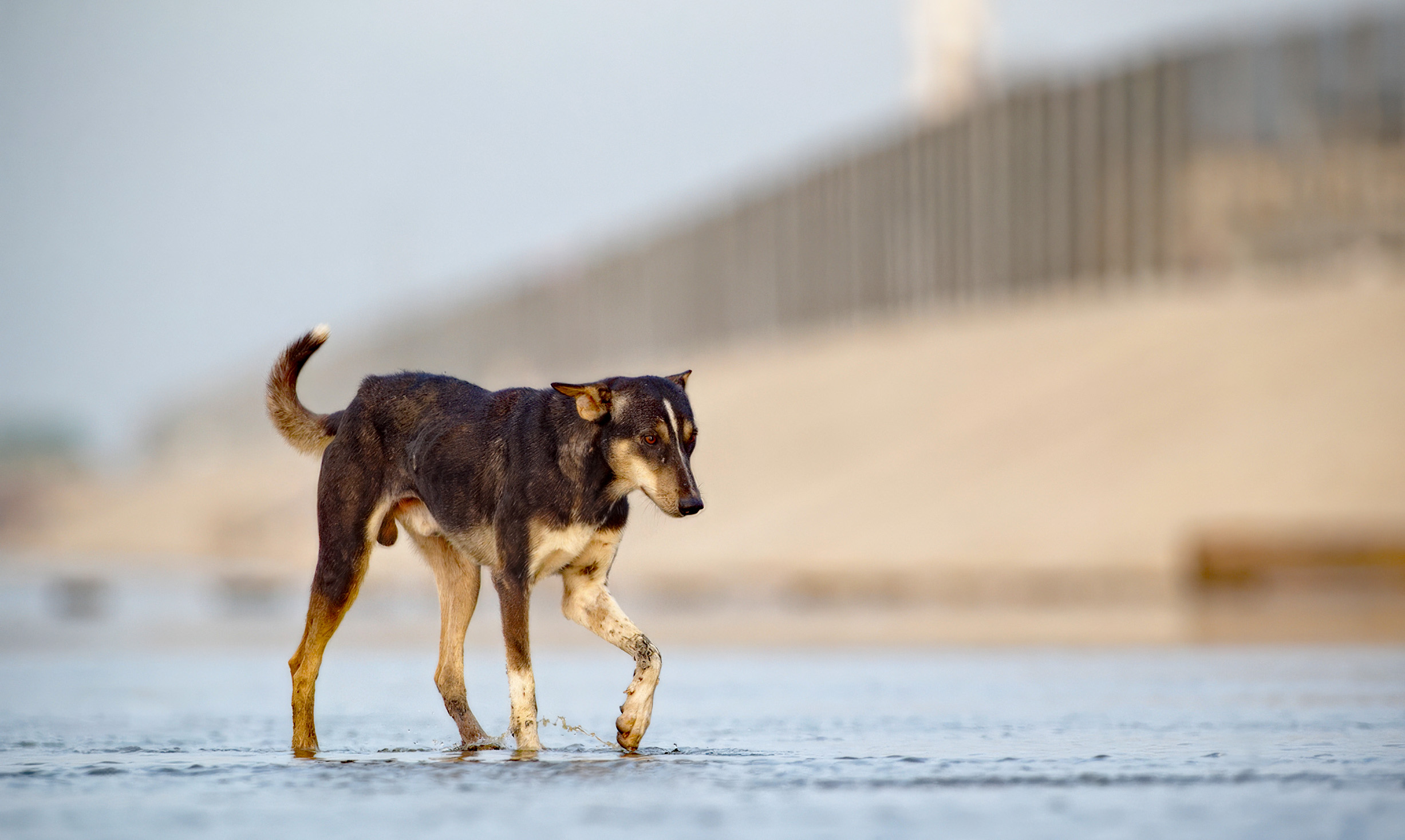
Harris found that stray dogs commonly disturbed and chased foxes. Moreover, during the study 87 dead cubs were recovered from the city; 13 (15%) of these were found to have been killed by animals and, in most cases, dogs were responsible. According to the most recent survey by The Dogs Trust, published in 2026, local authorities in the UK handled 26,342 stray dogs between April 2024 and March 2025, suggesting that stray dogs remain a considerable problem in Britain.
Non-violent encounters
If we consider that most foxes are about the size of a large domestic cat, realistically they pose a potential threat to only the smallest breeds. In my experience, foxes are wary of dogs -- certainly of medium to large breeds -- but there have been some reports of foxes apparently intimidating people out walking their dogs; these reports are often dismissed by researchers, but I have received several accounts of such instances and feel they warrant mention.

In one account, a lady reported being followed by a fox while out walking her dog at night until she crossed a road (presumably a territory boundary), at which point the fox turned and left. Encounter Nature founder Melissa Harrison recently relayed a similar encounter with her dog Scout:
"I have a medium-sized female dog and many times over the years young urban foxes have become fascinated by her, and her by them. One year, in south London the same young fox followed us on our last walk at night, fairly closely. If we stopped, it would stop too, and Scout and the fox would communicate via ear and tail positions. Sometimes it would sit down. At the end of the walk, it would often follow us right up to our front gate. This happened regularly for about three weeks. It occurred again last week when I was in Brighton with her. A young fox came up the street and watched us closely as we were letting ourselves back into the house. Scout, although 17 now and frail, was aware of it and very interested, but not in 'chase' mode or with her hackles up."
Another example was that of a lady in London who told me she was repeatedly barked at and followed by a fox while out walking her Belgian Shepherd dog at about 11 pm in June 2010. In these cases, and a couple of others reported to me by readers, the dog appears to have been the focus of the fox's attention. Foxes maintain territories throughout the year and become particularly sensitive to intruders during the winter and spring. A dog walking through the territory may therefore attract the fox's attention until it reaches the boundary, at which point the fox often loses interest and turns back. Certainly, based on the descriptions of the foxes' behaviour, it seems probable that the animals were either anxious at, or curious about, the dogs' presence rather than being bold in any aggressive sense.
Foxes maintain territories throughout the year and become particularly sensitive to intruders during the winter and spring. A dog walking through the territory may therefore attract the fox's attention until it reaches the boundary, at which point the fox often loses interest and turns back.
Indeed, several accounts I've come across suggest a much less sinister interest.
In February 2007, a lady wrote to me describing how a fox followed her while out walking her Welsh terrier in Surrey and, when she stopped, it approached and began play-bowing to her dog. In May of the same year, BBC Wildlife Magazine published a supplemental booklet called Fox UK, which contained information about foxes (compiled by Stephen Harris) along with photos and stories sent in by readers. In one letter, Mike Squires told how his 15-year-old Border Collie spent several minutes playing with a fox in their garden in Wales one December morning, each taking it in turns to chase the other.
In his 1986 book A Fox's Tale, Robin Page described how a fox cub he raised would play with the farm kittens and their black labrador. Similarly, Michael Chambers, in his 1990 book Free Spirit, described how a vixen he raised from a cub formed a strong bond with his dogs, even allowing one to babysit her cubs. In Town Fox, Country Fox, Brian Vezey-Fitzgerald recounted examples of foxes playing with dogs in his neighbours' gardens -- in one case with a Dachshund and in the other a miniature poodle -- although he points out that in his experience foxes generally avoid dogs:
"The fox avoids dogs rather than ignores them. I do not think there is any question of fear involved. Certainly I have seen no sign of fear. And I think that the fox is not an easily frightened animal. Avoidance is merely an elementary precaution."
Feeding and habituation
One factor worth bearing in mind is the degree to which local foxes have been habituated to human contact through irresponsible feeding. The issue is discussed in detail in the companion Q&A, Is it likely that a fox will attack a person? (see: Feeding the problem), but the key point is this: foxes that have been encouraged to enter houses, or to take food from the hand, may be significantly bolder in their general behaviour than those that have not. Deliberately tempting foxes into houses or allowing them to associate humans with hand-feeding serves neither the fox nor the people living nearby in the long run.
In conclusion
The evidence does not support the idea that foxes pose a significant threat to dogs. Confirmed attacks are rare, and fatalities are almost unknown; in the great majority of encounters, it's probably the fox that comes off worse. Owners of the very smallest breeds -- those approaching or below the size of a cat -- may wish to exercise some caution, but there is no basis for the kind of anxiety that would discourage responsible dog ownership or outdoor exercise.
Common sense around urban foxes is always advisable, as it would be around any wild animal, but foxes and dogs routinely share Britain's towns and cities without incident. A fox encountered during an evening walk is usually behaving exactly as any sensible wild animal should: keeping a watchful eye on its surroundings while avoiding unnecessary conflict.
References
Brooks, C. (2023). Owner left 'terrified' for pet Chihuahua after fox attempts to attack the four-pound dog. Daily Express. 25th January 2023.
Chambers, M. (1990). Free Spirit: A brush with the fox. Methuen Publishing Ltd, London.
Harris, S. (1981). An estimation of the number of foxes (Vulpes vulpes) in the city of Bristol, and some possible factors affecting their distribution. Journal of Applied Ecology. 18(2): 455-465.
Harris, L. (ed.) (2026). Stray Dog Survey Report 2024-25. Report by The Dogs Trust, London.
Page, R. (1986). A Fox's Tale: The secret life of the fox. Hodder & Stoughton, London.
Vezey-Fitzgerald, B.S. (1968). Town Fox, Country Fox. The Country Book Club, London.