Summary
Foxes are perfectly capable of killing domestic cats, and there's no doubt that such attacks occur. The evidence currently available, however, suggests that such incidents are uncommon relative to the large number of fox–cat encounters that occur nightly across Britain. Survey data suggests that fewer than 1% of pet cats are harmed by foxes each year, and a cat is statistically far more likely to be injured in a road traffic accident or in a fight with another cat. In most observed fox–cat encounters, the two species ignore one another; where conflict does occur, the cat is usually the dominant party.
For owners who lose a beloved pet to a fox, statistics offer little comfort, and it would be wrong to dismiss such incidents simply because they are unusual. Equally, however, isolated cases should not be mistaken for evidence that foxes generally pose a serious threat to Britain's domestic cats. Keeping cats indoors at night is the single most effective way to reduce the risk.
Table of contents
- How common are fox attacks on cats?
- Dietary evidence
- Witnessed attacks
- Identifying a fox attack
- Why do foxes attack cats?
- Feeding and habituation
- What can you do?
- In conclusion
- References
The Details
Whether foxes pose a significant danger to cats is a question that has ignited debate for decades. The subject has been brought to public attention in more recent years partly by unsubstantiated claims on social media that attacks are now more frequent as a result of the Hunting Act of 2004 and the widespread adoption of wheelie bins. The argument generally runs that the abolition of hunting with hounds led to an increase in the fox population, and that attacks on cats are the direct result; mounted hunts, I've seen it argued, should be reinstated. These subjects are covered in depth elsewhere on this site, so I won’t dwell on them beyond reiterating that there is no evidence that: (a) fox numbers have risen in response to the Hunting Act (quite the contrary); (b) mounted hunts had any measurable impact on fox numbers, particularly in urban areas; or (c) the introduction of wheelie bins has had any impact on fox diet, distribution or behaviour.

In February 2005, the Daily Telegraph carried the headline "Hungry foxes start eating the nation's cats" and the accompanying article told how fox attacks on cats were on the increase, quoting a pest controller near Edinburgh who explained that the fox population had "gotten out of hand" because the introduction of wheelie bins had deprived foxes of their regular food supply. As discussed above, however, I know of no evidence in support of this; so, if the number of fox attacks on cats has increased, the explanation seems to lie elsewhere.
How common are fox attacks on cats?
There are few datasets that tell us how many cats are attacked by foxes each year, not least because positively identifying the culprit as a fox -- as opposed to a small dog, for example -- is often all but impossible. The most oft-cited statistics on the subject come from Bristol University, who appear to have been the first to attempt a substantive investigation of the issue.
Stephen Harris distributed 5,480 questionnaires about fox disturbance, including losses of pets, to houses in an area of north-west Bristol estimated to be home to 1,225 pet cats at the time. Harris received 5,191 (95%) completed surveys and calculated that eight -- fewer than 1% -- of those pet cats, most being kittens under eight months old, were thought to have been killed by foxes.

The problem with the Bristol data is that they're not recent; the figures first appeared in a paper by Harris on the food of suburban foxes published in Mammal Review in 1981, and the questionnaire was actually circulated in October 1977. When we consider that, in a 1986 paper to the Journal of Animal Ecology on urban foxes in Britain, Harris and Jeremy Rayner noted that the colonization of London by foxes was continuing, and that subsequent studies in Bristol showed how the urban fox population peaked during the early 1990s, it's unclear how relevant these fox–cat statistics are today, nearly half a century on. A similar questionnaire-based study in Oxford, conducted by David Macdonald at the city's university during the early 1980s, yielded comparable results: nine of the 6,143 respondents believed their cat had been killed by a fox.
The most recent reference of which I am aware was a blog post by veterinary surgeon Pete Wedderburn on VetHelpDirect in February 2013. Wedderburn searched the VetCompass database for records of cats admitted with injuries caused by a fox. At the time, the database held medical records for some 400,000 pets from 200 practices across the UK, 145,808 of which relate to cats. Wedderburn's search yielded 209 admissions -- 79 confirmed and 130 suspected fox fights -- between January 2010 and February 2013. These results suggested that 14 in every 10,000 cats were attacked, or believed to have been attacked, by foxes over this period: an incidence of 0.14%. When Wedderburn ran the same search for other types of injury, he found that cats were 40 times more likely to be bitten by another cat and 14 times more likely to be hit by a car than to be attacked by a fox. Similarly, the in their CATS Report UK 2025, which surveyed 10,626 cat-owning households in Britain about their pets, the Cats Protection League note that 27% of owners reported their cats being injured, 15% of which were a result of fighting with another cat, making cat-on-cat fights the largest source of injury.
No study is perfect, but it's perhaps reassuring that surveys conducted decades apart using very different methods arrive at broadly the same conclusion: fox attacks on domestic cats occur, but they're uncommon.
Dietary evidence
Dietary studies and observations of dead cats recovered from fox earths suggest that cat predation is higher in urban than rural areas. Most rural studies make no mention of cat remains in either fox scats or stomach contents, although during his 1981 review Harris found cat remains in 2.1% of stomachs he studied, while a similar study on the food ecology of foxes in Sweden, conducted by Jan Englund in 1965, found cat remains in just under 2% of stomachs. Macdonald's studies returned lower figures, with cat fur found in eight (0.4%) of the 1,939 scats collected.
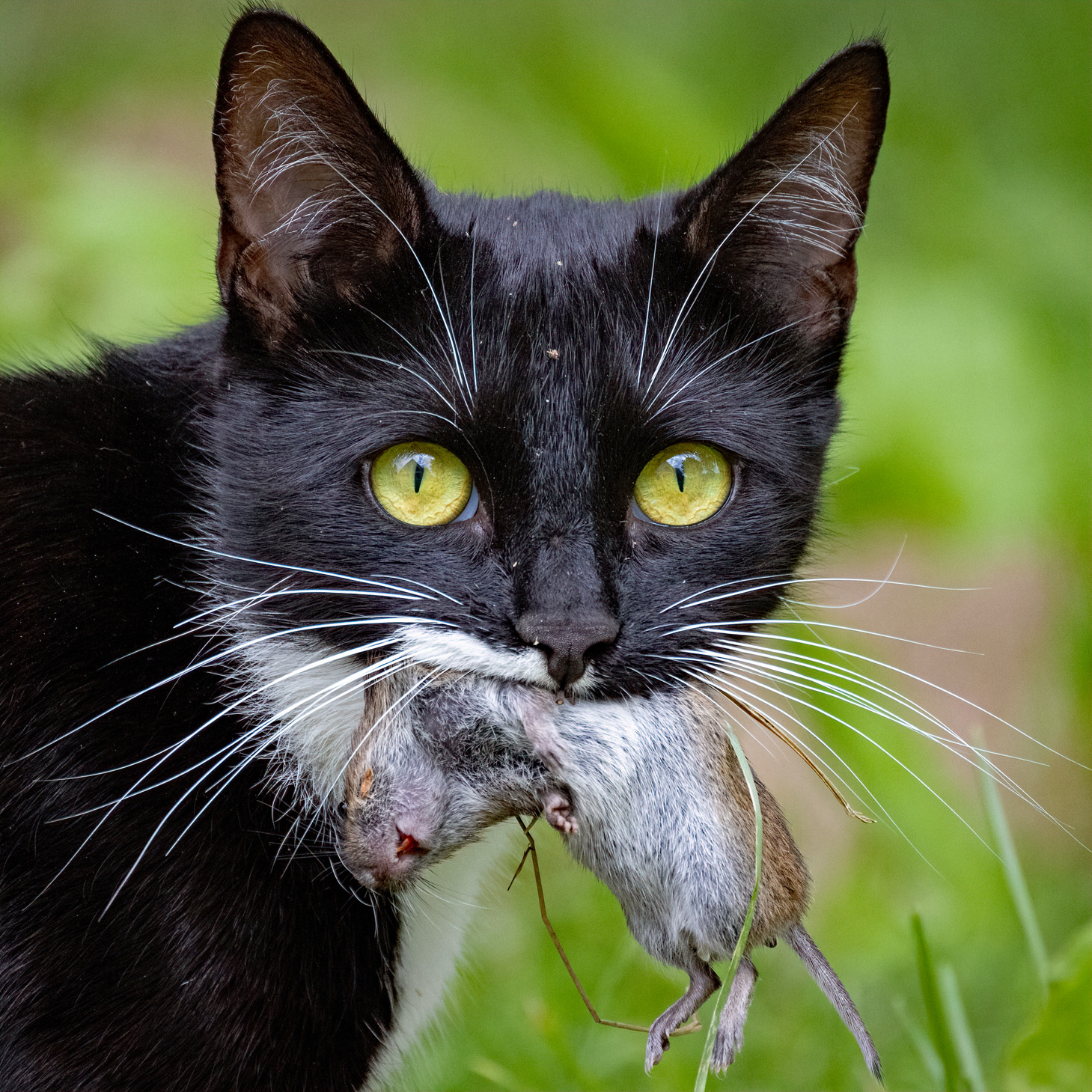
A crucial complication when making inferences from such data is that the foxes could have scavenged the remains rather than killed the cats. In a blog post in November 2023, the insurer Petplan estimated that some 230,000 cats were run over in Britain every year -- an average of 630 per day -- and foxes are well known to scavenge roadkill. Similarly, the CATS Report UK 2025 reported that 3% of injuries reported by owners were road traffic accidents, and presumably more are killed and never found. Whatever the full picture, scavenging of roadkill may explain much of the cat material found in fox dietary studies.
Witnessed attacks
While it is generally considered a minor threat, there can be no argument that foxes can and do kill cats. In his account of urban foxes published in the October 1985 issue of BBC Wildlife Magazine, David Macdonald noted:
"… both species are numerous in towns and active nightly in the same gardens, where they meet continually. If foxes in general were a serious threat to cats the losses would be huge."
Both species are certainly numerous. Recent survey data on foxes are lacking, but Fiona Matthews and colleagues, in their 2018 report on the population and conservation status of British mammals, estimated the fox population at 357,000. Data from the Breeding Bird Survey, which also logs mammal sightings, show a 53% decline in fox records between 1996 and 2025, however, indicating that rural fox populations are shrinking. By comparison, the CATS Report UK 2025 estimated 10.2 million pet cats in the UK – around 27 cats for every fox.
Macdonald went on to describe how stalking with infrared binoculars in Oxford allowed him and his colleagues to observe fox–cat interactions on many occasions; most cases involved the two species ignoring each other, but where conflict was observed, the fox appeared to be the more nervous party. A similar position was taken by Stephen Harris and Phil Baker in their 2001 book Urban Foxes, and in the Fox UK booklet Harris wrote:
"As for cats — well, I have witnessed many encounters between foxes and cats. The cats win every time, since the foxes are reluctant to risk injury when faced with such a powerful foe."
There have nonetheless been several cases where a fox was believed to have killed a cat that have made the papers, and most follow the same pattern: residents are woken by what they describe as a cat fight and, in some cases, a fox is seen at some point during the night. A case from a veterinary nurse in Manchester illustrates how easily the wrong conclusion can be drawn, however:
" At 8.00 this morning [23rd January 2011], we let our cat out (he is a lazy, diabetic cat, with no interest in birds or other wildlife. He lives for his meal times and does not venture out of our garden, so does not leave his business in other gardens). I went upstairs and at 8.30 my daughter came up screaming that he was being attacked by 2 dogs in our garden. We ran downstairs to find 2 terrier type dogs - one had him by the throat, the other by the back legs. When I ran out, they tried to carry him off, but I managed to get him.
I am lucky that I was able to assess his condition until I could take him to the vets where I work (we are not open on Sunday, so I had to get the vet up, for which I am eternally grateful). He is now on a drip, with IV antibiotics and pain relief. He has been lucky - in the respect that I was able to take him away from the dogs before they tore him apart - which they would quite literally have done. One of his hind legs is very badly injured, and will be x-rayed tomorrow. It looks badly broken, and to be honest I expect the eventual outcome will be amputation. He is also concussed, he was thrown to the ground with such force. To get back to the point - if we hadn't caught the dogs in the act, we would have found pieces of our cat strewn around the garden and assumed that the 2 foxes we watched in our garden the other night were responsible."
The idea of a dog being involved is often dismissed out of hand because householders rarely see evidence of 'foreign' dogs in their garden. Our trailcams have caught next door's dogs in our garden eating the hedgehog food overnight on several occasions, and one case of an unknown dog wandering through in the middle of the morning. Indeed, Britain has a substantial stray dog problem and The Stray Dog Survey 2025, published by The Dog's Trust, reported that between April 2024 and March 2025, local authorities in England handled 26,342 strays.
More recently, in February 2018, rumours surfaced that a cat had been attacked and killed by a fox in the Honicknowle area of Plymouth. The body was recovered by a member of Plymouth UK Pets Lost and Found (PUKPLAF) and taken to a local veterinary practice for postmortem. According to a social media post by the Plymouth & SW Devon branch of the RSPCA, the autopsy revealed that the cat had been hit by a car and showed no injuries consistent with a fox attack.
I am only aware of a handful of instances where a fox attack on a cat has been directly witnessed or filmed. In late August 2003, six foxes were reportedly seen attacking a 12-year-old tortoiseshell cat in a back garden in Corstorphine, Edinburgh. One of the cat's owners managed to scare the foxes away and rushed her pet to the vet; unfortunately, its wounds were too severe and it had to be euthanised. This case is unusual because it involved several foxes attacking together – foxes are solitary hunters and do not hunt in packs. If the incident took place as reported, this was presumably a family group: parent foxes teach their cubs how and where to hunt, and the well-grown cubs are almost indistinguishable from the adults by the end of summer.
Another incident took place in August 2010, when a fox was reported to have entered a house in Folkestone, Kent, through an upstairs window and attacked an eight-week-old kitten. As in the 2003 case, the owner intervened and the fox dropped the kitten and fled, but the kitten had to be euthanised several days later. This is the first case I know of involving a fox entering a house and attacking a cat – raising the question of whether someone in the vicinity had been feeding the animal in their house beforehand (see 'Feeding and habituation', below).
More recently, I was contacted by a lady in Hampshire who, in the early hours of 23rd January 2011, witnessed a fox dragging a cat outside her house. Part of her e-mail, reproduced here with her permission, reads:
"At about 3.30 in the morning I was awaken by a kind of strangled cat wail. I live in a suburban area with flats opposite and we often have cat fights, so running to the window (we have a very large cat who often fights!) we were very shocked to see a medium size fox dragging a struggling cat by the scruff of the neck in front of the flats – about 15 metres, stopping to readjust and then across the road towards our house. At that point (another 10 metres) my friend made a loud hissing noise not knowing what else to do and this startled the fox which dropped the cat. The cat immediately ran very fast away while the fox looked up and then started walking past our house (opposite direction from where it had been running with the cat), looking at the house then glancing back towards where the cat had run. The fox was just walking slowly and calmly away. It was not our cat, but it was a medium size cat, not small or 'kitten looking' and it ran away very fast."
Finally, in May 2026, London resident Martin Matthews got in touch after losing one of his cats to a fox. Unusually, the attack was captured on his father's front door camera, and one of the videos is embedded here with Martin's permission – though it's harrowing to watch, showing the fox dragging and shaking 10-year-old Millie. Martin described how, when they retrieved her body, Millie's head was almost severed. He also noted suspicions about attacks on his two other cats:
"Mimi recently disappeared completely around the end of February beginning of March. We have no idea what happened to her and over the last year Millie and Willy have been turning up with battle scars. Willy cuts and other marks to his face and hind quarters. Millie with big patches of fur missing from her legs and tail. We thought that she was just gnawing at herself, and that Willy was getting into big scraps with other cats."
Identifying a fox attack
The increased deployment of remote cameras has recently provided a window into the world of fox-cat interactions. Even so, the biggest hurdle to assessing these encounters remains the nocturnal habits of both species – encounters are rarely observed, and the first an owner knows of a confrontation is when they see injuries or, worse, find the body the following morning. This leads to a certain amount of conjecture.

If we witness a fox attacking a cat, there is no uncertainty; but how can we be confident a fox was responsible if we didn't see the incident? There are some features that tend to be associated with fox attacks rather than dog attacks or fights between cats, though they do not offer conclusive proof. It has been suggested that intercanine distance -- the gap between the canine teeth -- can be used to identify the culprit, but foxes and medium-sized dogs have similar measurements: about 30 mm and 26 mm for their upper and lower canines respectively. In a paper to Wildlife Research in 1970, Ian Rowley, reporting the results of a five-year study on lambing flock mortality in south-east Australia, wrote of:
"... the impossibility of differentiating between fox and dog attack on the basis of the wound inflicted ..."
Why do foxes attack cats?
Foxes may occasionally see cats as a potential meal, and it has been suggested that certain individuals may be more prone to attacking cats than others – some may 'specialise' in them, as one author put it. This might explain local clusters of incidents, where several cases are reported in the same town over a short period. Superpredation, where one carnivore preys on another, is generally rare, however; carnivores often carry parasites, and cats in particular have a protein metabolism that makes their meat unpalatable. Writing in British Wildlife in 2020, Stephen Harris noted that foxes have nothing to gain and a great deal to lose from fighting with a cat, and that even dead cats barely register as a food source:
Decapitation and the smell of fox on the body are both strongly associated with reports of cats attacked by foxes. In Town Fox, Country Fox, Brian Vezey-Fitzgerald described two instances where one of his cats appeared to have been in a fight with a fox and, on the first occasion, noted how the cat smelt strongly of fox; several readers have written to me saying much the same.
"Even though some 230,000 cats are run over each year (an easy food source), Foxes eat very few of them. As a very rough estimate, I calculated that only around one in 500 road-killed cats is scavenged by a Fox. It is common to see a Fox sniff a dead cat and pass on. Cats are not a favoured food item and, presumably, eaten only if a Fox is particularly hungry."
Nonetheless, in November 2011 a gentleman living at the foothills of the Wicklow mountains in Ireland contacted me to say he had found a freshly killed kitten buried headfirst in a raised vegetable plot in his garden. Assuming a fox was responsible -- and the details of his e-mail certainly implied so -- the burial suggests the kitten was being cached for later consumption. Similarly, the conclusion of the Metropolitan Police's "Croydon Cat Killer" investigation was that foxes were the culprits and, in their blog summary published in September 2018, the force described three instances captured on CCTV of foxes carrying cat bodies or parts thereof, including heads.
The most likely explanation for aggressive interactions is that foxes see cats (and cats see foxes) as both competitors for food and potential threats to their young; there are reports of cats killing fox cubs. It's not difficult to see how two carnivores of similar size, occupying the same territory and competing for the same food, might come into conflict. Such attacks may therefore represent what biologists call competitive displacement – one animal killing another to remove competition for a resource. Certainly, there are reports from farmers that rural foxes are often particularly hostile towards farm and feral cats, perhaps reflecting higher competition where food is more widely dispersed.
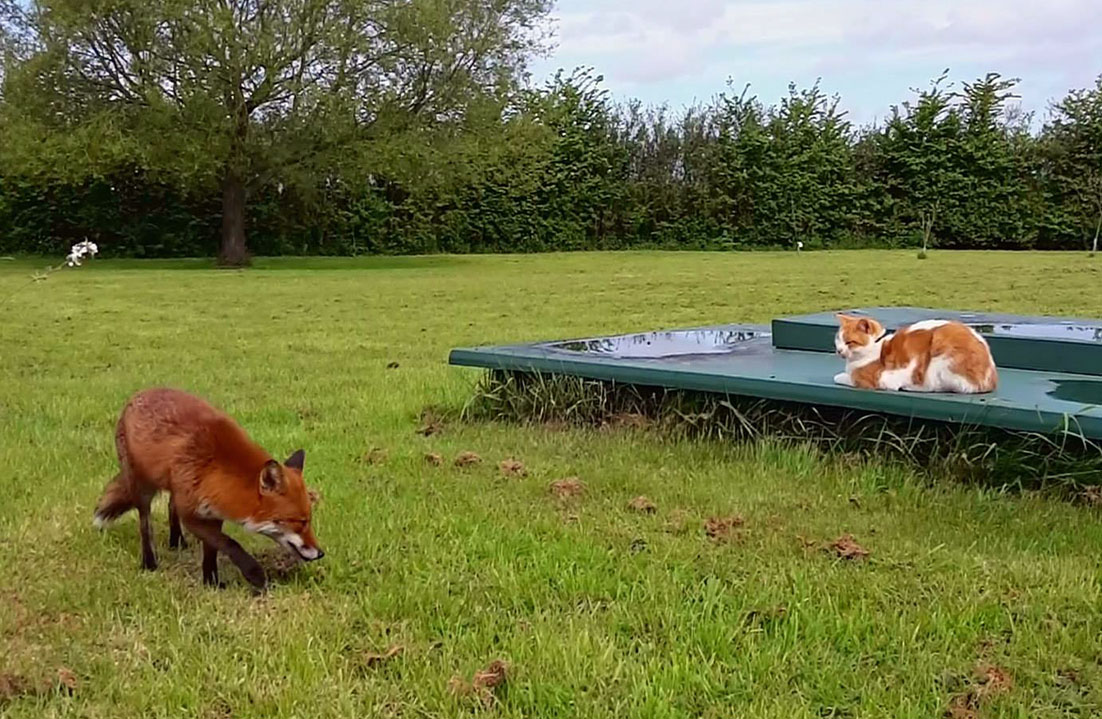
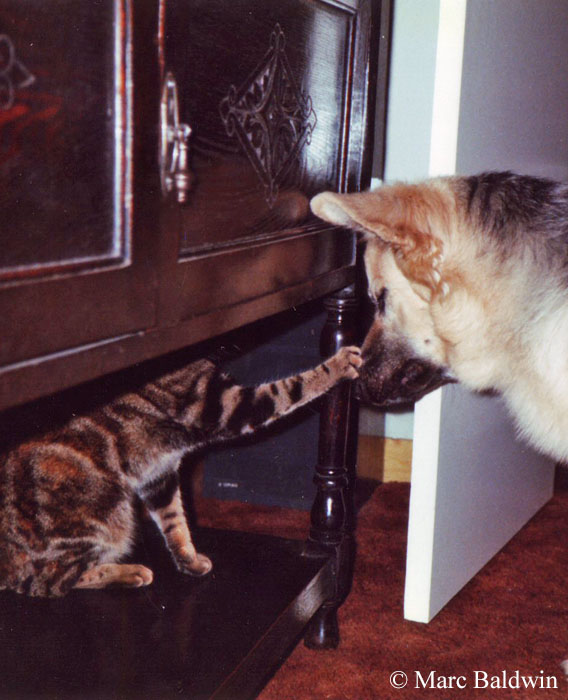
As with encounters with dogs, most fox–cat meetings do not end in violence. There are countless video and first-hand accounts of foxes and cats ignoring one another, feeding amicably from the same bowl, and cats (even kittens) chasing foxes away. This broadly reflects Harris' observation that, of the many thousands of fox–cat interactions he has witnessed, the cat prevailed every time and, provided it was not cornered, the fox fled. There are even reports of the two species playing together and hunting in company. One particularly engaging account came from a lady in Worcestershire who, in October 2014, observed a fox and a cat meeting in her garden:
"The fox appeared to be sneezing, like a human would. He did this about 8 times before the cat walked away. Later the same evening they met again & seemed to be enjoying each other's company. The fox was jumping up onto a small brick wall then jumping down again close to the cat. Good entertainment for us."
Similarly, in July 2026 I came across a video of a fox standing with its tail curled between its back legs, screaming at a cat that appeared entirely unmoved by the performance – a reminder that these encounters can be rather more farcical than fearsome.
Such behaviour should not be romanticised, however. Foxes and cats are very seldom companions in the way that domestic pets may become. Nevertheless, these observations demonstrate that some form of coexistence is by far the norm.
Feeding and habituation
One factor relevant to the risk of fox–cat incidents -- particularly those involving foxes entering homes -- is the degree to which local foxes have been habituated to human contact through irresponsible feeding. This issue is discussed in detail in the companion Q&A, Is it likely that a fox will attack a person? (see: Feeding the problem), but the key point is that foxes encouraged to enter houses, or to take food from the hand, may behave with a boldness that leads to unexpected incidents. Never entice foxes into your home, and never encourage them to take food directly from you.
What can you do?
No method can completely eliminate the possibility of a fox meeting a cat outdoors. There are steps you can take to exclude foxes from your garden, but it's unlikely your cat restricts its nightly wanderings to your garden alone. Attempting to remove foxes from an area is rarely practical and is unlikely to provide a long-term solution. In most urban environments, vacant territories are quickly occupied by neighbouring animals.

Given that both species are most active at night, and there's no guaranteed method of controlling the movements of either, the most effective way to protect your cat is to keep it indoors after dark. This also reduces the likelihood of encounters with other cats or dogs, lowers the cat's impact on the local wildlife population, and significantly reduces the risk of traffic accidents at times when few people are around to help, and veterinary assistance is harder to obtain. Garden enclosures for cats have seen a growth in popularity here in the UK in recent years.
In conclusion
There's no question foxes sometimes kill domestic cats. To deny this would ignore both published evidence and well-documented eyewitness accounts. Such incidents are uncommon relative to the number of fox–cat encounters that take place every night across Britain, however, and the available evidence does not support the suggestion that foxes pose a significant risk to pet cats. A cat is far more likely to be hurt by another cat or a car than by a fox.
The relationship between foxes and cats is therefore perhaps best viewed not as one of predator and prey, but as two adaptable carnivores sharing the same urban landscape. They sometimes compete, they occasionally fight, and very rarely one kills the other. Most of the time, however, they simply coexist.

There's a real need for more systematic research on fox–cat interactions to quantify the dynamic more precisely. In the meantime, the most practical step any cat owner can take is to keep their pet indoors at night – a measure that reduces not only the risk from foxes but also from other cats, dogs, and traffic accidents.
References
Anon. (2026). Mammal monitoring and population trends. In: Heywood, J.J.N.et al. The Breeding Bird Survey 2025. BTO Research Report 802. British Trust for Ornithology, Thetford. p. 30-31.
Englund, J. (1965). Studies on food ecology of Red Fox (Vulpes vulpes) in Sweden. Viltrevy. 3: 377- 385.
Harris, S. (1981). The food of suburban foxes (Vulpes vulpes), with special reference to London. Mammal Review. 11(4): 151-168.
Harris, S. (2020). Time to stop vilifying the urban fox. British Wildlife. 31(3): 163-170.
Harris, S. & Baker, P. (2001). Urban Foxes. Whittet Books Ltd., Essex.
Harris, S. & Rayner, J.M.V. (1986). Urban fox (Vulpes vulpes) population estimates and habitat requirements in several British cities. Journal of Animal Ecology. 55: 575-591.
Macdonald, D.W. (1985). Fox About Town. BBC Wildlife. 3(10): 479-482.
Matthews, F. (ed.) (2018). Britain's Mammals 2018: The Mammal Society's Guide to their Population and Conservation Status. The Mammal Society, London.
Nikkhah, R. (2005). Hungry foxes start eating the nation's cats. The Telegraph. 6th February 2005.
Rowley, I. (1970). Lamb predation in Australia: Incidence, predisposing conditions, and the identification of wounds. Wildlife Research. 15(1): 79-123.
Vezey-Fitzgerald, B.S. (1968). Town Fox, Country Fox. The Country Book Club, London.
Wedderburn, P. (2013). Urban foxes - could your pet cat be the next victim? VetHelpDirect.