Our only diving shrew, and found primarily in wetland habitats, the Eurasian water shrew is also the largest of the four members of the Sorcidae family found in mainland Britain. Historically referred to as the "otter shrew" or "water ranny", its binomial name is particularly curious. Most references consider neo and mys to refer to the Greek for "new" and "mouse", respectively, while, in his 1979 booklet on mammal scientific names, Derek Yalden gave the origin as néō, meaning "to swim", which seems logical. fodiens is derived from the Latin for "digging" or "burrowing". Hence, the water shrew's scientific name means either 'the new mouse that digs' or, more evocatively, 'the swimming mouse that burrows'.
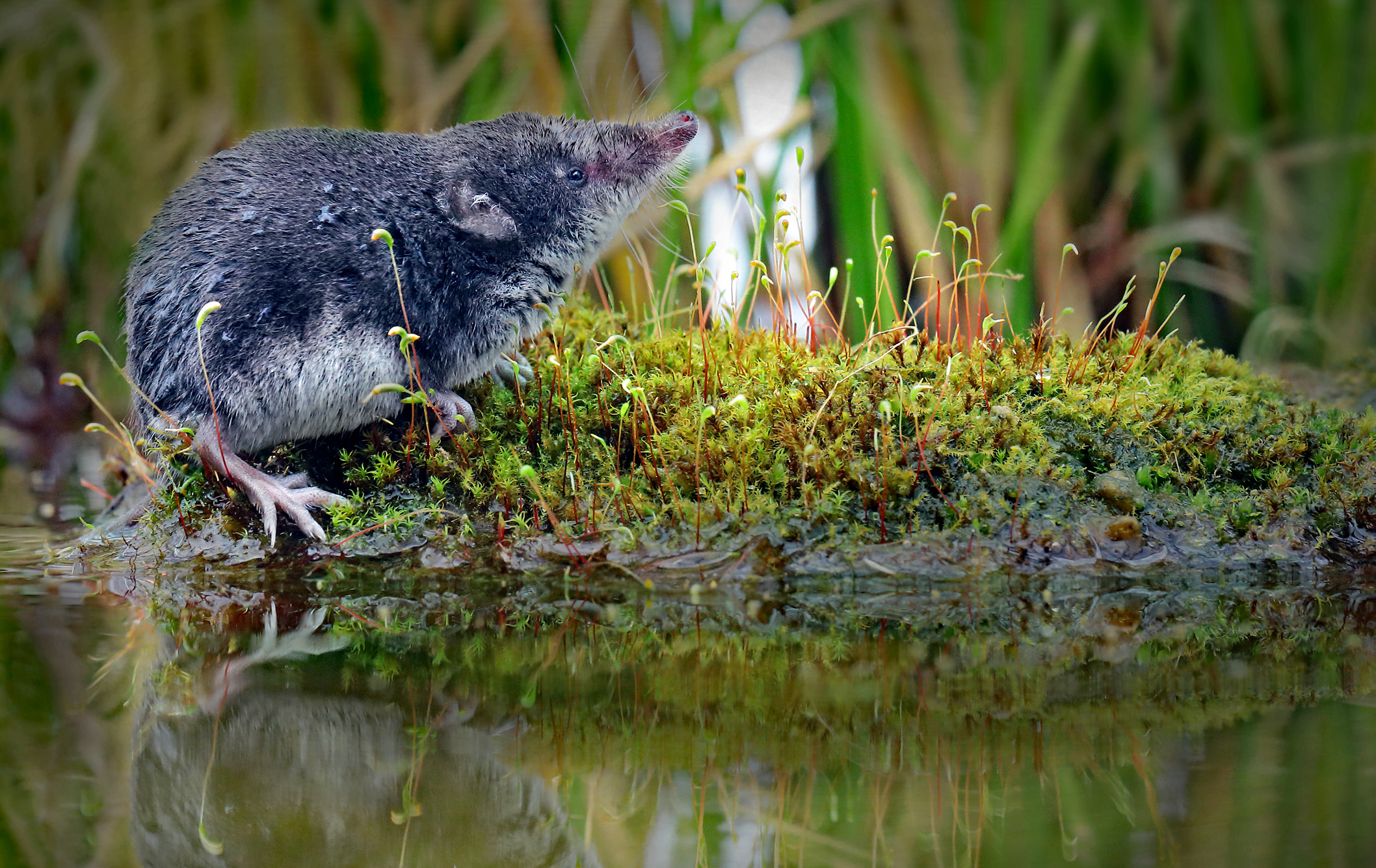
Water shrew at a glance
Size: Adult body length ranges from 6 to 10 cm (2.4-4 in.), with a tail about three-quarters the length of the body (i.e., 5-8 cm / 2-3 in.). Adult weight varies considerably depending on season, ranging from about 8 to 23 g (0.3-0.8 oz.), with the average (mean) around 15 g (0.5 oz.).
Colour/Appearance: A two-tone species, the water shrew has a dark-grey-to-black topside that delineates abruptly to a pale-grey-to-white underside. This dark colouration extends across the entire upper surface, while the tail is uniformly dark but with a keel of short white hairs along the underside. The ears have pale/white tips, and the short legs are dark with lighter coloured feet. The head is quite broad, tapering to a long snout that is liberally studded with sensitive, mobile whiskers and two small dark-coloured eyes. The tip of the nose is also dark with a blunt end. The fur is short but dense, and the powerful hind feet are fringed with a row of short, stiff hairs that help propel the animal while swimming. Being a member of the Sorcidae (shrew family), the white teeth are tipped with a rusty-red colour, caused by the deposition of iron. Females have five pairs of mammae (i.e., 10 nipples).
Distribution: Widespread throughout Eurasia, from Great Britain in the west to the Pacific coast in the east, albeit with a patchy distribution through Russia and northern Kazakhstan. South into northern Spain, Italy, and Macedonia, north to Scandinavia. In Asia its range extends from western Siberia and Asia Minor into North Korea and the Pacific coast of Siberia. Water shrews are widespread within Britain, although they typically do not stray far from wetland habitats. As of July 2025, based on just over 6,500 records from iRecord and NBN Gateway, there were fewer records from Devon and eastern Cornwall and the distribution appears patchier in northern England and Scotland, particularly western Scotland.
Longevity: In her 1983 paper to Acta Theriologica, Iwona Michalak reported one wild-caught female died at an estimated age of 14 months (May 1980-July 1981), while Richard Weigl's Longevity of Mammals in Captivity (2005) gave the maximum longevity in the wild at 3 years 1 month, based on a male born in a private collection in Germany during July 1981. There appears to be quite high juvenile mortality (e.g., one population in southern England exhibited 55% mortality within first two months of life), and mass adult die-offs are reported in some populations after breeding (e.g., between mid-June and late November).
Sexing: Shrews are notoriously difficult to sex by sight. In the hand the testes and vaginal opening can be detected during the breeding season.
Activity: There's a paucity of tracking data on this species. Most references mention that water shrews are active throughout the 24-hour cycle with a peak in the morning (just before dawn) and a hiatus during late morning, but this is based on a single animal kept in captivity by Peter Crowcroft in December 1949. Trapping of shrews at a commercial watercress farm in Hampshire for two years in the early 1980s led Sara Churchfield to observe water shrews were active both day and night, and significantly more active (above ground, at least) in spring and summer than during winter. More daylight activity was observed during the summer months.
The species swims well and is the only British shrew species known to dive to hunt underwater. German zoologist Robert Scholeth's 1980 paper on water shrews in Schweizerischen Nationalpark (The Swiss National Park) is the Western Rhaetian Alps, eastern Switzerland, described them diving frequently to depths of 2 m (6.5 ft.), in air temperatures between -10C and 15C (14-59F), but noted air is readily trapped in their coat, making them buoyant and requiring them to anchor themselves on rocks and weeds to search underwater. Owing to this buoyancy, most dives were short, lasting between 3 and 10 seconds, occasionally up to 24 seconds. In The Behaviour and Ecology of Riparian Mammals, Peter Vogel and colleagues note the species can dive to depths of just over 2.5 m (8 ft.) in captivity. In his 1990 paper, Vogel described how the fur is highly hydrophobic (water-repellent), causing the fur to remain dry even on the surface after a dive. Shrews have a high body temperature (~37.5C / 99.5F) and a consequently high metabolism meaning they must search for prey frequently and eat every three hours or so. Does not hibernate.
Territory: Apparently a rather nomadic species with frequent shifts in home range every few months. Home ranges are small, 20 to 500 sq-m (24-600 sq-yds), with most occupying perhaps only 30 sq-m (320 sq-ft) in good waterside habitat. Most activity is confined within a short stretch of bankside. Ranges appear smaller in winter than summer. Will inhabit burrow systems that it sometimes digs itself using its front feet; sometimes uses mouse/vole/mole tunnels. Territory peripheries may overlap with other shrews, although core areas are aggressively defended against intruders. Faeces deposited in middens along established runways and near the entrance to tunnels.
Builds a rounded nest from moss, dried leaves and grass in a chamber in the tunnel system for sleeping, and a larger nest in which to give birth. The tunnel system may be extensive, with entrances above and/or below the water line.
Habitat: Typically lives close to water, and usually fast-flowing bodies such as streams and rivers, but can be found along canal banks, ditches, ponds, and even garden ponds. Seem particularly abundant in watercress beds. Also found in reedbeds, marshes and bogs, and occasionally reported on the seashore. Some reports suggest a reasonable distance (e.g., 3 km / 2 mi.) from nearest watercourse.
Population: Density is highly variable with season (i.e., population peaks during summer) and habitat (e.g., watercress vs. woodland). Highest densities recorded in watercress beds at 3-5 per ha (1.6 per acre). Britain's Mammals 2018 estimated the British population at a maximum of 2 million, but more likely around 715,000, with a prediction that the population will decline in future.
Diet: Takes a diversity of invertebrate prey in common with the season, including aquatic crustaceans (e.g., shrimps and water lice), insect larvae (e.g., blackfly and caddis fly), beetles, spiders, millepedes, centipedes, molluscs, and worms. Small fish, frogs, and newts may also be tackled on occasion. Prey caught underwater, which can account for 80% in some regions (about 55% in southern England), is brought ashore to eat. Small submaxillary glands produce a venom that's released into the saliva and helps subdue prey, even vertebrates larger than the shrew. Will feed on carcasses of larger animals given the opportunity. Prey may be caught, immobilised with venom, and stored in tunnel system (cached) for later retrieval. Owing to their fast metabolism, water shrews must consume about 50% of their body weight per day.
Reproduction: Breeding season covers mid-April until early September, with a peak during May and June. Iwona Michalak described courtship based on captive individuals, reporting the male pursuing the female who subsequently attacked him causing him to "play dead" before continuing to pursue her. After a period of following, the female stopped being aggressive and started to follow him. After an hour of following one another, during which both animals made repeated squeaking noises, the male grabbed the female by the scruff of her neck and mounted her to copulate. Curiously, during copulation the pair shifted position twice; once so the female was on her belly and the male on his back (like the male had fallen backwards while mounting her), and subsequently so they were both lying on one side, while still connected. The male disengaged and the pair rested for a while before the male moved away; the female groomed her genitals. Copulatory plugs have been reported from this species, and the mating strategy appears polygamous. Data are lacking, but water shrews are likely induced ovulators (i.e., the act of mating stimulates ovulation).
A litter of 3 to 15 (average 6) pups, each about 1 g (0.03 oz.), are born after a 14- to 21-day gestation. In good conditions females may produce three litters per year, but most will have one or two. Pups are born blind and naked, fur developing around 10 days later. Female plugs the entrance to the nest when leaving the pups, which she does only very briefly to find food or void waste during the first week after birth. The female consumes the waste of the pups and maintains a clean nest. Michalak's observations suggest mothers are very aggressive and fiercely protective in the couple of weeks post-birth. Pups leave the nest from around 3 weeks old, are weaned about a week later, and continue to associate with their mother until about 5 or 6 weeks old, when aggression within the family is observed. No paternal care has been recorded. Most females won't breed until after their first winter.
Behaviour/Sociality: Water shrews appear predominantly solitary, although seem more tolerant of one another than other shrew species. In captivity, the introduction of an intruder generates a squeaking "churr-churr" vocalisation and often chasing and/or fighting. Indeed, Frederik Hendrik van den Brink described Neomys fodiens as "a very noisy species", making whistling cries and trills that may merge into very loud squeaks. As mentioned, partners may vocalise during courtship and high-pitched twittering has been reported from exploring/foraging animals, while loud churrs and squeaks are indicative of aggression. Senses of smell, hearing, and touch appear to be acute, while vision is poor. Scent may sometimes be applied from flank glands by males. Shakes and grooms coat frequently, which presumably helps retain waterproofing.
Threats: Currently considered of Least Concern by both the IUCN and The Mammal Society, but there's a paucity of data on population trends owing to the difficulty in monitoring such a small, fast-moving, short-lived species. The Science Report SC010073/SR to the Environment Agency on water shrews in Great Britain, published in 2006, suggested that despite being an "ecologically flexible" species, tolerant of considerable human disturbance, riparian sites should be managed with sensitivity to encourage bankside ground cover, the management of bankside trees and shrubs, and the maintenance of high water quality. Some limited protection is offered under the Wildlife and Countryside Act (1981) in the UK. While there is some suggestion that the spread of American mink (Neogale vision) may be detrimental to water shrew populations, their predators appear to be mainly birds of prey, including owls, kestrels (Falco tinnunculus), and buzzards (Buteo buteo).
Bibliography
Atlas of the Mammals of Great Britain & Northern Ireland - by Multiple Contributors
Pelagic Publishing
-- 2020
-- ISBN: 978-1784272043
Britain’s Mammals 2018: The Mammal Society’s Guide to their Population & Conservation Status - by Multiple Contributors
The Mammal Society
-- 2020
-- ISBN: 978-0993567339
Collins Field Guide: Mammals of Britain and Europe - by David MacDonald and Priscilla Barrett
HarperCollins Publishers
-- 1993
-- ISBN: 978-0002197793
Eurasian Insectivores and Tree Shrews: An Action Plan for their Conservation - by R. David Stone
IUCN
-- 1991
-- ISBN: 978-2831700625
Evolution of Shrews - by Jan Wojcik & Mieczysław Wolsan
Polish Academy of Sciences
-- 1998
-- ISBN: 978-8390752105
Mammals of the British Isles: Handbook, 4th Edition - by Stephen Harris and Derek Yalden (eds)
The Mammal Society
-- 2008
-- ISBN: 978-0906282656
The natural history "bible" covering all British mammals with detailed coverage of their biology, behaviour, ecology and taxonomy written by experts in the field and referenced to the primary literature.
Mammals of the World: A checklist - by Andrew Duff & Ann Lawson
A&C Black
-- 2004
-- ISBN: 978-0713660210
Shrews - by Sara Churchfield
The Mammal Society
-- 1986
-- ISBN: 978-0904614152
The British Mammal Guide - by Steve Evans & Paul Wetton
Isabelline Films
-- 2015
-- ISBN: None
The Water Shrew Handbook - by Phoebe Carter & Sara Churchfield
The Mammal Society
-- 2006
-- ISBN: 978-0906282625
UK Mammals: Species Status & Population Trends - by The Tracking Mammals Partnership
JNCC/TMP
-- 2005
-- ISBN: 978-1861075680