- Latin name
- Rattus rattus
- Class
- Mammals
- Group
- Mice, Rats & Voles
Once one of the most widespread mammals in the British Isles, the black rat -- also known as the house, roof or ship rat -- is now considered extinct in Britain, despite a recent sighting on a Scottish island. It has shared our homes, granaries, warehouses and ships since at least the Roman occupation in the 1st century AD, and its notoriety stems chiefly from its historical association with the 14th-century Black Death and the Great Plague of London in 1665.
Carl Linnaeus classified the species as Mus rattus in 1758, based on a specimen from Sweden. The genus Rattus was created in 1803 by German naturalist Gotthelf Fischer von Waldheim, in volume two of his Das Nationalmuseum der Naturgeschichte zu Paris, and this species was subsequently moved across by American zoologist Ned Hollister in 1916.
The Black rat at a glance
Size: Adults typically range between 12 cm and 18 cm (5–7 in.) head and body length, although they appear to grow throughout their lives and older individuals may reach a head and body length up to 24 cm (9.5 in.). The tail is longer than the body, even at the point pups leave the nest, reaching up to 26 cm (10 in.) in mature individuals. Adults typically weigh 150–200 g (5–7 oz.), occasionally up to 280 g (10 oz.), with males generally larger than females. Some subspecies appear smaller, weighing perhaps only 75 g (2.6 oz.).
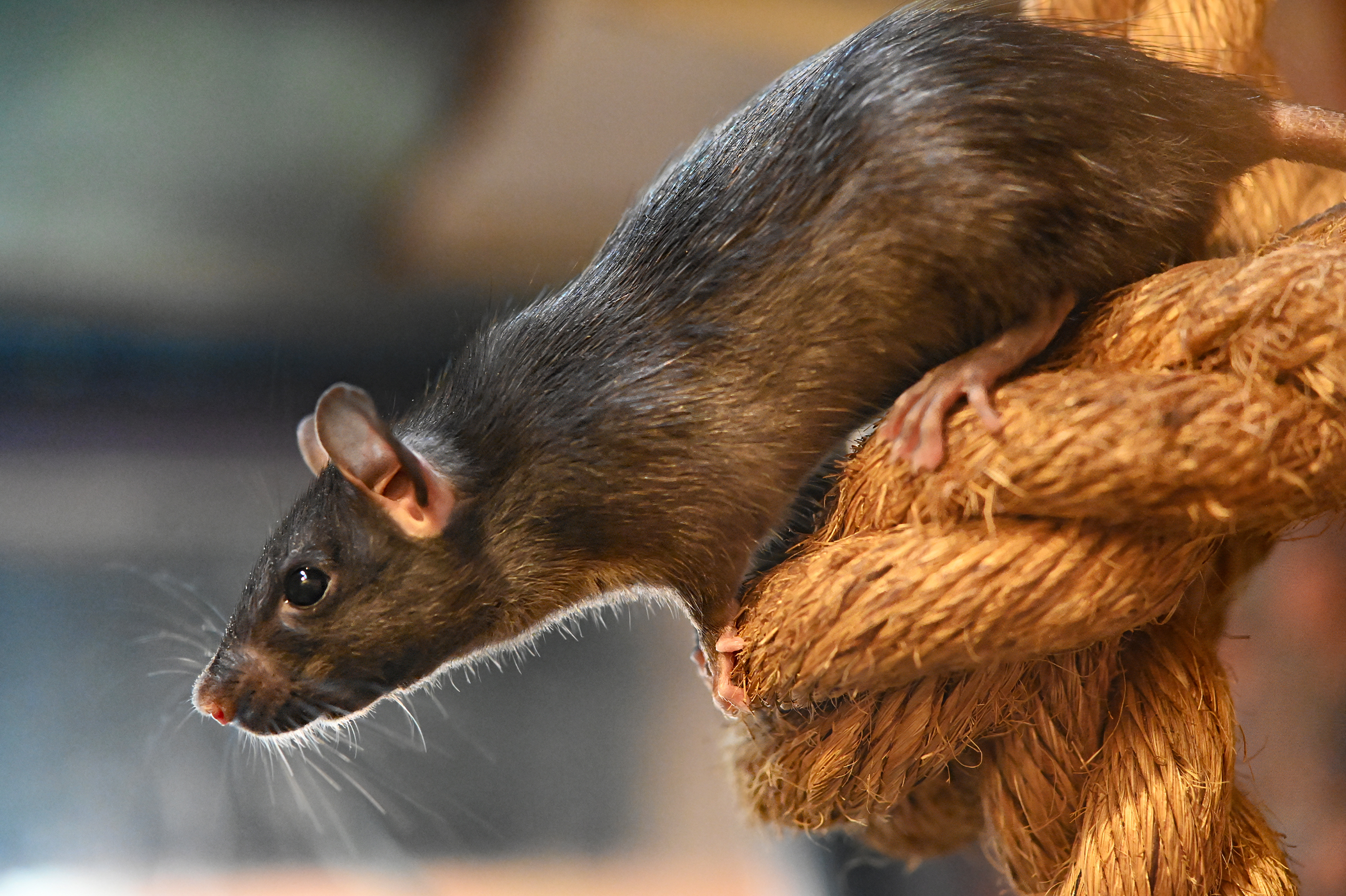
Colour/Appearance: A medium-sized rodent with a fully furred head, body and legs – the paws, nose and tail are unfurred. The eyes are a glossy black and the ears, feet and nose are pink, with long whiskers arranged around the nose. It's similar to the brown rat (Rattus norvegicus), but with relatively larger eyes and ears, and a longer, slimmer, hairless-eared tail that stays a uniform "dirty pink" along its length. Despite its name, black fur is not diagnostic of the species: individuals can be brown, while a proportion of brown rats are melanistic (i.e., very dark or black). Three colour morphs have been described at varying frequencies: all black (rattus type); brown with a grey underside (alexandrines type); and white-bellied (frugivorus type). Mammae number vary but are typically five pairs.
Distribution & Population: Probably originating in southern Asia, the black rat has been transported by humans around the world and is now found on every continent except Antarctica, though not in the Arctic. It occurs across much of Europe, Africa and Asia, and has been introduced to Australia, New Zealand and along the seaboards of the Americas.
The species is now regarded as extinct in the UK, following the eradication of the last population -- on the Shiant Islands off Scotland's north-west coast -- during 2017/18 over fears of seabird nest predation. In England, colonies held on into recent history in larger port cities, including Southwark in London, as well as on Lundy, Devon, and at Carnach Mòr on Garbh Eilean. The 1995 review of British mammals estimated the population at around 1,300 individuals: fewer than 750 in England, about 550 in Scotland, and none known in Wales. By the time the Mammals Tracking Partnership reported in 2005, the population was thought to consist of only 230–400 individuals on the Shiant Islands, with the species "near extinct" in England. The Shiants were declared rat-free in March 2018. A handful of photographs claiming to show black rats on social media appear more likely to be escaped "fancy rats" (i.e., domesticated brown rats), although one taken on Inchcolm in the Firth of Forth during September 2024 appears to show a genuine juvenile black rat.
Habitat & Territory: Despite being a habitat generalist, black rats are often associated with human settlements, ports, agricultural land and other disturbed habitats. In Britain they have historically been strongly tied to buildings such as supermarkets, restaurants and dockside warehouses, although on the Shiants and Lundy they occupied rocky cliffs and scrubland, and in New South Wales the species is found in forests. In urban environments these rodents don't appear to live outdoors, nesting instead in wall cavities, false ceilings and panelling. Being so closely tied to human structures, their ranges tend to be small, only around 100 m² (1,000 ft²), a smaller subset of which may be defended from neighbouring animals. Males appear to move more widely than females, and territories are scent-marked by rubbing the cheeks and underside on objects.
Longevity: Very high annual mortality (90%+) in many habitats means most wild individuals probably survive no more than a year, rarely 18 months. In captivity, one individual of unknown sex held at London Zoo at the turn of the century lived for 4 years and 2 months.
Sexing: Sexes can't be told apart from appearance alone, beyond size, as there's no other sexual dimorphism. In the hand, anogenital distance is diagnostic, as is the presence of testes or mammae.
Activity: Primarily nocturnal, although becomes progressively diurnal where disturbance is low or food is scarce. An agile climber and capable swimmer, though they're rarely found in water.
Diet: An omnivorous rodent that takes insects, birds, eggs and carrion, though most of the diet is fruit, nuts, grains, seeds, cereals and other vegetation such as leaves, stems and bark. Agricultural crops taken include cocoa, cereals, sugar cane, coffee berries and livestock feed, and food may be carried off to eat under cover. Captive studies suggest these rats consume around 15 g (0.5 oz.) of food per day, equivalent to around 7-10% of their body weight.
Reproduction: Black rats can breed year-round, though the peak is during summer and autumn. Dominant males mate more often than subordinates and mating itself is brief – males mount females for only a second or two before moving on to another. Following a gestation of 21–29 days, a litter of 6–12 pups is born, each weighing around 4.5 g (0.16 oz.); average litter size is 7–8. Pups are born in a nest of sticks, twigs and leaves built in trees, loft spaces or under floors, and females can produce up to five litters a year. Pups are largely helpless for the first 10 days but weaned rapidly, at 3–4 weeks; the female alone provides parental care. They reach sexual maturity at 3–5 months old, females (from around three months) somewhat earlier than males (nearer four), and females can return to oestrus within 24 hours of giving birth.
Behaviour/Sociality: A broadly social mammal, black rats live in mixed-sex groups with a single dominant male and a linear male hierarchy; the hierarchy among females is less obvious, despite females being the more aggressive sex. Intruders are generally attacked, though may be accepted if persistent, and group size likely tracks resource availability. Rats communicate through body language, including teeth-gnashing, and a range of squeaking and squealing calls, and are less wary of novel objects than brown rats.
Threats: Globally a species of Least Concern owing to its ubiquity, though the 2018 red list of British mammals considered it Critically Endangered here. Its near-exclusive reliance on buildings has made pest control more effective against it, while range contraction has probably been hastened by competition from the more adaptable brown rat. Its destructive habits and disease-carrying potential mean it's still widely regarded as a pest, though it's actively encouraged on religious grounds in some places, such as the Karni Mata Temple in Rajasthan, India. Black rats transmit bubonic plague (the bacterium Yersinia pestis) indirectly, via the Oriental rat fleas (Xenopsylla cheopis) they carry – although recent archaeological evidence suggests rats were unlikely to have been the primary driver of the plague that swept Europe, Asia and North Africa between 1346 and 1353.
Bibliography
Atlas of the Mammals of Great Britain & Northern Ireland - by Multiple Contributors
Pelagic Publishing
-- 2020
-- ISBN: 978-1784272043
Britain’s Mammals 2018: The Mammal Society’s Guide to their Population & Conservation Status - by Multiple Contributors
The Mammal Society
-- 2020
-- ISBN: 978-0993567339
Collins Field Guide: Mammals of Britain and Europe - by David MacDonald and Priscilla Barrett
HarperCollins Publishers
-- 1993
-- ISBN: 978-0002197793
Les Sentiers du Naturaliste: Les Rats - by Julie Delfour
Delachaux et Niestle
-- 2005
-- ISBN: 978-2603013878
Mammals of the British Isles: Handbook, 4th Edition - by Stephen Harris and Derek Yalden (eds)
The Mammal Society
-- 2008
-- ISBN: 978-0906282656
The natural history "bible" covering all British mammals with detailed coverage of their biology, behaviour, ecology and taxonomy written by experts in the field and referenced to the primary literature.
Mammals of the World: A checklist - by Andrew Duff & Ann Lawson
A&C Black
-- 2004
-- ISBN: 978-0713660210
Rats, Mice, and Dormice As Pets. The Complete Owner’s Guide - by Lolly Brown
NRB Publishing
-- 2014
-- ISBN: None
The British Mammal Guide - by Steve Evans & Paul Wetton
Isabelline Films
-- 2015
-- ISBN: None
The Rat - by S. A. Barnett
Aldine Transaction
-- 2007
-- ISBN: 978-0202309774
The Rat Trapper’s Bible - by Greg Ross
Independently Published
-- 2026
-- ISBN: 979-8183628449
The Story of Rats: Their Impact on Us, and Our Impact on Them - by S. Anthony Barnett
Allen & Unwin
-- 2001
-- ISBN: 978-1865085197
UK Mammals: Species Status & Population Trends - by The Tracking Mammals Partnership
JNCC/TMP
-- 2005
-- ISBN: 978-1861075680