- Latin name
- Neogale vison
- Class
- Mammals
- Group
- Badgers & Weasels
Europe and Asia have their own native mink, the European mink (Mustela lutreola), but archaeological evidence suggests this species never recolonised Britain after the last Ice Age. That absence led to the importation of its American cousin for fur farming in 1929. Many escaped, and more were deliberately released -- in what many consider misguided actions by animal rights groups -- and the first confirmed report of American mink breeding in the wild came from Devon in 1956; the species spread widely thereafter, with significant consequences for many smaller birds and mammals. According to Stefan Buczacki in his 2002 Fauna Britannica, the word "mink" first appeared in 1466 as a name for "a stinking animal in Finland", and there are several similar words in Danish and Swedish.
The American mink was originally placed in the genus Neovison alongside the now-extinct sea mink, before being moved into Neogale with other New World weasels in 2021, based on a comprehensive argument by Bruce Patterson and colleagues published in the Journal of Animal Diversity. The specific epithet vison derives from the French word for a marten or weasel. There are currently 15 recognised subspecies.
American mink at a glance
Size: Head and body length ranges from about 30 cm to 45 cm (12–18 in.), with a 15–25 cm (6–10 in.) tail. Body mass is highly variable with sex and season and can fall anywhere between 400 g (14 oz.) and 1.6 kg (3 lbs.), with individuals tending to be heaviest in autumn. Globally, the Alaskan subspecies (ingens) appears to be the largest, and the Eastern subspecies (vison) the smallest.
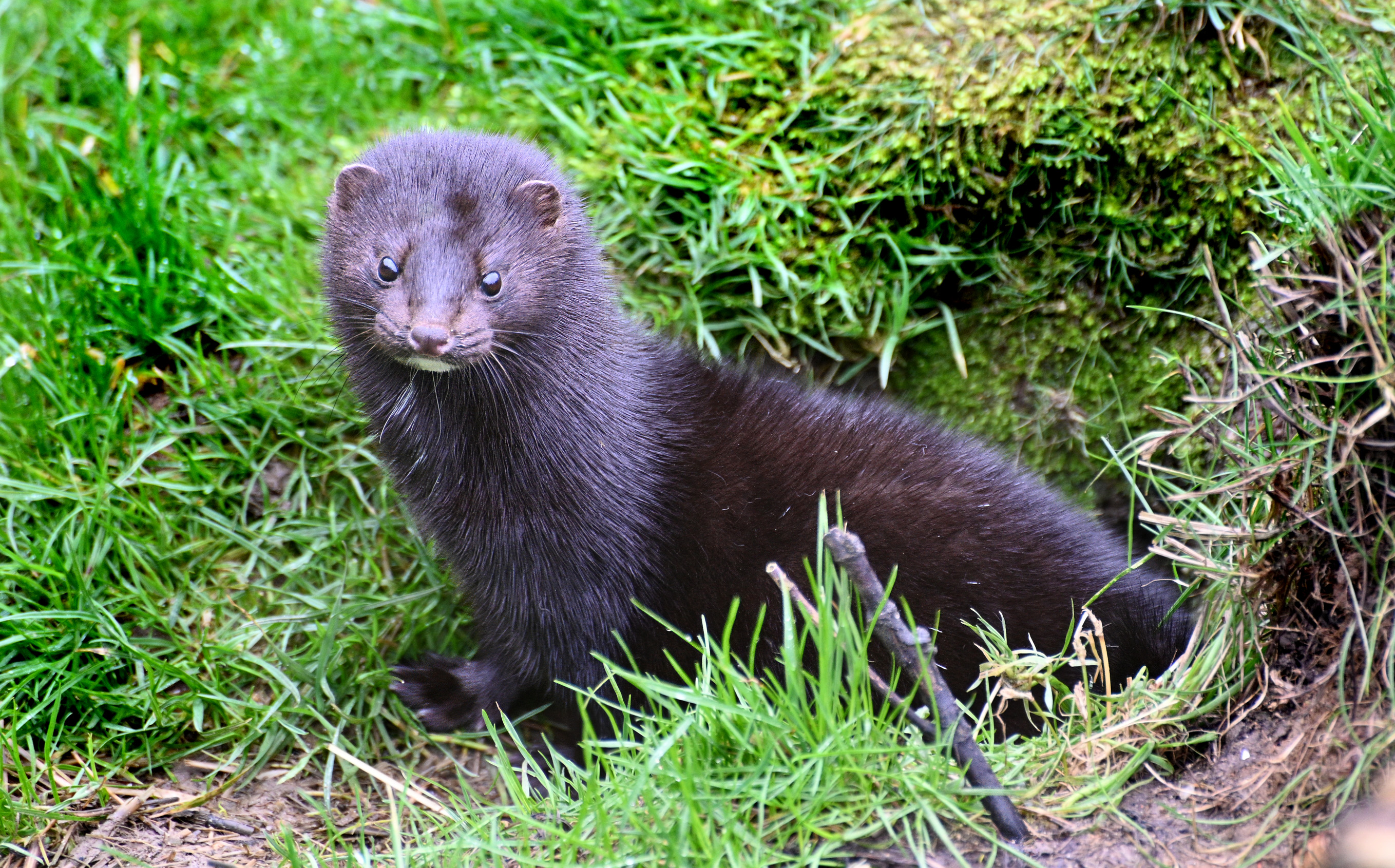
Colour/Appearance: Mink are long, slender mustelids with short legs ending in partially-webbed feet that belie their semi-aquatic nature, and a narrow, pointed face with short but broad ears, shiny brown eyes, and a pink nose encircled by long whiskers. The tail is fully furred and extends about half the length of the body. The soft, dense fur is typically brown, ranging from bright chocolate to very dark (almost black), sometimes with white patches on the chin, chest and throat; oily guard hairs give it the lustrous appearance for which the species has long been prized by fur farmers. Moult occurs twice a year, in spring (late March to July) and autumn (mid-August to November). A variety of colour morphs have been bred in captivity, though fur colour rarely strays from standard brown or black-brown in the wild, with some older animals developing white flecking around the cheeks and nape. Mink do not turn white in winter.
Distribution & Population: Globally, mink are found throughout much of North America, where they're largely native (excluding a population introduced to Newfoundland) though absent from the Arctic coast and some offshore islands. In Europe they're patchily distributed, including northern Portugal and Spain and northern France, and more widely established from Poland east into western Russia and north throughout Scandinavia.
Based on the updated distribution map published by Rachele Vada and colleagues in their July 2023 paper in Mammal Review, mink are probably distributed throughout Britain and Ireland except for the western and northern fringes of Scotland, although confirmed reports are sparser. The map shows the highest densities of sightings in south-east England (London, Surrey, Sussex and Kent) and from central and eastern Wales up into Cheshire and from Lancashire to Cumbria, while reports from Scotland, eastern England and the south-west of England are much patchier. Mink are patchily distributed throughout the whole island of Ireland.
Populations appear to be in decline, largely as a result of conservation projects that cull mink to protect water voles (Arvicola amphibius), and an expansion of the otter (Lutra lutra) in Britain. The Mammal Society's 2018 assessment had insufficient data to confidently estimate the UK population but tentatively suggested about 122,000 individuals.
Habitat & Territory: An aquatic mustelid, mink show a strong preference for riverine, littoral, canal and wetland habitats with abundant, dense cover. They're also found along rocky coastlines and, less commonly, near watercourses in urban areas.
Mink are highly territorial, aggressively defending territories from animals of the same sex, while there's considerable overlap between opposing sexes. Territories are marked by scent, deposited as spraint (greenish, black or brown faeces) on conspicuous objects such as stones and logs, much as otters mark theirs. Mink droppings smell repugnant -- variously described as "fishy" or smelling of burnt rubber or rotting meat -- though it's presumably the anal gland secretion, which contains disulfide and indole, that's the origin of the smell more than the faeces itself. Objects may also be marked with scent from glands on the chest and throat.
As mink tend to be found along rivers and shorelines, territories are typically reported as straight-line distances rather than areas. Males range over larger distances than females, overall covering anywhere between one and six kilometres depending on resource distribution. Male and female territories may show considerable overlap, and the territorial system appears less stable in poor-quality habitats.
Longevity: A female born at Tallinn Zoo, Estonia, in May 1981 reached 11 years and 5 months old, the oldest record of which I'm aware. Grzimek's Encyclopedia of Mammals (1990) suggests the upper age limit is 10 years in the wild, although several sources, including The Mammal Society, suggest an "average" of 10-12 years in the wild.
Sexing: Males tend to be larger than females, though there's considerable overlap. Males range between 34–45 cm (13–18 in.), with a tail up to 25 cm (10 in.), while females typically fall between 30–37 cm (12–15 in.), with a 21 cm (8 in.) tail.
Activity: Active throughout the day and night, though predominantly nocturnal or crepuscular. Mink move with a bounding gait, reaching speeds of around 6.5 km/h (4 mph). They climb and swim well, with about half the body above water level, and will dive for short periods -- typically around 10 seconds, but up to 60, and to depths of about 30 cm (12 in.) -- when hunting fish and crustaceans. Mink appear less active in winter than summer, and males seem to move further than females during the breeding season. Much of their time is spent patrolling their territory, regularly visiting its boundaries.
Predators & Mortality: Probably no natural predators in Britain. Otters have been reported aggressively attacking and even killing mink, though this seems more competitive displacement than predation. Similarly, there are occasional records of badgers (Meles meles) and eagle owls (Bubo bubo) killing mink, while elsewhere in their range they may be killed by wolves (Canis lupus), bears (Ursus sp.), bobcat (Lynx rufus) and lynx (Lynx lynx). Several diseases have been documented among ranched animals, but it's unknown whether these occur in wild/feral populations. A variety of parasites have also been recorded, including the nematode worm Skrjabingylus nasicola, which can cause skull damage. Most mortality is probably human-caused, either directly through eradication programmes or via road traffic, though autopsies of wild animals suggest some die from exhaustion or fighting, and kidney disease has been reported on several occasions. Mink are occasionally found drowned in fish traps and nets.
Diet: A highly opportunistic predator, mink take a wide range of mammal, bird, reptile, amphibian, fish and invertebrate prey, with diet varying geographically and seasonally. Rabbits appear to be important prey in many areas, with rodents and insectivorous mammals somewhat less so. Predation by American mink has been widely implicated in the rapid decline of the water vole in England. Various waterbirds have been recorded in the diet, although ducks, moorhens and coots feature most often in freshwater habitats, while gulls may be regularly taken in coastal regions; mink predation is thought to have caused declines in a few Scottish seabird colonies. Bird eggs are also taken, and mink have been reported to cause losses to poultry and gamebird enterprises.
Fish and shellfish feature heavily in the diet, particularly eels, rockpool fish species, crabs and crayfish, and damage from mink has been reported on fish farms. Frogs and snakes are taken opportunistically, as are beetles, earthworms and molluscs. Some data suggest males may take larger prey than females.
Like many carnivores, mink will sometimes engage in surplus killing – killing multiple individuals of a prey species when conditions allow, and caching leftovers for later retrieval.
Reproduction: Mink are promiscuous, with no long-term pair bonds reported. Females show reproductive swelling from around the winter solstice but don't appear to mate until the rut begins in January; the season runs until around the end of April, with most matings reported in March–April. Mink are induced ovulators -- mating itself triggers ovulation -- but the species also exhibits delayed implantation, such that gestation may last between 39 and 76 days, though most litters in England appear to be born in May. Litters of 4–6 pups are born about 28 days after implantation; young are suckled for 5–6 weeks and reach adult size at about 4 months old. A single litter is produced each year.
In Britain, juveniles appear to disperse from their natal range from August onwards, and many will breed in their first spring. Juveniles may disperse 10 km (6 miles) or more from their home range, with one US study recording a dispersal of just over 50 km (31 miles) in four months.
Behaviour/Sociality: Typically a solitary species, mink come together primarily to mate during the rut. They've evolved a range of threat displays for aggressive encounters, including back-arching, hair standing on end (sometimes called "bottle-brushing") and tail-lashing; they may also stamp and scrape the ground, and mouth-gape. Fighting seems common, particularly among males during the breeding season. Mink usually have several dens throughout their home range, normally close to good foraging grounds and less than 10 m (33 ft.) from water; they seldom excavate their own, preferring to take over disused burrows of other animals or natural cavities, and a lack of suitable den sites might limit population size.
Mink have good eyesight both above and below water, and keen hearing that extends into the ultrasonic range (1–16 kHz) in which the rodents they prey on vocalise. Their sense of smell also appears well developed, and scent marks play an important role in social communication: paired anal sacs open into the anus, and proctodaeal glands open into the rectum, the latter thought responsible for the distinctive smell of mink faeces. Belly-rubbing implies ventral glands, but these haven't been confirmed anatomically. Very few vocalisations have been documented, but ranch data indicate mink hiss or shriek when angry or fighting, and purr or chuckle in a manner similar to a cat when content.
Conservation: Mink have no specific legal protection in the UK, beyond that afforded to all mammals by the Wild Mammals (Protection) Act 1996 and the Animal Welfare Act 2006, both of which make it a criminal offence to cause unnecessary suffering to any mammal. There's a broad drive within Britain to eradicate mink, owing to their detrimental impact on some riverine and coastal birds and mammals and, in January 2026, Natural England and the Environment Agency published the National Framework for Action towards the Eradication of American Mink in England, which set out a vision of an England free of mink by 2035. The Mammal Society's 2018 review estimated that population density had fallen by nearly half between 1996/97 and 2016. In their native range across the United States and Canada, mink are still trapped for fur.
Bibliography
Stoats, Weasels, Martens & Polecats A Natural History of British & Irish Small Mustelids - by Jenny MacPherson
HarperCollins Publishers
-- 2024
-- ISBN: 978-0008334932