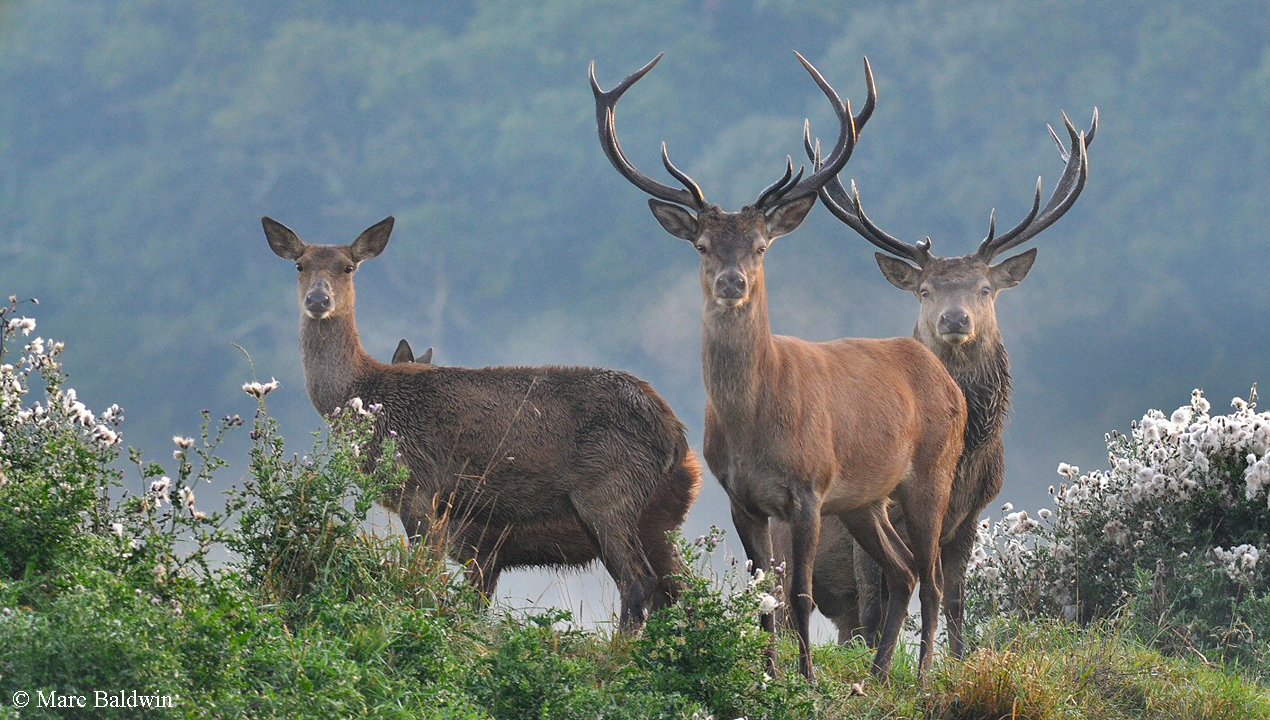
RED DEER
Cervus elaphus
Content
Updated: 27th April 2010
The Red deer has a long history in
Britain – one of only two native deer species in the UK, it’s a beast
highly prized by hunters, naturalists, artists, poets and photographers
alike. Renowned Scottish artist Archibald Thorburn summed up the
situation nicely in his 1920 book British Mammals, in which he wrote
that the Red deer “is unquestionably the grandest wild animal we now
possess in the British Islands.” That which follows is a summary of
Red deer natural history. Certain aspects of the natural history common
to all deer (e.g. antler growth and formation, collisions with vehicles,
chronic wasting disease) have been split from the individual overviews
and placed into their own Q/A – this is partly to avoid repetition but
also to allow more detailed coverage of the topics. A summary of the
more general aspects of the biology, ecology and behaviour of Britain’s
deer species can be found elsewhere on this site.
Taxonomy: Deer classification is a contentious subject, with
disagreement over where the animals sit in relation to other mammals
(namely whether or not they should be grouped with the whales and
dolphins) as well as how many species and/or subspecies should be
formally recognised. Nonetheless, there is agreement that the majority
of deer (i.e. all those except the Musk deer of the south Asian
mountains) can be grouped within a single family: the Cervidae. The
Cervidae holds two subfamilies: the Old World deer of the Cervinae and
the New World deer of the Capreolinae. Within the Cervinae sit two
tribes: the Cervini (“true deer”) and the Muntiancini (muntjacs). It is
the Cervini tribe that interests us here – it contains four genera:
Axis; Dama; Rucervus; and Cervus, which holds the Red deer in its
various forms. We now arrive at something of a taxonomical minefield!
Cervus is, to say the least, a contentious genus and there is much
debate as to the number of species, and especially the number of
subspecies, it contains. I have opted to follow the bulk of the
molecular data here and as such consider there to be 10 species within
the Cervus genus (12 if recent molecular data are confirmed – see
below). I should mention that the close relationship between members of
Cervus means that there is apparently a terrific potential for
hybridization, which serves to further confuse the allocation of species
within this genus. Fertile hybrids of Sika (C. nippon) and Red are known
from the wild, while two papers to the Journal of Heredity during 1997
demonstrated that successful conception can result from crossing Red
deer with both Sambar (C. unicolor) and Pere David’s (Cervus davidianus)
deer, although both studies used artificial insemination and success
rates were low. Indeed, it’s worth remembering that what happens in
captivity and what happens in the wild may be very different!
The majority of Cervus species have been fairly well defined, but
there are two in particular that have caused (indeed, are still a source
of) much controversy – debate rages over whether the wapiti and Red deer
should be considered the same, or distinct, species. The wapiti range
over much of North America and eastern Asia and are superficially
similar to the Red deer of Europe and Asia (an area collectively termed
“Eurasia”). (Incidentally, the wapiti are often referred to as “elk” in
North America, but should not be confused with the European “elk”, or
Moose, Alces alces!) Traditionally, many authors have chosen to lump
wapiti within (i.e. as a subspecies of) the Red deer because, despite
various anatomical, biochemical, ecological, behavioural and (more
recently) genetic differences, wapiti are able to hybridize successfully
-- i.e. to produce fertile offspring -- with contiguous populations of
Red deer. Consequently, many scientists prefer to think of Cervus
elaphus as a “superspecies” or “ring species”, containing a number
of very closely-related animals that can all be considered Red deer.
However, not everybody agrees.
The idea that Red deer and wapiti are distinct species is not a new
one; some of the first suggestions were made in 1737 and wapitis were
first elevated to the species level by German naturalist Georg Heinrich
Borowski in 1780. In 1806 Pennsylvanian-born naturalist and physician
Benjamin Smith Barton suggested that North American elk and Red deer
from Europe were sufficiently different to be considered different
species and proposed the name wapiti, meaning “white rump”, for the
North American elk. Since then, the wapiti has been the subject of much
taxonomic yo-yoing, being moved between a full species, Cervus
canadensis, and a subspecies of Red deer (Cervus elaphus canadensis).
Work by taxonomists from the mid-1980s to the mid-1990s led to the
splitting of wapiti and Red deer based on data from skeletal
measurements, protein assays and haemoglobin morphology. However, in
their review of the situation in 1989, Patrick Lowe and Andrew Gardiner
concluded that, from their analysis of nearly 300 deer skulls, although
some morphological variation exists supporting the separation at the
subspecies level, “there appears to be no justification for
distinguishing between them at the species level”.

A Western Red Deer, or Wapiti, (Cervus
canadensis) bull.
In 2001, Instituto Nazionale per la Fauna Selvatica (Italy)
taxonomist Ettore Randi and four colleagues published a study in the
journal Animal Conservation supporting the idea that European Red deer
should be split from the North American animals. The study looked at
mitrochondrial DNA (mtDNA) sequences from 13 species of deer (seven from
the Cervus genus) and found that the wapiti formed a clade, as distinct
from European Red deer, which is nestled with the Sika deer (Cervus
nippon) on their cladogram. In their summary, the researchers wrote:
“Cervus elaphus includes two divergent clades that must be referred
to as species elaphus (European elaphoid deer) and canadensis (Eurasian
& North American wapitoid deer).”
A large study, published in the journal
Molecular Phylogenetics and
Evolution during 2004, by Technical University Munich-Weihenstephan (in
Germany) taxonomist Christian Ludt and three colleagues, looked at a
particular gene carried on the mtDNA of 51 populations of deer spanning
the entire distribution of Cervus. The geneticists found that they could
identify two distinct groups: an eastern group (comprised of Cervus
canadensis
and several subspecies) and a western group (containing
Cervus elaphus), which split from each other about 7 million years ago.
Most subsequent molecular studies looking at deer taxonomy support the
division of wapiti and Red deer into separate species. With Cervus
canadensis
removed from the equation, we’re left with our species of
interest: The European Red deer, Cervus elaphus (henceforth
referred to as the Red deer).
Red deer, as we currently think of them, may actually be as many as
three separate species, according to the cytochrome analysis performed
by Christian Pitra and his colleagues published in the journal Molecular
Phylogentics and Evolution during 2004. I won’t go into much detail
about the findings here, but suffice to say that Dr Pitra and his team
found molecular evidence to suggest that Red deer from Central Asia and
those from North Africa and Corsica-Sardinia may represent species as
distinct from Cervus elaphus (Cervus yarkandensis and Cervus corsicanus,
respectively). The findings of Dr Pitra and his colleagues require
additional study and no such split has been widely accepted.
The terrific variation observed in Red deer throughout their range
has lead to the description of many potential subspecies. In his
Whitehead Encyclopedia of Deer, G Kenneth Whitehead lists 12 sub-species
(the highest number I’ve come across is 22) including Cervus elaphus
hippelaphus (the Carpathian Red from central Europe), Cervus elaphus
hispanicus (Spain and Portugal), Cervus elaphus atlanticus (Norway) and
the type specimen (i.e. that first described by taxonomists) Cervus
elaphus elaphus (Sweden). The variations between these subspecies range
from the subtle to the striking. Carpathian stags, for example, may
weigh in at some 500kg (1100 lbs), while the Corsican Red (Cervus
elaphus corsicanus) typically reaches less than 100kg (220 lbs);
Red stags in Britain and Norway sport thick, dark neck manes, while
those in Spain fail to develop any trace of a mane.
Coat colour and differences in the size and shape of the antlers are
also often among the characteristics used to distinguish subspecies.
Unfortunately, the majority of these traits are not good taxonomic
indicators, because they’re readily influenced by the environment –
arguably this is especially true for body size and antler growth, both
of which can be severely limited in habitats with poor grazing/browsing,
even though antler development appears deeply rooted in the animal’s
genetics. Consequently, the subspecific division of the Red deer remains
a controversial topic. I don’t wish to get too tied up in the debates
over which are valid subspecies and why, but I will briefly cover the
story of the subspecies considered by many to be the native stock of
Britain: Cervus elaphus scoticus.

A Scottish Red deer stag, often
classified as Cervus elaphus scoticus.
In 1906, Swedish zoologist Axel Lönnberg (who often went by his
middle name Einar) published a paper in the journal Arkiv för Zoologi
about the geographic races of Red deer. In the paper Dr Lönnberg
compared the skull anatomy of Red deer collected from various parts of
its range and proposed several of the 12-or-so subspecies still in
contention today. In particular, Dr Lönnberg describes the skulls of two
stags killed in Glenquoich Forest in Invernesshire, north-west Scotland.
The skulls displayed some features in common with Swedish (C. e.
elaphus) skulls and others in common with Norwegian (C. e. atlanticus)
skulls, but could not be confidently allied with either subspecies. In
his appraisal, Dr Lönnberg wrote of the Scottish deer:
“It is accordingly neither identical with the typical race of
southern Sweden nor with the race of western Norway and most probably
forms an independent geographic race or subspecies which suitably may be
termed scoticus.”
Since Dr Lönnberg’s comparisons, the Scottish Red deer has been
widely referred to as C. e. scoticus. However, more recently, several
studies have suggested that there may be far fewer than 12 subspecies
and have cast doubt on the validity of the Scottish Red as a valid
subspecies. In a major review of Red deer taxonomy published in the
Journal of Zoology during 1974, Patrick Lowe and Andrew Gardiner found
that C. elaphus exhibits a high degree of morphological similarity
between the animals across their range. Generally-speaking, it is
considered that in order for two individuals to be considered for
subspecific status, there should be a maximum of 10% overlap in physical
characteristics – in other words, they should be at least 90% different
from each other. Drs Lowe and Gardiner examined the skulls of 10 of the
19 subspecies of Red deer listed by John Ellerman and Sir Charles
Morrison-Scott in their 1951 Checklist of Palaearctic and Indian Mammals
1758 to 1946, examining 16 variables of skull size and shape and
subjecting the data to three separate statistical analyses. The
taxonomists did find evidence for two distinct, yet “visually
identical”, ‘forms’ of Red deer living wild in Britain (one in Scotland,
Ireland and northern England, presumed native, and another of apparent
park origin found through the rest of England), but only atlanticus
overlapped with the other subspecies by less than 10%, while scoticus
was 60% similar to the hippelaphus subspecies from Europe and
Scandinavia. Overall, the biologists failed to find support for more
than a single subspecies of Red deer in northern Europe, the type
species Cervus elaphus elaphus and in their conclusion they wrote:
“None of the features of the skull measured for this study support
the concept of subspeciation in red deer, there being no discontinuities
between the various subspecies sampled.”
Genetic data have contributed greatly to our understanding of
subspecific relationships among deer, although the debate is far from
settled. In a 1983 paper to the journal Heredity, Ulf Gyllensten and
three colleagues presented data from nearly 600 tissue samples on the
genetic diversity of four proposed subspecies from Britain, Germany,
Norway and Sweden. Dr Gyllensten and his team found what they called “a
major genetic dichotomy” between British and Norwegian deer on the one
hand and Swedish and German deer on the other. In other words, scoticus
and atlanticus form a group that are more closely related to each other
than either is to elaphus or some hippelaphus
specimens. This would suggest that even if all four subspecies aren’t
valid, a subspecific divide may exist between Swedish/German and
British/Norwegian deer.
More recently, Christian Ludt and his team presented their data from
a special type of protein called a cytochrome. In addition to the
east-west divide uncovered by the German biologists (see above), they
failed to find any support for the subspecies atlanticus, brauneri,
elaphus, hippelaphus, hispanicus and scoticus within the western group –
in other words, they couldn’t distinguish these specimens from the “type
specimen”, C. e. elaphus. Conversely, Dr Pitra and his team found more
support for some of the subspecies, but didn’t include samples from
either C. e. elaphus or C. e. scoticus. Unfortunately,
as far as I am aware, at the time of writing this is as far as the
situation has been taken, so we remain in something of a hiatus.
Despite the conflicting data, many authors consider that the
remaining native stocks of Red deer in Britain are represented by a few
populations of Cervus elaphus scoticus residing on the Scottish
hillsides and in parts of north-west England. Overall, I feel it is
probably best to avoid reference to subspecies until the situation is at
least closer to resolution. Consequently, the following classification
scheme works down to the species level and applies to Red deer
throughout their range (including the UK). While I have split out the
wapiti from the Red deer, the remainder of this overview will draw on
research and data on Red deer from throughout their range, irrespective
of proposed subspecies, but will focus on research carried out on
British populations where available. Similarly I will attempt to refer
to subspecies only where a given study makes particular reference to it. With that in mind, the current taxonomy of this species is as follows:
Kingdom: Animalia (Animals)
Phylum: Chordata (Possess a basic
'backbone')
Class: Mammalia (Mammals)
Order: Artiodactyla (‘Even-toed’
ungulates)
Family: Cervidae (Deer)
Subfamily: Cervinae (‘Old World’
deer)
Tribe: Cervini (‘True’ deer)
Genus: Cervus (Latin for “deer”)
Species: elaphus (from Greek elaphos, meaning “deer”)
For more information about how and why we
classify organisms, please see the Taxonomy page. (Back to
Menu)
Size: The following are
generalised figures for the height, length and weight of Red deer. As
David Macdonald and Priscilla Barrett point out in their Field Guide to
the Mammals of Britain and Europe, measurements of deer vary
considerably according to habitat, population density and prevailing
conditions. The mammalogists also note that there is a distinct
east-west cline, with animals in the east (e.g. in Scotland) being
smaller than those in the west (e.g. North America), although if one
subtracts the wapiti -- which aren’t the same species -- the difference
is more subtle. Indeed, in his Deer of the World, Valerius Geist
considers the view that Red and wapiti deer form a gradual cline to be
“unfounded”. Overall, there is tremendous variation in size across their
range, with deer living in poor habitat being stunted in both overall
size and antler development. At the lower end of the size range is
probably the Corsican Red deer, which typically weigh in at 80 kg (176
lbs), while those of the Carpathian Mountains sit at the other end of
the scale, attaining weights of six-times this.
Adult Red deer in the UK and Europe are usually between 1.6 and 2.6 m
(5.5 to 8.5 ft) in length and a full-grown stag stands about 1.2 m (4ft)
at the shoulder; hinds are slightly smaller, standing about 1 m at the
shoulder. Both sexes possess a tail of between 10 and 20 cm (4 – 8 in.)
in length. In the wild, adult Red stags generally weigh in at between 90
and 260 kg (200 – 570 lbs) depending upon the habitat, while hinds
typically do not exceed 150 kg (330 lbs). Weight at any given time is
highly dependant upon season and food availability and a mature stag in
very good conditions can weigh as much as 340 kg (750 lbs). Individuals
from England, especially English parks and deciduous woodland, are often
significantly larger than conspecifics (other animals of the same
species) on the impoverished hillsides and moorlands of Scotland. The
reason for this size disparity seems to be related to the amount of food
available during the crucial winter months. A study by a team of
biologists at the Rowett Research Institute in Aberdeen, published in
the British Journal of Nutrition during 1983, (further details in
Food and
Feeding) concluded:
“On Scottish hills deer reach a size appropriate to their environment
rather than their genetic potential.” (Back to Menu)
Colour: Red deer have a
short, rich red-brown summer coat with little or no underwool, which
starts to grow around May-time and is typically complete by late July or
early August – the hair is a fairly consistent red-brown colour along
its five centimetre-or-so (2 in.) length. During September, a longer,
coarser (hair is slightly corrugated) grey-brown winter coat starts to
grow, and is complete by the end of the year. The winter coat is
accompanied by a layer of underwool about two centimetres (1 in.) thick;
the hair colour changes from pale brown at the base to very dark brown
or black in the middle and light red-brown at the tip. The rump patch
is a yellowish or cream colour (see below left), with a short beige-coloured
tail; rump patch colour varies tremendously in relation to geography and
this is a feature commonly used as a distinguishing feature of
subspecies. Similarly, stags in some regions develop a mane during the
autumn that’s carried for the winter months (e.g. in Britain); the mane
is typically slightly darker in colour than the rest of the coat and may
be accompanied by a dark stripe down the animal’s back. The colour of
the fur on the underside varies from off-white to yellowish or grey and
on a rutting stag it may be heavily stained with urine and mud (giving a
dark brown or black appearance). The overall colour of the animal may
vary according to location: Red deer residing between the Black and
Caspian seas (the Caspian Red deer), for example, have a more
uniformly-grey coat and lighter rump patch than those in Europe.
Newborn deer are spotted for the first
few months of life, but spots are uncommon on adult coats, although on
occasion adults have been observed with a double row of spots running
down the back. Calves undergo two moults in their first year: the
neonatal “pomeled” (spotted) coat, which is shed at about two months
old, is followed by the growth of the winter coat during the
autumn. Older stags and those in better condition generally begin and
complete their moult before younger animals; the moult starts at the
front of the body (i.e. head, legs etc) and progresses posteriorly.
Deviations from the ‘typical’ colouration
seem rare, although as mentioned, some individuals may be darker or
lighter than others. Records of albino Red deer are rare; non-albino
white ‘morphs’ are reported more frequently. In his Whitehead
Encyclopaedia of Deer, Kenneth Whitehead notes that white morphs of the
Red deer have been preserved in deer parks, most notably Kinmonth in
Perthshire, Charborough in Dorset, Woburn in Bedfordshire and Zleby in
Czechoslovakia. It seems that entirely or predominantly white
individuals are occasionally reported from the wild, including sightings
in the Scottish deer forests, Scotland’s Corrie Ba and on the Quantocks
in Devon. There are also various legends, superstitions and stories
involving white deer, most notably stags, including that of David I of
Scotland, who was apparently almost killed by a white stag in 1128, and
the legend of a young white stag befriended by locals on the Island of
Arran off Scotland’s west coast – unfortunately, the stag became too
bold and was eventually shot by the estate’s Head Keeper in December
1970.
Colour variations may also take the form of “bald-faced” or
white-faced individuals, which exhibit white patches on their heads,
varying in size from a small patch on the forehead to a large white band
down the length of the face between the eyes, or even a completely white
face; individuals may also have white ‘socks’. Additionally, in their
contribution to Mammals of the British Isles: Handbook, 4th Edition,
Brian Staines, Jochen Langbein and Tim Burkitt mention that the summer
coat is “sometimes whitish or skewbald [patches of white]”, an
observation also made by Mr Whitehead. Indeed, it seems that pure white
morphs are uncommon and, in her 1991 book Deer, Norma Chapman notes that
although white morphs of Cervus elaphus have been documented, they are
seldom entirely white – they usually have a patch of red on them
somewhere. Interestingly, none of the aforementioned authors make
mention of melanistic (very dark or black) forms. (Back to
Menu)

Piebald patterning in fur of a
White-tailed Deer (Odocoileus virginianus) doe.
Distribution and Population:
Red deer are found throughout much of Europe, including a large swathe
covering north France, Germany, Austria, Czech Republic, Hungary, Slovak
Republic and Poland. They are also found in Norway, southern Sweden,
parts of Latvia and Estonia, and throughout Turkey into northern Iran,
north through Georgia into southern Russia and west to Crimea. There are
smaller populations in Spain, southwest France, west Italy and
Yugoslavia. Red are the only deer species that inhabit Africa, where
they are found in the Atlas Mountains in the north of the
continent. This species is generally absent from Mediterranean islands,
the exceptions being Corsica and Sardinia. Outside of Eurasia, this
species has been introduced to parts of South America as well as New
Zealand and Australia.
In the UK, Red deer are most abundant in the Scottish Highlands and
Outer Hebrides -- where they are still considered "native stock",
generally referred to as Cervus elaphus scoticus -- although
their distribution includes most of Scotland, with the exception of the
eastern fringes of Aberdeenshire, Kincardineshire and Angus – they
appear to be absent from Fife and a belt across southern Scotland from
roughly north Ayrshire to Berwickshire. Within England, there are
isolated populations in the Lake District (Cumberland and Westmorland),
parts of East Anglia (Cambridge, Norfolk and Suffolk), parts of
Hampshire and Wiltshire (the New Forest), the Quantocks in Somerset, and
Exmoor in Devon. The 2007 Deer Distribution Survey (published by The
British Deer Society) suggests this species has expanded into the
Midlands (Yorkshire, Derbyshire and Lincolnshire) and further into East
Anglia (Essex and Middlesex) and down into Surrey, Sussex and Kent in
recent years. There also appears to be expansion of the Hampshire
population west into Dorset.

The approximate distribution of the
main Red deer (Cervus elaphus) populations throughout Europe
(red colouration). This map is based on multiple sources, amended as per
Derek Yalden's drafts in Mammals of the British Isles: Handbook, 4th
Edition (2008) and the British Deer Society's 2007 survey maps. It
does not include single sightings nor records of vagrant animals.
Red deer are apparently absent from many
of our islands, including the Isle of Man, Orkney Isles and the Shetland
Isles. The Isle of Wight, just off the coast of Hampshire, is generally
considered free of deer, except for those held in deer parks on the
island (e.g. at Carisbrooke, right) – there are certainly no endemic
populations. However, there are some reports to suggest park escapees
may have been living in the wild on some parts of the island. In his
round-up of the amphibians, reptiles and mammals recorded during site
visits and surveys in 1997 (published in the 1998 Proceedings of the
Isle of Wight Natural History and Archaeological Society), Richard
Grogan mentioned escaped Red deer. Apparently, a group of Red deer were
frequently seen in the Calbourne/Brightstone Forest area in the
south-west of the island, while three other individuals were seen
wandering outside the deer fencing at Chale in the south during the same
year. In his round-up for 1999, Mr Grogan commented on deer grazing
damage at Firestone Copse, near Wooton in the north-east, although he
seemed to link this to Fallow deer (Dama dama), rather than Red. The
2000 Proceedings were the last to include a round-up of vertebrate
sightings, but Mr Grogan informs me that there are currently no known
feral populations of Red deer on the island.
There are scattered populations in Wales,
including Welshpool, Monmouthshire, and parts of the Lleyn peninsular –
these probably represent escapees from Powis Castle near Welshpool and
various deer farms. There are isolated populations in Ireland, including
Donegal, Down, south-west Connaught Province, Limerick, Wexford and
Kerry.
Deer are typically secretive mammals that
are acutely sensitive to humans (or predators) sneaking around in the
undergrowth; even where they dwell in or close to large human
settlements, they can be difficult to spot. Moreover, deer often live in
dense woodland/plantations or remote hillsides and the habitat in which
they live contributes directly to the degree of ‘critical resource
stress’ (i.e. some resource necessary to survival is in short supply)
that the animal is exposed to, which regulates breeding success and
ultimately controls population productivity. Thus, it is not difficult
to understand that they are hard to survey, making it a challenge to
obtain accurate information about numbers and population demography
(i.e. size, structure and overall changes in populations with
time). Over the years many have tried to estimate deer numbers in
Britain, but only recently -- with the aid of large networks of
scientists and volunteers using various techniques from counting scats
to radio-tracking -- have we started to get what we think is a good idea
of deer numbers.
In a 2005 paper to the journal Mammal Review, British Deer Society
(BDS) biologist Alistair Ward presented an analysis of data collected by
the BDS between 1969 (their first attempt to survey British deer
populations) and 2002. From the survey data, Dr Ward estimated that Red
deer numbers had expanded at a compound rate of 0.3% per year, the
lowest of the six species studied. [Click here for an explanation of
compound vs. simple interest] The range expansion of Red deer in England
and Scotland (recording efforts in Wales and Northern Ireland prior to
2000 were too low to provide a true picture of deer expansion) had also
been much slower, and the total area into which they’d expanded was
smaller, than for most of the other deer species. Dr Ward suggested
that, although Red deer use woodland throughout much of their range, the
thick abundant new woodland plantings may offer less suitable habitat
for them than other species (e.g. Roe deer, Capreolus capreolus), while
the large urban gardens and parks that have assisted the spread of
species such as the Roe and Muntjac (Muntiacus reevesi) are probably
unsuitable for Red deer and may even represent a physical barrier that
prevents or hampers their spread. The data analysed by Dr Ward also
revealed that Sika deer (Cervus nippon,
left) had encroached
significantly into the range of the Red, occupying 41 (7%) of the 10 km
survey squares in the Red’s range in 1972 and 275 (36%) by 2002 – Dr
Ward described this as a “trend that causes concern”. Finally, by
comparing the country-wide estimate of Red deer numbers provided by
Steve Harris and colleagues in their 1995 JNCC publication A Review of
British Mammals (360,000 animals) to the numbers estimated to be present
in Mesolithic (12,000 to 3,000 B.C.) Britain, Dr Ward concluded that
their numbers were “closer to their former population sizes than they
have been for centuries”.
In their UK Mammals: Species Status and
Population Trends report, published in 2005, the Mammal Tracking
Partnership gave estimates of Red deer numbers in Scotland, England, and
Wales of 347,000, 8,000 and less than 500, respectively; this puts the
overall figure for British Red deer at 355,500, close to the estimate
given by Prof Harris and colleagues in 1995. The UK Mammals report also
noted that the population in Scotland appears to have been increasing
steadily since 1969 (although it may now have stabilised), while Red
deer are increasing in both range and number across the south and west
of England.
In the 2008 Mammals of the British Isles: Handbook, 4th Edition,
Brian Staines, Jochen Langbein and Tim Burkitt present a collation of
the population literature and arrive at a figure of between 335,350 and
366,110 Red deer in the major populations within the British Isles. A
breakdown of their data suggests that the vast majority of these deer
(some 95%) live on the hillsides and plantations of Scotland. These
figures tally with the Parliamentary Office of Science and Technology’s
POSTnote, published in February 2009, which gives a population estimate
for Red deer of “>350,000”. The POSTnote gives the same estimate of
population growth as Dr Ward’s 2005 appraisal: roughly 0.3% per annum.
Unfortunately, the situation in Ireland is less clear. There were
insufficient survey data for the UK Mammals report to estimate deer
numbers here and neither the POSTnote nor Dr Staines and his co-authors
make any specific reference to Irish numbers. The Wild Deer Association
of Ireland (WDAI) doesn’t offer an overall estimate of numbers although,
on their website, they do note that there were 690 Red deer in the
Killarney National Park during the mid-1990s. More recently, in February
of this year (2009), several newspapers carried the story that Ireland’s
authorities (in this case the Irish Farmers’ Association, Irish Deer
Society and WADI in conjunction with the government) were planning a
widespread cull of deer. The quotations carried by the newsmedia didn’t
provide details as to the number of different species, but they did
suggest that upper estimates put the total number of deer in Ireland at
around 100,000. Despite this, on their website, the Irish Deer Society
point out that: “It is not known how many [deer] there are in Ireland as
no national comprehensive survey has been done.”
It should be noted that a drawback to using national estimates of
population figures is that they can mask local trends. In the New
Forest, for example, numbers have fluctuated considerably even to the
point of this species disappearing from the Forest altogether. The New
Forest Park Authority currently estimates there to be about 180 Red deer
on the Crown Lands, a number that is actively maintained by stalkers.
Elsewhere, Red deer populations have apparently seen a considerable
increase locally in recent years. In his 1972 book on the subject, Eric
Lloyd estimated that there were 500 to 800 Red deer on Exmoor, a figure
that was increased to between 700 and 900 by Gordon Miller, John Miles
and Bill Heal in their 1984 A Study of Exmoor, and upped again by Noel
Allen in his 1990 book Exmoor’s Wild Red Deer, who put the figure at
around 1500. Today, the Exmoor National Park Authority estimates that
there are some 3000 Red deer on the farms, woodland and moorland of
Exmoor. Similarly, a report published by the Royal Society for the
Protection of Birds and what was the World Wildlife Fund (now World Wide
Fund for Nature) in 2003 suggested that, after massive declines in
numbers up to the 1800s, deer populations in the Scottish Highlands have
now exploded; the report cites an increase from 300,000 in 1989 to
450,000 in 2002. However, in a brief communication to the journal
Nature
during 2004, Tim Clutton-Brock, Tim Coulson and Jos Milner argue that
the Scottish deer population is unlikely to be increasing by such a
startling rate, pointing out:
“A large part of the apparent increase [given in the RSPB/WWF report]
is due to the arbitrary tripling of the estimated number of deer living
in woodland, where they cannot be counted reliably.”
Deer density is another feature that can
vary considerably locally and, as we shall see shortly, the distribution
of resources has a pivotal influence on the area over which an animal
needs to range in order to find sufficient food. Consequently, the
number of deer that live in an area is dependant upon the resources
therein and this is significant in explaining the considerable
variations we see in deer densities. The Mammals of the British Isles:
Handbook, 4th Edition provides estimates of 10 to 15 animals per sq-km
in major deer forests and plantations, 20 to 25 per sq-km in Ireland’s
conifer woods, nine per sq-km on open hillsides and in excess of one
hundred per sq-km on some winter ranges. In their 1993 Field Guide to
Mammals of Britain and Europe, David Macdonald and Priscilla Barrett
give population densities of between five and 45 animals per square
kilometre, depending on the habitat.

Deer numbers can be assessed by
various methods, including spotlight counts, volunteer surveys and by
counting piles of deer scat within a given area.
The above photo shows scat of the Sika deer, Cervus nippon.
A summary of the fluctuation in Red deer numbers in Britain as a
result of human interference and management can be found in the
Interactions with Humans section. (Back to Menu)
Ageing and Longevity: There are various myths involving long-lived
stags. Perhaps the most famous is a Gaelic proverb that, according to
John Fletcher in his A Life for Deer, can be traced back to the Greek
poet Hesiod and forms the basis for the mediaeval pavement in front of
the high alter at Westminster:
Thrice the age of a dog, the age of a
horse;
Thrice the age of a horse, the age of a man;
Thrice the age of a
man, the age of a deer;
Thrice the age of a deer, the age of an eagle;
Thrice the age of an eagle, the age of an oak tree.
Assuming a generous estimate for ‘old
age’ during the Iron Age, this would put ‘the age of a deer’ at about
120 years old! Equally, even if the proverb was written by Hesiod, who
many scholars believe lived during the eighth century BC, we still
arrive at an impressive age of 90 years for the deer. As one might
expect, modern day estimates don’t come anywhere close to these values.
According to Frankfurt Zoo biologist Richard Weigl’s
Longevity of
mammals in captivity; from the Living Collections of the world, the
oldest Red deer on record is a female (listed as subspecies sibiricus)
who was born at Kiev Zoo in July 1968 and died in January 2000 at the
ripe old age of 31 years and six months. Mr Weigl published longevity
records for 20 subspecies of Cervus elaphus in his 2005 book –
the record for the subspecies elaphus stands at 21 years and 4 months,
while that for scoticus is held by a female born at Washington Park Zoo
during October 1927 that died in June 1954 at the age of 26 years and
eight months. Interestingly, Mr Weigl doesn’t mention a hind, nicknamed
‘the old lady of Richmond Park’, who apparently survived to 27 years
old.
Despite these rather impressive figures, these are all ages for
captive deer and the maximum age that an animal can reach in captivity
(with plenty of food, no predators, veterinary care etc.) is often a far
cry from the maximum age attainable in the wild. A cursory inspection of
the literature suggests that the oldest wild hinds attain about 25 years
old, while stags reach about 18 years old. Arguably, reaching 25 in the
wild is the exception rather than the rule; indeed, records of wild
hinds living beyond 15 years and stags beyond 12 years are rare.
Overall, the demographic data from the population of Red deer on the
Scottish island of Rum suggest that few specimens live longer than about
eight years. In her 1991 book, Deer, Norma Chapman pointed out that some
researchers have estimated that 50% of Scottish Red deer attain an
average age of four years, while only 25% reach eight-years-old.
Interestingly though, in volume three of his Mammals of Great Britain
and Ireland (published in 1906), English naturalist and travel writer
John Guille Millais wrote that Red stags reach their prime at about 11
years old and remain at this ‘peak’ for another four or five years!
Ageing Red deer from their physical appearance is not an easy task.
There are many features that experienced stalkers may use to assess age
-- for example body size, head length, time of moult, antler casting,
and various aspects of antler morphology -- but, as Rory Putman pointed
out in his 2005 report for the Deer Commission for Scotland:
“None of these factors however shows linear correlation with age.
Thus indicators used may be sufficient simply for categorical
distinction between discrete age classes rather than as indicators of
precise age.”
Indeed, most books on deer make
reference, at some point, to it being a common misconception that you
can age a deer by counting the points on its antlers – while the general
pattern of antler development seems to be ‘genetically fixed’ there are
other factors (most notably food quality) that can influence the final
arrangement. Nonetheless, this doesn’t mean that we shouldn’t look at
antlers in a bid to estimate age. Indeed, in their contribution to
Mammals of the British Isles, Brian Staines, Jochen Langbein and Tim
Burkitt note that, while antler size per se is a poor indicator of age,
beam width, coronet breadth and height of the coronet above the skull
are good indicators.
Obviously, antler morphology is only of
any benefit during certain seasons, and if the animal you’re trying to
age is a male, even then there can still be some ambiguity associated
with antler measurements. Consequently, biologists turned their
attention to teeth. When using dentition to infer age we are immediately
confronted with the problem that, contrary to popular misconception, it
is difficult to reliably tell the age of an animal from tooth wear, and
tooth eruption is of limited use. Tooth eruption is generally only
helpful for young animals (up to the age they obtain their permanent
dentition). Indeed, in a 2002 paper to the journal Anales de Biologia, a
group of Spanish biologists report their findings from a detailed study
of the tooth eruption pattern in Red deer from Sierra Morena in southern
Spain. The researchers concluded that, despite some difficulties
(including delays in the replacement and eruption of some teeth), it is
possible to determine age in this species up to three-and-a-half years
old by studying gradual changes in the teeth. In a 2003 paper, three of
the same Spanish researchers found that whether or not the mandible
(lower jaw bone) is fully grown may also point to the deer’s age, with
female mandibles being fully developed at around 55 months (4.5 years)
and males complete at about 80 months (6.5 years), although this
requires the deer to be dead in order to confirm. A similar study in
Norway yielded similar results; in a huge sample of more than 40,000 Red
deer it was found that there was a distinct relationship between
mandibular proportions and age, but this decreased with age and the
relationship between mandible size and weight was almost flat by the age
of five years.
In her 1991 book, Deer, Norma Chapman
noted that studies of captive Red and Fallow deer found that it was
possible to age the animals based on the level of wear on and between
each slope of each molar, with the total score giving the deer’s
age. Indeed, based on his studies of the Red deer population of Rum,
Victor Lowe wrote in a 1967 paper to the Journal of Zoology that “88% of
the marked deer up to the age of 8 years could be reliably aged from
tooth replacement, eruption and wear”. Despite Dr Lowe’s success, the
amount of wear on teeth is typically a poor indicator of age, because
the rate at which teeth wear down is almost exclusively a result of the
animal’s diet – there are some other contributing factors (tooth
topography and genetically controlled tooth mineralisation, for example)
but it generally holds that the coarser the diet, the quicker the teeth
wear. Thus, two populations of the same species could easily display
different degrees of tooth wear if they’re feeding on a different
diet. Moreover, work by Leif Loe at the University Center in Svalbard in
Norway, between 1971 and 2001, suggests that tooth wear actually
decreases with age in Red deer. In a 2003 paper to the journal
Oecologia, Dr Loe and his colleagues present data on tooth wear for
2,659 Red deer (roughly evenly split between the sexes) between three
and 25 years old. The zoologists found that the rate of tooth wear
declined with age such that four year old stags wore down their molars
at about 0.61 mm per year (0.024 in.), while stags at 11 years old
displayed wear rates of only 0.45 mm per year (0.018 in.). Rates of
wear were slightly lower in females, with four and 11 year old hinds
experiencing 0.52 mm (0.020 in.) and 0.39 mm (0.015), respectively. The
authors suggest that this difference in rate of wear between the sexes
is a result of a difference in diet selection, with males feeding on a
lower quality diet than females. Indeed, it has now been well
established that many grasses have granular structures called
phytoliths, of various sizes and shapes, made of silica on the surface
of their leaves – these phytoliths are hard and sharp (this is why you
can cut yourself on grass) and cause considerable wear on the teeth of
herbivores.
Given the problems associated with
inferring age from tooth eruption or wear, during the 1960s, scientists
came up with the idea of looking inside the teeth. More specifically,
they discovered that you could get a pretty good idea of a deer’s age if
you sectioned a tooth and counted the annuli (‘rings’) in its root –
this is known as the cementum method of ageing. The biochemistry that
governs the deposition of annuli is rather complex, but essentially it
appears that deer are low in blood-serum protein and phosphate during
the winter months, which leads to improper calcification of the tooth’s
cementum. This poorly calcified, narrow layer (sometimes referred to as
a ‘rest line’) shows up as a darker band in the tooth and there should
be one such band present for each winter through which the deer has
lived. In a 2004 paper to the Wildlife Society Bulletin, the same
Spanish biologists -- who published their data on Spanish Red deer tooth
eruption and mandible growth -- report on the efficiency of ageing deer
by using growth marks in their teeth. The researchers found that molars
provided the most accurate ages, correctly ageing 75% of their animals,
while only 49% of age estimates made from incisors were
correct. However, when the scientists widened the goal posts a little,
increasing the confidence limit to one year (i.e. the estimate could be
either a year over or under the actual age), they found that molars and
incisors could be used to accurately age 99% and 86% of the animals,
respectively. Interestingly, the researchers found that the first ‘rest
line’ was deposited in the molar at six months old, while it didn’t
appear in the incisor until the animal was 15 months old, so additional
caution may be necessary when interpreting ring data from incisors.
Studies on White-tailed (Odocoileus
virginianus) and Mule deer (O. hemionus) by American biologists have
suggested that it is possible to age deer fawns based on the wear on
their hooves. While this method seems fairly reliable on
captive fawns, however, much like tooth wear, it is tempting to think that there
are a considerable number of factors that can influence this
characteristic and this may cause confusion when applied to wild
animals.
Before we leave the subject of age in
deer, let us briefly touch upon the fascinating phenomenon of ageing
rate, described as “dramatic and sudden” in an article on the BBC News
website during August 2009. In a paper to the journal The American
Naturalist, a team of biologists led by Edinburgh University’s Dan
Nussey reported 40 years’ worth of data on senescence (i.e. the signs of
getting old) in Red deer from the Isle of Rum. The biologists uncovered
a complex pattern in which the signs of old age appear at different
times, with significant differences between stags and hinds. Dr Nussey
and his team found that, although stags seemed perfectly capable of
growing and maintaining antlers into their twilight years, those more
than about 10 years old rapidly became less successful at rutting and
typically fathered fewer calves – there are, of course, exceptions here
and fans of the BBC’s AutumnWatch will probably recall that a Red stag
named Percy won their ‘2009 rut award’ after being seen to mate with
more hinds than any other stag, despite being 14 years old. Similarly
interesting data were presented for females, which seem to start showing
signs of old age at around nine years old. It appears that, despite
starting to ‘look older’, hinds were able to successfully calf well into
their teens and even females that were considered ‘past their prime’
were observed to continue breeding, although their offspring were
typically smaller and thus less likely to survive their first winter
than those of younger hinds.
In addition to markedly different patterns of ageing between the
sexes, Red deer also appear to have a rate of senescence that is heavily
influenced by their early life conditions, especially the number of
other deer around. In a fascinating paper to the journal Current Biology
during 2007, biologists from Edinburgh and Cambridge Universities, again
led by Dan Nussey reported that:
“… females experiencing high levels of resource competition during
early life showed faster rates of senescence as adults.”
Basically, more deer means greater
competition for resources and Red deer hinds effectively age more
rapidly when food is scarce. Additionally, the researchers found that
the likelihood of a female producing a calf declined more quickly with
old age in hinds that experienced harsh conditions early in life. Hinds
that were born later as a result of their mother being exposed to harsh
conditions were found to start breeding later than those born to hinds
breeding during favourable conditions.
Overall, while there are methods by which we can establish the age of
a Red deer, it is always worth bearing in mind that the phenomenon of
ageing and senescence is complex and, in hinds at least, appears very
closely tied not only to the conditions in which she lives, but also
those experienced by her mother early in life. (Back to
Menu)
Sexing: In most cases, males are easily
separated from females during the breeding (rutting) season by the
presence of antlers and, typically, a mane of longer hair. During the
spring, young males can often be separated from females by the presence
of developing antlers – these develop from bony structures, called
pedicles, which constitute part of the skull. Some authors point to it
being possible to sex newborn calves and even foetuses based on the
swellings that will eventually form the pedicles. Indeed, in 1973 deer
biologist Gerald Lincoln described how he was able to sex foetuses as
young as 60 days old (some six months before birth!) by looking at head
swellings associated with antler development. There are some (rare)
instances where males fail to develop antlers altogether, usually
because they fail to develop normal pedicles – these animals are
referred to as “hummels” or “notts” and all other sexual development
seems normal.
Closer inspection of the animal may
reveal the penis sheath -- the external genitalia is evident in foetal
deer by just under two months old -- and, especially during the rut, the
stag’s underside will often be stained with urine. Males are typically
larger and heavier than females and differences may be noticeable in the
shape of the head. In a 2003 paper to the journal Acta Theriologica,
three Spanish biologists demonstrated some sexual differentiation in the
mandible (lower jaw) of Red deer from Spain. The biologists studied 126
mandibles and found that female mandibles are fully grown more than a
year before those of males. The researchers also found that several of
the measurements they took -- including the angle of the jaw and size of
some sections at the back of the jaw -- were consistently larger in
males than females. However, the biologists also observed significant
variation associated with climatic factors, which may lead to some
ambiguity in assigning sex. In his book Kia: A study of Red deer, Ian
Alcock noted that Red deer have very elongated faces and that youngsters
have quite short faces that elongate as they get older such that adult
hinds have very long noses.
Outside of simply studying a deer’s
appearance, it may sometimes be possible to sex them by proxy, using
their droppings. One study, published in 1994, demonstrated that it was
possible to sex Fallow deer on the basis of their scat pellets, although
no similar data were included for Red deer. In 2008, however, a group of
Chinese biologists were able to correctly assign the sex of 108 (59%) of
the 183 faecal samples collected from Red deer by subjecting them to
genetic analysis. Finally, a study published during 2005 by a team of
American biologists, led by Douglas Tolleson at the Texas A&M
University, demonstrated that it was possible to identify both sex and
species of deer by bouncing infrared light off their scat pellets in a
process known as Near Infrared Reflective Spectroscopy (or NIRS, for
short). However, the team had mixed success with their samples, being
able to identify Fallow more consistently than Red and females with
greater accuracy than males.
The sexes generally spend most of the year apart (see
Behaviour and Social Structure), coming together in the Autumn to mate (see
Breeding
Biology). Males are called stags, females are
hinds and the young are
calves. (Back to Menu)
Activity: Red deer are active over the full 24 hour period, but
exhibit both crepuscular and seasonal peaks in activity, with their
longest periods of activity at dawn and dusk (the term crepuscular is
derived from the Latin crepusculum, meaning “twilight”). Studies of
radio-collared deer in the Slovak Republic (Central Europe) have found
that these animals spend anywhere between 20% and 90% of their time
feeding, according to season, then reducing their activity during the
late winter months (January and February). The same study also found
that there was about a 60% decrease in heart rate during winter
(compared with summer peaks) and documented a previously unknown case of
nocturnal hypometabolism (i.e. where the deer reduce their metabolic
rate at night to cut their energy expenditure during winter) in this
species – the deer achieve this by lowering the temperature of
peripheral body tissues by 10 deg-C (50 deg-F) or more over the daytime highs,
which reduces heat loss. It seems that the majority of the variations
found in the deer’s metabolic rate over the year could be linked to the
heat increment of the vegetation available to the deer as food. When an
animal eats something, it generates heat in the process of digesting it
and it is this increase in heat production following the consumption of
food that biologists call the heat increment. The authors of this study,
which was published in the American Journal of Physiology during 2004,
wrote:
“…the approximately twofold difference between the annual maximum and
minimum of daily mean heart rate corresponded well with the also twofold
higher protein content of natural deer forage at the summer peak
compared with the winter low.”
Indeed, with the exception of the stags
during the rut, the bulk of a deer’s time is spent trying to find enough
food and, as such, their activity patterns are intrinsically linked to
the food available to them. When the rumen is full the deer cannot eat
anything else and they must stop feeding and start ruminating. Red deer
exhibit a feed-ruminate cycle of between five and nine hours, depending
on the type of food taken; this results in a clear pattern of activity,
cycling through periods of feeding and periods of ruminating.
Red deer living in open hill areas (e.g.
Scottish Highlands) tend to exhibit a pronounced activity cycle: they
spend much of the day at high elevations resting and ruminating (in some
seasons elevation may help reduce irritation from biting flies – see
below), descending at dusk to feed during the night, before returning up
the hillside at dawn. Deer inhabiting woodland have a similarly
pronounced cycle, whereby they spend the daytime in, or close to, tree
cover where they rest and ruminate (there may also be some browsing)
before moving into more open areas (e.g. meadows, clearings and
agricultural fields) at dusk to feed. Studies of Red deer in
Scandinavia and New Zealand have found that they are more nocturnal in
areas of high human disturbance. Deer of both sexes can also be seen
wallowing in mud holes during the daytime; this is especially true of
stags during the rutting season. The activity level of males increases
considerably during the autumn rut and stags will typically rest, eat
and sleep little (if at all) during this period. Indeed, time budget
studies suggest that feeding may account for less than 10% of a stag’s
activity during the rut.
Overall, the level of activity during the
rutting season, which runs from the end of September to the end of
October, will depend upon prevailing weather conditions (inclement
weather can reduce activity considerably) as well as population density
and levels of disturbance. Stags on the island of Rum, for example,
represent a high-density population that is subject to little human
disturbance (culling is prohibited on some areas of the island) and as
such the competition for mates is high and rutting stags will not
generally eat or sleep all the time there are hinds to be coveted. In
more disturbed places, such as the New Forest in Hampshire, where
culling pressure and human disturbance results in small populations of
deer, there may be few suitable challengers and the rutting stands can
be monopolised by a single large stag – the lack of competition means
that it is not uncommon to see the stag resting and feeding with the
hinds, breaking off only to chase away interlopers. In situations where
competition with other stags is low, rutting males tend to bellow less
than conspecifics in locations where competition is high.
Contrary to popular misconception, deer do sleep, although not in the
same manner that we humans do. The electrical chemistry of the brain
during rumination is similar to that of (mammalian) sleep, meaning that
they can stay ‘awake’ chewing the cud, with their eyes glazed. There are times when ‘genuine’ sleep is necessary,
however, and according to
Pennsylvania wildlife biologist Kip Adams, a typical bout of sleeping
includes:
“… 30 seconds to a few minutes of dozing, followed by a brief alert
period, and then more dozing followed by an alert period. This cycle
often lasts for about 30 minutes. Generally, once per 30 minutes deer
will stand and stretch and they may urinate or defecate before laying
back down.”
During periods of rest, which may account for 50% to 60% of their
time during winter and 40% to 60% during summer months, the deer remain
bedded down at sites for which they may have considerable fidelity.
Between June 1999 and December 2000, a team of French biologists
monitored the activity patterns of seven wild adult Red deer -- in the
Le Parc National des Cévennes (southern France) -- that had been caught
and fitted with GPS radio collars. The researchers found an interesting
duality in bed site choice by the deer: the animals appeared to be
facing a choice between availability of feeding sites and sufficient
cover. During the daytime, the deer opted for sites with greater cover,
while at night (when the deer were less affected by disturbance) the
deer could be less selective and chose resting sites with more variable
characteristics. The study, which was published in the European Journal
of Wildlife Research during 2008, also found that the deer resting bouts
were shorter during the night than during the day from June to October –
both sexes reduced their resting activity during the rutting season.
There was no significant difference between the resting bout lengths of
stags and hinds, although hinds tended to use steeper slopes than stags,
presumably because these were less disturbed than more open habitats.
Disturbance seems the key factor in
explaining deer bedding site choice, because work on the undisturbed
populations of Rum by Cambridge University and Edinburgh University
biologists demonstrates no occurrence of such variations in day and
night time rest site. Moreover, recent work by researchers at the
Northeast Forest University in China has found that Red deer in the
Wandashan Mountains of northeastern China avoided human-altered habitats
(e.g. villages and forest roads) for movement, bedding and foraging
because of disturbances during late winter – bedding sites were
sensitive to disturbances from humans and other ungulates. The
scientists also observed that the deer chose ridges and slopes with a
south-eastern and southern exposure as bedding sites during the winter;
these were presumably selected because of their warmth and might thus
offer energy savings to the deer.
It is also worth mentioning that deer
lying down may not be either sleeping or ruminating; they may be trying
to avoid biting flies. In an interesting paper to the journal Behavioral
Ecology and Sociobiology back in 1979, Yngve Espmark at the University
of Trondheim and Rolf Langvatn of the Norwegian State Game Research
Institute reported that resting times of captive Red deer at the Songli
Research Station, central Norway, were more than twice as long on days
when fly harassment was severe. Earlier work by English ecologist Fraser
Darling during the 1930s had established that tabanid flies (horse
flies) can have a profound impact on the activity patterns of Red deer,
with outbreaks causing, among other things, changes to the spatial
organization of the social groups; Espmark and Langvatn found that
Hydrotaea irritans (see right), the so-called ‘head flies’, can also
take their toll. The biologists observed that on days when fly
harassment was estimated as nil, the deer spent 33% of their time lying
down; this increased to 71% on days of severe fly harassment. It seems
that, when the deer laid down, the number of flies hanging around
dropped, probably (the biologists argue) because a resting animal is
less attractive than a moving one, perhaps because it has a lower body
temperature, is breathing out less carbon dioxide, perspiring less, and
so forth. Logically, lying down may also reduce the surface area of the
body available for flies to bite.
Recent tracking data have suggested that,
over some parts of their range at least, Red deer movements are highly
seasonal. In a paper to the Eurasian Journal of Wildlife Research
during 2009, Dominique Pepin and two colleagues -- all at France’s
Institut National de la Recherche Agronomique -- presented the data from
their monitoring of Red deer fitted with radio collars in the Cevennes
National Park in central France. Unfortunately, the biologists were only
able to trap four Red deer (two stags and two hinds) so it is difficult
to draw many conclusions from their study, but the GPS data do,
nonetheless, make interesting reading. Overall, the hinds moved greater
distances than the stags (although the stags tended to move further
during the night); it seems that there is only a short period during the
year when female walking activity is drastically reduced and this is
during the rut, when they are found on the rutting stands. The females
were most mobile between the hours of 15:00 and 18:00 and least active
during the night (between 21:00 and 03:00). The stags exhibited peaks of
increased walking at 06:00 and 18:00.
Dr Pepin and her colleagues noted that males moved around least
between November and January, having been most active during the rut;
the authors suggest that the change in the weather, with average minimum
temperatures of 0 deg-C at the study site may be the cause as the deer moved
around less to conserve energy. Males have lower body fat reserves
during this time of the year, having been engaged in the rut during much
of September and October and so may be more sensitive to changes in
weather (and specifically temperature) than females. This seems apparent
in the dataset, which show females active throughout the winter until
the end of February, when walking activity declined. Overall, the
authors concluded:
“The walking activity of males peaked during the rut whereas that of
females decreased. But compared to males, females moved more both during
winter and daylight hours.”
(Back to Menu)
Habitat: Red deer are
predominantly a species of open deciduous and mixed woodland although
they are highly adaptable animals and can be found in conifer
plantations, open grasslands and meadows, river valleys and flood
plains, parkland, scrub and on moorland. They are rare in large areas of
very dense forest and aren’t typically associated with visits to
gardens, as Muntjac and Roe can be. This species is generally found
below the treeline, although where they persist at higher altitudes
(e.g. the Alps) they may be found feeding above the treeline during the
summer. In Britain Red deer are found in their greatest numbers on open
moorland; they are also found in ancient and plantation woodland,
especially where such areas are peripheral to agricultural land used for
growing crops. During the summer months in Scotland the deer are
generally to be found on high ground with new heather growth during the
day; typically, they will move to lower ground during the winter
months. The Red deer sexes live apart during most of the year, with
hinds monopolizing more productive grassy areas, and stags confined to
nutrient-poorer heather regions.

On Scotland’s Isle of Rum, Red deer make
use of the seaweed habitats during the winter months. Zoologist Larissa
Conradt, currently at the University of Sussex in Brighton, studied the
use of this habitat by deer during her time with Cambridge University’s
Large Animal Research Group. In 2000, Dr Conradt published a paper in
the Journal of Zoology documenting her findings. It seems that, although
seaweed comprises less than one percent of the total habitat area of
Rum, it forms an important part of the deers’ diet, with stags and hinds
spending on average 18% and 12% of their time, respectively, foraging
there. The stags and hinds remained segregated while feeding; the two
sexes generally used different bays and, where they used the same bay,
they used different fractions of the seaweed (males preferred washed up
seaweed, while hinds actively grazed on growing algae). Analysis of the
rumen contents of an adult hind revealed that just over 17% was seaweed,
with Laminaria kelp (the Phaeophyceae, or brown algae) being the most
common – this is perhaps not surprising, given that it is also the most
nutritionally-rich species of algae growing in the bays. Dr Conradt
noted that some of the deer seemed especially keen on the seaweed and
were seen to watch the coast long before low tide and make a bee-line
for the beach as soon as the tide had gone out sufficiently far to
permit grazing. Perhaps most interesting was the finding that the use of
seaweed habitat was closely correlated with whether their mothers used
the habitat, which implies that some deer may learn to include seaweed
in their diet.
Red deer have adapted to a wide range of
different environments, but strong preferences for certain types of
habitat are apparent in some parts of their range. Additionally, habitat
use may be heavily influenced by weather, with stags seeking shelter
more readily than hinds, even if this means occupying sites with lower
quality resources. Indeed, the observation that males seem more
sensitive to the prevailing weather than females has been put forward to
explain the sexual segregation found in this species – it is known as
the ‘weather sensitivity hypothesis’ and is discussed in the
Behaviour
and Sociality section.
Observational data collected by mammalogists at the Polish Academy of
Sciences on managed plots in the Bialowieza Primeval Forest during 2008
suggest that Red deer show a preference for feeding in forest gaps. The
study, published in the journal Forest Ecology and Management
during 2009, found the visitation frequency of all the ungulates
combined (i.e. European bison, Red deer, Roe deer, moose and wild boar)
was almost twice as high to forest gaps as to areas of closed forest;
Red deer showed the strongest preference of any species, with single
visits to gaps lasting almost seven times longer than visits to sites in
the closed forest. It seems that the deer were attracted to the gaps
because of the relative abundance of regenerating trees and the broader
array of tree species found there. Biologically-speaking, the process is
fairly straightforward – when gaps are created in a previously closed
canopy, the increased light level leads to an increase in the growth of
the trees, while also allowing the growth of some that may have been
shaded out by the established trees. This abundance of new growth
attracts plant predators. (Back to Menu)
Territory and Home Range:
In the strictest sense of the term, Red deer stag territoriality is
seasonally ephemeral – that is to say that they establish a territory
for a brief period during the breeding season. The territory is small,
generally consisting of a small area to which females (most of whom will
be coming into oestrus) come to feed, and can be mobile – if the hinds
move, the stag goes with them (although there is a degree of
‘rounding-up’ while the hinds are using the stand). There is a common
misconception that the rut is about stags ‘gathering up’ as many females
as possible during the rut and holding them in their territory until
they’re in season and can be mated. In fact, it is the hinds that very
much call the shots. The hinds are drawn to rich feeding grounds as
autumn draws in and it is the males that congregate at this prime real
estate to try and keep control of a section of it. If done well, this
area will be that most favoured by the hinds and the stag will succeed
in holding a sizeable group. Thus, the territory of a dominant rutting
stag can move in accordance with the movements of the hinds – it is the
hinds that the stag is defending, rather than the ground on which they
feed.

A mixed herd of Fallow and Red deer.
These species often aggregate together.
The stag that succeeds in defending the females against interlopers
has the opportunity to mate with them as they become receptive and,
although he may permit other stags into the area, any attempt by them to
approach the hinds is met with a challenge. The group of hinds in this
situation is referred to as a ‘harem’ and this form of breeding strategy
is called harem defence. In areas where resources are scarce and female
distribution is both patchy and predictable, stags may shift from harem
defence to more ‘inclusive’ territoriality, where they defend an area
(that may cover several hectares) from other stags. Territoriality in
this sense has only been demonstrated for Red stags in parts of Spain,
although Dr Juan Carranza and his team at the Universidad de Extremadura
have shown, through the provision of supplemental food, that:
“territoriality should arise in other red deer populations if
resources are scarce and patchily distributed during the rut so that the
use of space by females produces places that are worth defending.”
The experimentally-induced territoriality
documented by Dr Carranza and his colleagues shows that stags are able
to make quick decisions about which strategy to employ, based on a few
days assessing the prevailing conditions.
Outside of the rutting season there is no
evidence for territoriality in either sex, although tracking studies
suggest that hinds show a greater site fidelity than stags, which tend
to disperse further and be more nomadic. Overall, the area over which
any animal will roam is directly dependent upon the availability of key
resources – one such crucial resource is food. The more food around, the
less you have to walk to find it and the smaller the area you need to
cover to stay fed. Similarly, the better the quality of the food (in
terms of high nutrient content), the less of it you typically need to
consume to get your recommended daily allowances. Consequently, the
overall home range of a deer varies not only according to the habitat in
which they’re living, but also with the nutritional requirements of the
animals; this can lead to variations in range size according to
sex. Hinds have high energetic demands during the winter because they’re
carrying a developing foetus, and thus monopolise the high quality
grazing, forcing stags to feed in relatively poorer areas. Consequently,
the stags need to cover more ground to get sufficient food and need
larger ranges than hinds. There is considerable geographic variation,
but in the Scottish Highlands a stag may range over 800 ha (~ 2,000
acres) or more, while a hind requires roughly half of that. In their
contribution to Mammals of the British Isles: Handbook, 4th Edition,
Brian Staines, Jochen Langbein and Tim Burkitt give ranges of 200 to 400
ha (500 – 1000 acres) for hinds on Rum and 900 to 2400 ha (2200 – 6000
acres) for those in the East Highlands of Scotland. Tracking studies by
University of Exeter biologist Jochen Langbein found that hinds on
Exmoor had home ranges between 275 and 711 ha, with the average being
430 ha (1062 acres); each deer’s range contained a single, smaller core
area in which they spent the majority of their time. The stags on
Exmoor, conversely, ranged over about 1100 ha (2700 acres) and their
activity was concentrated in two core areas that were occupied on a
seasonal basis.
In most habitats there is a pronounced seasonal difference in the
range of Red deer; winter is generally spent on low ground and summer at
higher altitudes, with males typically found lower than females during
the winter and higher during the summer. Possible reasons for such
sexual segregation are discussed in more detail in the
Behaviour and
Sociality section below, but it is interesting to note that such
seasonal range use is not always apparent. Tracking studies by Brian
Stains in Scotland and Jochen Langbein on Exmoor have demonstrated that
hinds in Scottish plantations and on Exmoor don’t appear to have any
seasonal differences in their range, while the stags in the same areas
do. (Back to Menu)
Survival, Mortality, Parasites
and
Predators: As Dr McDiarmid points out in his review on the
subject of deer mortality for Mammal Review in 1974, all deer must die
sooner or later and death is an important facet of their
ecology. Overall, it is estimated that about 3% of the adult Red deer
population currently die each year from ‘natural causes’, although this
is dependent upon habitat and age. Indeed, Red deer exhibit two
‘critical periods’ for mortality – early and late in life. Studies on
the Red deer of Rum by the Red Deer Research Group (RDRG – a
collaboration between Cambridge and Edinburgh Universities) have
provided a comprehensive picture of survival rates for this wild
population. In a paper to the Journal of Animal Ecology published during
1969, Victor Lowe constructed life tables (showing the mortality rates
of each age group of a population at a given time) of the deer on Rum in
a bid to get a general picture of the population structure. Dr Lowe
found a gentle reduction in survivorship up to around eight years old
(around 1% per year for 2 – 7 year olds), after which there were two
years of very heavy mortality (i.e. most of the adult deer dying in the
population were in their ninth or tenth year) and then a return back to
lower, but increasing, level. From his reconstruction of the 1957
population, Dr Lowe estimated that only 8.4% of the population were
older than eight years.
In a subsequent paper to the Journal of
Animal Ecology (during 1978), Fiona Guinness, Tim Clutton-Brock and
Steve Albon presented data on calf survival between 1971 and 1976 on the
North Block of Rum. The biologists found that, on average, 18% of calves
died before they reached five months old (i.e. by September of their
first year), most (78%) within their first week, and a further 11%
failed to survive the following winter, most dying during
March. Overall, the researchers found that anywhere between 19% and 35%
(the average being 28%) of calves died before their first birthday,
which compares favourably to Dr Lowe’s data, which record 37% of calves
dead before they reached a year old. It should be mentioned,
incidentally, that mortality can be much higher, and more recent data
suggest that as many as 65% of calves may fail to survive their first
winter if conditions are particularly bad.
The level of mortality seen in any given
year is the product of a complicated interrelationship between, amongst
other influences, weather, population density, birth weight and time of
birth. Dr Guinness and her team found that light-born calves were less
likely to survive their first winter than heavier ones, although
light-born hinds were more likely to die than light born stags, while
heavy-born stags were less likely to survive than heavy-born
hinds. Additionally, calves born late in the year were more likely to
die than those born earlier in the year or during the main birthing
period because they have less time to increase their body weight in time
for winter. The 1971-76 dataset also revealed that calves born to young
or old hinds were more likely to die during their first six months than
those born to hinds between seven and 10 years old – it appears that old
and young hinds produced smaller than average calves. Indeed, the age
and thus experience level of the mother can be a crucial factor in calf
survival. Dr Guinness and her colleagues found that 10 (32%) of the 31
calves, for which cause of death could be firmly established, died
because they were deserted or killed by their mothers.
Work by the RDRG (the 1971-76 data set and subsequent studies) has
also shown that deer survival is closely related to both population
density and weather conditions. On parts of the island where population
densities were high during the 1979 study, so too was calf mortality;
increases in winter (although not summer) mortality were associated with
increases in population density. This is to be expected because as a
population grows, so too does competition for food. Indeed, a study
published in the journal Ecology during 1997 presented population data
for Red deer on Rum between 1984 and 1993 and concluded that local
population density was more important in determining calf survival than
total population density. The authors, lead by Zoological Society of
London biologist Tim Coulson, wrote:
“We propose that high local density of deer occurs on herb-rich
Agrostis-Festuca grassland. Calves born here are more likely to die due
to high levels of competition for food than in other areas of poorer
grazing and low local density.”
In other words, the deer flock to the
areas where bentgrass and fescue grasses grow because they’re a good
quality food. Consequently, each blade of this grass has more hungry
mouths going for it here than in areas of lower quality grazing, which
means that the youngsters have more competition for food. According to
the study, the main factor influencing whether or not an individual
survived the winter was its condition at the end of summer – the calves
must gain weight and grow rapidly during the summer months if they’re to
survive winter. The authors go on to mention that males are more likely
to die than females, because they grow faster and therefore require more
food, making them potentially more susceptible to competition. Indeed,
another of the RDRG’s findings has been that stags seem more sensitive
to environmental conditions than hinds. Stags born on Rum during cold
springs are less likely to survive their first few years of life than
those born under mild conditions – it seems that cold temperatures lead
to reduced birth weights, which in turn lead to lower survival rates. In
general, the data from Rum show that the faster growth and development
of stags (see Breeding Biology) makes them more sensitive to
environmental conditions and thus more likely to die than hinds; there
is some indication that this may be equally true of stag foetuses.
In addition to low birth weights and
inclement weather, calves can suffer accidents and are sometimes born
with congenital defects that can be fatal, if they are born alive at
all. In their 1979 paper the RDRG biologists note that five (16%) of the
31 calves for which a cause of death could be reliably established were
stillborn. The authors also provide examples of calves born with various
congenital disorders including shortened hoof tendons (which cause the
feet to curl up and prevent the animal from walking), shortened lower
jaw, perforated skull and muscle wastage – all conditions were
invariably fatal (typically from malnutrition), although some calves
with skeletal defects lived for several months. The study records other
calves that died from various causes, including failing to suckle
properly, their mother’s milk drying up, knocking themselves unconscious
and drowning while crossing a burn or succumbing to heavy parasite
infection (see below). In his 1977 book Deer in the New Forest, John
Jackson notes that “various congenital abnormalities have been recorded
in New Forest deer, the most bizarre of which was a red deer born
without eyes or eyesockets.” Mr Jackson doesn’t mention whether the calf
survived, but the prognosis doesn’t seem good. Despite the foregoing,
accidental deaths and predation (see below) account for relatively few
calf deaths and Dr Lowe found that malnutrition killed the majority
(almost 90%) of the unfortunate yearlings.
Much work has gone into assessing the
survival rate of calves, but it is also important to look at adult death
rates. As we have seen, if a calf makes it to its first birthday its
continued survival is considerably more likely and there is a ‘levelling
out’ of mortality (i.e. mortality of two-year-olds, three-year-olds,
etc. are roughly the same and ‘absolute levels’ of mortality are fairly
low) until the animal reaches old age. Generally speaking, however,
stags are less likely to reach old age than hinds; there are several
reasons for this, but perhaps the most apparent is that they undergo the
strenuous physiological changes and increased activity associated with
rutting – moreover, they are often involved in fights that may prove
fatal.
For hinds, survival can be closely linked
with the time they first produce a calf. We have already seen, in the
ageing section, how recent work by the RDRG has established that “the
rate of senescence in maternal performance increases with early-life
fecundity” (the title of a 2006 paper to Ecology Letters). In other
words, the sooner (i.e. younger) a hind produces her first calf, the
more rapidly she shows signs of senescence (ageing) after the age of
about nine years. In their various papers on the subject, the RDRG
biologists don’t speculate about whether this is likely to translate to
an earlier death, but it seems likely. Data on other animals (including
a study, published in the journal Nature during 1998, that looked at a
large collection of human genealogical records) has linked, albeit
rather tenuously in some cases, low fertility with increased
longevity. The idea is referred to as the ‘disposable soma hypothesis’
-- sometimes also referenced under the ‘umbrella theory’ of antagonistic
pleiotrophy -- and while the details don’t concern us here, the basic
premise is that reproduction is an energetically costly undertaking and
producing a baby diverts resources away from the cellular ‘construction
crews’ that maintain and repair the body. Ergo, the sooner you start
reproducing, the sooner this energy budget is exhausted. Energetic
expenses aside, the act of calving can pose a threat to a hind and the
RDRG have found that each year a few hinds will die giving birth. Death
during parturition (i.e. giving birth; from the Latin parturire, meaning
‘to be in labour’) is generally uncommon and usually requires abnormal
presentation of the foetus, but if the mother is in poor condition and
the weather is inclement as many as 44% can die during childbirth.

A Red deer calf lying tucked up
between some rocks. It is common for the hind to leave her calf in
cover while she goes off to feed. It has not been abandoned!
Fighting, childbirth, population levels
and just being very young or old aren’t the only mortality sources that
affect Red deer. Weather is highly significant and the RDRG have found
that wet springs and autumns lead to an overall reduction in both adult
and calf survival (presumably because high rainfall has a detrimental
impact on plant growth and a lot of rain in the autumn thus reduces the
growth of grass, and hence food, for the winter). Road traffic may also
represent an important threat and although the first report of the
National Deer-Vehicle Collisions Project found that Red deer are
involved in fewer collisions than other species (presumably because of
their limited distribution), it is estimated that around 1% of the total
UK population are killed on roads each year and locally it can be a
serious problem. The subject of deer deaths on roads is covered in
greater detail in the main deer article and in the related QA.
Deer can also die as a result of various
accidents, including falls and drowning and are susceptible to items
such as discarded netting/twine, poorly maintained fences, snares,
barbed wire and, according to Norma Chapman in her book Deer, one (she
doesn’t mention the species) was found with a discarded lens hood caught
around its leg. Discarded fishing nets can also be problematic for deer
in coastal regions and, in his A Life for Deer, John Fletcher recounts
several harrowing stories of deer that had become entangled in fishing
wire and drowned or been latched to rocks and starved to death. Dr
Chapman also points out that some deer are killed by trains while
crossing the tracks.
In his review of deer mortality, Dr McDiarmid wrote:
“Deer on the whole, are extremely healthy animals and nowadays we do
not have the dramatic ‘die-offs’ which occurred in and before the
nineteenth century. It is worth remembering that serious diseases such
as rinderpest [a lymphatic virus primarily affecting cattle], contagious
bovine pleuropneumonia [a bacterial infection causing inflammation of
the lungs] and foot and mouth disease used to be rife. … Nowadays our
main problems are associated with parasitism…”
Indeed, although free-ranging deer are
largely disease-free (most of the data we have come from captive
populations), they are susceptible to various parasites and
infections. It is important to recognise that, although the majority of
parasitic infections aren’t fatal in themselves (after all, it’s seldom
in the parasite’s best interest to kill its host), during the winter and
early spring, when a deer may be malnourished and battered by the
elements, parasites can be an additional drain on the animal’s resources
– this can be a ‘tipping point’, overwhelming the animal and leading to
its death. Owing to the potential zoonosis (i.e. diseases that can be
transferred to humans) of certain deer parasites and diseases, the
subject is discussed further in the Interactions with Humans section.
Finally, and to a lesser extent in the
UK, predators can influence deer survival. To the exclusion of humans,
there is only one predator in the UK that is probably capable of
bringing down an adult Red deer: the Golden eagle (Aquila
chrysaetos). Golden eagles will take calves and have been seen
attempting to chase adult deer over cliffs; I have seen a video of a
captive eagle chasing and killing an adult Roe deer and eagles were
recently filmed by the BBC (as part of their Life documentary series,
although the footage was unfortunately left out of the final cut owing
to the distance the camera crew were from the action) hunting Reindeer
(Rangifer tarandus) in northern Finland. There are few data available on
how significant eagles are as predators of deer, but in his 1969 paper
Dr Lowe estimated that, based on bruises in the meat of carcasses, just
over 13% of calf deaths were caused by eagles. In Europe, Grey wolves
(Canis lupus), Lynx (Lynx lynx) and Brown bears (Ursus arctos) may take
deer as, occasionally, do wolverines (Gulo gulo). A study on the diet of
lynx in Poland’s Bialowieza Primeval Forest between 1985 and 1996
revealed that these cats killed between 42 and 70 deer per hundred
sq-km, which represented between 6% and 13% of the total spring
population. The study, published in the journal Acta Theriologica during
1997, also found that although wolves and hunters took more deer each
year, lynx most often targeted calves and similar studies elsewhere have
shown that Red deer calves can be an important component of a lynx’s
diet.
  
Throughout the global range of the
Red deer there are few predators capable of bringing down an adult deer.
Golden eagles (left), Brown bears (centre) and Eurasian lynx (right) are all known to tackle Red deer calves. Bears may occasionally tackle
adult deer. In Britain, Red foxes and eagles are the main predators of
deer calves.
Calves are vulnerable to dogs and potentially other smaller
carnivores – red deer meat has been identified in the diet of buzzards,
foxes, badgers and pine martens, although it is unclear how much
represents direct predation and how much is scavenge. In his fascinating
1999 book Kia: A study of Red deer, Ian Alcock, talks of the ‘intrinsic
aggression’ that Red deer hinds show towards foxes and writes:
“Foxes may kill a few Red deer calves during their first day or two,
but probably after that the calves are too big for them to tackle.”
I have come across a couple of casual references to wild boar (Sus
scrofa) being predators of calves, although I have been unable to track
down a source for them. Nonetheless, wild boar are more than capable of
killing a deer calf and have been known to take small mammals such as
field mice and young rabbits if the opportunity presents itself.
However, wild boar biologist Dr Martin Goulding recently told me:
“I am not aware of a reputable, or even anecdotal, reference
reporting that wild boar will predate deer calves. There is plenty of
evidence that wild boar will eat road kill deer, and wild boar are
reported in eastern Europe to have driven lynx away from their deer
kills.”
Calves may also be killed by their mother and at least one death on
the North Block of Rum during the mid-1970s was attributed to attack by
feral ponies. Outside of the UK and excluding man, wolves are probably
the most significant predator of deer and there has been some work
recently looking at the physical condition of the deer taken by wolves.
Between 1984 and 1988, Henryk Okarma of
Jagiellonian University in Poland studied the carcasses of 90 deer
killed by wolves during winter in the Carpathian Mountains of
southeastern Poland. Dr Okarma found that wolves predominantly killed
calves and hinds, representing 44% and 40% of the total respectively –
stags were only represented in 16% of carcasses. The majority of calves
were taken by wolves in the late part of the winter (i.e. February and
March), with calves consisting 32% of kills in early winter and 51% in
late winter – adult hinds were killed in roughly proportionate numbers
during both periods. The data also showed that wolves killed ‘prime’
adults -- the average ages of hinds and stags were 7.2 years and 5.3
years, respectively -- with old animals (those of 10 years or above)
accounting to only 13% of kills. From the carcasses, Dr Okarma was able
to assess marrow fat content of the animals, and found that adults had
highest marrow fat content during the early winter (76% in early winter,
52% by late winter) – calves showed a similar utilisation of fat during
the winter months. Overall, Dr Okarma concluded that wolves affected the
young classes of deer more significantly, with calves being particularly
vulnerable in late winter, and that hinds were more vulnerable to wolf
predation than stags. Calves are probably more susceptible during late
winter because they’ve used much of their fat reserves and begin to lose
condition. Given the pronounced sexual segregation in Red deer outside
of the breeding season, it may also be that wolves actively seek female
groups with calves – the author suggests that this might explain why
hinds seem more susceptible to wolf predation than stags.
More recently, a team of Italian
biologists studied the physical condition of Red deer killed by wolves
in an area of the western Alps between November 2003 and April 2004. The
data, published in the journal Folia Zoologica during 2007, showed that
most of the 14 Red deer killed by wolves were in poor physiological
condition, with low levels of fat in the femur (leg) marrow; almost 40%
had less than 25% fat content. The biologists tentatively suggested
that, unlike for the sympatric Roe deer which were the primary focus of
the study, body condition may have played a role in the wolves’ choice
of Red deer prey. Thus, taking these and other data together, it seems
likely that in areas where predation is a significant source of
mortality, body condition (and specifically the conditions in which the
deer spend the summer and autumn) may play an important role in
influencing the likelihood of being killed.
Overall, in Britain, deer that die of natural causes and aren’t
killed by another deer, predator or in an accident, die of starvation,
exposure, disease/infection or physiological failure (i.e. ‘old age’) –
the majority of deaths occur during March and April. Starvation is often
associated with the wearing/loss of teeth in old animals. In addition,
it is worth mentioning that we should be careful not to lump cars and
predators together as a source of mortality – cars are entirely
unselective in their actions. Deer populations are also heavily managed
by humans and where shooting is employed as a method of control,
allowing sickly animals to be killed and thereby reducing competition,
natural mortality can be significantly reduced. The management of deer
populations by man is discussed in greater detail in the
Interaction
with Humans section. (Back to Menu)
Food and Feeding Behaviour: An interesting collaboration between German
anatomist Reinhold Hofmann and Kenyan game biologist D.R.M. Stewart led
to the publication, in 1972, of a paper in the journal Mammalia in which
the scientists argued that all Ruminants could be split into groups on
the basis of their feeding strategy. Traditionally, ruminants such as
deer had been considered either ‘grazers’ or ‘browsers’ according to how
they fed. Drs Hofmann and Stewart proposed that there were actually
three groups: concentrate feeders (i.e. the browsers); grazers (eat
grass and other roughage); and intermediate feeders (which graze and
browse). Accordingly, the biologists grouped the ruminants such that
about 40% (including Moose and Roe deer) were concentrate feeders, 25%
(including sheep and cattle) were grazers and the remaining 35% were
intermediate feeders, which “choose a mixed diet but avoid fibre as long
and as much as possible” – Red deer were included within this group. In
a 1989 paper on the subject to the journal Oecologia, Dr Hofmann
re-affirmed these groupings and wrote of the Eurasian Red deer:
“When forage plants lignify [become ‘woody’]
these animals switch to
‘browse’ or falling fruit and seeds (‘autumn mast’) and finally reduce
their metabolism and food intake as they, like CS [browsers], cannot
digest fibrous forage as well as GR [grazers].”
As we shall see, some subsequent authors
have questioned these groupings and argued that Dr Hoffman’s conclusions
aren’t supportable; however most literature still refers to these three
feeding groups. I will avoid going into morphological and physiological
details of the Red deer rumen, but suffice to say that it seems less
adapted to the digestion of fibrous forage than in deer typically
considered browsers (e.g. Roe deer), although the matter is complicated
by the discovery that the lining of the rumen can change its morphology
(i.e. its structure and appearance) in accordance with the quality of
the diet. Why does any of this matter? Well, the amount of fibrous
material in the diet dictates how long it takes to break down the plant
material and how much nutriment the deer can extract from it. Food that
is high in fibre is slow to digest and difficult to extract nutrients
from – for deer, high fibre foods include grasses, sedges, heathers and
ferns. As the fibre content decreases, the ‘digestibility’
increases. Medium-high fibre plants include tree leaves and shrubs,
while herbaceous plants such as the forbs (clover, milkweed etc.) are
low-fibre.
Grasses (e.g.
Holcus, Deschampsia,
Festuca and Agrostis) are the most important food source, comprising the
bulk of the diet along with sedges and rushes (e.g. Carex, Eriophorum,
Tricophorum, etc.). Indeed, work on the Rum deer has found that they
preferentially opted for herb-rich Agrostis-Festuca grasslands (i.e.
that comprised predominantly of bent and fescue grasses) over other
vegetation types – in the summer they spent 78% of their feeding bouts
on this grassland, while in the winter it was 65%. However, many grasses
are only nutritious for a few weeks during the spring and summer; once
the grass has flowered, the nutritional value -- which is the protein in
the herbage -- is lost. Consequently, although the deer may continue to
feed on grasslands during the late autumn and winter, it typically
offers less nutritious forage and the deer often switch their diet to
include alternative food sources for the remainder of the year. Indeed,
a study on the diet of Red deer in Scottish plantation forests between
1990 and 1993 showed a clear seasonality in the diet. Grasses formed 30%
to 70% of the rumen contents in summer, while rushes, sedges, heaths,
forbs, deciduous browse and conifers made up between 5% and 20%. During
the winter, 30% to 60% of the rumen volume was heaths, mainly heather
and blaeberry, with sedges and rushes accounting for a further 30%.
Ferns (e.g. Dryopteris and Blechnum),
lichens, tree shoots and buds, herbs (namely forbs such as Galium and
Potentilla), shrubs/heaths (e.g. blaeberry and heather, Calluna
vulgaris) and bramble are staple during the autumn and winter. Bramble
is an important component of the diet throughout the seasons because it
remains green for most of the year and new growth begins early in the
spring. In some areas -- most notably on Rum -- the deer will also feed
on seaweed (predominantly Laminaria kelp, Rhodymenia red seaweed and
green Fucus seaweed) during the winter, which provides a good source of
nutrients and vitamins, including vitamins A, C, E, K, phosphorous,
calcium, iron, copper, manganese and folate – it is also a good source
of sodium (more information on the deer’s use of seaweed habitat can be
found in the Habitat section above).
In woodland habitats, the browsing of
tree and shrub shoots may account for 80% of the diet, while grass and
heather form the bulk of the diet in moorland. In her 1991 book, Deer,
Norma Chapman refers to a study of Red deer faecal pellets collected in
Thetford Forest on East Anglia’s Norfolk-Suffolk border. The Thetford
deer predominantly ate deciduous (e.g. oak, hawthorn, ash, birch and
beech) leaves, grasses and bramble in the summer; grasses and bramble
were also eaten during the winter, but the proportion of ivy in the diet
increased during this season. Looking at the year as a whole, the study
identified more than 21 different plant species eaten by the deer.
In some populations, there is a marked
difference between the diet of stags and hinds and during a study on Red
deer living on the Glenfeshie estate in Scotland’s Cairngorm Mountains,
a team from the Institute of Terrestrial Ecology, headed up by Brian
Staines, found that hinds ate more grass and less heather than
stags. The hinds also chose more fine-leaved species, which are easier
to digest than the broad-leaved species eaten by the stags. In their
write-up of the study’s findings to the Journal of Applied Ecology in
1982, Dr Staines and his team note that hinds also ate species higher in
nitrogen (important for building proteins) than stags, although the
overall rumen nitrogen content was the same for both sexes; the stags
had large rumens containing lots of lower-nitrogen species, while hinds
had smaller rumens with fewer, high-nitrogen, species. It appears that
the areas in which the hinds fed were situated on ‘richer’ rocks (in
terms of geology and soil quality) than those in which stags fed and, as
such, the hinds opted for quality while stags opted for quantity.
So, why should this disparity in feeding behaviour exist between the
stags and hinds? After all, as Dr Staines and his colleagues note in
their 1982 paper, the stags would be nutritionally better off if they
fed on the same ranges and species as hinds. Well, research by the RDRG
on Rum has shown that hinds move to more productive grassland prior to
commencing lactation; their energy demand almost doubles at the start of
lactation and in the weeks leading up to parturition they will double
their food intake as a consequence. Dr Staines and his co-authors point
out that small-bodied hinds may be displacing the larger stags from
these favoured feeding areas. The hinds have a smaller and narrower
mouth, which allows them to reduce the average sward height to such an
extent that the stags, with their larger mouths, can’t feed effectively
in the area – in other words, the females crop the grass so tightly that
the blades are too short for the males to get at. So, the stags are
forced into areas of poorer quality grazing where they consume more
coarse forage. Fortunately, for the stags, being larger animals means
they have a correspondingly larger rumen volume to cope with the coarse
diet, which requires them to process a greater quantity of food if
they’re to extract sufficient nutrients. Perhaps Rory Putman put it more
eloquently than me in his 1988 book The Natural History of Deer, in
which he explained:
“It would appear therefore that stags and hinds are actually
selecting different foods, each adopting the foraging strategy
appropriate to their body size, mouthpart size and ruminal physiology.”
It is important to note that seasonal and
sex-related changes in the diet have not been documented in all
populations. Indeed, dietary studies conducted in Europe and further
afield have uncovered different feeding preferences and strategies.

During the winter months, Red stags
in some areas are restricted to the relatively poorer grazing areas that
are dominated by heather
In a paper to the journal Mammal Review during 2001, Claudia Gebert
and Helene Verheyden-Tixier, at the French National Institute for
Agricultural Research in Toulouse, report on the variations in Red deer
diet across Europe based on a survey of 13 scientific papers looking at
rumen contents. The researchers found that these deer ate a wide variety
of different plants, counting 145 different species, and that the
variation in foods consumed was linked to environmental conditions and
habitat. Surprisingly, despite the seasonal shifts documented by other
researchers, this literature review found that only the consumption of
seeds and fruit (e.g. acorns, apples, pears, beech-mast etc.) showed any
clear seasonal patterns. Moreover, the amount of grasses and sedges
eaten didn’t vary according to habitat, season or sex – they were
consumed at a roughly constant level of 29% in all habitats and seasons.
Interestingly, the main finding of this review was that Red deer are
primarily concentrate selectors (i.e. they browse more than they graze),
with this feeding method accounting for 64% to 72% of their winter diet
and 50% to 75% of their summer diet, depending on habitat. So, while the
data generally support the classification of Red deer as ‘intermediate’
feeders because they browse and graze, they don’t succour the argument
made by Dr Hofmann that this species switches from browsing to grazing
as the seasons change and the plants start to lignify. In their
conclusion, the authors write:
“… Red Deer eat mainly concentrate food and do not switch from
concentrate food to grass between seasons.”
Similarly, a survey of the diet of Red deer in the floodplain forests
of the Morava River in the Czech Republic between October 2001 and
November 2002 by Jarmila Prokesova provides support for these animals
being more browsers than grazers, although it did also show some
seasonality. Dr Prokesova found that the majority of the deer’s food
(71%) was obtained from the forest in the form of broadleaf tree shoots,
leaves, buds and bark. The highest volume of this woody plant material
was found in the diet during April and May. It seems that the deer had
the broadest diets during the late summer and autumn, when they fed on
fruits, forbs, grasses and crops (e.g. maize) in fields bordering the
forest. Nonetheless, during all seasons it was the forest that was the
most important feeding site for the deer and in his 2004 paper to the
journal Folia Zoologica, Dr Prokesova wrote:
“The analysis of feeding behaviour showed that the floodplain forest
red deer were browse specialists [i.e. concentrate feeders] in all
seasons of the year. Other food sources were less important.”
These studies reinforce the notion that
Red deer are opportunistic feeders, eating the plants in proportion to
their availability – if grasses are available all year round, and
crucially both males and females are able to graze them, they’ll eat
grasses all year round. While their diet is typically dominated by a
few staple plant groups, part of being an opportunistic feeder is that
you’re able to make the best of the prevailing conditions. Red deer will
graze lichens from tree bark and fence posts and will eat ivy, nuts,
fungi, fruit (especially acorns and beech mast), berries and even holly
and roses. Bark is sometimes eaten, generally during the winter months,
and affected species include rowan (typically Sorbus aucuparia), beech
(Fagus sylvatica), willow (Salix spp.), Norway spruce (Picea abies) and
lodgepole pine (Pinus contorta). Over some parts of their range, bark
stripping by Red deer can be a significant problem, especially in
commercial pine forests. This subject is discussed at greater length in
the associated Q/A, but the general findings suggest that the activity
is not driven by nutritional requirements (stripped and non-stripped
trees in the same area have very similar bark compositions), but may
help the deer improve its digestive efficiency or get rid of internal
parasites.
Finally, Cervus elaphus has
earned something of a reputation for carnivory and in the 2007 edition
of the Guinness Book of Records, the Red deer holds the record for “Most
bloodthirsty ungulate”. The reason for this unenviable title was the
discovery that deer on Rum sometimes kill and eat seabirds. In 1969, the
now former chief warden of Rum, Peter Wormell, published a letter in the
Deer journal in which he briefly described Red deer biting the heads off
Manx shearwater (Puffinus puffinus) chicks. The following year,
ornithologists found Arctic tern (Sterna paradisea) chicks with cleanly
amputated wings and legs, while ringing chicks at a colony on Rum. A
stakeout of the colony revealed that the island’s sheep were biting off
the limbs and heads and eating them. In a bid to get a better
understanding of the predation on birds by sheep and deer, Glasgow
University biologist Robert Furness studied the tern colony on the
island of Foula and the shearwaters on Rum.
Dr Furness scoured the hills for corpses and, between 11th and 17th
September 1987, he carefully studied the feeding behaviour of the Red
deer. It transpires that the deer only attacked shearwater chicks, never
the adults, and the attacks only occurred during the latter part of the
chick-rearing period from August to late September. Moreover, it seems
that the deer were primarily interested in the birds’ bones. On several
occasions a hind was observed holding a chick, by its head, in her mouth
before vigorously shaking it for a few seconds until the decapitated
body fell to the ground. The hinds ate the head, leaving the remainder
of the body untouched. In one instance, a young stag investigated the
remainder of the corpse, severing the skin to remove the leg bones and
those from the carpal (wrist) region – there was no significant removal
of flesh or feathers by the deer. All attacks by the deer ended in
decapitation of the chick, but not all had additional bones extracted.
The 20 deer in the area killed, on average, two birds per day removing
around 12g (about half an ounce) of bone from each bird and, with an estimated
60 birds killed per season, Dr Furness calculated that each deer could
potentially gain 36g (1.3 oz.) of bone during the important pre-rut
period. It seems probable that the deer saw the chicks as a potential,
albeit comparatively small, source of calcium in an environment where a
staple food (e.g. heather) is typically low in calcium – heather on Rum
also tends to be lower in nutrients than the same species growing on
more nutrient-rich rocks elsewhere in Scotland. The results of Dr
Furness’ study were published in the Journal of Zoology during 1988, and
in the paper he wrote of the phenomenon of deer eating shearwater
chicks:
“… it may be an unusual habit, found only in peculiar circumstances
where ruminants feed on mineral-deficient vegetation on which
ground-nesting seabirds are present in high density.”
Reports of carnivory in Red deer aren’t
limited to Rum. In his riveting 2000 book A Life for Deer, veterinarian
John Fletcher describes seeing a deer knock-over rabbits infected with
myxomatosis and ‘chew them up’, and others to chew antlers that were
still attached to another stag! Similarly, in his excellent Kia: A study
of Red deer, Ian Alcock talks about an Australian friend who told him of
a Red deer stag that ate a dead sparrow that it found in the enclosure
and, a couple of weeks later, the same deer caught and ate a frog from a
small pond in the enclosure. Mr Alcock also points out that the late
naturalist Frank Fraser Darling described deer eating frogs, while, in
his 1890 Some Account of Jura Red Deer, Henry Evans wrote that not only
will they chew the antlers and bones of dead deer, but large bits of
skin have also been found in the stomachs of shot stags.
Before we leave the topic of feeding
biology, it is worth taking a moment to consider the deer’s feeding
behaviour. The biology and physiology of rumination is discussed at
length in the main deer article, so I won’t reiterate it here. There are
however some aspects of Red deer feeding behaviour that merit a
mention. The first of these is the question of how much a deer can be
expected to consume each day. There are very few references in the
literature to the amount of food one might expect a deer to eat in a
single sitting. I presume that this a reflection of several factors
including that the digestive system size and morphology can change with
season and diet; that there are five chambers involved in the digestive
process; and because the amount eaten depends on the size of the animal,
the quality of food available and the energetic requirements of the
animal and it must thus vary according to both season and
location. Consequently, I feel it is more useful to consider the
energetic requirements – that is, the number of calories required.

Calorific requirements are also affected
by season and size, but provide a better handle on energetics than
stomach volume. In their contribution to Mammals of the British Isles:
Handbook, 4th Edition, Brian Staines, Jochen Langbein and Tim Burkitt
provide rudimentary daily energy requirements of 3,500 kcal (14,700 kJ)
and 4,500 kcal (18,900 kJ) for a hind and stag respectively, during
winter. The biologists quote much higher values for summer, with around
9,000 kcal (37,800 kJ) for a lactating hind and 11,500 kcal (48,300 kJ)
for a stag. We can illustrate the seasonality here a little more clearly
if we do a little mathematics. If we take an average stag to weigh about
200 kg (31.5 st), we see that during the winter the stag needs 22.5 kcal
(94.5 kJ) per kilogram of body weight. That, however, changes
dramatically during the summer (antler growing) months, when the stag
needs some 57.5 kcal (241.5 kJ) per kilo. Obviously this is a very crude
comparison, but I think it illustrates the impressive energetic demands
that the deer must live with. Incidentally, if you’re interested in how
this compares to an ‘average’ human, the recommended daily calorie
intake for an adult male is typically around 2,500 kcal (8,400 kJ), or
2,000 for a female – this increases by 300 – 400 kcal (1,260 – 1,680 kJ)
per day during pregnancy. As an adult male, I weigh about 70 kg (11
st), which means I need 35.7 kcal (120 kJ) per kilo.
We have seen that hinds increase their
food intake to correspond with their entry into lactation, but stags
also show marked feeding cycles, with both sexes showing a voluntary
reduction in food intake during the winter. In a paper to the British
Journal of Nutrition during 1983, a team at the Rowett Research
Institute in Aberdeen led by James Suttie report on the effects of
winter food restriction on feeding behaviour of Red stags. The
researchers split 12 hand-reared stags into two groups; one was given
unlimited access to food and the other was given 70% of the amount eaten
by the first group. The physiologists found that the deer on the
restricted diet had reduced overall skeletal growth over those on the
unrestricted diet; despite increasing their intake once the restriction
was lifted and putting on weight rapidly, the end result was that the
unrestricted deer grew larger than the restricted ones. This study
highlights how important adequate nutrition is during the winter months;
even though the deer show a remarkable ability to compensate for low
winter nutrition by increasing their food intake during the spring,
they’re never able to fully ‘make up’ for that lost time. Dr Suttie and
his team suggested that this phenomenon might explain why Scottish hill
stags are smaller than those found elsewhere in Scotland and English
deer parks. The biologists also observed two periods of voluntary
appetite loss; the first was during the rut and the second, which
occurred in early spring, was associated with a resurgence of sexual
activity.
A cessation of feeding during the rut is
a well documented phenomenon in Red deer and a study of Red deer at
Norway’s Songli Research Station, by a team led by Atle Mysterud at the
University of Oslo, found that rumen fill was lowest during mid-October,
when males are at their lowest weights and female ovulation peaks. Dr
Mysterud and his colleagues propose two theories to explain this lack of
feeding: either the deer consider rest to be more beneficial than food
(they need rest to compete for females and can’t rest if they’re
feeding), or they are energetically drained by the rigours of the rut,
which probably means they have a weaker immune system and thus stop
feeding because they’re unable to deal with any parasites they might
ingest with the food. The biologists also found that younger stags had
higher rumen fills than older ones, with rumen fill declining until the
age of about six years, after which rumen fill was low and stable (i.e.
seven-, eight-, nine-year-olds etc. all had about the same amount of
food in their rumens). The reason for this is related to the different
breeding strategies used by the deer at different ages (i.e. ‘capital’
vs. ‘income’ breeding as discussed in Breeding Biology).
It should be noted that, while an
age-specific behaviourally-induced cessation of feeding seems to occur
in some populations, the amount of food taken in during any given
feeding bout can be affected by age regardless of breeding
strategies. Just over a decade ago (in 1998) Javier Perez-Barberia and
Iain Gordon demonstrated that the amount of tooth wear understandably
influences the amount of food eaten. Simply put, as deer get older they
wear down their teeth, which makes them less efficient at grinding up
plant material; this means that they swallow larger chunks of food than
deer with more efficient teeth. The researchers found that deer with
worn teeth ate less per ‘sitting’ and suggest that eating less may be a
strategy to compensate for a less efficient grinding mechanism. The idea
is this: larger particles take longer to break down (more accurately,
they have a larger ‘surface area to volume ratio’), so it’s better to
have fewer of them at a time, so that more time and resources can be
devoted to digesting them. If the rumen was flooded with large
particles, the microbial ‘workforce’ would be spread more thinly and
each particle would receive less ‘digestive attention’ and thus
potentially yield fewer nutrients.
Feeding behaviour often involves standing
on hind legs to pick higher twigs and bushes clean, which creates a
browse line that can be 180cm (6ft) above the ground. Once the food has
been ingested, the deer will ruminate (i.e. regurgitate the food, at
this stage referred to as cud, and re-chew it to further break down the
material); the upper limit for rumination is generally assumed to be
about nine hours, although most bouts are substantially shorter, lasting
a couple of hours. Complete digestive passage (i.e. from ingestion to
excretion) takes two-or-three days. (Back to
Menu)
Breeding Biology: Deer,
like all mammals, practise internal fertilization and their reproductive
cycle is highly seasonal, being driven by photoperiod (i.e. how many
hours of darkness the deer sees over a 24 hour period). There is a
sexually quiescent period during the spring and early summer, followed
by a resurgence of sexual activity as the breeding season, formally
referred to as the rut, approaches.
Stags undergo a puberty lasting around
six months, at which point testosterone secretion begins and the process
of spermatogenesis (sperm production) is complete – interestingly, deer
spend a similar proportion of their life undergoing puberty as humans
[Click here for more] Data from Rum suggest that most stags start
puberty at about nine or ten months old and reach sexual maturity at
between one and three years old (depending on conditions), the average
being around 16 months; at this point, the reproductive organs will have
increased roughly ten-fold from that of the six-month-old calf. It
should be mentioned that although stags are physically capable of mating
by 16 months old (i.e. there are sperm in the testes), most will not do
so until at least six years old, because prior to this age the stags
fail to develop a set of antlers sufficiently large to challenge other
males for mating rights. Additionally, studies on free-ranging Red deer
on Rum have shown that most calves will not develop the conspicuous
secondary sexual characteristics (i.e. a neck mane, brown winter coat
etc.) until their second year of life. It seems that there is a fairly
narrow range of breeding success in free-ranging deer, with data from
the Rum population showing that few stags will have much mating success
until they’re six or seven years old and most will fail to carry the
success into their teens.

A Red deer stag with a group of hinds
in the New Forest, Hampshire
The Red stag’s year is heavily influenced
by hormones: primarily the androgen testosterone. Testosterone has a
considerable influence on the sexual state of the stag. Much of the
pioneering work on testosterone’s impact was done by Gerald Lincoln,
Fiona Guinness and Roger Short during their time in the Red Deer
Research Group. The biologists demonstrated that castration of stags at
any time of the year led to the abolition of any subsequent rutting
behaviour; implanting the castrates with testosterone in December lead
to resumption of rutting behaviour within a couple of weeks, although no
rutting behaviour was observed until the autumn if they were implanted
during April or June (when the stags are in a sexual hiatus). When the
intact stags were implanted with testosterone, no changes were seen in
rutting behaviour, but there was a noticeable increase in
aggression. Castration or administration of testosterone also has
profound impacts on the development and cleaning of the antlers such
that if a male calf is castrated it will fail to develop pedicles while,
if castrated as an adult, the antlers will be lost and re-grown as
normal, but will never shed their velvet layer. If you implant hinds
with testosterone they too will develop the pedicles from which antlers
grow. More details on the influence of hormones on antler development
and rutting behaviour can be found in the corresponding Q/As.
The deer cast their antlers between March
and May -- the precise date is dependent upon age and social rank such
that older, more dominant males cast their antlers (often several weeks)
before younger ones -- when increasing day length leads to a drop in
their blood testosterone level. Once the antlers have been cast the
deer’s testosterone levels remain low, at less than 0.1 nanograms per
millilitre (abbreviated to ng/ml, with nano- meaning ‘one billionth’),
throughout the spring and early summer and the stags spend their time in
bachelor groups feeding and growing a new set of antlers (see
Q/A and Behaviour and Sociality). The low levels of testosterone keep the stag in
a reproductively quiescent state from April until June during which time
the testes are regressed within the abdomen.
In mid-to-late summer (usually July or August), as day length starts
to decrease, the stag’s testosterone level begins to rise to its
autumnal peak of around 9 ng/ml and this has profound implications for
the stag. The velvet covering that has, up until now, nourished and
protected the developing antlers is cast. By late-August or early
September the stags undergo various physiological changes, including
maturation of their testes, a doubling of neck thickness (referred to as
a hypertrophy of the neck musculature) and, in most populations, the
growth of a shaggy mane – they also begin emitting a strong ‘goat-like’
odour, their larynx becomes more prominent and their tongue changes
shape. Simultaneously, the bachelor groups begin to break down as the
stags become more aggressive to one another. At this time, the stags
begin to move to traditional rutting stands and start wallowing and
roaring – in the Gaelic calendar, the 20th September is traditionally
Bhuiridh, the ‘Day of the Roaring’ as the stags begin vocal challenges
to rivals. The rut runs from late September until early November,
peaking during early October, although the amount of rutting activity is
heavily influenced by the weather. In his book WildGuide, Simon King
writes: “If I had to pick a date to watch the rut, it would be around 10
October, but weather conditions make a huge difference to the amount of
activity.” Indeed, it is generally said that a hard frost precipitates
roaring, while very wet weather can serve to suppress activity.
Intriguingly, studies by Geoff Asher and colleagues at the Invermay
Agricultural Centre in New Zealand have found that genetics can have a
significant impact on the length of the breeding season. Dr Asher and
his team have demonstrated that hybrids of Cervus elaphus
scoticus
(the ‘native’ Red deer in Britain) and C. e. nelsoni (a wapiti)
started breeding, on average, more than a week earlier than the
pureblood Red deer and continued for a few days afterwards such that the
overall length of the breeding cycle for the hybrids was 13 days longer
than for the Red deer. (Photo:
Close-up showing 'furry' velvet covering of Cervus deer antler, which
supplies the developing bone with blood. Photo from
Wikipedia Commons, by Mehmet Karatay.)
As September draws to a close, the stags
move away from their summer feeding grounds on to traditional rutting
grounds, called ‘stands’. Rutting stands are typically areas of
nutritious grassland, which attract females who come to feed and lay
down the fat to see them through the winter. The hinds move around in
herds that generally consist of family members and travel about the
stands at will. A single stag will ‘lay claim’ to the best quality area,
which will attract the most females and he will defend both from other
stags. A given area of grassland may contain several rutting stands,
each with its own group of hinds shadowed and protected by a stag – the
harems may merge or split according to the will of the hinds. Indeed,
contrary to appearances, it is the hinds that ‘call the shots’ and
although the stags may round up any that move away from the main herd,
there is little he can do to stop the hinds moving out of his
stand. Fortunately for the stags, hinds seem fairly faithful to their
harems and during a study aimed at assessing paternity, Josephine
Pemberton and colleagues found that hinds on Rum moved comparatively
little between harems visiting, on average, three males during the 11
days when they were most likely to conceive. Overall, it seems that the
hinds are better off in a harem because not only does it offer the
possibility of mating with a prime stag, but it also provides them with
some respite from other males; studies in the UK and Europe have
demonstrated that hinds which are in harems suffer less harassment from
amorous stags than those that aren’t. This may be part of the reason
that hinds in Spain’s Doñana National Park move away from some prime
feeding grounds to collect at mating grounds where they form harems
within the stag’s territory. A stag will generally take all necessary
action to maintain the harem, because the longer he holds it, the more
likely he is to mate.
Despite being generally faithful to their harems, hinds do
occasionally wander and the females within a harem may show a tendency
to spread out across the stand. In such cases, the hinds become
vulnerable to what biologists call “kleptogamy”, which literally means
‘stolen sex’ (klepto- comes from the Greek kleptin, meaning ‘to steal’,
while –gamy comes from the Greek gamos, meaning ‘marriage’). There are
generally stags roaming the periphery of the stands and, if they
encounter an opportunity (in the form of an unguarded hind or distracted
male) they will attempt to mate. Consequently, where competition is
intense a stag can be seen ‘herding’ hinds in his harem; chasing around
trying to keep them where he can see them. However, this behaviour is
not as commonplace as is often believed and is seldom observed outside
the Scottish Highlands and some deer parks. Indeed, in his book
Deer
Watch, Richard Prior wrote:
“The idea of the male rounding up his females like a sheep dog comes
from observations of red deer on the open hill in Scotland. This is not
typical behaviour, even of red deer. It is more or less unique to the
Highlands.”
The reason for the frenetic activity of
hill deer, which generally isn’t seen in forest dwelling populations, is
an important consequence of the environment, as we shall come to in a
moment. The upshot of all this is that, if the hinds do move out of a
stag’s stand into the stand of another male, or another stag tries to
claim the harem, the males must decide whether to retreat or fight.
Red stags are large, powerful animals
with antlers that can represent formidable weaponry. Consequently,
although antler clashes are a familiar image of the rut -- largely
because such encounters are impressive and make captivating video and
photographic footage -- the decision to fight is not one that is taken
lightly and there is a highly ritualised series of behavioural
interactions that happen before stags clash. The aim of these behaviours
is to prevent direct physical violence wherever possible, because
violence can be costly. Indeed, early work by the RDRG on Rum
demonstrated that a rutting stag will, on average, only fight with
rivals five times during the three weeks of the rut. Despite this
relatively low contact rate, Tim Clutton-Brock and his colleagues have
estimated that roughly 5% of rutting stags receive permanent injuries --
in the form of broken bones, deep wounds, a gouged eye etc. -- and
calculate a 30% chance of a stag being maimed at some point during a
typical rutting run; most free-ranging stags can expect to rut for about
five seasons.
When two harems get close, or a stag
decides to try and approach another male’s harem the two males will
challenge one another. One of the stags will roar and the other will
respond. We shall look at the roaring more closely in a moment, but as
Michael Bright says in his 1984 book Animal Language, roaring offers
each stag a “reliable, and safe, method of assessing rivals”. Indeed,
roaring may be all that is required and many challengers back down if
their roar doesn’t match or beat the roar of the other stag. In some
cases, roaring bouts may be protracted, lasting for an hour-or-more,
with the frequency of roaring gradually increasing to three-or-more per
minute. If the two stags have roars that are evenly matched and neither
retreats, the animals will begin a ‘stiff legged’ side-by-side strut,
known as parallel walking, which can last anywhere from a few seconds to
several minutes. Parallel walking involves the stags moving slowly along
the stand, a couple of metres apart, as each assesses the size and
condition of his opponent. The stags will often stop repeatedly to
thrash the vegetation with their antlers and roar; this is often
accompanied by a jerking of the penis and spraying of fluid (apparently
a mixture of urine and semen) onto the vegetation. If both stags are
evenly matched and neither backs down they turn and lock antlers. Each
stag will attempt to push the other off balance in a fight that can last
several minutes and typically ends with one chasing the other away; the
winner will sometimes attempt to wound his opponent’s flanks with his
antlers. The victorious stag may continue to strut and roar, signalling
his victory to his hinds and neighbouring males.
The roaring of the stag is an important, not to mention impressive
and (when heard in pitch darkness) somewhat eerie, component of the rut.
Roaring notifies other males of your presence and gives them an idea of
your fitness – roaring is an energy-expensive activity, so those who
roar at frequent intervals for prolonged periods must be relatively fit
individuals. The acoustics of the roar is what biologists refer to as an
‘honest’ indicator of fitness, which means that it’s not something the
animal can ‘fake’ because it is under physiological control. If you
think about your own voice, for example, you can make it higher pitched
or deeper, but you can’t make it deeper than your physiology (i.e. the
size and shape of your vocal tract) will allow. In the case of stags, a
deeper louder roar signals a large animal. Of course, this information
is not only of use to other stags -- who can decide whether or not to
‘try their luck’ from a safe distance -- it is also an honest signal to
females, who use it to judge the best quality males in the area; work by
Cambridge University biologist Karen McComb in the mid-1980s found that
it may go even further than this. In a letter to the journal Nature
during 1987, Dr McComb presented her data on the impact of roaring on
hind reproductive state, which showed that the roaring of stags advanced
the date of oestrus (i.e. caused the hinds to ovulate earlier) over the
control groups that weren’t exposed to taped roars. Dr McComb concluded
that harem-holding males could improve their mating success by calling
regularly. Curiously, roaring is not only associated with stags; hinds
are known to roar in the days leading to parturition, which vet and deer
biologist John Fletcher suggested may be a response to a flooding of the
brain with oestrogen. (See Q/A)
In most habitats, clashes between stags
are less common than most realise and in forest environments the rut is
often a quieter affair, with stags rarely uttering more than the
occasional roar (especially on frosty nights/mornings) or, more
commonly, just grunting. The frenetic activity that we see in the
Scottish Highlands -- and to some extent in park situations, too -- is a
result of the large open expanses of the grasslands. In forest habitats,
tree cover prevents a harem-holding stag from seeing neighbours and he
apparently finds it unnecessary to continually proclaim his
harem-holding might. On the hillsides, it’s easier for the hinds to
disperse more widely and the stag can see all the other stags in the
vicinity and must therefore exert a terrific amount of energy trying to
keep his hinds together and see off challenges from other males. All
this activity takes its toll on the stag, which may lose between
one-fifth and one-third of its body weight during a fortnight of
intensive activity; he must then retire to recover from what Richard
Prior rather comically described as a “kingsized
hangover”. Consequently, as the rut advances, the harem-holding stags
become progressively more exhausted and the likelihood of them being
overthrown increases. The rutting season may last for six weeks or more,
each stag will hold a harem for considerably less than this – from a few
minutes to a couple of weeks.
It is interesting to note that some
mature, experienced stags appear to convey some form of stability to the
rut; this was demonstrated in exciting fashion on British television
last year. During the 2009 rutting season on Rum, the long-standing
‘champion’ of the rut -- as proclaimed by the BBC’s AutumnWatch
programme -- Percy (most, if not all the Rum deer have been named by the
RDRG biologists) was defeated by the younger stag Cassius following a
fight that lasted more than five minutes. It seems that Percy’s
displacement triggered a coup d'état the likes of which the RDRG
biologists had never seen. Many other stags emerged from the
metaphorical ‘woodwork’ to challenge Cassius and during a period of a
little over an hour, Cassius fought with each stag and won! This
situation provided a fascinating behavioural insight into the mating
behaviour of Red deer and aptly demonstrates a crucial point: holding a
harem is important.
The biologists of the RDRG have
established that a critical component to successful mating for Red deer
is holding a harem; without one their chances of mating are low. The
RDRG have demonstrated that, among the Rum deer, stags rarely hold
substantial harems (harem size ranges from two-or-three hinds to as many
as 70) until they are six or seven years old and few maintain them past
11 years old – stags are most likely to hold harems at between nine and
11 years of age. This is reflected in feeding studies, which illustrate
how stags of different age groups use different breeding
strategies. Biologists typically divide animals into either ‘capital’ or
‘income’ breeders, which basically means that they either rely on fat
reserves during the breeding season (capital) or they rely on whatever
food is available at the time (income). In habitats such as Rum, mature
harem-holding stags are typically capital breeders; they don’t feed
during the rut and survive on the fat reserves laid down during the
spring and summer. Conversely, older and younger animals are income
breeders who continue to feed during the breeding period because they’re
less involved in challenging ‘prime’ males for mating rights.
Consequently, it tends to hold that prime age males lose the most weight
(relatively speaking), while both young and old individuals lose
proportionately less. I should mention that, in my experience, this is
not true of all populations, and in habitats where competition is low
(e.g. in the New Forest at the time of writing) prime harem-holding
stags may continue to feed throughout the rut.
Of course, all of this effort on the part
of the stag is aimed at one goal: to mate with the greatest number of
females possible, and pass as many of his genes on to the next
generation as he can. Thus, if a stag can defend a group of hinds from
the attentions of other males, he has the opportunity to mate with each
hind as she comes into oestrus (season). As the hinds approach oestrus,
the male becomes increasingly attentive and displays a behaviour known
as flehmen, a phenomenon first described in Red deer by hunter and
naturalist Jacques du Fouilloux in 1561. Flehmen is a German word
meaning ‘to curl back the lip’ and involves the stag curling its top lip
back to expose the vomeronasal organ (VNO) located in the top of the
mouth (see Deer). The VNO (or Jacob’s Organ) is a fleshy organ used to
assess air currents and fluids for pheromones – this explains why the
flehmen response is often associated with the stag sampling a hind’s
urine.

Two Red stags lock antlers and
attempt to push each other backwards at Bradgate Park, Leicestershire.
The animals that turns and runs first is the loser of the clash.
Early studies of the Red deer on Rum
failed to find any evidence of a ‘silent oestrus’ -- where the hind
undergoes a physiological oestrus, but no behavioural oestrous (in other
words, she ovulates, but doesn’t show any changes in behaviour like she
does for her first proper, or ‘overt’ oestrous) -- that is so well
documented in livestock. However, the phenomenon has since become well
established in deer, including Reds and has led some biologists to
speculate that a silent oestrus may be a trigger for the rut to get into
‘full swing’. Regardless, studies by Claire Adam at the Rowett Research
Institute during the mid-1980s have suggested that the trigger for the
oestrous is a rise in melatonin (a hormone produced in the pituitary
gland in response to shortening days), which leads to a change in both
quantities of, and sensitivity to, progesterone and oestrogen in the
hind’s blood plasma. The precise hormonal mechanisms involved in
stimulating oestrous in hinds are rather complex and require further
study. To try and avoid unnecessary confusion (and extending this
article by several pages!), I shall deem the topic out of the scope of
this article, but in summary Dr Adams and her team were able to show
that by giving their captive deer supplements containing melatonin the
stag shed his antler velvet and started rutting five weeks earlier than
the un-treated stags. Similarly, hinds administered with melatonin
started their first oestrous and ovulation in mid-September, five weeks
earlier than those that weren’t given the melatonin. The initiation of
oestrous as a response to the nights drawing in is why deer are
sometimes referred to as ‘short day’ breeders.
The specific time at which the female
reaches puberty and comes into oestrus depends largely on the
environmental conditions and, specifically, the conditions in which the
animal overwintered. In high-quality habitat (e.g. in deciduous forests
and parks), hinds reach puberty at around 15 months old, although on the
Scottish hillsides and Rum, puberty may not be attained until the animal
is three years old. Studies on both farmed and wild deer suggest that
there is a ‘critical’ body weight that the hinds must reach if they are
to successfully ovulate and stand a chance of conceiving. Consequently,
hinds weighing less than about 50 kg (110 lbs) rarely calf. Given that
body condition (generally expressed in terms of body weight) is such a
critical component to the hind’s fertility, it is not unexpected that
hinds wintering in good conditions enter oestrus earlier than those
wintering in harsher conditions. Similarly, hinds living in good quality
areas may be able to re-gain sufficient weight after having calved to
produce a calf every year, while those in poorer habitats (such as on
Rum) may only breed every other year. Indeed, Tim Clutton-Brock and his
colleagues at Cambridge University have demonstrated that the hinds on
Rum that successfully raise a calf in a given year -- these are referred
to as milk hinds because they have borne the costs of lactation -- often
fail to put on sufficient weight by the onset of winter and are more
likely to die than those that haven’t calved (so-called yeld hinds, from
the old English gelde meaning ‘barren’). The Rum biologists estimate
that about 35% of these milk hinds fail to breed in the following year
and the majority of hinds in the Scottish highlands breed in alternate
years. As can be imagined, population density also has a considerable
influence on the condition of the hind; more deer equates to less food
per animal and a lower probability of reaching ‘critical weight’ in time
to breed. Thus, increasing populations typically lead to reduced
breeding success and low calf survival.
Prior to the initiation of the Rum
long-term study, little was known about the reproductive biology of
deer. This changed in 1971 when RDRG biologists Fiona Guinness, Gerald
Lincoln and Roger Short presented their data, in a paper to the Journal
of Reproductive Fertility, on the reproductive physiology and behaviour
of Red deer hinds that were caught on Rum as calves and
hand-reared. From this study it was established that hinds came into
oestrus during the second week of October; the hind is then receptive
for around 24 hours every 18 days-or-so until February or March, or
until she conceives. The biologists noted that, just prior to starting
oestrus, the hinds developed a “sweet, musty smell around the tail” and
a “second, strong penetrating odour coming from the vaginal
mucus”. Apparently, at the start of oestrus clear fluid mucus could be
seen dripping from the vagina and tail, which became increasingly cloudy
and viscous as the rut progressed.
As the hind approaches oestrus, the stag will remain within a few
metres of her and become very attentive. During the initial approach to
oestrus the hind may shun the stag’s advances, but as she comes into
season she may solicit the stag by trotting past with her head held low
and neck extended making a characteristic open-mouthed chewing action.
The stag will follow and, in some cases the act of mating may be
preceded by a brief chase. When the hind is ready, she will stand still
in front of the stag with her back slightly arched, her ears back and
her tail raised, at which cue the stag will mount her. In their 1971
paper, Dr Guinness and her colleagues wrote of the mating:
“After mounting, the stag would pause momentarily to achieve
intromission [penetration]. Then, after a few mild pelvic thrusts, he
would lunge violently upwards from his hind quarters so that his legs
left the ground and his body assumed an almost vertical position. The
force of his ejaculatory thrust usually pushed the hind forward a few
paces, and the stag dismounted in the process.”

A similar description of the mating procedure is given by John
Fletcher (who worked with Dr Guinness and her team in the late 1960s and
early 1970s) in his fascinating book A Life for Deer, in which he wrote:
“Eventually, late in the rut, the hinds will stand, and after some
nervous clumsy attempts the stag will rapidly come to ejaculation, and
presumably orgasm, and with one colossal thrust lifts all his four legs
off the ground and push the hind forwards.”
The hind will continue to ovulate every
18 days until she is successfully mated and Dr Fletcher goes on to
mention how the intensity of the hind’s oestrous behaviour grows with
each successive cycle: at the start of October, the oestrus is barely
perceptible to the human observer but, come December, if she hasn’t been
mated, the hind is “rampant with overt urge to be mated and solicits the
stag shamelessly”! In their 1971 study, Dr Guinness and her team noted
that when hinds were prevented from becoming pregnant, some continued to
come into oestrus until March, undergoing as many as eight cycles.
Once successful copulation had been completed, the biologists
observed that the stag often stood, roared and urinated, while the
female either stood for a few minutes with her back arched and ears flat
straining her abdominal muscles, urinating and defaecating, or she would
resume grazing. Following ejaculation, the stag wouldn’t attempt to mate
again for at least another 20 or 30 minutes. Cervus elaphus is a
polyandrous and polygynous species, meaning that neither sex show any
monogamy, although they may mate with the same partners on several
occasions. In some instances, a hind may be mated by several different
stags during a single oestrus, but in general she will mate only once
per oestrus. Whether or not a hind becomes pregnant depends upon the
conditions: in areas of low deer density (where there is more food per
head) between 25% and 67% of the yearlings can become pregnant, while in
the favourable conditions offered by many lowland deer parks the
yearling pregnancy rate can be 90% or higher. There also appears to be a
considerable synchronicity of conception; in his 1999 book Kia: A Study
of Red Deer, Ian Alcock points out that:
“... around 75% of wild red deer hinds [presumably on Rum]
conceive
within about a three-week period at the end of October.”
Work in Scotland and elsewhere has
demonstrated that the majority of hinds (up to 85%) conceive during
their first oestrus, if successfully mated. Gestation lasts for between
225 and 245 days (7.5 to 8 months) and in the 1971 Rum study, the
average was 231 days. The gestation length varies considerably among the
proposed subspecies of deer and some fascinating crossbreeding studies
have revealed that hinds gestating hybrid foetuses have gestation
periods intermediate between the two parent subspecies. Such results
fostered the notion that the length of gestation in Red deer was
genetically fixed, within narrow limits. However, recent work by a team
of New Zealand biologists, headed up by Geoff Asher, and a team from
Spain’s Universidad de Castilla-La Mancha, fronted by Andres Jose
Garcia, have uncovered compelling evidence to the contrary. The studies
have shown that both nutritional state and date of conception can affect
the length of the gestation. Hinds conceiving early in the season
tended to have longer gestation periods than those conceiving later – Dr
Garcia and his team proposed that this may help reduce the likelihood of
out-of-season births. Similarly, Dr Asher and his colleagues have found
that well fed hinds had shorter gestations than those on a lower
quality, or restricted, diet – the quality of the nutrition seems to be
most important during the third trimester of pregnancy, during which the
developing calf puts on the most weight. The biologists speculated that
it may be desirable for hinds to devote the effort to ensuring that a
fully developed calf is born, even with the added expense of a longer
gestation. There is also some evidence to suggest that pregnant hinds
which fail to reach the necessary condition early on in the rut may
resorb the foetus. Thus, overall, it seems that nutritional state
(especially late in gestation) is probably a more significant driver of
protracted gestation than the date of initial conception, but more work
is needed to clarify the relationship.
During the latter part of pregnancy, the
hinds tend to spend much of their time resting; in captivity they may be
seen pacing the fences more than at other times of the year. In some
instances increased aggression has been documented just prior to giving
birth, while others have recorded bellowing in a similar manner to a
stag during the rut. Indeed, in his A Life for Deer, John Fletcher tells
of how hinds “roar like stags in the few days prior to parturition” and
he suggests that by this stage the hind’s progesterone (the hormone that
gets the womb ready for, and maintains it during, pregnancy) levels have
fallen, exposing her brain to the full force of oestrogen. Dr Fletcher’s
Ph.D work on the Red deer of Rum showed that oestrogen mimics
testosterone, acting to stimulate roaring in both sexes.
When the hind is ready to give birth, she
will leave the main herd and move to an area peripheral to her normal
range (i.e. where she spends the majority of her time) to give birth in
isolation – a hind may calve in the same general area over successive
years, but it is apparently rare for the exact same site to be used more
than once. The hind may leave the herd at any point from a couple of
days to a couple of hours before parturition; in a paper to the journal
Behaviour during 1975, Tim Clutton-Brock and Fiona Guinness report that,
on Rum, the hinds usually left their matriarchal group between two and
12 hours prior to calving. A team of biologists headed up by Tim
Birtles, the operations director of Tatton Park in Cheshire, has
documented the calf site selection by Red deer in two deer parks and a
deer farm in north-west England. The results of the study, published in
the journal Animal Welfare during 1998, show that “areas of obvious
plant cover were selected in preference to open ground” and although
this did vary with the habitat, the biologists concluded that “cover
appeared to be a primary requirement for calving”. Similar data have
been obtained from wild deer and the RDRG have also noted that hinds on
Rum tended to move to higher ground, where deer densities are lower,
just prior to calving and remain there until the calf was old enough to
join the herd (around two weeks old).
Shortly before parturition there is a
noticeable swelling of the hind’s udders and vulva. In two papers to the
Journal of Reproduction, Fertility and Development during the
mid-to-late 1970s, Pamela Arman at Aberdeen’s Rowatt Research Institute
and her colleagues described in detail the calving and maternal
behaviour of penned and free-ranging (farmed) tame Red deer. In the
penned deer, Ms Arman found that labour lasted around 40 minutes, from
the appearance of the amniotic sac to the birth of the calf – during
labour the animals were restless, standing up and lying down
alternately. Ms Arman witnessed three births during which two hinds
calved standing up, and the third lying down. Ms Arman, along with two
colleagues, subsequently described the calving of 27 free-ranging farmed
deer, among which parturition lasted an average of 1 hour 47 minutes,
with the placenta being released just over 1 hour 30 minutes after
calving. In 79% instances, the hind gave birth lying down and in 88%
cases, presentation of the calf was normal (i.e. front feet first, then
the head); only one calf was abandoned when the hind was disturbed by a
keeper bringing the morning feed. From the observations of Ms Arman and
her colleagues it appears that the hinds are primarily attracted to the
smell of the placenta and afterbirth, which they immediately eat
(presumably as an anti-predator mechanism), even at the expense of the
calf. In one case, a hind in the free-ranging group was seen to stagger
into a stream where she dropped the calf before stepping out to clean-up
the fluids; the authors wrote that the calf “would have become chilled
and drowned but for rescue by the observer”. On Rum, the new mothers
(called “dams”) have been observed to eat the afterbirth, placenta and
any grass stained where it fell.
Typically, Red deer give birth to a single calf; twins are rare. In
his A Life for Deer, John Fletcher notes that under conditions of plenty
(e.g. in a deer farm or managed deer park), as many as 1% (1 in 100) of the hinds
may give birth to twins, while only about 0.1% (1 in 1,000) of Scottish hillside
hinds have twins. As with conception, birth times appear to be highly
synchronised and during a study of hinds at Kilmory Glen (Rum) during
1974, Tim Clutton-Brock and Fiona Guinness found that nearly 70% calved
in the three weeks between 25th May and 14th June, with just over
one-quarter of all births taking place in the week of 1st to 7th June.
These findings are in line with other studies, which have found that Red
deer in the northern hemisphere have a short calving season, running
from late May until mid-June, with the majority of births taking place
during the first and second week of June (although there have been
reports of fully developed foeti in December and calvings in January!).
The weight of the calf at birth varies
according to the habitat, condition of the mother and the sex of the
calf. Ms Arman and her colleagues reported male calves with a mean
weight of just over 6.5 kg (just under 14.5 lbs), while female calves
averaged 6 kg (weights were once the calf was dry and had suckled for
the first time). Birth weights reported elsewhere in the literature
range from 6 kg to 11 kg (24 lbs). On Rum, the RDRG have found that the
birth weight of calves was closely related to the average daily
temperature during April and May – when temperatures were higher (i.e.
between 9 deg-C and 10 deg-C; 48 - 50 deg-F) birth weights were higher than in years
when the temperature was between 6.5 deg-C and 7.5 deg-C (44 – 46 deg-F), presumably
because grass growth is advanced by warm springs. It seems that, on Rum
at least, although population density can influence birth weight (with
smaller calves being born when deer numbers are high), the climate
exerts a stronger influence.
Taking the Kilmory and captive data in
concert, we can construct a reasonable postnatal timeline of the
behaviour of the dam and her calf. The captive observations showed that
the first suckling took place after about half-an-hour, while the hind
was lying down, and lasted between 45 seconds and four minutes, during
which time the calf took between 150 mLand 600 mL of milk; the calves
were able to stand within about 45 minutes of birth. Drs Clutton-Brock
and Guinness noted that, in the first few hours following birth, the
hinds remained within about 50 m (164 ft) of their calves, after which
they spent much of their time more than 100 m (328 ft) away – some were
observed feeding more than a kilometre (just over half-a-mile) away from
their calves. The biologists also found that the hinds were more
frequently alerted while feeding away from a hidden calf (i.e. they were
more ‘wary’); if accompanied by a calf less than 21 days (three weeks)
old, they increased their ‘circle of fear’ (i.e. the observers couldn’t
get as close as they could before the calf was born). It seems that when
the calf was more than 21 days old, the hinds returned to their
pre-calving level of alertness; hinds were also less wary when their
calves were lying down than when they were standing up. The calves are
born with their hooves enclosed in yellow cartilage (sometimes referred
to as ‘golden slippers’), which protect the mother’s womb and wear away
during the first couple of days following birth.
The notion that it is perfectly normal
behaviour for the dam to leave her calf in a suitable ‘hiding place’
(typically an area of long grass, or woodland cover) while she moves off
to feed is important to recognise. There are countless examples each
year of people ‘rescuing’ a deer calf that they have found lying on its
own, believing it to have been abandoned by its mother. There is little
doubt that some calves are orphaned (especially in areas where deer are
at risk from predators) or abandoned by their mother; the latter of
these seems most likely soon after birth, before the calf can suckle and
death is usually rapid. However, in her book Deer, Norma Chapman points
out that true deer orphans are very rare. Rather ironically, a person
acting in what they assume is the best interest of the calf may actually
cause it to be abandoned; the dam may reject the calf if it carries the
scent of a human. The advice from the major animal welfare charities and
deer biologists alike is, if you find a calf lying on its own, unless it
appears in need of veterinary attention, leave it where it is and do not
attempt to touch it – the mother will be somewhere nearby. Indeed, the
mother will return to feed the calf periodically.
It should be noted that calves choose
their ‘hiding spots’ carefully, generally opting for long vegetation in
sheltered spots and often on raised ground when very young. The RDRG
found that, as the calves grew older they were more frequently found
lying on the short grass of the greens, at sites where they weren’t
sheltered or raised. The calf remains in one of its various hiding spots
until late September or early October, when the longer hairs of the
winter coat starts to grow. The hind pays close attention to her calf’s
the choice of hiding spot. In his 1999 book, Ian Alcock noted that Kia
(a hind in his care) called to Juno (her calf), lying nearby,
periodically with a “squeaky grunt” that was clearly loud enough to be
heard by the author at about 200 yards (600 ft) away.
Drs Clutton-Brock and Guinness noted that
most of the hinds made daily trips away from their calves to feed,
returning two or four times per day to suckle them (the calf may be
suckled five to ten times per day). Stag calves are suckled more
frequently than hind calves, although there is also a close relationship
with the vegetation quality – in areas where forage quality is poor the
calves are suckled less often. A series of experiments on deer imported
to Mexico from New Zealand have provided an insight into suckling
frequency under conditions of plentiful food. A team of biologists at
the Universidad Nacional Autonoma de Mexico found that the calves
suckled more frequently as they got older, although the average time
spent ‘per suckle’ declined. Some of the calves started eating solid
food (in the form of cut grass mix put into their pens) at about eight
days old, although they didn’t start ruminating until they were around
20 days old. Similar data have been gathered from wild deer, showing
that within the first few weeks of life, a calf will suckle around six
times per day, declining to three times or fewer per day by the time the
calf is two months old. Interestingly, however, data from wild deer
suggest that the lower frequency of suckling events is counterbalanced
by longer durations of suckling (i.e. the calves suckle less often, but
spend longer per suckle); presumably the confinement of captivity makes
it easier for the calves to suckle ‘little and often’. During the
Mexican study the researchers observed allosuckling, where a dam allowed
a calf that wasn’t her own to suckle from her and, at one point, 14 out
of the 20 hinds in their herd were nursing calves that weren’t
theirs. In all cases, the allosuckling bouts were less frequent and
shorter in duration than filial nursing (i.e. mother nursing her own
calf). The dam will lick the urogenital opening of the calf as it
suckles, to stimulate it to empty its bowels; she then eats the faeces
and urine.
Having access to sufficient milk, and milk of a suitable quality, is
crucially important for the developing calf. Milk yield and quality
seems to be dependent upon the hind’s condition and, according to recent
work on captive deer in Spain, the subspecies of the deer in question.
It transpires that Scottish hinds (Cervus elaphus scoticus) are
not only larger than their Iberian (C. e. hispanicus) counterparts, but
also drop heavier calves that grow more rapidly on a diet of milk that
is richer in protein. In 1975, Pamela Arman and three colleagues from
the Rowett Research Institute in Aberdeen published a paper in the Journal of Reproduction and Fertility, in which they documented the
components and yields of Red deer milk. The researchers found that
well-fed hinds could produce up to two kilos (just under 4.5 lbs) of
milk per day during early lactation; the lactation period varied from
190 days (just under 7 months) to more than 280 days (10 months). The
total yield during the first 150 days (5.5 months) was estimated to be
between 140 kg and 180 kg (309 – 397 lbs) in the well-fed hinds and 65
kg (143 lbs) in an underfed hind. Ms Arman and her colleagues found the
red deer milk to be very rich and noted that the composition changed as
lactation progressed. As the calf grew, the fat content increased from
around 7% close to the start of lactation to 13% 140 days in, while the
protein increased slowly from 7% to 9% over a period of about 180
days. The increase in solids with progressing lactation led to a marked
increase in the energy value of the milk. The biologists also found
fairly high levels of calcium and phosphorous (important bone-growing
nutrients) in the milk; their data also point to a rapid replacement of
colostrum (the first milk produced, high in fat and white blood cells)
with normal milk, complete by the third day of lactation.
In 1987, R.M.F.S. Sadlier wrote of how deer typically produce milk
from the food ingested on the day, rather than mobilising body reserves.
This fits in well with observations from Rum and elsewhere that
lactating hinds tend to seek out grazing areas offering the highest
protein content, because protein is crucial to the growth and
development of the calf. Indeed, there are several studies that show
how, if a hind fails to maintain sufficient protein content in her milk,
her calf suffers reduced growth, which can have a dramatic influence on
its survival. Indeed, in their 1982 book Red Deer – Behaviour and
Ecology of Two Sexes, Drs Clutton-Brock, Guinness and Albon write:
“The growth rate of calves during the first six months of life is
probably the principal determinant of the size at which they enter
winter and is likely to affect both their chances of survival and their
body size as adults.”
As lactation wears on, the calf becomes
less interested in suckling and the hind typically seems less patient
during periods of suckling; some authors report the hind walking away
mid-suckle. The calf is suckled for six to ten months (they are
typically weaned by about eight months old) and is usually independent
by the time it’s a year old, although data from Rum has shown that, if
the hind fails to conceive during the following rut, she may continue to
suckle the youngster until it is a year-or-so old. Observations on
captive deer have documented calves eating soil, which some have
suggested is a way for the calves to obtain their gut microbes, while
others point to a possible mineral deficiency.
The calf may begin to follow its mother
at between seven and 10 days old and as the hinds return to their normal
feeding grounds, the calves may form crèches. On Rum, the RDRG have
found that the calf is generally seen within 10 metres (33 ft) of its
mother but in their 1982 book Dr Clutton-Brock and his colleagues note
that it was “unsafe to assume that the hind closest to a calf was
necessarily its mother.” Parental care is entirely maternal and the hind
receives no paternal input during either gestation or suckling.
Much deer research on Rum has focused on
the sex ratio of calves, because it reveals some interesting features of
deer population biology. As we have seen, stag calves tend to be born
heavier than hind calves; they also grow more rapidly, which means they
require more milk and this puts a greater strain on the dam than a hind
calf would. The more rapid growth rate of stags means that they’re more
sensitive than hinds to food shortages. We shall see later on (see
Behaviour and Sociality) that there is a marked, almost linear, social
hierarchy within deer herds – in other words, there’s a pecking order
with a hind at the top, one at the bottom and the rest arranged in
between. A consequence of this hierarchy is that dominant animals tend
to have access to more food and food of a better quality than lower
ranking individuals, which leads to dominant animals generally being
larger and in better condition come the rut. The years of uninterrupted
study of the Red deer on Rum has allowed the RDRG to observe that high
ranking hinds tend to have more sons than lower-ranking females. The
sons of dominant hinds also tend to be more successful (i.e. hold larger
harems and sire more offspring) than stags born to low-ranking hinds –
this is because the dominant hinds are better able to meet the energetic
demands of the growing stag, while lower-ranking hinds generally produce
weaker sons. Overall, the trend that the RDRG have observed is for
females that produce stags rather than hinds to be more likely to die
during the following winter (because they’ve not had chance to put the
fat back on following lactation) and, even if they survive, they’re less
likely to successfully rear a calf next year. Indeed, the RDRG have
established that hinds producing male calves come back into oestrus, on
average, 11 days later than dams that produced a female calf the
previous year.
Purely in terms of genetics, a mother is better off producing sons if
she can ‘afford’ to and there are two primary reasons for this: first
males tend to disperse sooner and further than females, so they don’t
hang around, adding pressure to the local food resources; and secondly,
males can potentially sire more offspring than females can and thus the
mother’s genes have a better chance of making it into subsequent
generations. As we have seen, this seems to be the case with Red deer…to
a point. In a fascinating paper to the journal Nature more than a decade
ago (1999) some of the RDRG biologists presented their data on how
population density affects the sex ratio of these deer. The authors,
lead by Loeske Kruuk at Edinburgh University, found that as the number
of deer in the population rose, even dominant hinds were less likely to
produce stags; they also observed that as winter rainfall (i.e. that
between November and January) increased, so the likelihood of a hind
producing a stag calf decreased. Similarly, the biologists found that
hind fecundity (i.e. how likely she is to produce a calf) declined as
the population density increased and with increasing winter rainfall.
Why should this be? Well, more deer per unit area means less food per
deer and higher rainfall is not conducive to good grass yield –
consequently, both factors impose what biologists call “nutritional
stress” on the deer. Even under such nutritional stress, the previous
observation that dominant hinds are more fecund than subordinates held
and the biologists wrote:
“... dominant females were consistently more likely to calve in a given
year than subordinates, but at low densities the sex ratio of their
offspring differed.”
In other words, at high densities both
dominant and subordinate hinds tended to produce female calves, while at
low densities the dominant hinds had more stag calves, while the
subordinates still had more hind calves. The relationship between
fecundity and population density came as no surprise to the biologists,
because previous work by the RDRG has shown that, although the time of
mating isn’t dependent upon social status, the function of the corpus
luteum appears to be, with the effect of breeding being suppressed in
low-ranking hinds.
I have touched on the theory of the ‘disposable soma’
earlier in this
article and although I don’t wish to delve too deeply into it, I feel it
should be mentioned briefly here. The theory goes that breeding is an
energetically costly exercise and diverts resources that would otherwise
be used for repairing and replacing damaged and worn out cells elsewhere
in the body. The result, as a team of RDRG biologists fronted by
Cambridge University scientist Daniel Nussey has discovered recently, is
that females that start breeding earlier show signs of reproductive
senescence earlier than those that have their first calf later in life.
In other words, hinds that are ‘past their prime’ (and this prime is
reached earlier in early breeders) may continue to breed, but their
calves tend to be smaller, weaker and less likely to survive than the
calves born to younger females. The biologists have also found that
hinds born in hard times (i.e. when competition for food is high)
senesce faster than those born in times of plenty. As Dr Nussey and his
colleagues put it in their paper to Current Biology in 2007:
“A female’s probability of producing a calf in a given year declined
more rapidly in old age amongst females that experienced harsh early
environments.”
Stags also show a decline in fecundity
beyond about 10 years old, at which point they show reduced breeding
success, holding fewer and smaller harems and ultimately siring fewer
calves. This reproductive senescence is more pronounced in stags than
hinds. Overall, the pattern is that, on Rum at least, the average hind
raises four calves during her lifetime (although some won’t raise any,
while others may raise as many as 13), while the average stag sires six
offspring (ranging from zero to 24). In captivity, some deer have
continued to produce calves (albeit at a much reduced rate) up until 19
years old, when there is apparently a cessation in reproduction, even if
the hind lives for longer.
The final aspect to consider before
leaving the subject of reproduction is that of inbreeding. In
evolutionary terms, inbreeding (that is, breeding with a family member)
is typically a poor survival strategy, because it reduces the potential
for ‘fresh blood’ (more specifically fresh genes) entering the gene pool
and makes it less likely that the offspring will be able to cope with
environmental changes. In some cases, this lack of genetic variability
(geneticists call such genetic variability “heterosis” or “hybrid
vigour”) can also lead to problematic genes -- those that code for
diseases, for example -- building up in the gene pool, which can prove
debilitating, if not fatal. So, breeding with those outside of your
family (known as “outbreeding”, for obvious reasons) typically allows
for a more diverse gene pool and this is good – there are, incidentally,
examples of where this isn’t true (type “outbreeding depression” into
your favourite search engine, if you’re interested), but that need not
concern us here. The details of this subject are outside the scope of
this article, but it’s fair to say that the genetic inheritance a deer
receives from its parents is important. I won’t go any further into the
specifics, but suffice to say work by Josephine Pemberton and RDRG
colleagues during the mid-to-late 1980s has established that the
combination of genes a calf carries in its genome (genetic ‘blueprint’)
can determine how likely it is to survive; some combinations benefit
stags, while others benefit hinds. It also affects their long-term
breeding performance and in a 2000 paper to the Proceedings of the Royal
Society of London, some of the RDRG biologists report that outbred deer
had greater ‘lifetime breeding success’ -- i.e. sired/raised more calves
-- than their inbred counterparts.
‘Will a stag breed with his mothers,
sisters and/or daughters?’ is probably a question fairly often asked of
deer biologists. It is certainly true that rutting stands tend to be
used year-on-year and that hierarchical relationships within female
groups are fairly stable. If we couple this with the observations that
hinds show a high degree of natal philopatry (i.e. they tend not to move
far from their birthplace) it is not difficult to see how a stag could
end up mating with his relatives and, as we have seen above, this does
sometimes happen. However, genetic analysis of the Rum deer using
repeating sections of DNA called microsatellites has revealed that close
inbreeding -- i.e. mating with mothers, sisters and daughters -- is
relatively rare among these deer, suggesting that there is reasonable
mixing of populations on the island. Further weight is added because
the biologists who conducted the study were unable to assess paternity
(i.e. identify the father) in 35% of cases, which ties in nicely with
the fact that at least 35% of stags are known to immigrate into their
study area (North Block) solely for the rut.
Overall, the genetic work on the Rum Red deer has shown that there is
relatively high mixing between populations, with stags and hinds being
drawn to the rutting stands every autumn. The RDRG have also established
that few calves are fathered by males using what they refer to as
“sneaky” strategies; even though young males may gather in the vicinity
of an established harem and try to herd them away, it seems that the
hinds avoid mating with these kleptogamists. (Back to
Menu)
Antlers: The growth and
formation of Red deer antlers is a complex process that appears to be a
case of modified endochondral ossification (i.e. a cartilage ‘model’ is
turned to bone); they may reach 90 cm (3 ft) in length and weigh 3 kg
(6.6 lbs) each, although 70 cm (2 ft 4 in.) and 1 kg (2.2 lbs) is more
common. During their development, the antlers are soft and vulnerable to
damage and covered in a grey-to-purple coloured membrane referred to as
velvet. The velvet carries nerves and blood vessels to the developing
antlers and, should the velvet become damaged, the antlers can become
deformed. The antlers have androgen (male sex hormone) receptors and it
appears that an increase in testosterone levels in the stag -- probably
related to increasing day length -- causes a cessation of the velvet’s
blood supply, and it dies and dries out – at this stage, dry velvet can
be seen hanging from the stag’s antlers and he is said to be “in
tatters”. Dry velvet is usually removed by rubbing the antlers against
trees and bushes – this generally happens during July and is a process
known as “cleaning”. During this rubbing, the antlers become stained
with tannins and sap from the trees and saplings, causing the antlers to
change from white to a polished brown colour.
The rate of antler growth varies
according to conditions, but may be as high as six centimetres (2.5
inches) per day in mature stags living in good conditions. A mature stag
may well have 12 to 15 branches (called “tines” or “points”) to his
antlers; stags are often named according to the number of these
points. Antler development typically begins at around 10 months of age
and by his second year a stag will, provided the conditions are good,
have his first “head” – these are short, simple, unbranched antlers and
at this point he is referred to as a brocket. Over subsequent years, the
antlers should become progressively larger and branched (up until the
stag is about 10 years old, after which the number of tines starts to
decline), although the number of tines is an unreliable indication of
age. A Red deer with 12 points (six per antler) to his antler is called
a Royal stag, while 14 points make an Imperial
stag and an animal with
16 points or more is referred to as a Monarch. In his article for South
Coast Today (a Massachusetts news and current affairs website), outdoor
writer Marc Folco describes how hunters speak in terms of “pointers”. Mr
Folco explains that a deer with five tines each side is a five-pointer,
while one with six either side is a six-pointer. In cases where the
antlers are asymmetrical (i.e. different number of tines each side), the
two values are given separated by an “X” – thus, a deer with six tines
on one antler and five on the other is a “6 X 5”, rather than an
11-pointer.
The names given to the year classes of
male Red deer, often assigned based on the level of antler development,
are:
Yearling = Calf
Second Year = Brocket
Third Year = Spayad
Fourth Year = Staggard
Fifth Year = Stag
Sixth Year = Hart
Seventh + Year = Great Hart
The antlers -- which are fully developed
and cleaned by August -- are used during rutting; they are employed as
weapons with which to fight for access to hinds. Come March or April,
increasing day length triggers a reduction in the amount of circulating
testosterone, which causes the antlers to be shed and the cycle to begin
again. The time of casting seems to be fairly stable, at least for some
stags – in his excellent book WildGuide, Simon King mentions that one
old stag he knew cast his antlers on or about 15th March each year for
eight years. Shed antlers and velvet represent a veritable goldmine of
nutrients for many animals, including both sexes of deer – they contain
many of the common essential elements including calcium, phosphorous,
sulphur, magnesium, potassium, sodium and iron amongst others. The
velvet also contains various amino acids, including all eight essential
ones (i.e. those that are required in the diet and can’t be synthesized
by the animal). Consequently, it is not uncommon to find deer chewing on
an antler or velvet they (or another deer) have recently shed.
More comprehensive details of the structure and formation of antlers,
as well as a discussion of the various theories proposed to explain
their evolution can be found in the antler QAs. (Back to
Menu)
Behaviour and Social Structure:
Red deer are gregarious mammals, often associating in family
groups. Early work looking at the social systems and group structures of
Red deer (during the late 1930s through until the mid-1970s) yielded
mixed results; some have pointed to fairly stable (principally familial)
groups, while others have suggested that any ‘ties’ are irregular and
group membership fluctuates on a daily basis. More recent studies on
this species in almost all conditions (island populations, mainland
populations, captive animals etc.) have started to clarify the situation
and it’s painting a fascinating picture. We now know that Red deer have
a highly flexible social system that varies according to the habitat and
time of year, as well as the age and sex of the animals involved. That
which follows is a summary, but the reader is directed to the excellent
1982 book Red Deer: Behaviour and Ecology of Two Sexes, by RDRG
biologists Tim Clutton-Brock, Fiona Guinness and Steve Albon. The book
is fairly old now but still provides a fascinating and in-depth
grounding in Red deer sociality on Rum.
There is a distinct sexual segregation
among Red deer that appears to vary geographically; almost all stags on
Rum, for example, can be found in so-called ‘bachelor groups’, while
studies on Crimean Red deer have shown that only 20% to 30% of stags are
likely to be found in bachelor groups. Some researchers have observed
that sexual segregation breaks down when artificial feeding stations are
provided, although this doesn’t seem to be the case for all
populations. The data from Rum have shown that, although stags may be
seen in groups of females, it is generally rare for stags more than
three-years-old to associate with hind groups. In their 1982 book, the
RDRG biologists note that most of their hinds spent between 80% and 90%
of their time in groups without stags older than three years and only
10% to 20% of mature stags associated with hinds outside the rut. The
exception seems to be if the stag is castrated; research from Rum has
shown that orchiectomized (another word for castrated, from the Greek
orkhis, meaning ‘testicle’) stags associate more closely with their dams
-- adopting a core range coinciding with that of hers -- than ‘intact’
stags. The RDRG have found that there is an obvious close bond between
the dam and calf during its first year, which tends to degrade as the
hind approaches her next oestrous – it appears that this initial level
of mother-calf ‘closeness’ is never regained, although if the mother is
barren in the following year, the relationship with her most recent calf
may continue for longer. Overall, while the frequency with which sons
and daughters associated with their mother (and/or her group) tends to
wax and wane as they get older, they’re generally seen in their mother’s
party less often as they approach maturity, although daughters typically
associate more closely with their mothers than sons.
Before looking at the stag and hind
groups more closely, it is worth considering why we see sexual
segregation in this species. Several theories have been put forward to
try and explain these groupings; the two that seem to have amassed the
most support are the ‘feeding dichotomy’ (or ‘indirect competition’
hypothesis) and ‘weather sensitivity’ hypotheses. The first of these, as
discussed by Dr Clutton-Brock and his co-authors in their 1982 book,
points out that the extent to which stags associate with hinds declines
at between three and five-years-old, which corresponds to changes in
feeding behaviour, where stags consume more heather while the hinds feed
predominantly on grasses. Why should this be? After all, rumen content
analysis has found that there is little, if any, significant difference
between the diets of the stags and hinds during the summer months; why
should this change during the winter? Dr Clutton-Brock and his
co-workers suggested that the hinds may out-compete the stags for the
short greens (i.e. flushed grassland). The theory goes that because
stags have higher energetic demands, they need more food and, in areas
that are heavily used by hinds, the standing crop of the short greens is
too low to satisfy their needs and they’re forced on to the heather
moorland where the standing crop biomass is higher. In other words, the
heather may be of poorer nutritional value than the grass, but there’s
more of it so the stags use less energy trying to get enough of it. This
theory is supported by the observations that the degree of segregation
varies according to the plant community the deer have access to and is
more pronounced in places where (or during seasons when) food is
scarce. However, more recent data have cast doubt on this hypothesis.
In a paper to the journal Oecologia during 1999, Larissa Conradt, Tim
Clutton-Brock and Derek Thomson present their findings on the habitat
segregation in Rum’s deer. The biologists found that even when they
reduced the number of hinds on the greens, the males didn’t start using
them in favour of the heather, which you’d expect if the females were
responsible for the males moving to lower quality feeding sites. The
Jarman-Bell Principle (which states that small grazers are more
efficient at grazing short swards and force larger grazers to areas of
poorer quality habitat) is well established among mammals, but the
authors suggest that the sexual dimorphism between stags and hinds is
insufficient for this principle to apply to Red deer – in other words,
stags aren’t that much bigger than hinds that the hinds could
out-compete the stags for areas of prime grazing. The authors concluded
that:
“... the indirect-competition hypothesis does not explain sex differences
in habitat use in red deer on Isle of Rum.”
So, if it’s not the female’s grazing
‘technique’ that prevents the stags from using the greens during the
winter, what is it? Dr Conradt and her team don’t propose an alternative
explanation in the aforementioned paper, but there is another theory
that has gained support.
In 1973, as part of a Master of Philosophy degree at the University
of Edinburgh, Anne Jackes studied the use of wintering grounds by Red
deer in Ross-shire, Scotland. Ms Jackes observed that adult stags
appeared to opt for shelter over food; they sacrificed the better
quality foraging grounds (which tended to be more exposed to the
elements) for areas of lower quality food but better shelter – this is
known as the “weather sensitivity hypothesis”. A few years later Brian
Staines found that wind direction, and more importantly wind chill,
affected the distribution of the deer at Glen Dye in North-east
Scotland. Dr Staines observed that some, more exposed, feeding sites
were used less during bad weather, with deer opting to graze in more
sheltered areas even though the food may be of better quality on the
exposed patches. Thus, on windy days, it seems probable that the deer’s
choice of feeding sites is more limited than it is during calm weather.
More recently, Drs Conradt, Clutton-Brock and Guinness set out to test
the weather sensitivity hypothesis as an explanation for the sexual
segregation of deer on Rum. Dr Conradt and her colleagues conducted
regular censuses of the deer on the North Block of Rum between 1974 and
1993 and found that while both hinds and stags reduced their use of high
quality, but exposed, habitats during bad weather, males were more
sensitive to strong winds and low temperatures than females and fed more
at sheltered sites on windy days than hinds. Writing in their paper to
the journal Animal Behaviour in 2000, the biologists concede that there
probably isn’t a single, universally acceptable explanation to explain
sexual segregation among ungulates:
“… it is unlikely that a single explanation applies to the widespread
phenomenon of intersexual habitat segregation, and different
explanations will have to be sought for different species under
different ecological conditions.”
So, the jury is still out as to why the
sexes split up during the winter, but it seems likely that, on Rum at
least, the stag’s greater sensitivity to adverse weather conditions may
be a major factor. We may not yet see the full picture of sexual
segregation, but the question of why deer group in the first place is
more straightforward to answer, and there are two primary
theories. Grouping may represent an anti-predator mechanism and the RDRG
biologists note that deer in small groups are ‘jumpier’ than those
feeding in larger groups – large groups have more eyes to spot a
potential predator and more bodies that a predator could choose, meaning
the odds of it being you is reduced as group size increases. Deer may
also group as a response to biting flies for a similar reason: more deer
means fewer flies per animal. Deer biologists tend to argue that relief
from biting flies is unlikely to be the main reason for deer grouping
together, but it is interesting to note that, on Rum, group size shows a
tendency to increase on days when biting fly activity is high. Whatever
the reason(s) for grouping, it is a common feature among this species
throughout much of its range. The number of animals seen in groups
depends on the habitat (smaller groups form where resources are patchily
distributed) and weather conditions (small groups seek out sheltered
ground during bad weather) – the range is anywhere from four animals to
in excess of one hundred. Most studies suggest that group size tends to
increase as the day wears on, with larger groups seen in the late
afternoon and evening. Deer living in ‘closed’ habitats (e.g. forests)
typically form smaller groups than those living in ‘open’ areas (e.g.
moorland or greens); this is presumably a combination of the
distribution of resources (food, water, shelter etc.) and the physical
space available for congregations.
Stag Groups
The detailed studies on Rum’s deer population by the RDRG
have shown that the relationship between a stag calf and its mother
deteriorates rapidly as the summer wears on, such that the calf is
typically only seen with its mother about 20% of the time as the rut
approaches. The calf appears to receive more threats from its relatives
during its second year and there is a noticeable increase in the calf’s
range size in its third year, as it begins associating more with other
stags than the hinds it grew up with. In their 1982 book, Dr
Clutton-Brock and his colleagues recall that about 30% of the stags had
moved out of their study population by the time they were
five-years-old; this was roughly balanced by stags immigrating from
other populations such that about 25% of the six- and seven-year-old
stags resident in the population were immigrants. The biologists also
point out that although dispersal distances on Rum are generally small
(owing to the size of the island), a report for the Red Deer Commission
(now the Deer Commission for Scotland) in 1978 found that 70% of stags
tagged on the mainland were recovered more than two kilometres from
their birth place – the record was one that travelled 22 km (15 miles).

Deer are good swimmers and crossing
channels between near shore islands and the mainland doesn’t present a
significant barrier to dispersal, although genetic work by biologists at
the University of Edinburgh suggest that in some Highland populations
sea lochs, mountain slopes, roads and dense forests can be barriers to
dispersal – the data indicate that inland lochs, rivers and railways
promote dispersal. Data, from Snillfjord in Norway, have shown that
dispersal distance is understandably related to population density, with
stags moving more than 10 km (7 mi.) further away from high density
populations than low density ones – the average distances were 37 km (25
mi.) and 26 km (17.5 mi.), respectively, with the greatest distance
recorded being 147 km (99 mi.). Red deer can also display quite a turn
of speed and, according to Norma Chapman in her 1991 book Deer, one
escaped Red stag was clocked by a police radar trap doing 42 mph (68
kmph) down a street in Stalybridge, Cheshire during October 1970.

Red deer are excellent swimmers and
will readily cross short bodies of water, across lakes and even between
islands. Here, four Red stags cross a lake at Normanby Hall just outside
Scunthorpe in North Lincolnshire.
Whether stags end up dispersing a few
kilometres, or several tens or hundreds of kilometres, they begin
exploring at about six months. Work on Rum shows that stag calves are
generally tolerated by harem-holding males until they’re about 18 months
old, at which point the breeding male will usually chase them out of the
group, although they commonly return after the rut and remain with their
mother until the following rut. In their contribution to the Mammals of
the British Isles: Handbook, 4th Edition, Brian Staines, Jochen Langbein
and Tim Burkitt mention that stags leave their mothers at between one
year (in Plantations) and two years old (on open ground), or are chased
away when the rut begins or a new calf is born. Dr Staines and his
co-authors also note that stags may wander widely, failing to settle for
several years, when they establish their seasonal ranges and often
associate with other stags. Stag groups typically consist of individuals
of the same age, although mixed-age groups have been documented, with
old stags generally seen alone. On Rum, observations suggest that males
typically join stag groups in areas close to those used by the hinds, at
between two and three years of age.
There is no evidence that stags preferentially associate with (or
indeed even recognise) male siblings and the groups are usually loose
(i.e. less stable than those of hinds); the RDRG have documented how
stags in these bachelor parties change core areas, leave and join groups
regularly. Indeed, in their 1982 book, Dr Clutton-Brock and his
co-authors wrote:
“The membership of stag parties changed from hour to hour as
individuals joined or left. Relationships between parties were relaxed,
and we did not observe either aggressive interactions between parties or
cases where one party displaced another.”
The authors also note that, among animals
more than four-years-old on Rum, the median (i.e. middle) group size of
stags in the summer months was seven individuals, declining to groups of
four during the winter. In his 1967 A Field Guide to the Mammals of
Britain and Europe, Frederik Hendrik van den Brink notes that old,
non-pregnant or infertile hinds are sometimes found in these bachelor
groups. Stag groups have a hierarchical structure that seems more linear
than that of hind groups (i.e. there are fewer cases of low-ranking
animals dominating higher-ranking ones in stag groups) and dominance
relationships seem to be relatively consistent year-on-year. The factors
affecting the placement of an individual in the hierarchy are
complicated and poorly understood.
While stags retain their antlers, the
‘pecking order’ -- so named, incidentally, because it was first
described in chickens by the Norwegian zoologist Thorleif
Schjelderup-Ebbe in 1921 -- is largely based upon body size, although
once the stags have cast their antlers this situation changes. The stags
will each lose their antlers at different times associated with their
place in the hierarchy – the higher the rank, the earlier they cast,
re-grow and clean their antlers. The reason for this association
appears to be related to access to food and studies by Cambridge
University zoologist Michael Appleby has shown that higher-ranking stags
excluded lower-ranking animals from the experimental feeding plots he
setup on Rum. Dr Appleby suggested that holding a high rank might allow
a stag to improve body condition by turfing lower-ranking stags out of
prime feeding spots; this ‘displacement’ was more common during the
winter when food is at its scarcest; peaking in March, when food was at
a minimum. Given that several studies have linked antler casting dates
to the nutritional state of the stag, it is not difficult to see how
holding a high rank, and the access to more/better food it conveys,
could lead to earlier casting.
Stags will sometimes leave the bachelor group briefly to shed their
antlers and, when they return antlerless, they often find themselves at
a lower position in the hierarchy. Studies on Rum by Dr Appleby have
shown that, even though the hierarchy starts to re-establish once all
the antlers have been cast, the linearity of the hierarchy is disrupted
until the antlers have been cleaned. While the antlers are growing (and
are thus in velvet), disputes are settled by rising up on hind legs and
kicking out with forefeet – this is referred to as “boxing”.
Observations on captive deer -- which are maintained in mixed-age groups
-- have shown that the stags generally don’t remain in the same social
group while they’re in velvet, preferring to associate with individuals
of a similar age or rank. Work on the “white red deer” held at
Czechoslovakia’s Zehusice Game Reserve by Ludek Bartos and Vaclav Perner
has found that the greatest number of stag groups occurred as the
cleaning period approached (i.e. there were more, smaller groups), as
did the number of solitary stags observed and probably for good reason.
Writing in the journal Behaviour in 1985, Drs Bartos and Perner note:
“Increases in the size of a social group caused increased levels of
aggression in dominant stags and increased the number of attacks on
subordinate stags.”
Once the antlers have been cleaned, by late summer, the stags may
engage in sparring matches, which should not be mistaken for dominance
challenges. Among the stags, the RDRG biologists observed that
displacements -- where one animal walked steadily, in a ‘stiff gait’
towards another, forcing it out of the feeding site -- were the most
common threat displays, while dominant stags were also observed to raise
their head back (pointing the chin at their opponent), curl their lip up
and hiss or grind their teeth. Failure of the opposing stag to back down
was met with a nod or shake of the head (I have observed Sika stags,
Cervus nippon, to do a similar thing at bystanders or
photographers that venture too close), a jab with the antlers or a kick,
which if performed with both front legs simultaneously is often referred
to as a ‘scissor kick’. Apparently, biting is rare. The opponent is
typically chased away from the immediate area or feeding site, but
seldom driven out of the locality. In their 1982 book, the Cambridge
University biologists report that although the ‘threat rate’ increases
during the winter for both sexes, in a discovery that won’t surprise
most of my female readership, males threatened each other about
three-times as frequently as hinds threatened each other.
In autumn the bachelor groups break down and the stags disperse to
the rutting stands – there is, incidentally, some evidence to suggest
that males holding high ranks in bachelor groups tend to be more
successful in the rut and sire more offspring, which is perhaps not a
surprise given the increased food benefit that being high in the pecking
order seems to convey. Once the rut is over, by late November or early
December, the groups reform. Writing in his 1980 paper to the journal
Behaviour, Michael Appleby noted that:
“… after the rut, reformation of the group involved fighting in some
dyads [pairs of stags], but the hierarchy was then stable again through
the winter.”
(Back to Menu)
Hind Groups
Female groups seem more
stable than bachelor groups – when the RDRG performed a statistical test
called cluster analysis (which, as the name implies, looks at the
arrangement of natural groups), they found that the majority of the
clusters were small (four, or fewer, animals), matrilineal -- consisting
of genetically related hinds -- and stable in composition (i.e. didn’t
change year-to-year). In their 1982 book, Dr Clutton-Brock and his
co-workers discuss the findings of the cluster analysis study and point
out that the core areas of the hind groups overlapped extensively, but
rarely coincided perfectly with each other. Overall, the biologists
observed that the median hind party size on Rum was seven individuals in
summer and five during the winter. As mentioned above, male calves of up
to two years old may also join the group.

Hind groups are typically both
matriarchal and matrilineal in nature, meaning that they have a
hierarchy where a mother is dominant to her daughters and each daughter
is dominant to another, younger, daughter. In hinds older than three
years dominance rank appears to be related to age (i.e. younger hinds
are subordinate to older ones). Interestingly, dominance relationships
appear stable even as the animals change through the years. In a paper
to the journal Animal Behaviour during 1990 Chris Thouless reports that
dominance relationships established early in life remained even though
the hinds changed in body size as they grew older. This might explain
why hinds are generally reluctant to leave their group, even if they
currently hold a low ranking; hinds who know each other don’t have to
undertake risky contests to establish dominance, while if they moved to
a new group, they’d risk potentially dangerous conflict trying to
establish their place, which might be as low or lower, in the ‘pecking
order’.
On Rum, the RDRG biologists have observed that daughters tend to
associate less with their mother as they grow older and, by the time
they reach four or five years old, they adopt their own range that often
overlaps with their mother’s range. In their 1982 book, the Cambridge
University researchers note that, on average, hinds more than three
years old shared about 30% of their core areas with their mothers.
Interestingly, the research on Rum has shown that the daughters of young
mothers tend to associate more closely with the dam than do daughters of
older mothers – it has been suggested that this may reflect that older
hinds generally have more daughters than younger ones and the calf seeks
companions of her sisters rather than her mother. Concomitantly, sisters
are commonly seen in groups with aunts and nieces. Dr Clutton-Brock and
his colleagues sum up nicely the phenomenon of hind groups in their 1982
book, in which they write:
“Hinds tend to associate with their mothers and sisters more
frequently than with animals that do not belong to the same matriline.”
Why should this be so? Why do animals
associate more with their relatives than strangers? Well, generally
among social animals, we see that relatives tend to be more tolerant of
their own offspring than those of strangers and will allow family
members to feed closer to them than they would a stranger (this may also
be sex dependent; on Rum it has been shown that hinds tolerate other
hinds at closer proximity than stags tolerate other stags). Similarly,
it is now well-established for a number of species now that a youngster
is safer from predation or attack when near its parents or another
family member, who are considerably more likely to intervene than a
stranger. I don’t want to go into too much detail about this, but the
idea that by protecting your close relatives you’re also protecting, and
thus aiding the survival of, some of your own genes is known as the
‘selfish gene theory’. I would direct any interested readers to the
fascinating book, The Selfish Gene, by evolutionary biologist Richard
Dawkins; Professor Dawkins explains the idea far better than I could
hope to. It certainly seems that it is beneficial for a deer to
associate with its relatives and observations from Rum have documented
that orphans that aren’t adopted early in life are often subjected to
aggression from the herd and typically hold a low status in the
hierarchy.
One might be tempted to think that life in a hind group might be more
‘relaxed’ than a stag group, but this doesn’t appear to be the case.
We’ve already seen that stags fight with each other more often than
hinds squabble, but hinds can still be aggressive. On Rum, matrilineal
threats (where a hind threatens a close relative) were found to be less
common than threats made to strangers and in their study of one
population between 1977 and 1978, the RDRG observed that hinds between
three and six years old received about seven matrilineal threats and 129
non-matrilineal threats (i.e. threats from strangers). It appears that
not only were matrilineal threats less common than other threats, they
were also less intensive/aggressive. The most common threats were ‘nose
and ear threats’, which involved jabbing the nose at the neck of another
animal while exhaling loudly, and flattening the ears on the head while
walking towards another animal, respectively. Hinds also kicked, bit and
chased other hinds, generally in a bid to remove them from the immediate
vicinity (presumably to have the feeding site to themselves), rather
than drive them out of the area. Disputes were also settled by boxing,
in the same way that antlerless or velvet stags were observed to fight.
In their book, Dr Clutton-Brock and his colleagues note that despite
their appearance, the threats from hinds could lead to lasting injuries:
“Adult hinds not infrequently show the marks of kicks or bites on
their flanks and ears, and a significant proportion of hinds shot in the
annual cull had broken ribs.”
A study of the 560-or-so deer of the Val Trupchun valley in the Swiss
National Park during 2003 yielded similar results to those presented for
Rum. The data, collected by Nicole Bebie at the Universitat Zurich in
Switzerland and Alan McElligott at the University of London, was
published in the journal Mammalian Biology during 2008 and show that
displacements, nose threats and kicking were the most common forms of
aggression, with biting, ear threats and chases recorded less
frequently. The zoologists also found that of the three social
situations they studied -- i.e. females in oestrous and in a harem;
hinds in a feeding group; and non-oestrous hinds in a harem -- the first
two exhibited significantly more aggressive interactions than the third.
Interestingly though, the scientists didn’t observe any relationship
with aggression levels and group size – ordinarily, one would expect
that there would be more aggression in larger groups, but this doesn’t
appear to be the case for these Swiss deer. Drs Bebie and McElligott
suggest that higher aggression in oestrous females might represent
evidence of female competition for mates and that increased aggression
in feeding groups could reflect a mixing of unrelated animals feeding
together (while harems tend to be composed of related individuals). The
latter of these seems to be supported by observations that family groups
may merge in open areas while feeding, splitting up again upon returning
to cover. Data from Rum add support for the initial conclusion of Drs
Bebie and McElligott and in their 1971 paper to the Journal of
Reproduction and Fertility, Fiona Guinness, Gerald Lincoln and Roger
Short note that:
“A hind’s position in the social hierarchy did not change at oestrus,
but some became much more aggressive towards subordinates and
demonstrative towards humans.”
Despite the above, some studies suggest
that aggressive encounters are generally low among the hinds and, in his
1990 Animal Behaviour paper Chris Thouless notes that feeding
competition among hinds was generally passive – that is, subordinates
generally avoided dominant individuals, moving away if one
approached. Indeed, Dr Thouless found that the feeding rate, as measured
by the number of bites of food taken, of a subordinate increased the
further she was from dominant hinds, but was unaffected by how close she
was to individuals of the same, or lower, rank.
In many mammalian societies, social bonds are reinforced by grooming.
The rate of grooming between hinds of the same social group appears
fairly low, although the RDRG document occasional observations of hinds
grooming other hinds (always family members); licking and nibbling
around the face, head, neck and ears. Grooming among stags is apparently
extremely rare and although hinds have occasionally been seen to groom
adult stags (i.e. those over two years old), this seems to be generally
confined to the rut. (Back to Menu)
Communication
So, we’ve
seen that deer are highly social mammals, forming mixed and single-sex
groups depending upon the season; but how do the deer communicate with
each other? Well, much of the communication between deer is
scent-orientated. In her 1991 book Deer, Norma Chapman notes that among
the Cervidae (deer family) as a whole there are at least 13 sites on the
body where a scent gland is known to be situated; although no single
species is known to have all 13 glands, most have a combination of them,
some of which are active all year around and others that are only active
during certain seasons. The secretions of these glands come from
specialised sweat and sebaceous glands within the skin, the latter of
which produce fatty compounds – some of these secretions, as is the case
for the tail gland of Red deer, take the form of a tar-like
substance. Red deer possess several of these skin glands that include
those on their ankle or ‘hock’ (metatarsal glands), those on the inside
of their back legs (tarsal glands), those between the cleaves of the
hooves (interdigital glands), those on the underside of the tail
(subcaudal gland); and that just in-front of the eye (the lachrymal, or
pre-orbital, gland). In general, the scent produced by these glands may
encode messages about the age and sex of the animal, and each deer may
have its own distinct scent. The histology of the glands and the
chemistry of their contents are outside the scope of this article, but I
will try and summarise the basics.
Gerald Lincoln has demonstrated that the
subcaudal and lachrymal glands of Red deer increase in size and activity
during the rutting season, which ties in nicely with behavioural
observations of stags in the wild that document them opening their
lachrymal glands while roaring, parallel walking and fighting. Work by
University of Trondheim (in Norway) researchers Jan Bakke and Erik
Figenschou has uncovered details of the chemistry of some gland
secretions as well as the urine chemistry – urine is often sprayed into
wallows and scrapes as well as being released during rutting clashes. In
a paper to the journal Comparative Biochemistry and Physiology during
1990, Drs Bakke and Figenschou documented 70 volatile compounds from Red
deer urine, the majority being carboxylic acids or their derivatives. It
seems that, during the rutting season, the amounts of these compounds in
the stag’s urine increase significantly, alluding to a change in the
animal’s metabolism. In an earlier paper, to the Journal of Chemical
Ecology, the same authors identified nine volatile components from the
subcaudal gland of Red deer. In chemical terms, the more volatile a
substance is the more prone it is to vaporizing and thus the better it
is as a candidate for being odiforous. The components of the gland
secretion can change according to season and the age of the animal. Work
by deer biologists Ruth Lawson, Rory Putman and Alan Fielding has shown
that the lachrymal secretion of Red deer changes as the animal ages and,
in their 2001 paper to the Journal of Zoology, suggested that some of
the secretions from deer scent glands may carry “coded information about
sex and possibly age as well as for the individual identity of the
signaller”.
Scent is also an important component of
mother-offspring communication and the pre-orbital gland seems to play a
particularly important role. The pre-orbital gland sits in a depression,
or tear-pit, just in front of each eye and is covered by a flap of skin
under nervous control so the deer can open and close it. The scent gland
produces a strong-smelling waxy substance that’s usually yellow in
colour. Some authors have suggested that the hind soon learns to
distinguish the scent of her calf, even from some distance away, and if
danger threatens, the calf will crouch down and close its scent gland –
the hind can detect the cessation in scent from her calf, and will
quickly return to it. Off-hand, this seems an odd strategy, because if a
dam can detect the scent from a distance, surely the keen nose of a
predator could too? Thus, it seems to make more sense that the gland
should be opened to start an odour trail and alert the dam to a problem;
new research suggests this may indeed be the case.
Studies by biologists at the Research
Institute of Animal Production in the Czech Republic suggest that it is
actually the opening of the pit that signifies stress and calves in
their relaxed state typically have their glands closed. The scientists
observed that when calves were manipulated by researchers (to mark them
with an ear tag) all the animals opened their pre-orbital pit, whereas
before they were caught (while they were lying in their enclosure), all
but three calves had their glands closed. Previous studies by the same
biologists have suggested that there are various other factors that
affect whether the pre-orbital gland is open or closed, including
whether they’re hungry or excited. Observations on the calves while
suckling revealed that some (although not all) opened their glands when
hungry and closed them when they’d drunk their fill.
Sound is also important in Red deer society. Red stags are fairly
quiet outside of the rut, but during the breeding season they may spend
much of their time roaring – the stags produce a deep, loud, resonating
roar/bellow, which is sometimes called “balving”, especially in parts of
southwest England (see Q/A). Stags may also bark when alarmed, while
hinds produce a sharp bark or high-pitched squeal when alarmed and may
also produce a growling sound when anxious. Both sexes are known to
produce low grunts when approaching each other. I have already mentioned
John Fletcher’s observation that hinds, under the influence of oestrogen
close to parturition, can bellow like stags and there is at least one
record to suggest they may do the same when scared or stressed. In a
fascinating short communication to the Journal of Zoology in 1969, A. B.
Cooper described an attack on a Red deer calf by a Golden eagle (Aquila
chrysaetus) that he witnessed in July of the previous year. Mr Cooper
wrote of how the “howl” that the calf had given upon being struck by the
bird had alerted a group of deer over the other side of the hill; these
deer (a party of nine hinds) started to “low and bleat in an anxious
manner” as they came looking for the calf. Mr Cooper then wrote:
“The nine hinds kept up a constant lowing, similar to the bellowing
of stags, and frequently gave the reedy bleats characteristic of milk
hinds.”

Once the eagle had flown away, the hinds
lowed for a few minutes before quieting down. Calves, when not being
ambushed by a large bird of prey, tend to emit a softer ‘bleat’, which
the hind responds to with a louder nasal bleat, not dissimilar to that
produced by sheep. In their Mammals of the British Isles: Handbook, 4th
Edition, Brian Staines, Jochen Langbein and Tim Burkitt describe a “low
mooing” that the hinds make when locating their calf.
In terms of other behaviour, Red deer
stags may also partake in mud wallowing – a favoured wallowing hole will
generally be scraped with the feet and sprayed with urine before the
stag commences wallowing. The wallowing pits are generally two or three
metres in diameter and emanate a strong musky smell. The heavily scented
mud is then spread over the stag’s body. Hinds are also known to wallow,
although apparently less often than stags, and stags have been seen
wallowing outside of the rutting period. Wallowing behaviour often
coincides with the moult and the mud may help remove loose hair; it may
also help provide relief from biting insects.
Tail-flagging, where a deer erects its conspicuous white tail when
fleeing from a disturbance, is well documented in Red deer; it has been
suggested to signal to a predator that the deer has spotted it and it
has thus lost the element of surprise, and attack is therefore futile.
Some authors have documented the deer to flare their rump and ‘pronk’
away. (Back to Menu)
Interaction with Humans:
Historically, Red deer were considered a ‘beast of chase’ by the Norman
kings, who set aside large areas of their kingdoms so they could hunt
stags – the deer, and other hunt-worthy animals were protected by
stringent forest laws and poaching of the king’s deer was met with often
brutal punishment. Today, stag hunting is generally carried out only by
stalkers under licence; the Hunting Act of 2004 made it illegal to chase
deer on horseback with staghounds. Despite the best efforts of deer
stalkers, it seems that the current mortality of Red deer in the UK is
insufficient to offset population growth and deer numbers are estimated
to be higher now than they have been at any point in the last five
decades. Consequently, there is concern for potential conflict between
deer and landowners for space and, at the local scale at least, deer can
be serious predators of cereal crops and can cause considerable damage
to plantations.

Numbers and Management
The available fossil data suggest that Red
deer appeared during Europe’s mid-Pleistocene Cromerian Interglacial
period (about 400,000 years ago), having probably evolved from the
Sika-like Cervus perrieri, where they are the earliest deer associated
with woodlands. It appears that Cervus elaphus died out
throughout much (if not all) of Europe during the Younger Dryas cold
spell, returning (and extending their range to Great Britain) during the
early Postglacial period. Indeed, Red deer were once plentiful in
Britain, where they were hunted by our early ancestors for skins and
meat, but this species has endured something of a tumultuous history in
the UK; there is even some evidence to suggest that early man farmed
deer for their antlers, which were carved into tools and jewellery. For
a comprehensive and enlightening account of Red deer history in Britain,
the reader is directed to Derek Yalden’s seminal 2002 book, The History
of British Mammals. In summary, we have a good record of Red deer in
Britain dating back to the end of the Anglian Glaciation, some 300,000
years ago, in remains from Hoxne in Suffolk. Remains dating back to the
Wolstonian Glaciation of Jersey suggest that human hunters were taking
Red deer as prey around 150,000 years ago. Interestingly, archaeological
evidence suggests that the Red deer present around the time of the
Devesian Glaciation (which ended about 12,000 years ago) were
considerably larger than modern day animals, rivalling the Canadian
wapiti at about 400 kg (880 lbs. or 63 stone) and with basal antler
circumferences of almost 30 cm (12 in.), compared to the 120 kg (265
lbs. or 19 st.) and 20 cm (8 in.) of today’s Scottish hillside stags! We
also have remains from Somerset that date to between 12,800 and 11,900
years ago, putting Red deer among the late glacial mammals of Britain
(hence their status as native animals). In Ireland, Dr Yalden notes that
carbon 14 (radioactive) dating of remains found at County Waterford,
part of the province of Munster in the south of the country, suggests
that Red deer were present around 26,000 years ago and possibly as long
ago as 39,000 years ago (mid-Devensian Glaciation). The influence of Red
deer on early settlers can be seen in the research of Sarah Beswick; her
investigation, recounted by Dr Yalden, has turned up at least 185 place
names making reference to Red deer, including Hartwell in both Aylesbury
and Northamptonshire, and Hindhead in Surrey.
Red deer seem to have survived well
following the retreat of the ice at the end of the last (Devensian)
Glaciation, when Britain was a largely tree-covered island. Growing
pressures for land led to clearing of woodland and by the end of the
18th Century, few stands remained in the Scottish Mountains. The
breakdown of the Scottish clan system lead to the immensely unpopular
Highland Clearances of the late 1700s and early 1800s, during which
landlords evicted people from their homes in the glens and imported
considerable numbers of blackface sheep, which added to the grazing
pressure already applied by the deer. Eventually, the sheep and their
shepherds were translocated to New Zealand and there was a substantial
decline in Scottish hill sheep farming. Elsewhere in Britain, Red deer
started declining in England during the Middle Ages owing to an
increased need for timber and an increased demand for hunting the
introduced Fallow deer (Dama dama). At this point, nobility began
establishing areas of forest as hunting grounds for the sport of the
King or setting up deer farms to provide venison to royalty. In 1079
William the Conqueror declared an area of Hampshire, the Nova Foresta
(or New Forest), a royal hunting preserve in which only he was permitted
to hunt. Deer gradually became more of a fashion accessory and no grand
estate was complete without deer roaming the grounds. As the Crown began
to lose interest in deer, the forests were progressively felled and sold
off to private owners or divided up by Enclosure Acts. Queen Elizabeth I
renewed some interest in the forests as a source of deer (leading to an
increase in Red deer by 1586), and some of the Stuart monarchy
maintained an interest in hunting
Unfortunately, deer became such a problem for forestry that some
areas implemented legislation to remove them as a ‘pest’ species. In the
New Forest, the Deer Removal Act was passed in 1851 -- ironically the
same year that Sir Edward Landseer was commissioned to paint the iconic
Monarch of the Glen -- because, as Terry Heathcote puts it in his book
A
Wild Heritage:
“From the viewpoint of the Crown [the deer’s]
usefulness had now
passed, but worse they were costing the Crown money because of the
damage they caused. Even the commoners did not want them because of the
competition with their stock for available grazing on the open forest.”
The result of this Act was that deer (of all species) numbers in the
Forest crashed and remained low for much of the following 50 years. The
money that had been allocated to the deer extermination, however,
eventually ran out and this lead to deer numbers starting to increase
again from the early-1900s. Fallow deer were the most numerous deer
species in the Forest when the Act was passed and suffered the most
substantial decline; historical data on how this affected the Red deer
is sparse and it is difficult to assess what impact the Act had on their
numbers. Colin Tubbs, a passionate naturalist and legend of the New
Forest, picks up the story in his classic reference work, The New Forest
(originally published in 1986 and revised, by his widow, in 2002), in
which he wrote:
“The red deer population has been small for at least 400 years and
has been sustained by periodic introductions.”
Prior to the passing of the Hunting Act
2004, stag hunting was a fairly popular sport in the UK. In 1997
University of Cambridge physiologist Professor Patrick Bateson presented
a controversial report to the British government suggesting that deer
suffer unnecessarily from being hunted with hounds. While vehemently
supported by most animal welfare groups, it is not a surprise that the
data have been questioned by the pro-hunting lobby and that a subsequent
report, commissioned by the Countryside Alliance and published in 1999,
presented data suggesting that hunting was less stressful on stags than
Prof. Bateson’s conclusions indicated. Interestingly, if you read the
reports you find that the data are actually fairly similar, but the
authors draw opposing conclusions from it. The situation is far from
clear, but anyone wishing to find out more is directed to Richard
North’s overview
The Hunt At Bay: A Paper on Stag-Hunting.
Today, in many areas of the country, deer numbers are carefully
managed by the Forestry Commission who pay stalkers to harvest them; the
population of Cervus elaphus in the New Forest, for example, is
maintained at between 80 and 200 animals. Overall, however, while
control can be effectively managed at a local scale, there is no single
body in the UK that is responsible for coordinating deer control. The
Deer Commission Scotland is the lead agency in Scotland as set out under
the Deer (Scotland) Act of 1997; the DCS is funded by the Scottish
government and advises on the protection of agriculture, forestry and
other natural heritage and welfare management issues. The closest
comparable body in England is probably the Deer Initiative, which is a
charitable partnership of 21 wildlife and farming groups that is
responsible for some deer policy decisions. Unlike the Deer Commission
in Scotland, the Deer Initiative cannot force landowners to control deer
numbers on their land, although they do interface with Natural England
(a non-departmental public body of the UK government), who can intervene
if necessary. The British Deer Society, which was established (i.e.
broke away from the Mammal Society) in 1963 in response to a growing
need to control of deer in Britain following World War II, is another
charity that advises regulatory and private bodies on subjects relating
to deer management and welfare. In Northern Ireland, deer control falls
under the jurisdiction of the National Parks and Wildlife Service.
The Deer Initiative has estimated that we
should be culling around half-a-million deer (around 25% of the
estimated population) each year if we are to maintain populations at
manageable levels – it is unclear precisely how many Red deer should be
culled, but in an interview with the BBC during 2005, BDS technical
officer Hugh Rose, suggested that 30% of the population (about 120,000
animals) should be culled annually. Unfortunately, there is currently a
lack of full-time deer stalkers in the UK and, as a consequence, about
350,000 deer (of all species) are currently culled annually. In a recent
investigation for the BBC current affairs series Countryfile, it was
estimated that some 90% of stalkers shoot as a hobby, which leaves the
door open to private trophy hunters and this can lead to a shifting of
selective pressures. If we take the Highlands of Scotland as an example,
it costs around £350 (about US$ 550 or €400) to shoot a stag on an
organised stalk and, in a 1992 paper to the journal Nature, Tim
Clutton-Brock and Steve Albon estimated that the majority of the 16,000
stags killed each year in the Highlands were shot by tenants and clients
of stalking estates. The problem is two-fold. First there is a distinct
preference for shooting stags, which make the better trophies, but this
means that hinds aren’t as popular and are either left to breed or
killed, often at a loss, by estate employees. Secondly big stags, with
impressive antler sets, are generally more appealing to hunters than
smaller ones. With more hinds around, there is a tendency for poorer
growth of males (because, as we have seen, they deplete their resources
more quickly than hinds) and where large males are preferentially culled
there is a selective pressure towards smaller males with smaller antlers
– in other words, if all the large, fit and strong males are shot, it’s
the smaller ones that survive to pass on their genes and this generally
isn’t seen as good for the population. Thus, in order to maintain a
healthy Red deer population there should be a properly targeted cull of
stags, hinds and calves. In England and Wales, the open season (i.e.
period when deer can be shot) runs from 1st August until 30th April and
1st November until 28th February for stags and hinds, respectively. In
Scotland stags can be shot between 1st July and 20th October, while the
hind open season runs from 21st October to 15th February.
The prospect of a cull is an uneasy one for some communities, and not
without its controversy; especially where Red deer are relied upon as a
source of tourism. In 2004, more than 100 gamekeepers from 60 estates
converged on Glenfeshie Estate, in Strathspey (Scotland) to protest
about Scottish Natural Heritage’s plans to carry out a cull of the Red
deer that these keepers point out is their livelihood. This is perhaps
not a surprise when one considers that, according to the British
Association for Shooting and Conservation Scotland, the deer stalking
industry is worth an estimated £240 million (US$ 377 million or €276
million) to the Scottish economy, and supports the equivalent of 11,000
full-time jobs. The Parliamentary Office for Science and Technology are
rather more conservative in their estimates and, in their 2009 POSTnote,
they reference the findings of a 2006 report by the Public and Corporate
Economic Consultants, stating:
“In Scotland, sustaining wild deer for sport is a primary management
objective across much of the Highlands, and is estimated to contribute
over £170 million to the economy. Deer management provides the
equivalent of over 2,500 full-time jobs in Scotland…”
It should be mentioned briefly that
immunocontraception is currently being tested as a method of population
control for deer in America. I don’t want to cover it in any detail here
because it is not currently being tested on UK deer, but the basic
premise is that you can use the deer’s immune system to prevent
fertilization if you inject females with a Porcine zona pellucida
vaccine (extracted from pig ovaries and commonly abbreviated to
PZP). The zona pellucida (meaning roughly ‘transparent belt’ in Latin)
is the transparent membrane that surrounds the mammalian egg and
contains receptors to which spermatozoa bind, resulting in
fertilization. Injection with PZP causes antibodies to form on the
deer’s zona pellucida, blocking sperm from attaching to the egg and thus
inhibiting fertilization. Despite some argument from the pro-hunting
lobby, some confusion in the media over the difference between
sterilization and immunocontraception (the latter being wholly
reversible infertility), and some unfounded concerns about the impact on
the food chain, the results are positive. Biologists working with
White-tailed deer (Odocoileus virginianus) on the National Institute of
Standards and Technology campus in Gaithersburg (Maryland, USA) have
found that they were able to reduce the population by an average of 8%
per year by injecting the females with PZP vaccine. Nonetheless, while
immunocontraception is being trialled in parts of the USA, there are (to
the best of my knowledge) no such trials underway in the UK and culls by
stalkers are the primary method of controlling populations.
So, why is a cull necessary? What is the problem with having lots of
deer? Well, increasing deer numbers puts increased pressure on resources
and deer can come into conflict with landowners (by eating and trampling
crops and competing with livestock for food) and forestry. In an
assessment of Red deer stock in the Highlands of Scotland, published in
Nature during 2004, RDRG biologists wrote:
“Grazing by hill sheep and red deer prevents the regeneration of
woodland in many parts of the Scottish highlands and has also led to
extensive loss of heather cover.”
Indeed, Red deer can pose a considerable
problem for forestry, especially commercial conifer plantations. Damage
from deer can be split roughly into that resulting from direct
consumption (‘feeding damage’) and that arising through more indirect
actions (‘non-feeding damage’). Deer will nibble on new growth,
especially leading shoots and runners of saplings, which can retard
development at sufficient intensity (moderate grazing can serve to
stimulate new growth and increase yield). Deer will also strip bark --
trees are stripped upwards because deer use the teeth in their lower jaw
-- which can be included under the feeding category because the bark may
or may not be eaten; in periods of harsh weather, bark may account for
some 10% of the diet. The feeding actions of Red deer can result in a
‘browse line’ -- lower branches are stripped clean of leaves and buds to
a consistent height -- extending to a height of just under two metres
(6ft) above the ground. Indirect, or non-feeding, damage comes from
trampling and fraying – during the rutting season, Red stags will fray
vegetation as a means to remove velvet from their antlers and may rub
against trees to remove loose hair during the moult. The stags
generally fray tree saplings that are 10 cm (4 in.), or less, in
diameter – the damage is generally confined to a height of less than 1.5
m (5 ft) from the ground.
Deer grazing can prevent tree seedlings
from growing, which is beneficial if the management aim is to maintain
open grassland, but not if the desire is for woodland
regeneration. Additionally, a penchant for browsing back undergrowth has
also resulted in deer being implicated in the decline of ground-nesting
bird species. There isn’t much evidence implicating Red deer
specifically, but it seems that an overabundance of deer in general can
lead to a decrease in songbird habitat quality through both decreased
food resources and a decline in nest site quality and shelter.
In terms of agriculture, deer can also
make a nuisance of themselves, although the significance of the damage
varies locally. Red deer are generally associated with damage to cereal
and root crops, which they either eat or trample; they rarely occur in
gardens and thus aren’t a significant problem to horticulture (compared
with Roe deer). Radio-tracking studies of the Red deer on Exmoor have
shown that they can make extensive use of ‘improved pastures’ (those
fertilized for use by livestock), especially during the night when some
25% and 35% of radio-fixes found hinds and stags, respectively, on these
pastures. A similar tracking study on a Red deer hind from Ashtead
Common in London revealed that, depending on the season, between 45% and
60% of GPS fixes found her on agricultural land (bear in mind this may
not be representative, given that only a single hind was collared). The
authors of the study, conducted with funding from DEFRA, suggest that
the hind may have been targeting what farmers refer to as the ‘early
bite’, that is, the start of the growing season when grass is at its
most nutritious. The aspect that really ‘jumps out’ when you read these
studies is that there is considerable variation both with season and
with locality and it is difficult not only measuring deer damage, but
also predicting it. Moreover, many of these studies are several years
old now, as are the financial estimates of deer crop damage (one 2003
estimate for Red deer damage to wheat crops in Eastern England was £60
per hectare). Nonetheless, it has been estimated that Red deer damage to
crops is more likely where densities are greater than about one animal
per four square kilometres (1.5 miles).
I don’t wish to pursue these topics
further here, because they are covered in greater depth in the
main deer
article and associated Q/As. Overall, however, it has now been well
established that Red deer can have a major impact on forestry and some
native woodland plants and cereal crops, and there is certainly the
potential for their grazing activity to affect some woodland bird
species. There is also some, admittedly rather circumstantial, evidence
to suggest competition between deer species – it seems that Fallow deer
in parks often do worse when there is a large population of Red deer
present.
A second problem associated with high population numbers is the
impact on the health of the deer. As numbers rise, competition for food
and space increases and each deer is typically in poorer condition than
when populations are low. A consequence of poor condition is that the
animal is more susceptible to disease than it is when healthy and, at
high density, such susceptible animals are usually closer together and
so diseases can spread more easily through the population. Some deer
diseases are zoonotic in nature, meaning that they can be transferred to
humans, while others can affect livestock. (Back to
Menu)
Parasites and Diseases
Lice and ticks are probably the most common ectoparasites
(ecto- from the Greek ektos, meaning ‘outside’ or ‘external’) and the
deer tick Ixodes ricinus (see left), which can carry the Lyme Disease
bacterium Borrelia, is probably the most common of these. Lyme Disease
is transferrable to humans, although it seems that the ticks are
generally picked up by walkers from vegetation rather than via any
direct contact with the deer themselves. Tiny crab-like insects called
deer keds (Lipotena cervi) feed on skin and blood, while sucking lice
(Solenopotes burmeisteri) and various biting lice species are also
fairly common. These parasites are rarely more than an irritant to the
deer. There are, however, some that can potentially do more damage. A
significant parasite of Red deer is the Warble fly (Hypoderma diani),
which is most problematic during the spring when a single deer may be
infested with more than a hundred larvae. The adult fly lands on the
deer and pierces its hide to lay its eggs under the skin. The larvae of
the fly don’t burrow into the deer’s flesh, but remain under the skin –
as the larvae develop they form lumps (called ‘warbles’) under the skin
which remain through the winter until the maggots drop from the deer’s
back in early spring the following year. The condition isn’t generally
fatal as the lumps will heal once the larvae have hatched, although the
open sores can sometimes become infected. Another significant parasite
of Red deer is the nasal-bot fly (Cephenemyia species), which lays eggs
in the nose of the deer; the eggs develop into maggots roughly three
centimetres (one inch) long with well developed bristles that allow them
to cling to the base of the nostril. The maggots can then migrate up the
nostril to over-winter, feeding on blood and mucus, before crawling back
down and dropping out in the spring – the maggot typically cause the
deer irritation (causing considerable coughing and sneezing), but in
sufficient numbers they can block the nasal passages and suffocate the
deer.
Deer can also suffer from a range of
endoparasites (endo- from the Greek endon meaning ‘within’ or
‘internal’) including the tissue worm Elaphostrongylus cervi, lungworms
of the genus Dictylocaulus (these are of considerable concern to the
deer farming industry and can heavily infest malnourished wild calves
causing appreciable mortality), liverflukes (Fasciola hepatica) and
various tapeworms. As with the ectoparasites, these endoparasites
generally don’t lead to the death of their host, but under conditions of
hardship when the deer is undernourished, they may represent an
additional drain that can prove fatal. There are several viruses and
bacterial infections that have been documented in deer -- including
rhinotracheitis, bovine herposvirus, Mycobacterium (including
M. bovis
and M. avium) and Salmonella -- but they are rare and cases of clinical
infection are exceptional. The Mycobacterium bacteria have been in the
headlines for some time now over their ability to cause tuberculosis;
most of the attention has focused on M. bovis, which causes bovine
tuberculosis (bTB) - see Q/A.
The nervous system disorder Chronic
Wasting Disease (CWD) is well known from deer and further details can be
found in the Q/A. Tumours occur very rarely, as do cases of infection
with the protozoan parasites Babesia and Toxoplasma, some species of
which can be passed to humans. There are no records of bovine
spongiform encephalopathy (better known as BSE) in wild deer, although
laboratory studies have shown that they are susceptible to it – thus
far, symptoms (which include anorexia, blindness, ‘panic attacks’ and
failure to moult) have only been induced by direct injection of infected
material into the deer’s brain. In addition, farmed deer have died as a
result of vitamin deficiency. During the late autumn of 1999 three
adult hinds in a Norwegian deer park died shortly after presenting as
‘generally thin and unthrifty animals’ with very dull light-coloured
hair and diarrhoea. A necropsy was carried out on the animals and it
revealed that all three were suffering from copper and selenium
deficiencies. The biologists who conducted the post mortems tried an
experiment, the results of which were published in the journal Acta
Veterinaria Scandinavia during 2008. The scientists found that just
giving the deer a copper-enriched salt lick in their enclosure wasn’t
sufficient to maintain their copper requirement and they had to give the
animals copper oxide capsules every couple of months to maintain their
condition. When copper levels returned to normal, the deer’s coat
condition dramatically improved, as did their overall body condition;
the biologists also observed increased fertility and reduced parasite
load.
Much of our understanding of deer diseases, indeed of deer biology in
general, has come from studies conducted on deer in parks, farms and in
nature reserves and there are some diseases that have caused appreciable
mortality to captive herds. Malignant Catarrhal Fever, a fatal viral
infection caused by the Ovine herpesvirus-2, presents with symptoms of
blood-shot eyes and blood and foaming around the mouth following an
incubation period that can last from six weeks to five months; it has
led to high mortality of Red deer in New Zealand deer farms. (Back to
Menu)
Deer Parks and Farms
In his book, A Life for Deer, John Fletcher tells of how the
Victorians sent crate-loads of Red deer from English deer parks up to
Scotland by train in a bid to re-stock the Highlands and improve the
quality of the stock – this apparently continued up until the start of
World War II. Dr Fletcher amusingly describes attempts to improve the
Highland deer quality by introducing different subspecies as ‘rather
misguided’, pointing out that “undoubtedly the limiting factor in the
productivity of Highland red deer is very rarely the genetics of the
deer but rather the environment: food and shelter”. It was actually
during the Victorian period that the foundations were laid for one of
the longest studies on a wild mammal population conducted anywhere in
the world. According to Dr Fletcher, the (second) Marquis of Salisbury
bought the island of Rum in 1845 (for £26,455), with the apparent goal
of making it a hunting estate – he reintroduced Red deer to the island
and tried, in vain, to establish a population of Fallow. The island was
sold again, this time to Farquhar Campbell, in 1870, and at this point
there were an estimated 600 Red deer on it. The island was sold a third
time, to John Bullough, in 1888 and remained in the Bullough family
until it was bought by the Nature Conservancy Council in 1958, with the
aim of using it as an outdoor laboratory. In 1958 the first studies on
the Red deer of Rum began, looking at grazing patterns, and since then
the group (whom I have referred to as the ‘Red Deer Research Group’
throughout this article) has involved more than 30 scientists based at
various institutions (Cambridge and Edinburgh Universities being the
main two) and has done more to untangle the mysteries of Red deer
ecology, behaviour and biology than any other group. The RDRG’s work
continues today, meaning that the Red deer on Rum have been under
constant study for 52 years! Anyone interested in reading more on the
history and findings of the RDRG is directed to
their website.
Deer parks provide an opportunity for
many people to get a good view of animals that are otherwise generally
fairly elusive and timid. Every autumn photographers and naturalists
flock to Britain’s deer parks and forests to try and catch a glimpse of
the rut and this can lead to problems. In parks, where deer are
acclimated to human activity, they generally seem relatively at ease. In
a study published in the journal Animal Welfare during 1992, Jochen
Langbein and Rory Putman report that although both Red and Fallow deer
in Richmond and Bushy Parks (both in London) were disturbed by people
nearby (i.e. they were more vigilant), this was transitory and there was
no overall observable impact on the health of the deer. However, this
has not always been the case in deer parks and, as Norma Chapman points
out in her book Deer, London’s Hyde Park used to have deer until they
were moved to other parks in 1883 because there was a high incidence of
dogs chasing deer into the path of oncoming vehicles; Richmond Park is
now apparently experiencing similar problems today. Similarly, human
disturbance was tentatively implicated in the large die-off of Red and
Fallow deer in Richmond Park during the mid-1980s.
How significant human disturbance is on deer populations seems
largely dependent upon how accustomed the deer are to humans. Thus,
although Richmond and Bushy Park deer (which are exposed to humans on a
daily basis, often for long periods) may not be unduly affected, the
situation can be very different in areas where the deer remain more
secluded. According to keepers in one area of the New Forest, for
example, the Red deer rut is becoming an increasingly dangerous time as
photographers place themselves too close to the action – in some cases,
between two challenging stags! In the case of the New Forest Red deer
rut, the keepers have noticed a change in the deer’s behaviour and
distribution patterns. It seems that the increased disturbance is
causing deer to move out of the region, increasing their susceptibility
to traffic collisions and causing them to move into Sika (Cervus
nippon) 'territory', where they are currently shot on site in a bid to
prevent hybridization (see below).
Parks where deer are raised solely for
the provision of meat, rather than to help maintain a landscape or for
tourism purposes (as is the case with Richmond Park and the New Forest,
even though culled deer are usually sold for venison) can be considered
true deer farms. John and Nickie Fletcher set-up the first commercial
deer farm in Britain at Reediehill Farm, near Auchtermuchty in Scotland
in 1974 and now, according to the British Deer Farmers Association,
there are about 28,000 Red deer farmed commercially in the UK across
some 300 farms – this represents almost 80% of the total number of deer
farmed in the country. Generally, stags are culled at between 15 and 17
months, whilst hinds are dispatched slightly later, at about 27 months
old and the carcass is hung for at least a week before being processed
by a butcher. Venison prices in the UK are still fairly high and in
early 2009 it was fetching about £1.50 (roughly US$ 2.35 or €1.73) per
pound, which is about £3.30 per kilo – a topside or silverside steak of
Scottish Red deer venison (from Dr Fletcher’s farm) will set you back
about £27 per kilo (£12 per lb.). In his book A Life for Deer Dr
Fletcher unsurprisingly extols the virtues of venison as a healthier
alternative to traditional livestock meat, pointing out that livestock
are “rich in injurious saturates”, while most game species are rich in
the fatty acids (e.g. omega-3 and -6 fatty acids) that are essential for
body function and neural tissue (most notably brain) development.
Much has been made recently of the
increase in deer poaching as a response to Britain’s entry into the
global recession and, coupled with the bad weather of recent months,
there has been an estimated 50% rise in deer poaching in the
UK. Invariably, some of this poached meat makes it into local butcher
shops. It should also be mentioned that not all venison available in the
UK is from Britain and there is a considerable farming operation in New
Zealand, the produce of which make it into some UK
supermarkets. Nonetheless, many local butchers obtain their venison,
freshly shot, from licensed stalkers or deer parks. If one considers
that the deer may have lived all its life in an open park or forest
before being dispatched by a trained and licensed stalker, it certainly
seems to me to offer a potential source of meat to vegetarians who chose
the diet solely on animal welfare (based around intensive farming and
slaughterhouse conditions) grounds.
Death on the roads is a problem affecting both deer and motorists,
although as some authors point out, it is often difficult to get a
handle on how many collisions there are because many carcasses disappear
in the boots of cars as venison – such carcasses are presumably either
sold to local butchers or consumed by whoever found it. (Back to
Menu)
Road Traffic Collisions
When considering deer ‘in general’, it seems that road traffic
accidents where motorists hit deer (also referred to as Deer-Vehicle
Collisions, or abbreviated to DVCs) are a growing problem. In 2007, the
Deer Initiative published some preliminary results from their Deer On
Our Roads survey, conducted in conjunction with the Highways Agency. The
results make rather depressing reading, showing that between January and
December 2005, there were more than 30,500 reports of DVCs in Britain,
of which nearly 25,000 (82%) occurred in England. Worse still was that
many -- perhaps, according to the Deer Initiative, as many as 80% --
DVCs go unreported and the total number per year could be 74,000 or
higher! The majority of DVCs involve Fallow, with Roe being the second
most commonly struck – Red deer are rarely hit by vehicles and they,
combined with Sika and Chinese Water deer make up only 3% of reported
cases. In Scotland, where Red deer numbers are higher, they accounted
for 25% of DVCs. According to the survey, DVCs involving Red deer were
most likely to occur between October and January; the reasons are
probably two-fold, with the nights drawing in (making driving conditions
more dangerous) and the deer being more active (rutting) at this time of
year.
In the 2009 Countryfile investigation on
the subject of deer numbers in Britain it was estimated that there may
be as many as 200 DVCs per day, with 20 people killed per year in such
accidents – this leads to some £20 million (US$ 31m or €23m) worth of
insurance claims per year. The subject of DVCs, including methods being
trialled to reduce their frequency, is covered in greater detail in the
associated Q/A. (Back to Menu)
Genetic Diversity and Hybridization
The final aspect of human interaction I wish to cover is that of genetic
diversity and hybridization. It may seem peculiar to lump this topic in
with human interaction, but it is human activity that has helped shape
much of the history of Britain’s Red deer and it is the human taste for
exotic animals that has caused hybridization problems. The latter of
these is covered in more depth in an associated Q/A and so will only be
summarized here.
The British Isles is home to the largest
population of wild Red deer to be found anywhere in Europe and the
majority of these, some 300,000 to 400,000 animals, live on the Scottish
mainland. Red deer have been a constant feature of Scotland since the
end of the last glaciation, 11,000 years ago, even though their numbers
have subsequently waxed and waned. As we have already seen, an increase
in hunting has been largely responsible for increases in Red deer
numbers during the 19th Century. Many of the deer used to increase
numbers were from translocations (i.e. brought in from
elsewhere). Indeed, Britain has been subject to various introductions of
Red deer from the continent in order to both bolster numbers and improve
the quality of the animals already resident. There don’t appear to be
any reliable accounts of direct introductions of Red deer from Europe
into the wild, but imports from Europe were made into deer
parks. Subsequently, where translocations occurred, deer were generally
taken from parks, so it is not difficult to see how animals of European
descent could be found in these populations. Consequently, most British
stocks are now expected to be allocthonous; in other words they’re not
native to the area but reintroduced from elsewhere. The Red deer on Rum
are a case in point. Genetic data presented in a 2006 paper to the
journal Heredity by biologists at the University of Edinburgh indicate
that the population on Rum is descended from at least two geographically
separate ancestral stocks – one that’s closely related to Mediterranean
and North African animals, and another from mainland European stocks.
The introductions and mixing of
subspecies is, of course, not necessarily a problem because it can add
much needed genetic diversity to a population and bolstering numbers can
help bring populations back from the brink of extinction. That said, it
can also have some less desirable effects. Recently concern was raised
regarding the introduction of Fallow deer hybrids to Richmond
Park. These deer, which were apparently bred in Germany, have larger
antler sets than the existing deer and this leads to fighting of
mis-matched individuals, resulting in a higher injury rate among the
deer.
Since the 1960s, evolutionary biologists have been investigating an
idea that mutations (i.e. changes to genes) on strands of DNA can build
up at a reliable rate; this is known as a molecular clock. This means
that by comparing the same DNA segments, or proteins, of two different
species you can get an idea of how recently they diverged (split) from
each other. The idea is controversial, but has a large following.
Several studies published during the early-to-mid 2000s took fossil data
and calibrated it using molecular clock estimates, concluding that Red
and Sika (Cervus nippon) deer diverged between 5.2 and 7
million years ago. Sika deer originate from Japan, but a small group
were introduced to Powerscourt in County Wicklow, Southeast Ireland
during 1860. According to Derek Yalden in his The History of British
Mammals, this introduction was so successful that Sika stags were
transferred to many sites in Britain. Dr Yalden lists several
introductions of Sika in Britain, including 11 animals to the Carradale
Estate on the Kintyre Peninsula on the west coast of Scotland during
1893, and several in Inverness (Scotland) during 1900. There were also
several cases where park Sika escaped into the wild (e.g. from Beaulieu
in the New Forest during 1904), where populations were introduced to
islands but swam to the mainland (e.g. from Brownsea Island in Poole
Basin during 1896), and where the deer were deliberately released to
provide hunts with quarry. These releases (intentional or otherwise)
were initially fairly contained, with populations remaining local until
the early 1970s, when the maturing conifer forests and plantations
allowed a dramatic range expansion.

A group of Sika deer (Cervus
nippon) in the New Forest. Sika are an introduced
species closely related to our native Red deer and, in recent years,
they have spread into many areas occupied by Reds. The two
species can interbreed to produce hybrids. Most
hybridization events seem to be Sika stags mating with Red hinds.
Despite being separate species -- and
this is one of the issues that muddies the waters when trying to
define
what a species actually is -- Red and Sika deer are sufficiently closely
related to allow them to breed and produce fertile calves – in other
words, they can hybridize to produce offspring that are genetically part
Sika, part Red deer. In his 2002 book, Dr Yalden notes that Red-Sika
hybrids were reported as early as 1940, in the southern Lake District
(Northwest England), and that it has been known for some time now that
the deer living in the Wicklow Mountains of Ireland are neither entirely
Red, nor entirely Sika, but a completely hybridized population. Several
fascinating studies have been conducted by Edinburgh University
molecular biologist Josephine Pemberton and her colleagues and students
looking at the phenomenon of Red-Sika hybridization. In general the
biologists have found that rates of hybridization are low -- a study of
735 deer, from 20 sites across Scotland, found that only about 7% were
hybrids -- although in one particular population (at West Loch Awe in
central Scotland) 43% of the deer were hybrids. More interesting was
that the majority of the hybrids couldn’t be identified as hybrids by
the rangers employed to collect the tissue samples. In many cases
(including Red-Sika hybrids in captivity), hybrids display characters
intermediate of the two parent species; that is, they look like a cross
between a Red deer and a Sika. In this case, however, it seems that
there may be a domination of one particular phenotype (‘appearance’),
which would make it very difficult -- if not impossible -- to
selectively cull the hybrids out of the population. Dr Pemberton and her
colleagues suggest that hybridization is probably sporadic events,
mostly between Red deer hinds and Sika stags.
Two questions often asked about the
Red-Sika hybridization problem are something like: ‘Does it really
matter if the two species mix?’ and ‘What can stop it happening?’ These
are discussed at greater length in the Q/A, but I shall touch on them
here. There are biological, ecological and even psychological arguments
(see Q/A) for preserving biodiversity (literally the ‘diversity of
life’), but given that -- as the old adage goes -- ‘money makes the
world go around’, there are also financial incentives for preserving the
Red deer. From a purely economic perspective, as we have seen there are
many communities (especially in Scotland) that depend on Red deer as a
source of tourism. Indeed, on their website Scottish Natural Heritage
point out that “Red deer are managed as a sporting resource on many
Scottish estates”. Will hunters pay £350 (plus travel, accommodation and
meal costs) to shoot a smaller deer with a less impressive set of
antlers? Invariably some will, but I can’t help but think that demand
will be lower, possibly much lower.

Generally-speaking, the best way to prevent the hybridization of two
species is to keep them apart. In the natural world, this separation can
take many forms but can be roughly divided into physical barriers or
biological barriers. Physical barriers include a variety of features,
including mountain ranges, roads, railway lines, lakes and rivers.
Biological barriers, by contrast, include obstructions such as different
numbers of chromosomes (this usually leaves hybrids sterile, preventing
them from reproducing), physiological adaptations that make mating
difficult or impossible, differences in behaviour that mean the two
avoid one another, and differences in habitat usage that prevents them
from coming into contact. Unfortunately, in the case of Red-Sika
hybridization, introductions have placed Sika where they may not have
been able to spread to on their own, thereby eliminating many of the
physical barriers that they may have encountered. Ultimately, without
human intervention, Red-Sika hybridization would be impossible in the
UK. There are cases where barriers or intensive management (in the New
Forest, for example) appear to be effective at keeping the species apart
and there are also cases (e.g. in parts of Argyll, Scotland) where the
two species use the same habitat in different ways and thus rarely
encounter each other. Nonetheless, many conservationists are concerned
about the potential ‘merger’ and, in his 2002 book, Derek Yalden
laments:
"The saddest change seems likely to be the total loss of the red deer
through introgression [genetic mixing] with sika. … Conserving at least
some native genotypes on the Scottish islands, safe from sika, seems
essential.”
Dr Yalden is not alone in his concerns and, in a bid to protect the
‘Red deer genotype’ (i.e. to conserve pure-blood Red deer), Schedule 9
(Part 1) of the Wildlife and Countryside Act (1981) makes it illegal to
release any Cervus species onto the Scottish islands of Rum, Islay,
Jura, Arran and the Outer Hebrides. Hopefully it is not too late to halt
the loss of, to return to Archibald Thorburn’s quotation that began this
article, “unquestionably the grandest wild animal we now possess in the
British Islands”. (Back to Menu)
Questions and Answers:
Why do deer roar?
What does testosterone do for stags?
Why are Sika deer problematic for Red deer?
What are antlers and what
are they used for?
What are Chronic Wasting
Disease and Tuberculosis?
Return to TOP
|