- Latin name
- Megachasma pelagios
- Class
- Sharks & Rays
- Group
- Sharks & Rays
The Megamouth shark is one of the greatest fish discoveries to have emerged in the 20th Century – a fish that grows to at least 5.5 m (18 ft) going undiscovered until 1976. Moreover, this first discovery was pure accident!
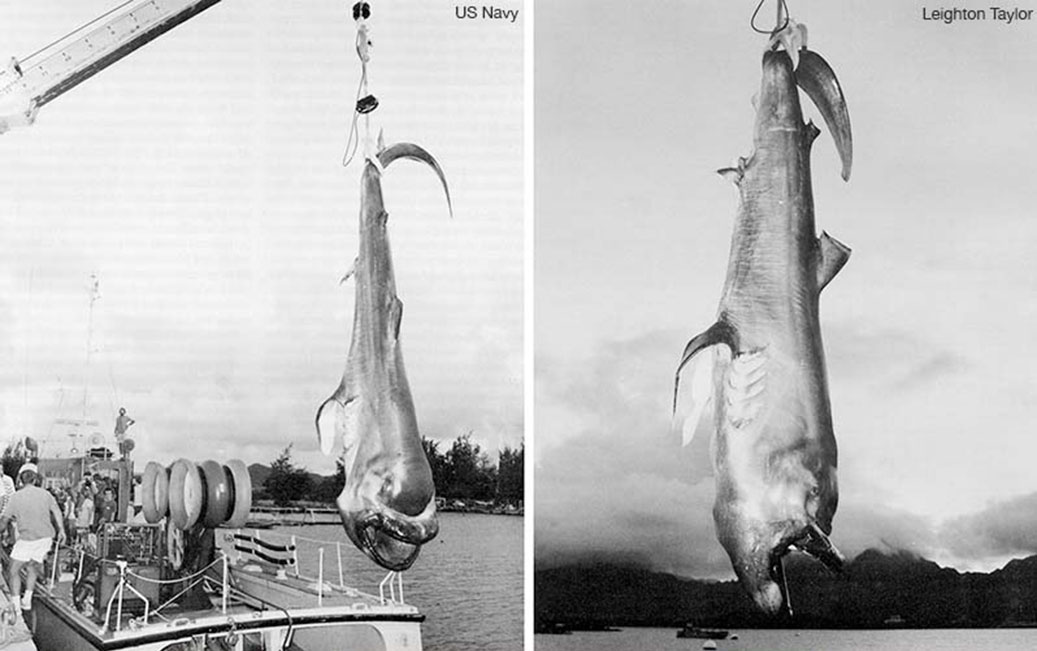
In November 1976, some 26 miles (42 km) northwest of the Hawaiian island of Oahu, a 4.5 m (14.5 ft) adult male Megamouth became entangled in a parachute sea anchor of the US Navy vessel AFB-14. It then took eight years and 14 days for the second specimen -- a similar sized male -- to become trammelled in a swordfish gillnet off Santa Catalina, south-west California. We now know of 272 confirmed individuals of this enigmatic shark worldwide, albeit the majority (58%) having been caught/observed in Taiwanese waters, with several other unconfirmed sightings. The most recent sighting of which I'm aware was from a fishermen off San Diego who filmed two sharks, a 4.5 m female and 3.8 m (12.5 ft.) male, swimming together during September 2022 - this is also the first account of two wild megamouths travelling together.
The largest specimen on record so far is an individual of unknown sex caught in the waters off eastern Taiwan during June 2010, measuring 7m (23ft). This appears to have been an exceptional specimen, with most ranging between 4.5 and 5.5m (15-18ft). Conversely, the smallest specimen hitherto recorded was found washed up on a beach in Sumatra, Indonesia during March. On the afternoon of 13th March 2004, Syukur stumbled across an unusual fish lying in shallow water on the Gapang Beach, close to his house. Realizing that this was something special, Syukur and his friend, Ton Egbers, collected the recently dead shark, placed it on a concrete slab and took some photographs. It was not long before the discovery of the World's 20th Megamouth shark began causing a stir -- not only was it the 20th, it was arguably the smallest ever recorded, a male measuring only 1.77m (5.8ft.). Megamouth 20 is now on display at the Indonesian Research centre in Jakarta.
Keeping it in the family
Despite the first discovery having been made in 1976, the first paper describing and officially classifying this new shark did not make it into the scientific literature until July 1983, published in the Proceeding of the California Academy of Sciences. According to the late ReefQuest director Aidan Martin, the paper's publication in 1983 was only spurred by a practical joke played on the principle author (Leighton Taylor) by two of his colleagues. Anyway, the paper made it into print, with co-author and elasmobranch taxonomy guru Professor Leonard Compagno, currently at the South African Museum, erecting a new family and genus within the Lamniformes (mackerel shark) order.

Compagno considered that the differences in Megamouth's teeth and skull morphology, when compared to the other lamnoids (great white, mako, thresher, basking shark, etc.), were sufficiently different to warrant placement in its own family, the Megachasmidae. Compagno called this mysterious creature Megachasma pelagios that, roughly translated, means "the great open-mouthed shark of the open sea". There was some debate, however, as to whether the distinctions Compagno had used to separate the Megamouth from other extant (living) lamnoids were sufficient to justify placing it in its own family. The primary objection to Compagno's proposed phylogeny came from John Maisey, a palaeontologist at the American Museum of Natural History in New York. In a short paper to the journal Copeia in 1985, Maisey suggested that -- based on five lines of morphological evidence -- Compagno's decision to place the Megamouth in its own family was unjustified.
Maisey considered that Megachasma was actually a sister taxon of the basking shark (Cetorhinus maximus) -- in other words, the Megamouth and basking sharks were more closely related to each other than any of the other mackerel sharks -- and, as such, should be placed in the Cetorhinidae family. Compagno repudiated this, contesting each of Maisey's lines of evidence in a 1990 paper. In this paper, published as part of the NOAA Technical Report Elasmobranchs as Living Resources, Compagno concluded that the Megamouth was the sister-group of the Alopiidae (thresher sharks), Cetorhinidae and Lamnidae (the family containing the makos, porbeagle, salmon and great white sharks). Compagno also suggested that, based on the jaw mechanism and morphology, this shark probably uses pharyngeal suction (i.e. it expands its throat, causing a vacuum that sucks hapless prey into its mouth) to capture prey, rather than the active filter-feeding seen in the whale and basking sharks. Compagno noted that the teeth of the Megamouth are similar to that of Megascyliorhinus, an extinct collared carpet shark of the Parascyllidae, while its skull bares similarities to Squalicorax, an extinct lamnoid shark sometimes referred to as a "crow shark" because of its habit of scavenging. These similarities are, however, insufficient on their own to do little more than speculate on the possible fossil relatives of Megachasma.
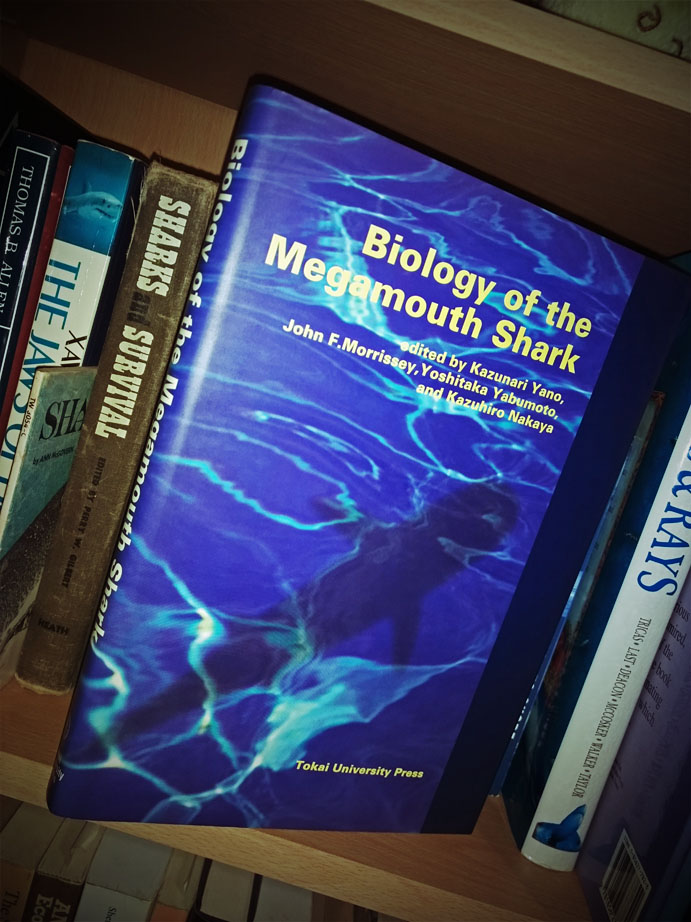
The taxonomy of this shark was finally subjected to molecular phylogenetics (i.e. using DNA to infer relatedness) with the discovery of the seventh specimen, a 4.7 m (15.5 ft) female found washed ashore in Hakata Bay, Japan in November 1994. The specimen was rushed to the Marine World complex in Fukuoka (northwest Japan), where a host of scientists performed a painfully methodical dissection, collected tissue samples and then stuffed the carcass with blankets, sewed it up and put it on display. From this single specimen, a collection of 21 scientific and technical papers was spawned, published in 1997 as a single volume (Biology of the Megamouth Shark) representing the most complete reference on the Megamouth to date.
In this volume John Morrissey at Hofstra University in New York and two colleagues, Katherine Dunn at Texas AandM University and Francesco Mule also at Hofstra, used samples of skeletal muscle to uncover the taxonomic relationships of the Megamouth. Morrissey et al. found that, not only is Megachasma the most primitive living lamniform, but it is also not the sister taxon of the basking shark, thereby rejecting Maisey's hypothesis and supporting Compagno's inference that filter-feeding had evolved independently in this shark. Subsequent genetic analysis on other specimens, most notably by Gavin Naylor, has corroborated Morrissey et al.'s findings, retaining the placement of the Megamouth in its own monotypic genus (Megachasma) and family (Megachasmidae).
Untangling the ecology
An interesting paper from this anthology by Yutaka Itabashi and Kazuhiro Nakaya at the Hokkaido University in Japan and Atsuko Yamaguchi at Tokyo University looked at the composition of liver oil from this specimen, reporting that 90% of the lipids (fats and oils) were triacylglycerols. Triacylglycerols are also the form in which most fats are stored in the human body and their presence suggests that the shark is not a deep-sea species, but instead a surface dweller. Successive papers have since revealed that this shark inhabits waters from the surface down to almost 170 m (about 560 ft).
A study by a seven-strong team of researchers, led by the late Donald Nelson, tracked Megamouth number six, a 4.9m (16 ft) male that became tangled in a gillnet off Dana Point in California during October 1990, along a 62km (38.5 mile) path for just over two days using acoustic transmitters. The biologists found that the shark spent the daytime at depths of between 120 and 166 m (394 -- 545 ft), migrating towards the surface to spend the nights in shallower water, between 12 and 25 m (39 -- 82ft). The researchers calculated that the shark swam at an average speed of 1.5 to 2.1 km per hour (about one mph), which fits reasonably well with swimming speeds calculated for other plankton feeders such as the basking and whale shark (Rhincodon typus), but is slower than the average reported for larger, predatory sharks such as the great white (Carcharodon carcharias).
Based on the information returned by Nelson et al.'s transmitters, the researchers suggested that the shark's movements (shallow at night and deeper during the day) may be related to the light intensity -- i.e. the shark may be attempting to avoid conditions it deems too bright, which from their data appeared to be about 0.4 lux. This is an idea referred to as the "Light Preferendum Model" or "Isolume Hypothesis". Several attempts to reproduce this have, however, failed and studies by Professor Howard Roe at Southampton Oceanography Centre in the UK suggest that many species of zooplankton can't attain sufficient speed to follow the rising and falling of this isolume in the water column. Ergo, it seems more likely that such migrations have a different, probably food-related.
Aidan Martin covers the idea of a food-based migration in greater detail on his site and I would recommend a visit if you're interested in learning more. Basically, Aidan considered that it is far more likely that the Megamouth's nocturnal excursions into shallow water are related to the deep scattering layer, a surfeit of marine animals ranging from tiny zooplankton to fish and squid that migrate up and down in the water column en masse, that moves surface-ward as night ensues and sinks back down to 1,000 m (3,000 ft) or more at daybreak. Aidan explains that the movements observed by Nelson and his colleagues could be the Megamouth following as its food moves up and down in the water column.
Food & feeding
Little is known about the feeding behaviour or the chosen prey of the Megamouth shark. The only information we have is based on the analysis of stomach contents from freshly dead specimens -- such data indicate that Megachasma feeds on euphausiid shrimp (krill), copepods (small, free-living, often parasitic crustaceans) and deep water jellyfish (e.g. Atolla vanhoeffeni). The exact method by which the Megamouth catches its prey is also largely conjectural.
In their tardy paper describing the first Megamouth specimen, Leighton Taylor, Leonard Compagno and Paul Struhsaker suggested that -- based on its soft, flabby body and fins, low-flow feeding apparatus and small gill openings -- this giant fish probably swims slowly through schools of krill with its mouth open and, every now and then, closes its mouth and contracts its pharynx to concentrate the shrimp before swallowing. Leighton et al. also considered that the silvery strip around the mouth of Megachasma may serve as a "light trap" to lure prey into its jaws, a surmise with which several subsequent authors have agreed. Study of subsequent individuals has, however, failed to prove the existence of any bioluminescent tissue or bacteria. This strip of skin is covered with guanine crystals, the same substance that give fish scales their shiny appearance, giving it a shiny hue that fades with preservation. The notion that this silvery strip acts as a light trap is still quite plausible, even though we now know that it is not bioluminescent.

The idea that the Megamouth swims slowly through aggregations of its was also supported by an analysis of the gill structure performed by Shin Oikawa at the Kyushu University and Takeshi Kanda at the Miyazaki University. Oikawa and Kanda compared the gills of the seventh Megamouth specimen to those of the shortfin mako shark (Isurus oxyrinchus), concluding that the larger and thicker gill filaments found in Megachasma represented a larger water-to-blood barrier. This, coupled with the observation that Megamouth gills have a thick collagenous layer that further impedes oxygen uptake from the water, suggests that this shark has a low metabolism and supports Taylor et al.'s surmise that this shark is probably rather sluggish.
One aspect of the Megamouth's feeding biology that has become clear with the intensive study of specimen seven, is that this fish has fewer teeth than either the whale or basking shark and displays an apparent sexual dimorphism in dentition. In their paper for the Biology of the Megamouth Shark, Yoshitaka Yabumoto and his co-workers found that the female specimen they analysed had 83 rows of teeth in her upper jaw and 97 in her lower jaw, of which only three rows were functional. By comparison, the basking shark may have well in excess of 100 rows of teeth and the whale shark can have over 300 rows. Yabumoto et al. also noted that, based on observations from previous specimens, females have more teeth than males -- why this should be remains unclear.
Reproduction
Almost nothing is known about the reproduction of these mysterious sharks. Of the 63 specimens found to-date, two (individuals 2 and 6, both males) have displayed signs of recent or impending mating and, although a couple have raised suspicions of pregnancy, as far as I know, no embryos have ever been recovered. Observations on the structure of the ovaries from female number seven by Jose Castro at the Mote Marine Laboratory in Florida and three co-workers suggest that this shark displays oviparity, as is found in other lamnoids (i.e. the first embryo to develop in each uteri feeds on the stream of eggs coming in from the oviduct). Indeed, in his 2001 revision of the Food and Agricultural Organization's (FAO) Sharks of the World, Professor Leonard Compagno states that the Megamouth is "probably aplacental viviparous with uterine cannibalism or cannibal viviparity suspected in the form of oophagy". In other words, the Megamouth young probably develop without a placenta, gaining their nourishment from eating either their developing siblings or (more likely) the stream of fertilized eggs entering the uterus.
The brain & senses
Studies on the brain of the tenth Megamouth specimen, a 5.4m (almost 18 ft) mature female caught in a purse seine net on 30th April 1997 about 12 miles (19 km) south of Mikizaki on the Central South Coast of Japan, revealed a small brain set in the back of a very large brain cavity. Nippon Medical School anatomist Hironobu Ito and two colleagues found that the brain, which weighed only about 20g (0.7 oz) and represented less than 0.01% of the body weight of this 1,040 kg (nearly 2,300 lbs) fish, displayed similar features to the brains of the frilled (Chlamydoselachus anguineus) and seven-gilled sharks (Notorynchus cepedianus).
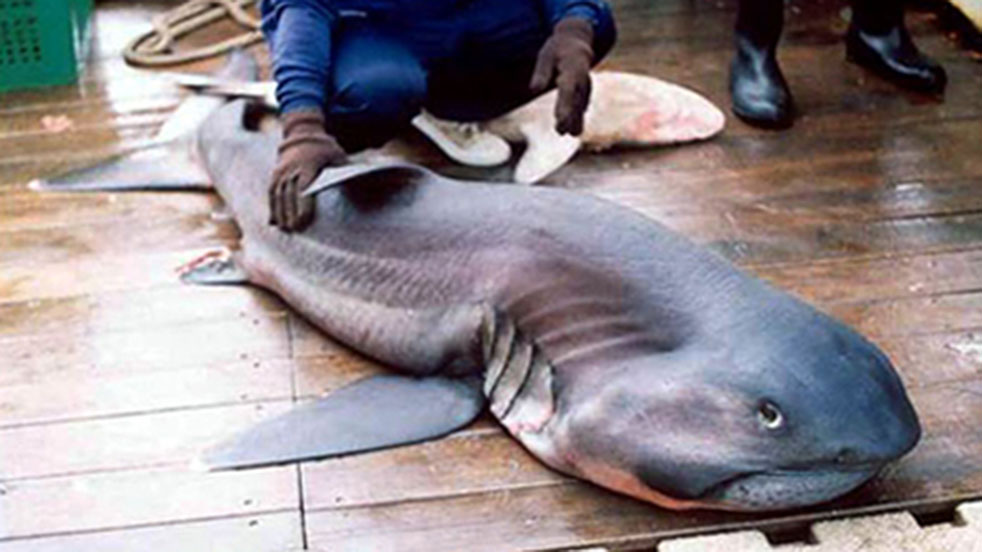
Ito and his colleagues found that Megachasma had a small corpus cerebelli and large auricles, features shared with Chlamydoselachus and Notorynchus, both of which are considered "primitive" species. Ito et al. do point out, however, that the aforementioned traits may be characteristic of the species' relatively inactive feeding behaviour. The biologists also note that Megachasma has a well-developed telencephalon (end brain) and large olfactory bulbs, suggesting that this species has a proficient sense of smell. Oddly, Ito et al. failed to find any terminal nerves outside the brain, which (if they actually aren't present, rather than having be destroyed by ice crystals) would make the Megamouth brain differ from that of other elasmobranchs and more closely resemble the brains seen in some bony fishes.
More questions than answers
Although our knowledge about this elusive, yet quite probably cosmopolitan, species has increased significantly in the last two decades, there are still a great many questions yet to be answered. For example, we really don't know how large Megamouths grow; how many pups they have; when they mate, although observations on mating scars and claspers of stranded specimens seem to point to October or November time; how long they live; or even how widely distributed they are. Despite having some insights from the stomach contents of dead animals, there are still gaps in our knowledge of what the Megamouth eats and, more intriguingly, whether anything eats it.
With regard to the question of predation on the Megamouth shark, there are a couple of lines of evidence that lead us to believe that this shark is not exempt from the diet of others. The seventh specimen that was so well studied back in 1997 had some intriguing cookie-shaped bite marks on its belly. The navel-like scar was found on the underside of the shark, just in front to the cloaca, from which the flesh had not been entirely removed. Japanese ichthyologists Ryoji Yamaguchi at Miyazaki University and Kazuhiro Nakaya at Hokkaido University analysed the wound and reported that it had been made by "some animal with sharp teeth". Indeed, Yamaguchi and Nakaya concluded that this female Megamouth had been bitten by a small cookiecutter shark.

Isistius brasiliensis is one of three similar species placed in the Dalatiidae family (sleeper sharks) and is a smallish shark, growing to a maximum of about 56cm (nearly 2ft), that spends much of its life in deep waters below 1000m (3289ft), migrating up to the surface at night. Morphological study of this little shark found it to possess specialized suctorial lips and a strongly modified pharynx, allowing it to attach to its victim much like a plunger, sink its impressive batch of razor sharp teeth in and rotate around its axis. The shark can apparently control the suction in its throat by moving its basihyal (the fish equivalent of a tongue) and once it has cut a plug of flesh it swims off, leaving a cookie-shaped cavity in its hapless victim. These scars are well known from other large marine species, including whales, tuna, wahoo (a large, fast moving game fish) and other sharks. Indeed, the third Megamouth specimen, a 5m (16.5ft) male that washed ashore near the Mandurah Estuary in Western Australia during August 1988, showed signs of a meeting with a cookiecutter shark; the individual had a small crater-like plug of tissue removed just above the gills on its right-hand side. Other papers in the Biology of the Megamouth Shark compendium report the presence of various copepods, protozoa and tapeworm parasites found in this individual.
The discovery of the 13th Megamouth also brought with it a tantalizing glimpse of another possible predatory relationship; this time with whales. On the 30th July 1998, a research vessel just offshore from the island of Nain in Indonesia spotted a Megamouth, which they estimated to be about 5m long, being harassed by a pod of three 10- 12 m (33–39 ft) sperm Whales (Physeter macrocephalus). The whales swam away as the researcher's boat approached and the Megamouth continued swimming normally. The scientists took some photos and noticed some relatively minor abrasions to the shark's gills, although the shark didn't seem unduly distressed. It is not known whether this was an interrupted act of predation by these whales, which are known to eat giant squid (Architeuthis), fish, octopus and elasmobranchs, or whether it was the same sort of harassment that dolphins have been observed to perform on some sharks.
Specimens of note
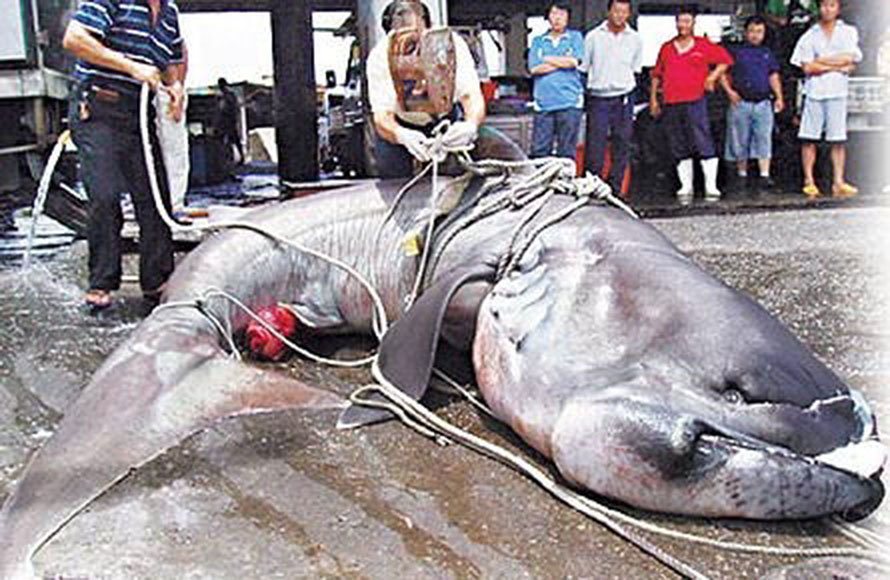
Complete lists are sometimes difficult to obtain because records are occasionally duplicated. For example, some sites list an immature male caught off western Baja California peninsula during June 2011 as a unique specimen, but this is actually a duplication of the 49th specimen caught on 6th November 2009. In this instance, it appears some media confusion led to a 're-reporting' of this with the implication that it was a new specimen. One thing the majority of sightings have in common is that they have little or no information about them. In some instances, identification was made from skinned carcasses, as was the case for Specimen 50 caught in the Taiwan Strait off south-eastern China in April 2010. That said, Alex Buttigieg maintains a comprehensive list of all the encounters he hears about and, more generally, specimens of interest include:
Numbers 31 and 32: Female caught off Taiwan in early May 2005 (one day apart). Specimen 31 had a swollen belly, while 32 was significantly heavier than most other specimens at 807 kg (just under 1,800 lbs), leading some to suggest both were pregnant. Pregnancy has, however, never been confirmed in any specimen caught so far.
Number 44: A female caught off eastern Taiwan in July 2008, which media reports claimed was 9m (29.5 ft) long, although this seems unlikely. Based on the picture, its length was closer to about 5.5m (17 ft).
Number 45: Stranded alive on a beach in the Philippines on 5th September 2008 and was pushed back into the water, apparently swimming away. No photos were taken, but this small (2m / 6 ft) shark was positively identified by a Fisheries biologist who helped with the rescue.
Number 53: A specimen of unknown sex caught in the Sea of China in January 2012, was also the heaviest weighing between 1,150 and 1,250 kg (2,500 - 2750 lbs).
Bibliography
Fauna Britannica - by Stefan Buczacki
Hamlyn Publishing
-- 2002
-- ISBN: 978-0600598671